ByteDance's "favored child" lifts the veil on the capital game of the AI pharmaceutical industry
Recently, Anew Labs (Shanghai Xinsheng Tantuo), an AI pharmaceutical company spun off from ByteDance, has completed a $290 million first-round financing. The investor lineup is impressive: HSG and IDG Capital led the round together with GL Ventures, 5Y Capital acted as the co-lead investor; Gaorong Ventures, Chunhua Ventures and Boyu Capital participated in the financing; the strategic investor is China Biopharmaceuticals, and there is also the Shanghai Future Industry Fund. The post-money valuation has reached 1.5 billion US dollars.
This investment is a microcosm of the warming up of the AI pharmaceutical track. Data from CVSource (ChinaVenture Jiachuan) shows that since 2026, 57 investments have been completed in the AI pharmaceutical track, 44 enterprises have obtained financing, and the total disclosed financing amount has reached 157.65 billion yuan. The financing amount exceeds the sum of the three years of 2023, 2024 and 2025.
01. In 9 months, the financing amount exceeds the total of the previous three years
How many enterprises related to AI pharmaceuticals are there in China at present? The answer given by CVSource (ChinaVenture Jiachuan) is 164, and 117 of them have received investments, accounting for more than 70% of the total.
We counted the investment and financing data in this field over the past 4 years, and found that this year has witnessed explosive growth.
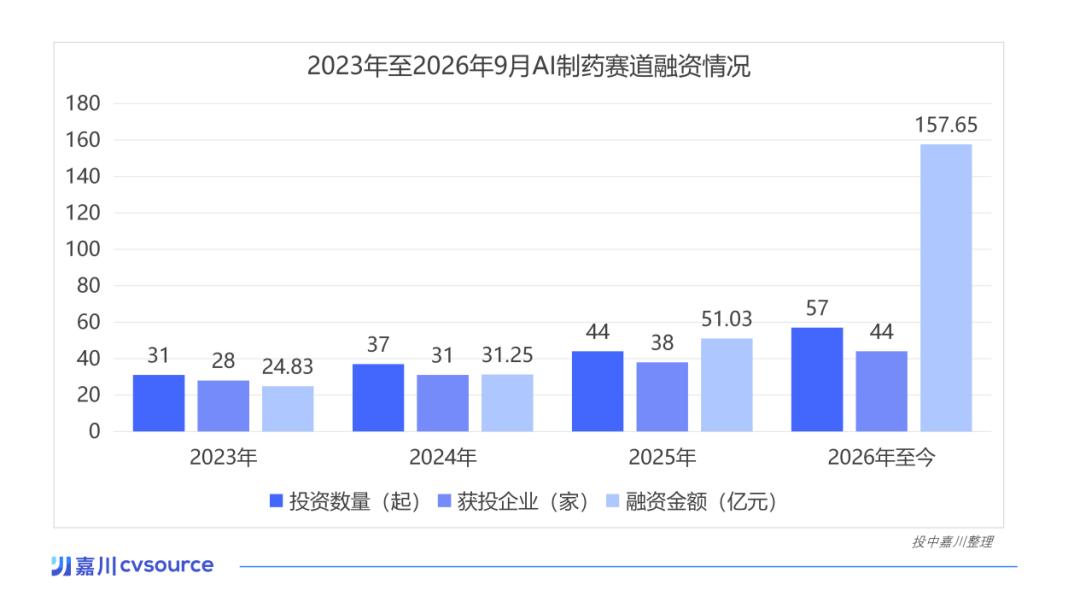
Data from CVSource (ChinaVenture Jiachuan) shows that in 2023, there were 31 investments in the domestic market, 28 enterprises received investments, and the financing amount was 24.83 billion yuan. In 2024 and 2025, the number of investments, invested enterprises and financing amount all increased, but the growth rate was not large.
Until the first nine months of this year, the financing amount of this track jumped to 157.65 billion yuan, which is not only 3.1 times of the 51 billion yuan of the whole year of last year, but also surpasses the sum of financing of the previous three years (of course, the financing amount of many enterprises has not been disclosed, so the actual situation will be different from the above data).
In addition, the financing amount has increased sharply, but the growth rate of the number of deals and the number of enterprises is not synchronized. Compared with last year, the number of deals only increased from 44 to 57, an increase of less than 30%; the number of invested enterprises increased from 38 to 44, with only 6 new enterprises added.
This may indicate two problems:
First, the AI pharmaceutical track is a cross field with high barriers, and there are relatively few excellent entrepreneurial teams; second, the industry is entering a growth period, the valuation of the original early-stage enterprises is rising continuously, and the single financing amount has increased significantly.
In addition, the concentration of capital this year is also very obvious.
The four largest investment transactions in 2026 are respectively the $787 million Series B financing of Hua Deep AI Pharma, the $290 million financing of Anew Labs, the $150 million financing of Yuansi Peptide, and the $100 million financing of Xunming Biotech. The total of the four investments is about 95 billion yuan, accounting for 60% of the total financing of the whole track.
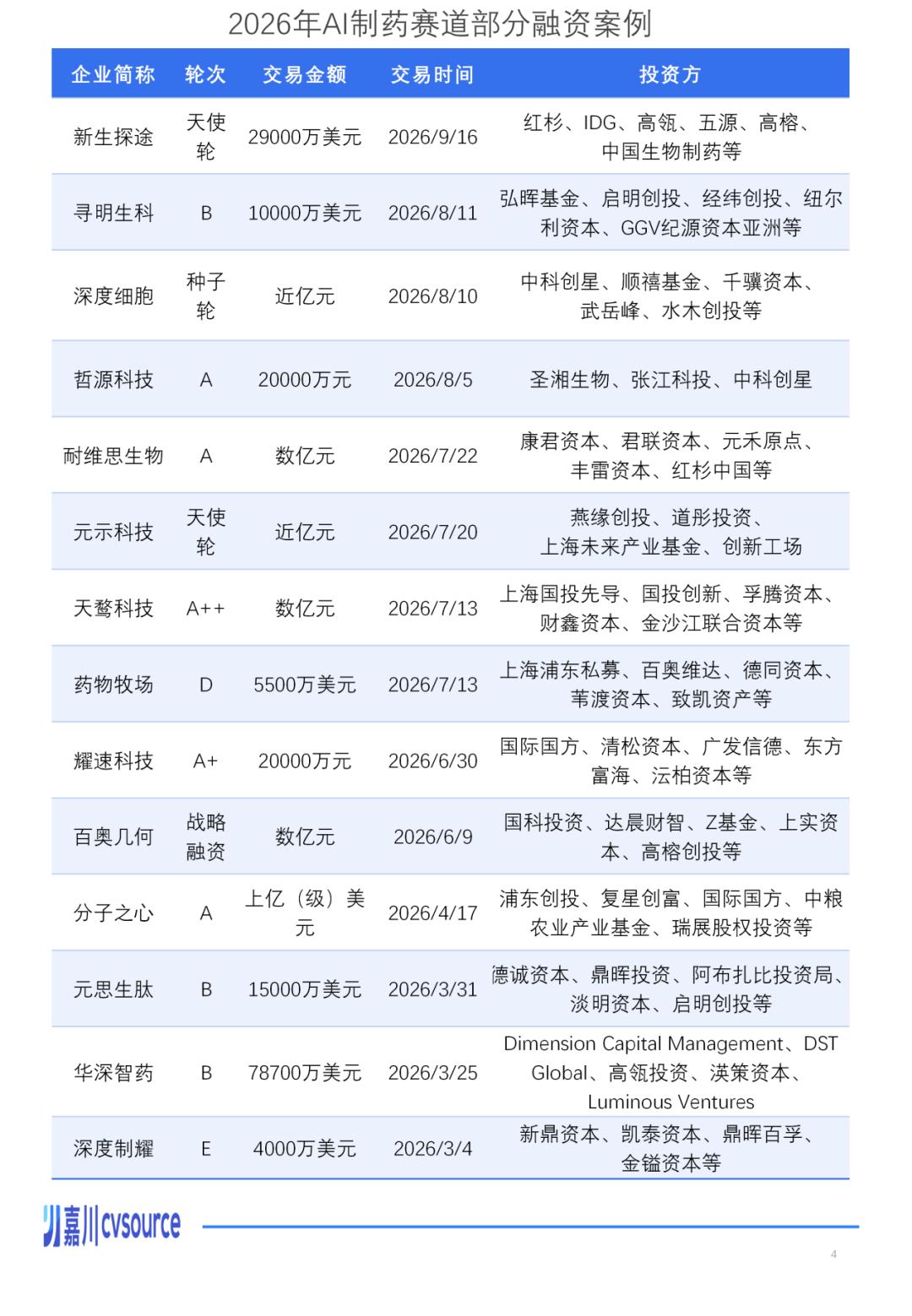
But obviously, this structure did not exist in 2023 and 2024.
The largest single financing in those two years was 700 million yuan, which appeared in the Series B+ round of Deep Potential in August 2023. The largest deal in 2024 was the 530 million yuan Series C round of Medtea AI Pharma. Most of the investments did not exceed 200 million yuan. It can be seen that since this year, the head aggregation effect has become more and more obvious.
02. What do the companies that get huge financing look like?
Why can the four companies above get huge financing? It goes without saying that Anew Labs is a direct line of ByteDance, let's look at Hua Deep AI Pharma which has obtained the highest financing.
Hua Deep AI Pharma was founded in 2021, incubated by the Institute for AI Industry Research of Tsinghua University. Its founder Peng Jian previously taught in the Department of Computer Science at the University of Illinois Urbana-Champaign in the United States. His doctoral supervisor is Xu Jinbo, the founder of MolecularMind.
The RaptorX that Peng Jian participated in during his doctoral period, and the OmegaFold that he later led, are both representative works in the field of protein structure prediction. He thus won the 2016 Sloan Research Fellowship and the 2020 Overton Prize of the International Society for Computational Biology. The co-founder Zhu Zhenping once served as Vice President of Novartis and Global Head of Protein Science and Design.
In January this year, Earendil Labs, the overseas company of Hua Deep AI Pharma, reached a strategic cooperation with Sanofi. It provides an AI discovery platform to design bispecific antibodies for multiple autoimmune and inflammatory disease projects, and Sanofi is responsible for subsequent development and global commercialization. The total potential value of this transaction is up to 2.56 billion US dollars, of which the down payment and the recent payment linked to the progress of early projects are up to 160 million US dollars.
Shortly after announcing the cooperation with Sanofi, Hua Deep AI Pharma obtained $787 million in financing, setting the highest record for financing of global biotech companies in 2026. The investors include DST Global, Sanofi, Dimension Capital, Inception Capital, and the Biotech Development Fund jointly established by GL Ventures and Pfizer. Sanofi has a dual identity in this transaction, both as a partner and a shareholder.
The financing story of Hua Deep AI Pharma has at least these two elements: The founding teams all have profound academic and industrial backgrounds, and have obtained substantial orders from industry giants. On this basis, equity financing continues to expand. These two points also apply to Yuansi Peptide and Xunming Biotech.
Yuansi Peptide was established in March 2022, focusing on macrocyclic peptides. The company's Synova platform connects protein structure prediction, protein interaction prediction, protein-peptide affinity prediction with the synthetic peptide experimental platform, uses AI for sequence design and druggability prediction, forms a dry-wet closed loop, and greatly reduces the screening cost.
Founder Zhang Xiao was previously a partner of E Capital and head of the pharmaceutical and biotech team. According to his own account, during his tenure, he led the team to complete a total of nearly 400 billion yuan in biomedical equity transactions. Co-founder Gao Xin graduated from the Department of Computer Science of Tsinghua University, and is now a professor in the Department of Computer Science at King Abdullah University of Science and Technology in Saudi Arabia, serving as the Chief Artificial Intelligence Officer of the company.
In March 2025, AstraZeneca obtained the right to use its Synova platform. According to the caliber disclosed by AstraZeneca, the down payment is 55 million US dollars, plus the recent milestones linked to early progress, the total is up to 75 million US dollars. Subsequent licenses will be obtained by exercising rights project by project. If all rights are exercised, the R&D and commercialization milestones will be up to 3.4 billion US dollars.
In December of the same year, AstraZeneca appeared in the lead investor list of its Series A+ round. In March this year, the $150 million Series B was completed, with Decheng Capital, DKH VGC, a wholly-owned subsidiary of the Abu Dhabi Investment Authority, Lightrock (Temasek), and Qiming Venture Partners all on the investor list.
Xunming Biotech will not be elaborated further. In short, "the companies that get financing are all similar".
It is worth mentioning that the new players who get financing are by no means mediocre. Although they have not yet cooperated with industry giants, capital has bet on their potential.
For example, MetaCell Technology, which was just established in April this year, is a biotech company focusing on artificial intelligence virtual cell technology. The company was founded by Wu Jiaqi, a 2017 doctoral student at the Academy for Advanced Interdisciplinary Studies of Peking University. Its core R&D direction is artificial intelligence virtual cells and general cell large models.
Less than two months after its establishment, MetaCell Technology obtained investments from Yanyan Venture Capital, DaoTou Capital, Shanghai Future Industry Fund, and Sinovation Ventures. It is not only one of the early start-up teams in China to deploy cell-level AI drug R&D, but also represents the new force of the AI pharmaceutical track.
03. Who is paying the money, and which is the first city of AI pharmaceuticals? Industrial capital, state-owned capital and sovereign funds have taken the main seats
After looking at the enterprise side, let's look at the capital side.
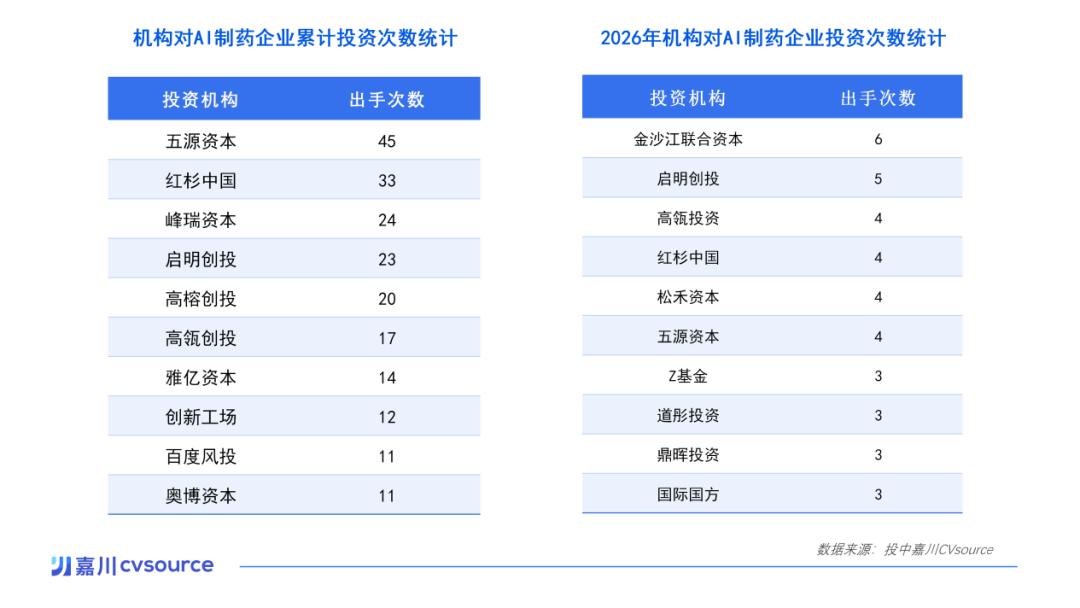
Data from CVSource (ChinaVenture Jiachuan) shows that the institution that has made the most shots in the domestic AI pharmaceutical field is 5Y Capital, with a total of 45 shots. HSG ranks second with 33 shots. Frees Fund has 24 shots; Qiming Venture Partners has 23 shots; Gaorong Ventures has 20 shots; GL Ventures has 17 shots.
This year's investment data also roughly maintains this ranking. Junsan Capital, Qiming Venture Partners, GL Ventures, HSG, Tsing Capital, and 5Y Capital are all in the first echelon, making 4-6 shots respectively.
However, the detailed changes that have emerged this year are reflected in the type of capital. In this round of financing of Anew Labs, China Biopharmaceuticals entered as a strategic investor, and Shanghai Future Industry Fund entered as a local state-owned capital. In the Series B list of Yuansi Peptide, there are wholly-owned subsidiaries of the Abu Dhabi Investment Authority and Lightrock under Temasek.
Industrial capital, local state-owned capital and overseas sovereign funds are gradually entering the market. This also shows that the industry has passed the early stage, and many excellent projects have provided greater certainty for capital parties.
Regional distribution: Shanghai and Beijing account for more than 40%
The geographical distribution of AI pharmaceutical companies is also highly concentrated. Data from CVSource (ChinaVenture Jiachuan) shows that there are 164 AI pharmaceutical enterprises in China, distributed in 22 cities across the country.
Shanghai has the largest number with 37 enterprises; Beijing ranks second with 34. These two cities are far ahead, with a total of 71 related enterprises, accounting for 44%.
This proportion is not unexpected. Shanghai and Beijing are home to numerous universities and research institutes, and are highlands of domestic scientific and technological innovation. Both the AI industry and the biomedical industry are in the first echelon in China. Anew Labs under ByteDance is located in Yangpu, Shanghai, while Hua Deep AI Pharma is incubated by the Institute for AI Industry Research of Tsinghua University and located in Haidian. It is expected that the two cities are equally matched.
Shenzhen, ranking third, has 23 enterprises; Suzhou has 17 enterprises; Hangzhou has 15 enterprises. If we include the latter three cities, the top five cities have a total of 126 enterprises, accounting for 78% of all enterprises.
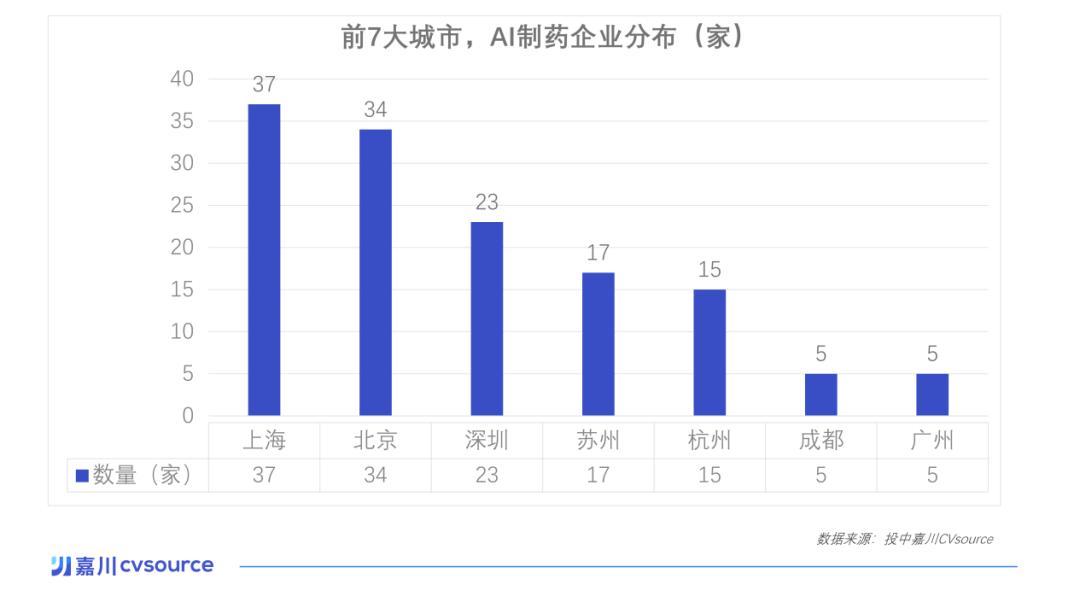
From the perspective of urban agglomeration, Shanghai has 37 enterprises, Suzhou 17, and Hangzhou 15. This number exceeds that of the Beijing-Tianjin-Hebei region and the Guangdong-Hong Kong-Macao Greater Bay Area. It is the region with the highest density of AI pharmaceutical companies in China.
This article is from the WeChat official account "ChinaVenture Jiachuan", author: ChinaVenture Jiachuan, published with authorization from 36Kr.