Large models are starting to shrink collectively.
Text by Li Zhaofeng, Wang Xinyi
Edited by Zhang Yuxin
In Shenzhen, the AI startup where Lin Zhou works has only 10 employees, and most of the work is completed with the help of AI — hundreds of Agents run simultaneously every day, working on coding and research tasks separately.
The models that have long powered these Agents are OpenAI's GPT series.
But as the team assigned more and more tasks to Agents, Lin Zhou found that GPT could no longer keep up: the GPT 5.6 they were using at the time could only handle two or three tasks concurrently at most. "The number of concurrent tasks GPT can process is limited, which will delay our work progress," Lin Zhou said. The team began to look for models that can support more parallel tasks with lower invocation costs.
DeepSeek V4.1 Flash became their new choice. Since September, the team has tested Claude and several domestic models, and finally selected V4.1 Flash: it can complete all their current development tasks, provides faster feedback, and has lower invocation costs. Lin Zhou said this is their most cost-effective option at the moment.
Earlier this year, Google CEO Sundar Pichai stated at the Google I/O conference that as far as he knew, some companies had almost used up their annual Token budget by May. Taking Google itself as an example, the daily Token consumption of its internal AI programming tools rose from 500 billion in March to more than 3 trillion in May.
At this very conference, Google launched Gemini 3.5 Flash, a model with faster speed and lower cost, targeting more daily development and work scenarios. Since the beginning of this year, the "Lobster" boom sparked by OpenClaw has allowed ordinary users to start using Agents to handle various work affairs, which is a more daily, lower-threshold and higher-frequency demand than programming.
Meanwhile, an increasing number of small-parameter models have emerged. As tasks grow in volume, model invocations become more frequent. If users use flagship models with hundreds of billions or even 2 to 3 trillion parameters, the cost they have to bear will be extremely high. In addition, large-parameter models cannot run fast enough, which will greatly increase users' waiting time.
Model vendors, especially Chinese model vendors, have successively launched Flash versions of small-parameter models, competing for the daily demands that were previously met by flagship models. "Flash" means lightning. Model vendors usually use this naming convention to represent model versions that are faster and lower-priced: they invoke fewer parameters per run, making them suitable for repeated processing of daily tasks, while complex problems can still be handed over to flagship models such as Pro versions.
On July 31, DeepSeek released the official version of V4 Flash. On August 26, Alibaba's Qwen team launched Qwen3.8-Flash-Next, and Zhipu released GLM-5.3-Flash on the same day. In September, DeepSeek launched V4.1 Flash. These models have different parameter sizes, all at the level of hundreds of billions (ranging from 100B to 500B), far smaller than the trillion-level parameters of current flagship models.
Two months ago, after the official release of DeepSeek V4 Flash, some developers plotted its evaluation results and the cost of completing tasks on the same graph, putting forward the so-called "execution line": models with weaker performance than V4 Flash but higher cost for the same tasks are thus "executed".
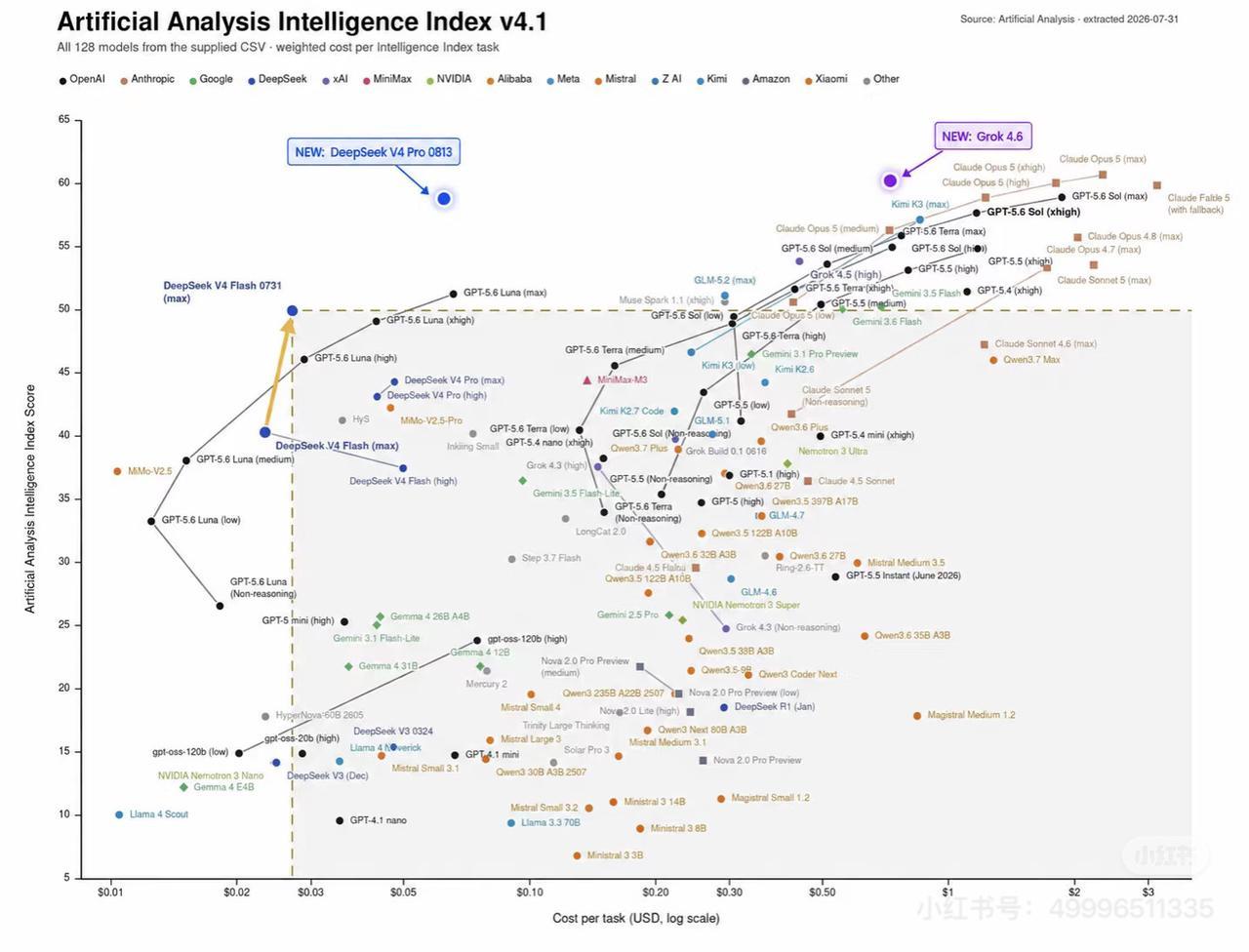
Models in the gray area are "executed" by DeepSeek V4 Flash. Source: Artificial Analysis
In late August, the US programming Agent platform Cline began to provide an unnamed model for free. Cline stated that in less than a week, this model undertook more than 11% of the platform's inference volume. Later, Zhipu claimed ownership of this model, which is the GLM-5.3-Flash that was launched later. Earlier, Tang Jie, the founder of Zhipu, talked about the next-generation model at the performance meeting, saying that the company "will not build a large but useless model".
In fact, the "small model" camp is still expanding. Intelligent Emergence has learned that both Moonshot AI and Tencent Hunyuan are promoting the development of Flash model versions.
On the other hand, since the beginning of this year, the capital market has placed high bets on Chinese model companies. Against this backdrop, commercialization has become a more realistic issue.
Public data shows that by August this year, Zhipu's ARR (annualized recurring revenue) is about 1.6 billion US dollars, with a price-to-sales ratio as high as 46 times. DeepSeek, which is not yet listed, has a valuation as high as 163 times its estimated annualized revenue. Across the ocean, Anthropic has a price-to-sales ratio of about 20 times. Chinese model companies still have a long way to go in commercialization.
Therefore, another main line has emerged in the Sino-US model competition: while continuing to pursue AGI and compete for the upper limit of model capabilities, who can make more cost-effective models complete more real tasks and serve more users? Who can use high-cost-performance models to open up a larger market and generate more revenue?
01 A Model Efficiency Revolution
After switching to the new model, one of the most notable improvements Lin Zhou experienced is that the model responds much faster.
The team often needs dozens of Agents to write code at the same time, and he will adjust instructions while checking the progress. If he finds the direction is wrong, he will immediately ask the model to make modifications. When using Codex before, he often had to wait for the model to output a long paragraph of content before he could step in to correct it. "No matter you use the CLI format or its native App, the response takes a very long time." And when encountering a long project, the model needs to sort out the previous conversation content, and using GPT-5.6 would make him wait even longer. "But after switching to V4.1 Flash, no matter what you tell it, it can give you feedback immediately."
Since the beginning of this year, the Scaling Law is still the main line of large model R&D. The total parameters of Qwen3.8-Max released this year reach 2.4T (T means trillion parameters), and Kimi K3 reaches 2.8T. According to the comparison disclosed by Elon Musk in April this year, Claude Opus at that time had about 5T parameters, although Anthropic did not confirm this figure.
While these super models have touched higher intelligence, their larger base requires more training and deployment resources. When the model is called repeatedly in Agent scenarios, the cost of using the model will also increase exponentially.
After switching to V4.1 Flash, another obvious feeling Lin Zhou has is that the invocation cost has been greatly reduced. He cited the example of the team developing a small application: a colleague completed the development independently, "it only cost about 3 or 4 US dollars to get a small App done".
The weekly ranking of model service platform Requesty in August shows that DeepSeek V4 Flash accounts for about one third of the actual Token usage on the platform, ranking first among all models. In previous third-party evaluations, its comprehensive score is close to that of the US GPT-5.6 Luna high-inference version, and the cost of completing the same set of tasks is about 60% lower.
"Model companies are starting to pay more attention to real market demands, and will listen more to the voices of developers," a foundational model researcher told Intelligent Emergence. Small models require less time and resources for one round of training, allowing users to see faster whether the content they run with the model is feasible or needs adjustment. "Developing with small models can achieve faster version iterations and get feedback faster."
In daily work, the researcher himself also selects models according to the requirements of tasks. For example, for simple but heavy-load tasks such as modifying experimental scripts, it may take 20 minutes for GPT to process, but only 2 minutes for DeepSeek V4 Flash. "Since the task is not that difficult, I just want the model to finish it as soon as possible."
Driven by such user scenarios, most of the Flash models released recently have parameters below 400B (B means billion parameters): DeepSeek V4 Flash has a total parameter of 284B, GLM-5.3-Flash has a total parameter of 320B, and the main model of Qwen3.8-Flash-Next is 125B.
"From the perspective of training, models with 300B parameters and slightly larger ones have little difference in capabilities," the researcher said. He has conducted training experiments on models of different sizes. With the data and training scheme he used, a model of about 300B parameters can already learn the long reasoning chains output by larger models.
A 2025 study published in *Nature Machine Intelligence* analyzed 51 open-source models and found that to achieve similar results in five tests including knowledge, reasoning, mathematics and coding, fewer and fewer parameters are required. Researchers call this the improvement of "capability density": a model of the same size can do more things.
Qwen3.8-27B is a recent example. In the same set of tests announced by Qwen, it scored 61.7 in the SWE-bench Pro programming test, while the previous generation model of the same size scored 53.5; it scored 70.7 in the CoWorkBench long-distance office test, compared with 61.0 of the previous generation.
The problems that models need to solve are also changing with users. The researcher gave an example: programming products often answer programmers how to write code and manage projects; in office scenarios, the problems become "what should I do if I can't remember the Excel formula" and "how to finish writing this paper".
The underlying work may still be coding, but the actual complexity of the work to be completed may be reduced. From Code to Work, a revolution in model efficiency and cost is taking place.
02 From "Programming" to "Daily Office Work"
"I think there will be two paths." A Code Agent entrepreneur commented on the current two differentiated Agent products for "programming" and "office" scenarios. Both programming and office products require models to understand instructions, write code, and call tools, but they target different user groups. He believes that for office products oriented to ordinary people, "it is absolutely necessary to achieve extreme cost reduction and extreme cost performance."
In January this year, Yao Shunyu, head of Tencent Hunyuan, talked about the differences in user demands at the AGI-Next Summit: enterprises are still willing to use the most capable models for productivity tasks, but ordinary users do not need such capabilities most of the time.
The two types of users also choose models in different ways. "Programmers can distinguish by themselves which tasks to use more expensive models for, and which to use cheaper ones." Ordinary users may not know how capable the model needs to be to process spreadsheets and write reports. The above entrepreneur said: "This is the problem that product managers of office Agents need to find solutions to."
In January this year, Anthropic launched Claude Cowork, allowing Agents that originally mainly assisted in coding to handle desktop office tasks. OpenAI subsequently launched ChatGPT Work, which also allows users to directly assign a work task without asking step by step in the dialog box.
Meanwhile, domestic products are also expanding from programming to office scenarios. In March, Tencent Cloud's CodeBuddy team launched WorkBuddy. In August, Alibaba integrated QoderWork, Wukong and MuleRun to launch Qwen Office. At about the same time, ByteDance integrated the office capabilities of products such as Feishu and TRAE Work into Doubao, and launched "Doubao Work".
QuestMobile reports show that in July 2026, Tencent WorkBuddy had 6.582 million monthly active users; PC client users used the product 19 times per capita that month.
Faced with millions of users repeatedly assigning daily tasks, office Agents cannot only select models according to the standards of complex programming. In some WorkBuddy user communities, some users commented on DeepSeek V4 Flash and GLM-5.3-Flash: "These two Flash models are basically enough for our work." On the enterprise side, a person close to Zhipu said that after the release of GLM-5.3-Flash, many enterprise customers have shown strong interest in this model with a total parameter of 320B.
In real office Agent usage scenarios, the models that perform tasks can be even smaller, down to the level of tens of billions of parameters.
YuanKong Intelligence, a startup focusing on office Agents, has used models of dozens of B parameters in its YuanKong AI Work product. The team performs post-training based on open-source models to enable them to handle more vertical tasks; for general tasks, they call hybrid cloud models.
In this mode where the product selects the model for users after receiving their tasks, the YuanKong team observed that users are very sensitive to interaction speed. A team member said: "If our system is a little bit slow, a large number of users will contact us within a minute."
In fact, some office tasks do not even require the maximum thinking intensity of DeepSeek Flash. A member of the YuanKong team said that using such a model for some of their tasks "is actually overkill, which will output a huge amount of Tokens and cause a lot of cost waste".
YuanKong Intelligence is balancing task effectiveness and Token consumption, and Qwen Office also divides tasks into two levels: the standard mode handles daily office work, and the advanced mode deals with more difficult problems. At the end of August, Qwen Office applied Qwen3.8-Flash to its standard mode.
According to the test results announced by Qwen Office, the standard mode completes a single task about twice as fast, with an average 75% reduction in Token consumption; this mode can complete about 95% of the daily tasks it defines, and more difficult tasks are handed over to the advanced mode.
03 A Larger, More Competitive Market
A few months ago, the US startup Lindy announced that it began to use a Chinese model — switching most of the daily work Agent invocations managed by the platform from Claude Sonnet and Gemini to DeepSeek V4 Flash. The company disclosed that after the switch, the model cost of this part of invocations decreased by about 90%.
"This is the most impactful adjustment to our cost structure since the company was founded, and the product quality has not been affected," said Flo Crivello, founder of Lindy.
In late August, an anonymous model named Ox-Alpha entered the overseas programming Agent platform OpenCode and model platform OpenRouter, immediately triggering widespread discussion.
The US programming Agent company Cline tested it with real faults in its own code base: both Ox-Alpha and another model fixed the problem, but the output Token consumed by the former was only about one third of that of the latter.
This model, jokingly called "Niu Lai" (which means "the bull is coming") by Chinese users, was used by about 500,000 people on OpenCode alone in less than a week after its launch. On August 26, Zhipu claimed ownership of this model — GLM-5.3-Flash. The "Niu Lai" model forms a high-low matching combination with Zhipu's flagship GLM-5.3: difficult problems are handled by the flagship, and daily tasks are assigned to the Flash version.
Developers' free trial is only the first step. Obviously, Chinese model companies hope to rely on the capabilities and price advantages of Flash models to enter global Agent products, so that more of users' daily tasks will be transferred to their own models.
This is almost a market driven by DeepSeek. Globally, the invocation volume of DeepSeek has remained at a high level since the release of V4 Flash. Data from OpenRouter in June shows that DeepSeek's share of Token usage on the platform rose from 9% at the beginning of the year to 18% in early June; the growth mainly came from Agent tasks. By the end of May, V4 Flash had accounted for 70% of the Token usage