Hallucinations invisible to the naked eye? Tsinghua proposes visual source hallucination, achieving SOTA with only 0.9% of the data
Object hallucination in multimodal large language models has long been attributed to language prior.
Let's first look at the following two groups of dialogues.
In the first group, for a photo with only a puppy, when the model is asked "Is there a chair in the picture?", it answers "No, there is a dog in the picture", which is completely correct;
In the second group, for another photo, when asked "Is there a dining table in the picture?", the model confidently answers "There is a dining table, and a boy is standing in front of it", while there is no dining table at all in the frame.
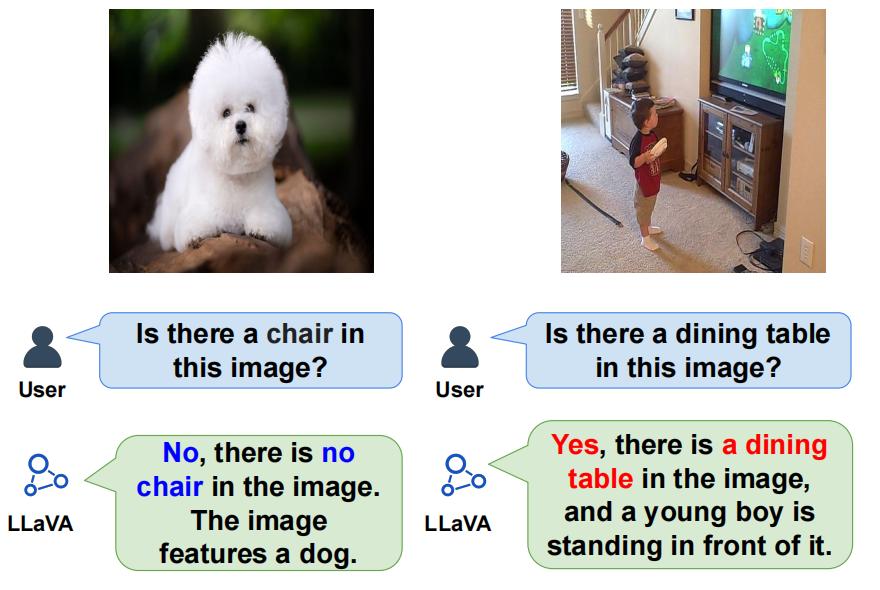
This is the object hallucination that plagues the implementation of multimodal large language models (MLLM): the model will "see" non-existent objects, or turn a blind eye to objects that clearly exist. In high-risk scenarios such as autonomous driving and medical assistance, the cost of such errors can be extremely high.
The mainstream explanation in the past was: this is all due to the language prior.
The model has seen the co-occurrence of "dining table" and "boy" in the training corpus so often that even if they do not appear in the image, it outputs the answer following the statistical rules of language.
However, the research team from Tsinghua University believes that this explanation is incomplete.
Recently, the team from Tsinghua University proposed in the paper of ACM MM 2026 (the 34th ACM International Conference on Multimedia): when the model output is very short, such as only answering Yes/No, the reasoning relies more on the visual modality, and another set of hallucination mechanisms that are rooted in visual feature extraction itself will emerge at this time.
The researchers named it visual-origin hallucination, and proposed the corresponding solution ACFT.

Paper link: http://arxiv.org/abs/2609.00231
Code link: https://github.com/zxp555/ACFT_MM26
Experiments show that ACFT uses only 0.9% of the data volume of the COCO dataset and does not add any inference overhead, and achieves excellent performance on three models including LLaVA, MiniGPT-4 and Qwen2.5-VL on POPE, MME and four description-level hallucination benchmarks.
Research Background
Object hallucination has always been the core obstacle to the reliability of MLLMs. Most of the existing work is carried out along the clue of "language prior": some attribute it to over-reliance on text co-occurrence statistics, some locate it at the "hallucination attention head" that specifically focuses on text tokens, some point to the attention aggregation phenomenon of summary tokens, and others believe that it is caused by insufficient fine-grained reasoning supervision.
Accordingly, mitigation methods are also divided into several categories according to the intervention position: VCD, OPERA and other methods perform input-level intervention at the decoding stage; Woodpecker uses an external grounding module for output post-processing; and post-training alignment methods such as RLHF and DPO.
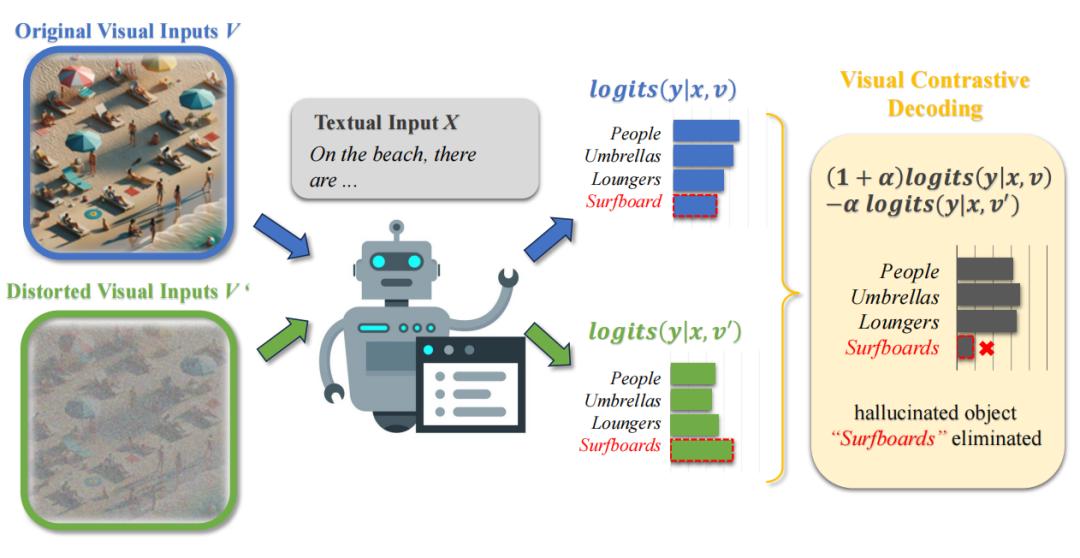
However, these methods share a common premise: hallucinations mainly come from text-side biases. This assumption is indeed valid in long-text output scenarios (such as "describe this image in detail"), because rich context will amplify language biases.
The problem is that when the output is reduced to a short answer of "Yes/No", the role of language prior is greatly weakened, and the effect of such methods also declines accordingly. So where do the hallucinations at this time come from exactly?
Research Methodology
Step 1: Diagnosis, does visual-origin hallucination exist?
The researchers conducted two complementary analyses on LLaVA v1.5 and provided quantitative evidence.
Finding 1: Misalignment of image-text embeddings.
The cosine similarity of image-text embeddings of hallucinated samples is significantly lower than that of correct samples. The average value of correct samples is 0.158, and the average value of hallucinated samples is −0.122, indicating that there is a systematic collapse in cross-modal alignment.
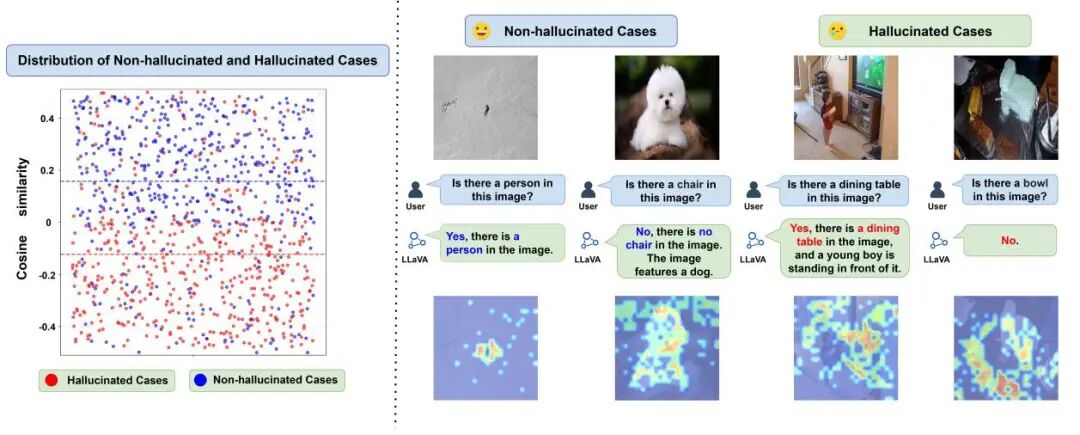
Finding 2: Attention pattern reversal.
The researchers used Smooth Grad-CAM to visualize the model attention, and defined a distribution standard of "semantic rationality": when the target object exists, the attention should focus on the target area; when the target object does not exist, the attention should be dispersed.
After quantifying with normalized Shannon entropy on 500 hallucinated samples and 500 non-hallucinated samples, it is found that the hallucinated model systematically violates this pattern: the entropy value is 5.1% higher when the object exists, indicating that the attention is excessively dispersed and the target is missed; the entropy value is 6.2% lower when the object does not exist, indicating that the model incorrectly focuses on irrelevant areas, thus triggering hallucinations.
Causal verification. To confirm that this is not just a correlation, the researchers directly intervened in the visual encoder: applying Gaussian noise, downsampling, and replacing it with a weaker encoder, the average POPE accuracy dropped from 0.842 to 0.739~0.822; on the contrary, replacing it with the stronger SigLIP-SO400M encoder, the accuracy rose to 0.864. This provides causal-level support for "visual feature quality drives object existence hallucinations".
Step 2: AHAF — Flipping hallucination attributes with adversarial perturbation
The diagnosis points to visual misalignment, so contrastive learning is the most straightforward correction idea. However, the researchers found that ordinary contrastive fine-tuning (OCFT), which takes the matched image as the positive sample and randomly takes an irrelevant image as the negative sample, does not perform well.
The reason is: the feature difference between positive and negative samples is uncontrollable, and it is not focused on the target object, so it is difficult for the model to learn exactly which visual features trigger the hallucination.
To this end, the researchers proposed AHAF (Adversarial Hallucination Attribute Flipping): using PGD to apply directional adversarial perturbation to the original image within a very small ℓ∞ ball, so as to "flip" an image that does not trigger hallucinations into an image that triggers hallucinations. The positive and negative sample pairs constructed in this way are completely aligned, and the only difference is the controlled perturbation.
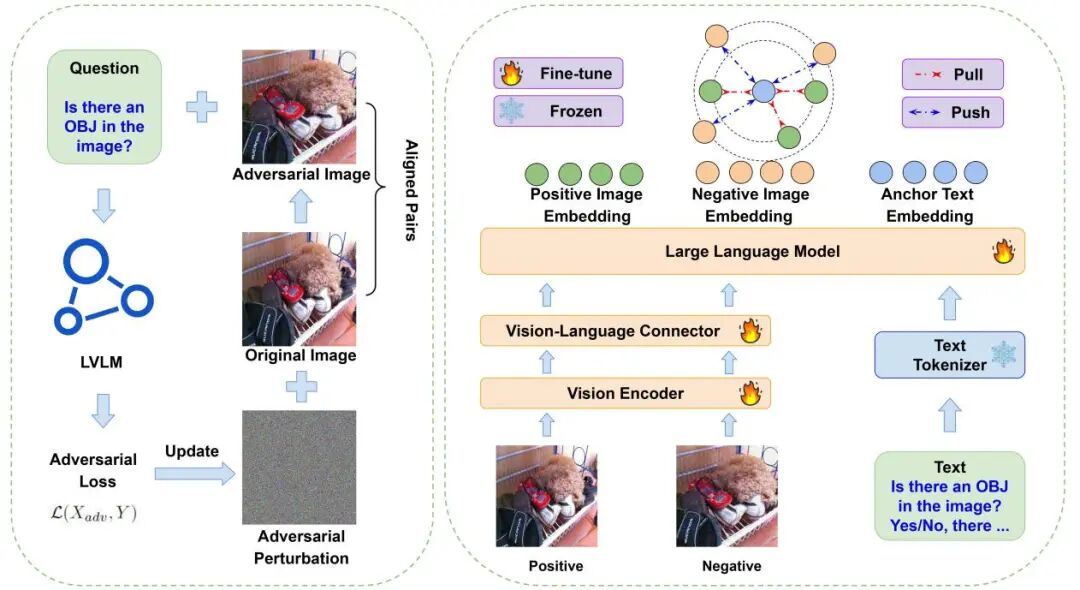
AHAF also has a by-product value: it is also a diagnostic probe. A very small pixel-level perturbation is enough to flip the answer of the model, which shows that the visual representation of MLLM is dangerously close to the hallucination decision boundary even on clean images — this phenomenon in turn confirms the diagnosis of "visual-origin hallucination".
Step 3: ACFT — Adversarial Contrastive Fine-Tuning
Based on the aligned sample pairs generated by AHAF, the researchers designed ACFT (Adversarial Contrastive Fine-Tuning): maximize the similarity between the text anchor and the positive sample image in the embedding space, and minimize its similarity with the negative sample image at the same time.
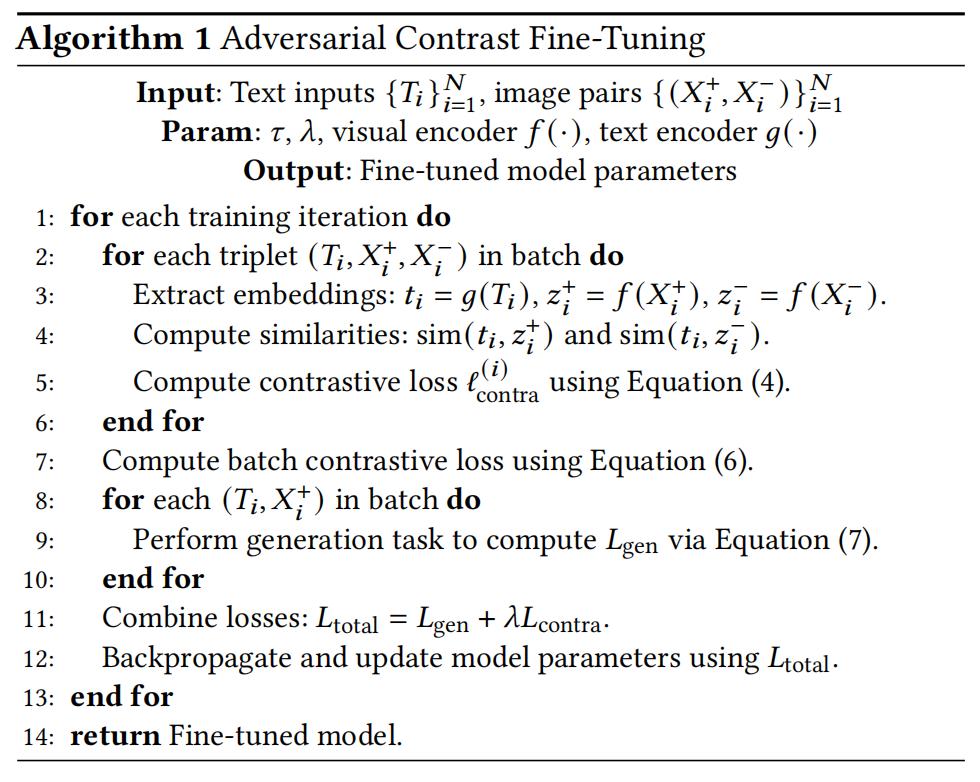
The whole set of methods has three engineering advantages: it does not depend on a specific backbone architecture, only requires a small amount of data, and is completely completed in the training stage, with no additional overhead during inference.
Experimental Results
The researchers conducted systematic evaluation on three models including LLaVA v1.5-7B, MiniGPT-4 13B and Qwen2.5-VL-7B. The benchmarks include POPE and MME. The reason for choosing these two is that all their questions are answered with Yes/No, which exactly corresponds to the short output scenario focused on in this paper.
Main Experiment: POPE
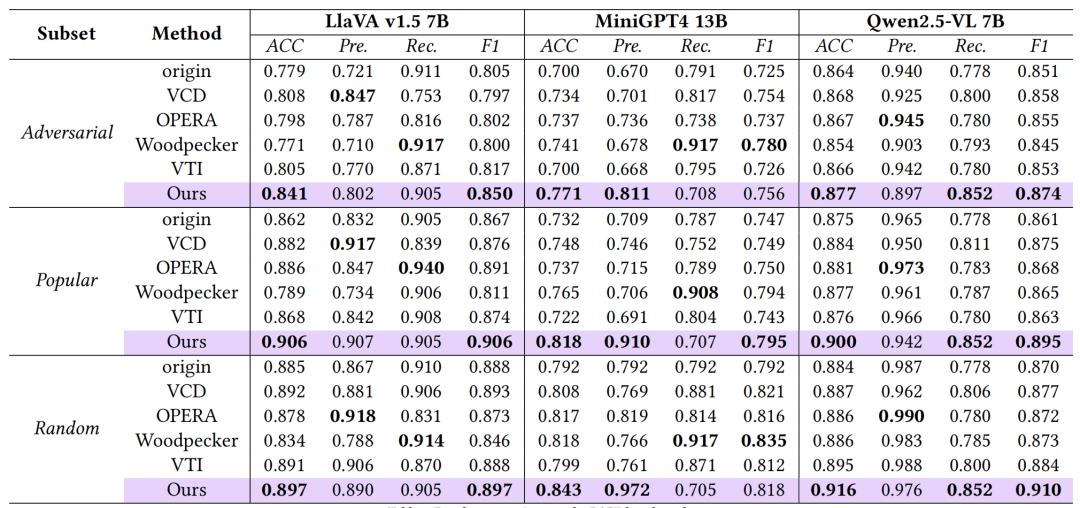
On LLaVA, ACFT achieves accuracy of 0.841, 0.906 and 0.897 on the three subsets respectively, which is 3.3%, 2.0% and 0.5% higher than the suboptimal baseline; on MiniGPT-4, it leads the suboptimal baseline by 3.0%, 5.3% and 2.5% respectively; on Qwen2.5-VL whose own baseline is already very strong, the accuracy still increases from 0.864, 0.875 and 0.884 to 0.877, 0.900 and 0.916 respectively.
Key Ablation: How important are the aligned sample pairs?
This is the most illustrative set of comparisons in the paper. The researchers used the same 3000 COCO images to train OCFT and ACFT respectively.
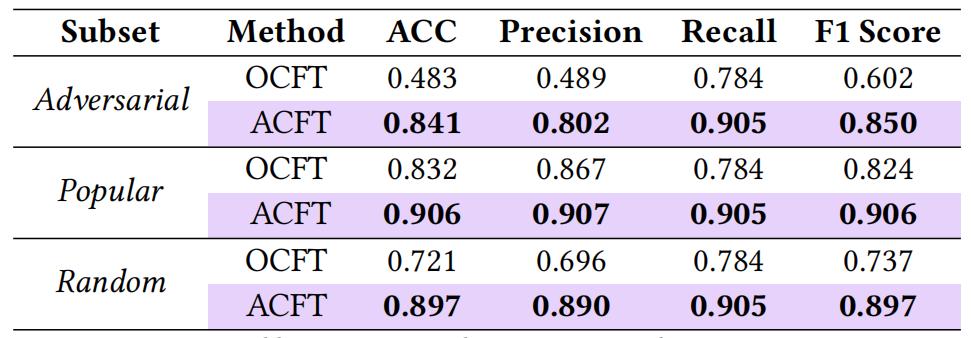
The result is: the accuracy of ACFT on the three subsets is 35.8%, 7.4% and 17.6% higher than that of OCFT respectively.
Especially on the Adversarial subset, OCFT only has an accuracy of 0.483, which is even much lower than the original LLaVA model without fine-tuning, indicating that misaligned negative samples are not only useless but harmful.
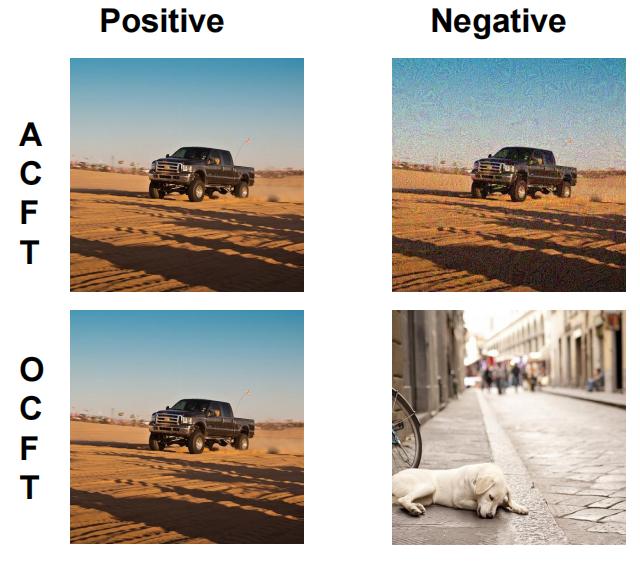
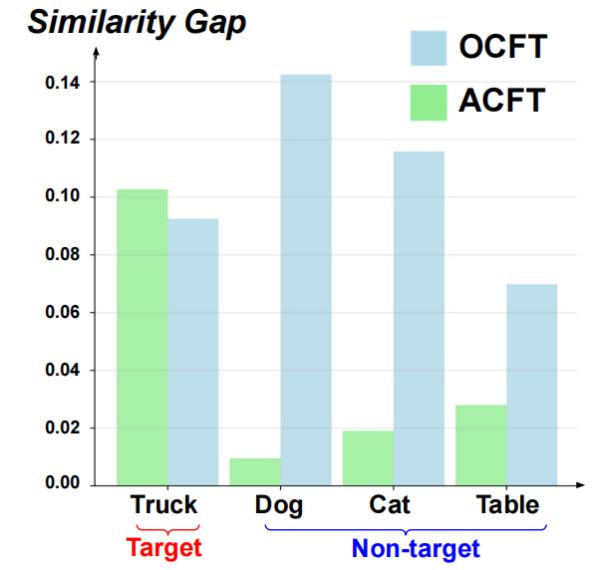
Further similarity gap analysis gives the explanation: in ACFT, the similarity gap between positive and negative samples of the target object (truck) is significantly different from that of non-target objects (dog, cat, table); while OCFT does not have this property at all. This means that ACFT enables the model to learn "consistent rules", that is, to focus on the difference in the features of the target object itself.
Visualization
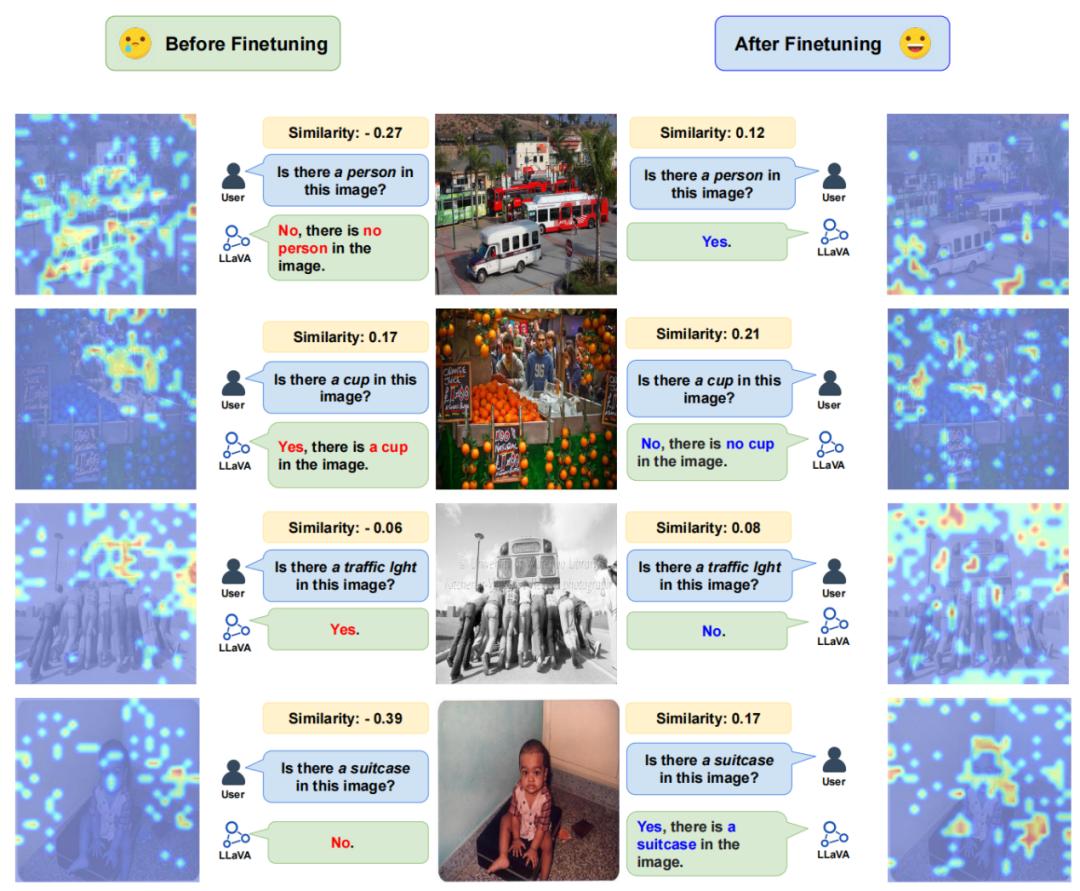
The visualization intuitively shows how ACFT corrects the two "symptoms" diagnosed earlier: the cosine similarity of image-text embeddings is significantly improved, and the Grad-CAM attention also returns to a semantically reasonable distribution, that is, focusing when the object exists and dispersing when the object does not exist. Entropy analysis further confirms this correction: the entropy values of cases where the object exists decrease by 8.7% and 2.6% respectively, and the entropy values of cases where the object does not exist increase by 7.4% and 6.4% respectively.
Conclusion and Outlook
On the basis of the existing "language prior" explanation, the researchers further identified and systematically characterized a type of hallucination mechanism driven by visual feature extraction errors and image-text embedding misalignment, namely visual-origin hallucination.
On the basis of diagnosis, the researchers proposed AHAF and ACFT: the former is not only a diagnostic probe to reveal the visual representation vulnerability of MLLMs, but also an efficient generator for aligning contrastive training data; the latter is a data-efficient fine-tuning method that only requires 0.9% COCO data and has zero inference overhead.
The significance of this work goes far beyond updating the metrics. It reminds us that the reliability problem of multimodal large language models cannot only focus on the language side.
When the visual representation of the model is already close to the hallucination decision boundary even on clean images, any remedy only made on the text side or at the decoding stage may be a palliative rather than a permanent cure. Enabling the model to "see more accurately" may be the only way to achieve trustworthy multimodal perception.
Author Introduction
The authors of the paper are in order: Xu Peiyang (co-first author), undergraduate of Tsinghua University; Zhu Xiaopei (co-first author), Shui Mu Scholar of Tsinghua University, with Prof. Zhu Jun as the co-supervisor