Thirty Years of Guangfo Commerce: A Galaxy of Shining Stars
In 1996, Tianhe City in Guangzhou opened to the public, marking a key milestone for China's commercial sector to enter the shopping mall era. Over the following 30 years, 12 cities across the country have joined the "10 million square meters shopping mall stock club", with Guangzhou and Foshan taking two of the seats.
According to Winshang Big Data monitoring, Guangzhou now has over 260 operational shopping malls with a total gross floor area of over 17 million ㎡, ranking 6th nationwide in terms of existing shopping mall stock. It is the most understated first-tier commercial city, pragmatic and full of lively daily atmosphere.
Foshan's commercial sector has followed a similar progressive trajectory. In 1997, Foshan welcomed the embryonic form of a modern shopping mall — Foshan Baihua Plaza. At present, the city has accumulated over 130 operational shopping malls with a total gross floor area of over 10 million ㎡. Its per capita shopping mall area has quietly surpassed that of first-tier cities including Beijing, Guangzhou and Shenzhen, reaching 1.04 ㎡ per capita and ranking 6th nationwide. As a second-tier commercial city, it is also facing a fully competitive "involution" situation.
Over 30 years of the shopping mall era, more than 27 million ㎡ of shopping malls have reshaped the commercial landscape of the two cities, and also changed people's lifestyles.
Note: The commercial volume and scale mentioned in this article only count centralized commercial projects including shopping malls, "shopping mall + open block" complexes, and centralized underground commercial projects, excluding independent department stores, outlets, creative industrial parks and other commercial types. The data statistics are as of August 2026. The "30 years of Guangzhou-Foshan commerce" mentioned in this article refers to the 30 years since 1996 when the commerce in Guangzhou and Foshan entered the shopping mall era.
01.
30 Years, Over 27 Million ㎡
"Starry Shining" Commercial Territory
Against the backdrop of the continuous evolution of domestic commerce, neither Guangzhou nor Foshan are cities that often appear at the "forefront of trends" in recent years. However, looking back at the first 10 years of the Guangzhou-Foshan shopping mall era, it can be described as a decade of "shining stars", highlighting the "courage to take the lead" of these two southern cities.
In the first 10 years starting from 1996, Guangzhou Tianhe City was the pioneer driving the iteration of Guangzhou's commerce. A former nursery plot was transformed into a modern shopping mall, and the slogan "stand Beijing Road up" turned from advertising words into reality. Foshan Oriental Plaza with an investment of nearly 2 billion yuan transformed the old Zumiao Liansheng area into a comprehensive shopping mall, once setting a record of over 230,000 single-day passenger flow.
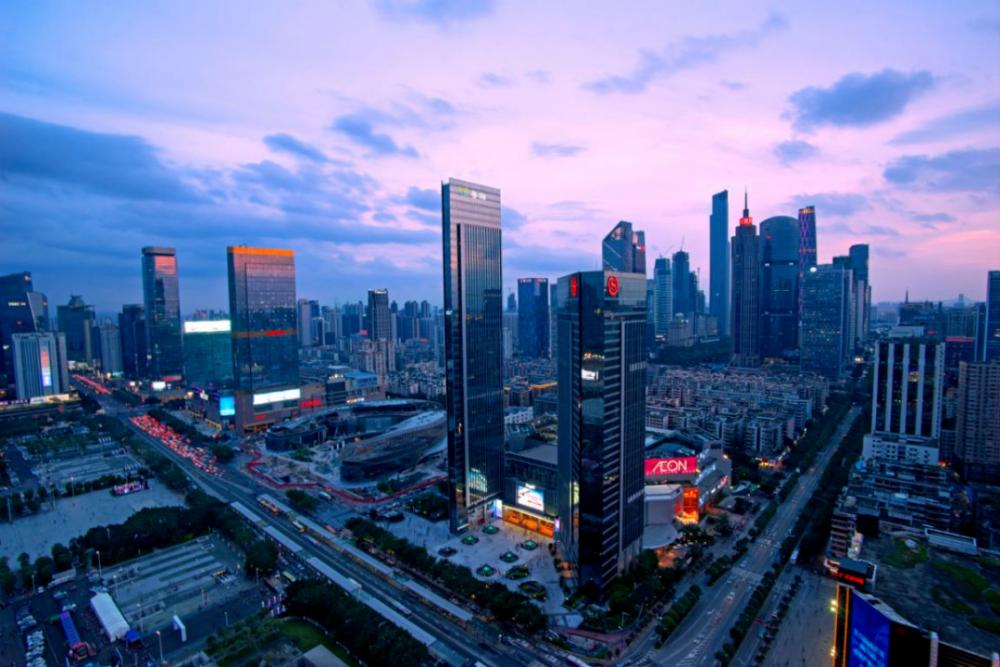
Guangzhou Tianhe City
High-net-worth consumers visited Guangzhou La Perle Plaza, the "first-generation luxury shopping mall in Guangzhou", while the younger generation flocked to Guangzhou Animation Star City, the "originator of domestic ACG-themed commerce".
The first 10 years saw the pioneers in the industry explore the market "from 0 to 1". Entering the second 10 years, the investment enthusiasm in Guangzhou-Foshan commercial market increased significantly, and one key variable was that foreign and Hong Kong-funded enterprises began their layout in Guangzhou and Foshan.
Guangzhou Taikoo Hui pushed Guangzhou's luxury commerce to a new level. Guangzhou Tianhuan Parc Central built by Sun Hung Kai Properties completed the last piece of the "commercial puzzle" of Tianhe Road business district. New World China brought Cantonese Plaza to Zhujiang New Town business district, and Guangzhou PO PARK Oriental Baotai fully taken over by Hong Kong-funded enterprises was transformed from a clothing wholesale market into a shopping mall.
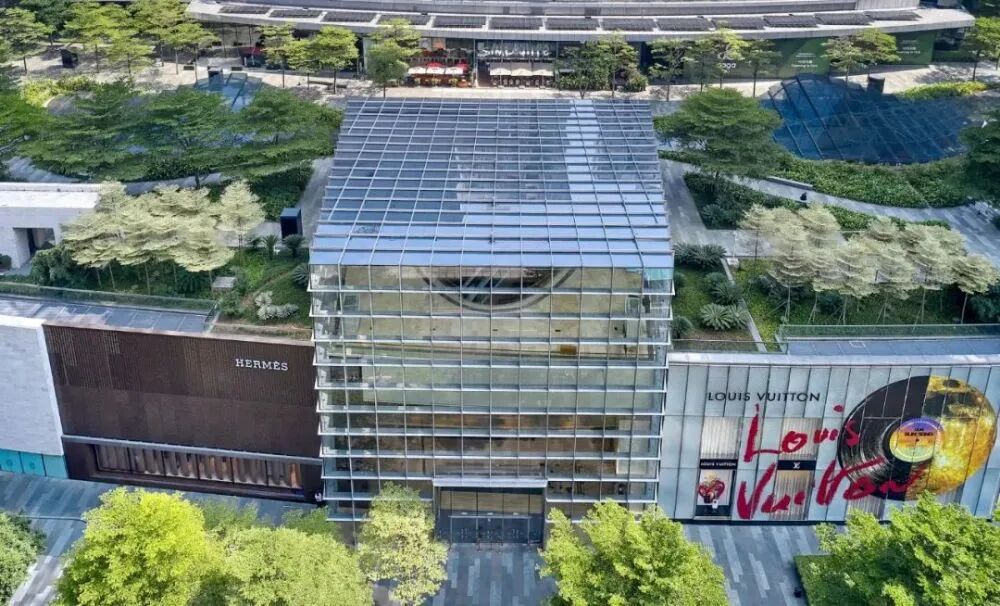
Guangzhou Taikoo Hui
In Foshan, Lingnan Tiandi built by Shui On Group is not only the collision of modern commerce and traditional Lingnan architectural complex, but also an urban renewal sample of "restoring the old as it was".
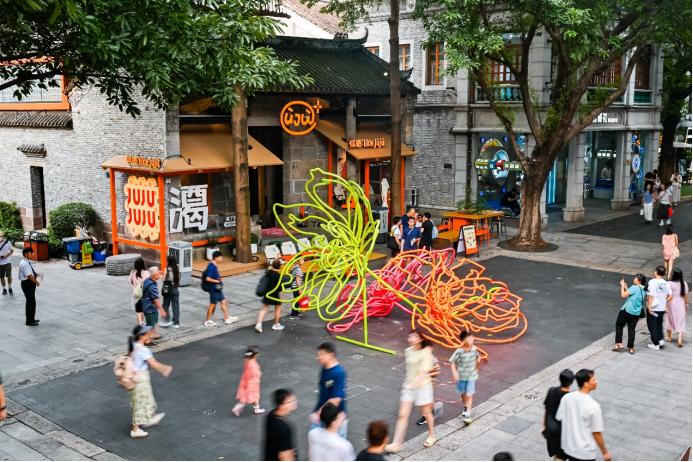
Lingnan Tiandi
With the accumulation of the previous 20 years, the third 10 years of Guangzhou-Foshan commerce ushered in a real "blossom of a hundred flowers".
According to incomplete statistics from Winshang, by 2026 (including pre-opening projects from September to December 2026), Guangzhou and Foshan have gathered at least more than 70 commercial product lines with different positioning from over 50 domestic and overseas commercial management companies.
As of August 2026, about 6 commercial product lines have opened or laid out 4 or more projects in Guangzhou and Foshan, namely: Wanda Plaza, Vanke Li, Jinbo Tiandi, Uni Park, AEON MALL, and Aoyuan Plaza.
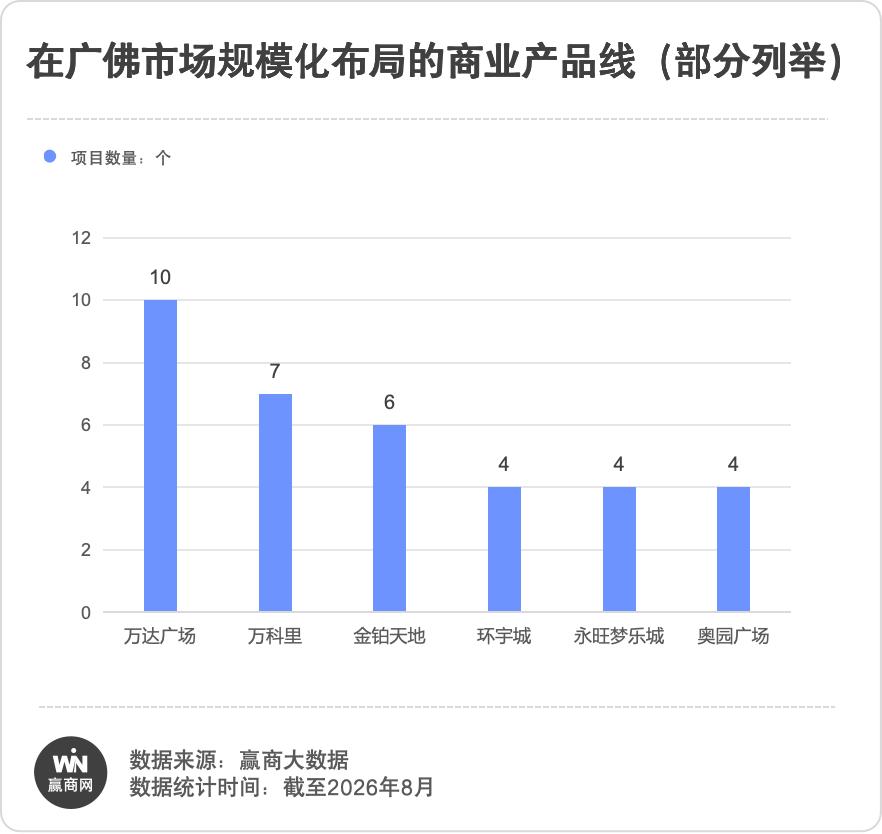
From the corporate dimension, by 2026 (including pre-opening projects from September to December 2026), 5 commercial management enterprises have laid out more than 3 product line projects in Guangzhou and Foshan, namely: SCP Group, Jinbo Commerce, Poly Commercial Travel, China Resources Mixc Lifestyle, and Guangzhou Kaifa Holdings.
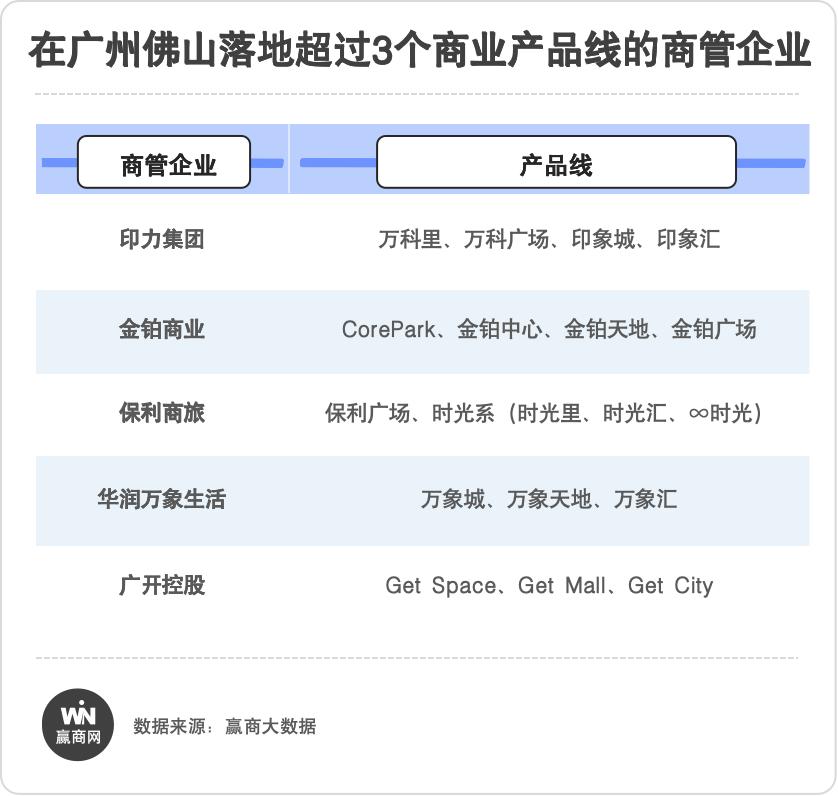
Taking "product line" as the observation perspective, we can see that the "blossom of a hundred flowers" in the third 10 years of Guangzhou-Foshan commerce has a clear core context — scaling up.
The stock scale of Guangzhou-Foshan commerce keeps increasing, and major commercial management enterprises pay more attention to shaping differentiated cognitive labels in the market through product lines with brand attitude; the scaled development of commercial management enterprises themselves also requires adapting to different business district environments and project volumes through differentiated product line systems.
From the improvement and upgrading of the product line systems of major commercial management enterprises, we can also see the generational iteration of shopping mall development.
First-generation shopping malls: One-stop shopping that focuses on meeting the basic consumption demand of "shopping spree";
Second-generation shopping malls: Transformed from relatively single-function consumption spaces to leisure and entertainment experience spaces;
Third-generation shopping malls: Put more emphasis on the interpretation of spatial advantages or commercial personalities, including POD projects oriented by park development, TOD projects oriented by public transport development, art malls oriented by artistic and humanistic personality, non-standard commerce that breaks away from traditional operation ideas... The commercial forms of shopping malls are more diversified, and pay more attention to interaction with people;
Fourth-generation shopping malls: Re-deconstruct commerce with the dual vision of "return and outlook", take "Life Mall" as the core, return to the essence of life, and look forward to new possibilities of lifestyles, deeply integrate consumption, culture, nature and people's daily life, and build a life destination with a sense of identity.
Taking Jinbo Commerce as an example, with three major product lines of "Jinbo Plaza - Jinbo Tiandi - Jinbo Center", Jinbo Commerce has witnessed the evolution process of the first to third generation shopping malls of Guangzhou-Foshan commerce. When the development of shopping malls entered the fourth generation, in early 2026, Jinbo Commerce officially announced its brand new product line — CorePark positioned as "an international life and social center".
The background of building CorePark is the upgrading of Jinbo Commerce's site selection. Two new projects in Guangzhou and Foshan, one located in Baiyun New Town business district, the core CBD of Baiyun District, Guangzhou, and the other located in Zumiao business district, "the top business district in Foshan", both have higher commercial positioning, which gave birth to CorePark.
It is understood that CorePark will extract commercial keywords from dimensions such as the historical and cultural heritage of Guangzhou and Foshan, the lively and relaxing atmosphere of urban life, and the expression of urban image from an international perspective, to build a Life Mall with city-level and even cross-city influence.
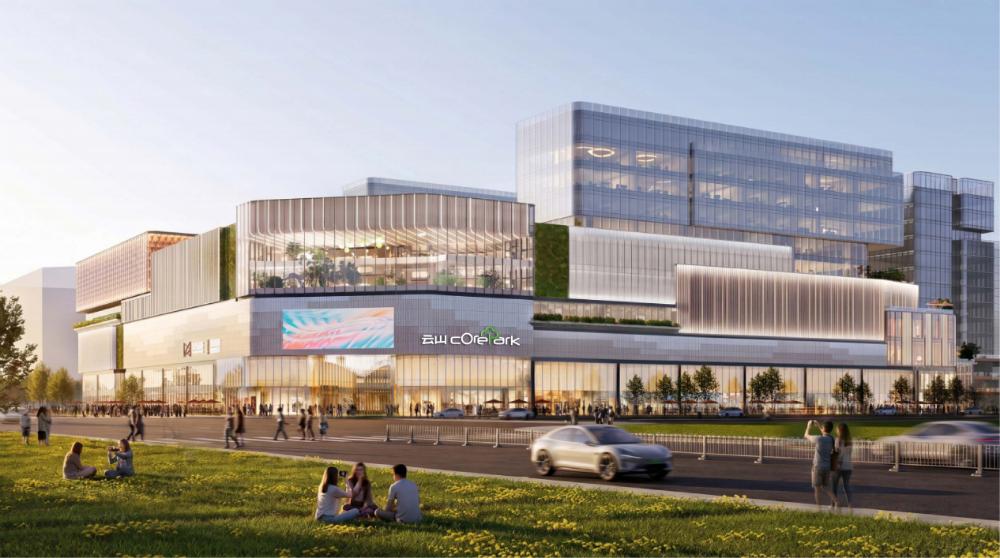
Guangzhou Yunshan CorePark
02.
Top 3 Commercial Management Enterprises by Guangzhou-Foshan Commercial Stock Scale
Three Expansion Modes of Different Styles
When the commercial stock scale of a market reaches more than 27 million ㎡, an inevitable accompanying phenomenon is that commercial management enterprises with scaled layout have emerged in this market.
In the Guangzhou-Foshan market, the top 3 commercial management enterprises in terms of existing commercial scale contribute 11.7% of the total commercial stock of Guangzhou and Foshan. The leading position of these three enterprises also shows three scaled expansion modes of different styles.
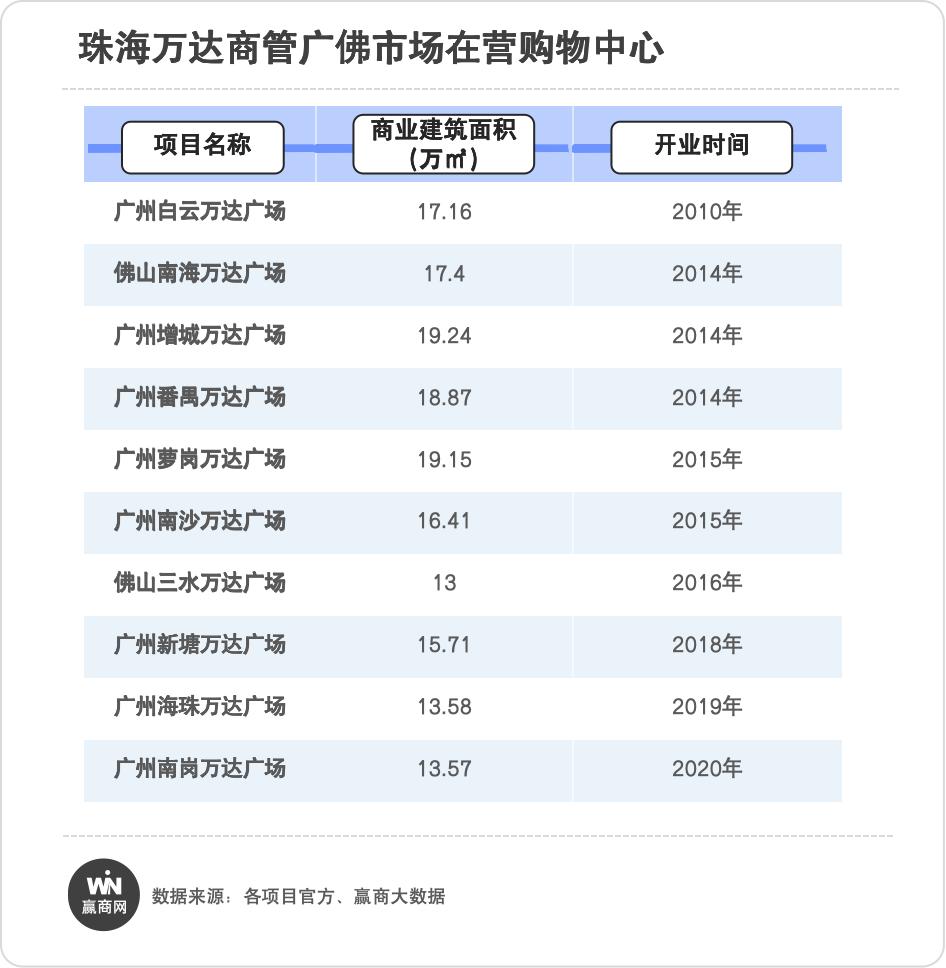
Zhuhai Wanda Commercial Management is the undisputed No.1 commercial management enterprise by Guangzhou-Foshan commercial stock scale, with 10 Wanda Plazas totaling over 1.6 million ㎡ in gross floor area. In the Guangzhou-Foshan market, the "Wanda speed" of opening 5 Wanda Plazas in 2 years has not been surpassed so far, showing the market the ultimate efficiency of scaled expansion of well-known domestic commercial product lines.
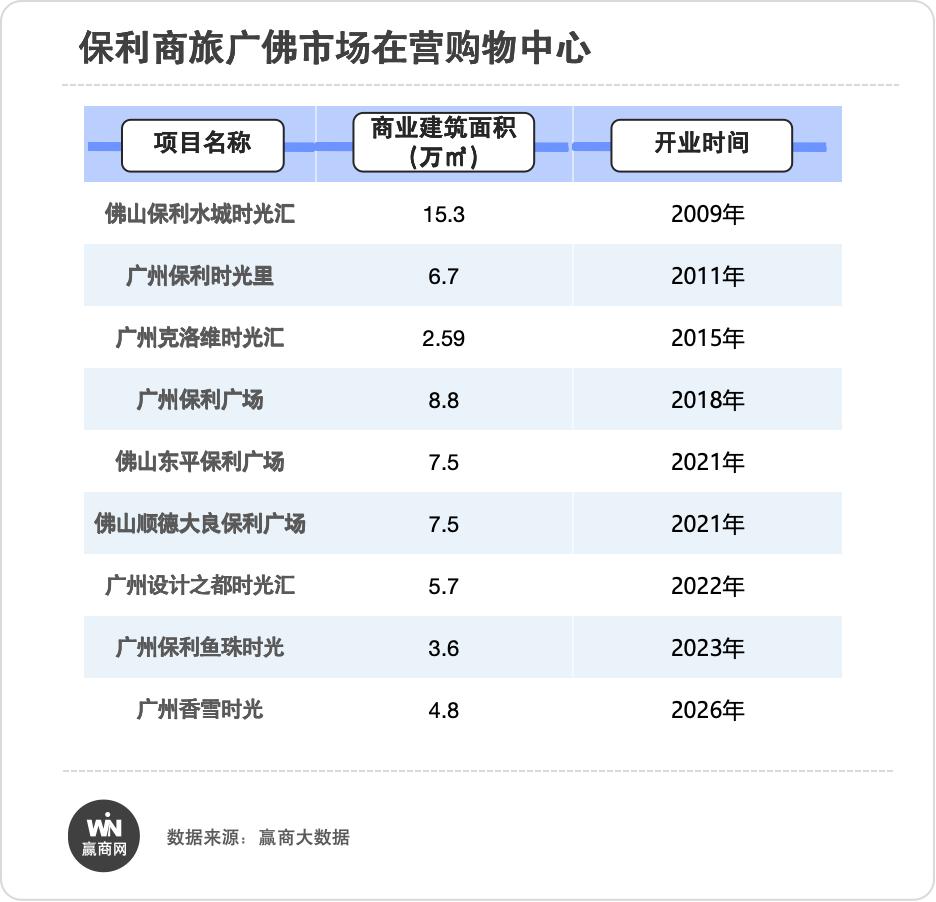
Ranked No.3 by Guangzhou-Foshan commercial stock scale, Poly Commercial Travel has a more comprehensive expansion mode. In the shopping mall business sector, it promotes both heavy asset development and self-holding, and light asset operation and management output, and carries out differentiated layout through multiple product lines — Poly Plaza, Time series (Time Li, Time Hui, ∞ Time). Up to now, Poly Commercial Travel has operated a total of 9 commercial projects in Guangzhou and Foshan, with a commercial stock scale of over 620,000 ㎡.
If the rankings of Zhuhai Wanda Commercial Management and Poly Commercial Travel are in line with most people's intuition, then Guangdong local commercial management enterprise Jinbo Commerce ranked No.2 may seem a little "counter-intuitive" at first glance. After all, it was not until the opening of Jinbo Tiandi in Jinshazhou in 2019 that Jinbo Commerce truly realized the layout in both Guangzhou and Foshan, with its commercial stock scale just exceeding 250,000 ㎡.
The "curve overtaking" took place from 2020 to 2025 when the whole industry was in cyclical turbulence. During this period, Jinbo Commerce's long-term pursuit of healthy cash flow, in-depth understanding and deep cultivation of the Guangzhou-Foshan market truly showed its advantages. In 5 years, 4 Jinbo Tiandi projects and 1 Jinbo Center in Guangzhou and Foshan opened one after another, and its commercial stock scale rapidly increased to over 910,000 ㎡, about 3.5 times that of 2019. It can be said that it is the commercial management enterprise with the highest "adversity quotient" in the Guangzhou-Foshan market in these 5 years.
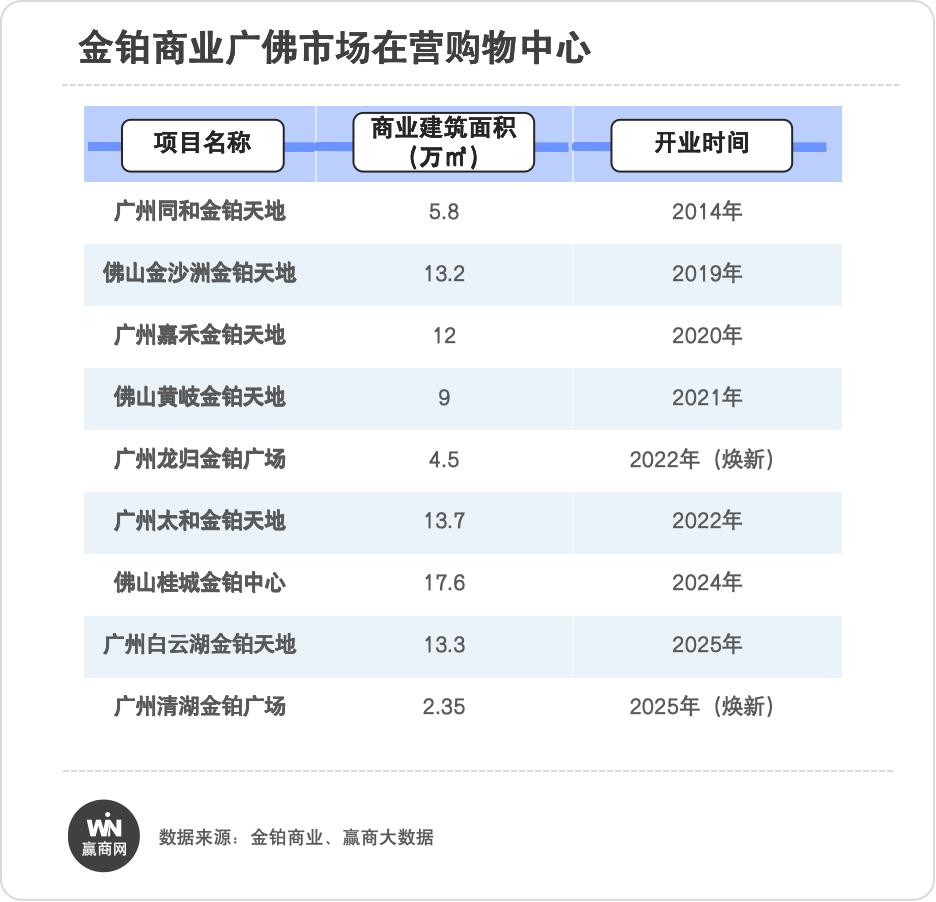
The scale of the Guangzhou-Foshan commercial market will continue to increase, and the scale ranking of major commercial management enterprises will naturally change accordingly. According to Winshang Big Data monitoring, in the next 3-4 years, Jinbo Commerce is expected to become the No.1 commercial management enterprise by Guangzhou-Foshan commercial stock scale.
From Q4 2026 to 2029, Jinbo Commerce has initially confirmed 5 pre-opening shopping malls, with a total pre-opening gross floor area of 962,000 ㎡. When these pre-opening projects are unveiled, the total gross floor area