It has gone viral all across the internet. Why is everyone scrambling to use Jev, a product developed by a former OpenAI researcher?
The Editorial Department of Almost Human
Recently, a new name has emerged in the AI circle: Jev.
https://typesafe.ai/blog/introducing-system-one-models-and-jev
In the past few days, Jev has quickly gone viral on X, GitHub and the Agent developer community. Some users use it to analyze 724 real-time ads in 40 seconds, some integrate it into Claude Code to clean up context, some use it to complete task acceptance for AI Agents, and some developers have connected Jev to browser Agents, using it to decide which button to click next and which page to navigate to.
LangChain also quickly followed up, releasing a Jev-as-a-Judge experiment on September 20 to test its performance as an Agent evaluator.

Even Tibo, known as the "Reset God" at OpenAI, has promoted Jev.

What exactly is Jev?
Simply put, it is an AI specifically designed to handle "judgment questions".
On September 15, TypeSafe AI officially released Jev, and referred to this type of model as "System One Models". According to TypeSafe's definition, this type of model receives a segment of program status or text information, and quickly returns structured judgment results along with corresponding probabilities.
We reported on Jev when it was first released. A few days later, its popularity has risen to a new level, with related tweets having been viewed by 37 million people.

For example, suppose a customer service system receives an email, developers can let Jev make multiple judgments at the same time: "Is this a sales lead?", "Is the user's sentiment intense?", "Is manual intervention required?", "Does it belong to a billing, technical or sales issue?"
What Jev returns may be a set of probabilities: Sales lead: 0.91; Manual intervention required: 0.12; Technical issue: 0.83. The application can immediately proceed to the next process based on these figures.
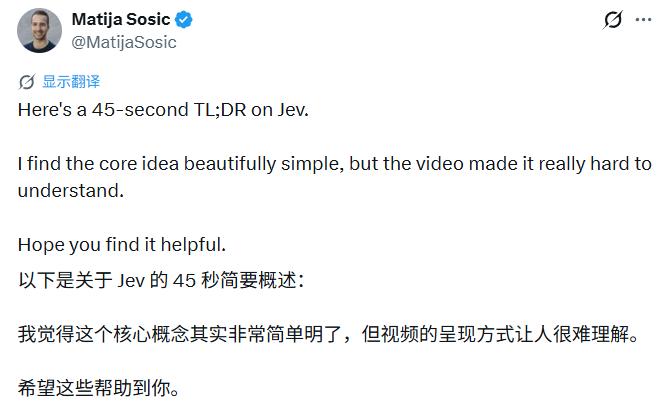
Matija Sosic, co-founder and CEO of Wasp, also posted a 45-second interpretation video of Jev on X.
Currently Jev provides three core judgment forms: Noul, Choice and Score. Noul is responsible for Yes/No type judgments, Choice selects answers from given options, and Score rates results based on preset criteria. Each result comes with a corresponding probability or confidence level, and multiple questions can be judged simultaneously around the same input.
This design quickly helped Jev find an application scenario for explosive growth: acting as a "referee" for Agents.
Today's AI Agents often need to complete dozens or even hundreds of steps in a row. After writing code, calling tools, searching web pages, and modifying files, the system still needs to judge whether the task has been completed. This type of problem perfectly fits Jev's working pattern.
Developers can hand over the Agent's execution records to Jev, then ask: "Is the goal achieved?", "Does the result meet the requirements?", "Are there any omissions?", "Which level does the quality of the current result belong to?"
The latest experiment announced by LangChain adopted a similar idea. They let Jev, GPT-5.6 Luna, GPT-5.6 Terra and Claude Sonnet 4.6 repeatedly score the output of a fixed Agent. In this small-scale set of experiments, Jev took about 0.44 seconds per call on average, with a cost of about 0.00035 USD, while delivering outstanding performance in the consistency of continuous scoring. LangChain also emphasized that this is still an early, small-scale test, and subsequent verification is needed on more Agents and real production tasks.
A set of data from Jev's advertising analysis further pushed it out of the niche circle.
In an experiment shared by developer Matthew Berman, the system used Jev to analyze 724 real-time ads from 37 brands, classifying the ads' Hook, format, Offer, CTA, user awareness stage, and the consistency between the ad and the landing page, generating a total of 8724 judgments.

According to the data released by the developer, this batch of tasks was completed in about 40 seconds, with a Token cost of about 9 cents, and the median processing time for each ad was about 216 milliseconds. Relevant cases have been included in Jev's community case library.
Another project that spread rapidly in the developer community is called fast-jev-compaction.
This Claude Code plugin submits a large number of tool calls and terminal outputs to Jev for scoring, letting Jev judge which content remains relevant to the current task, and then compresses the context sent to the model based on the results. The project quickly gained a lot of attention after its launch, and multiple ported versions have emerged.
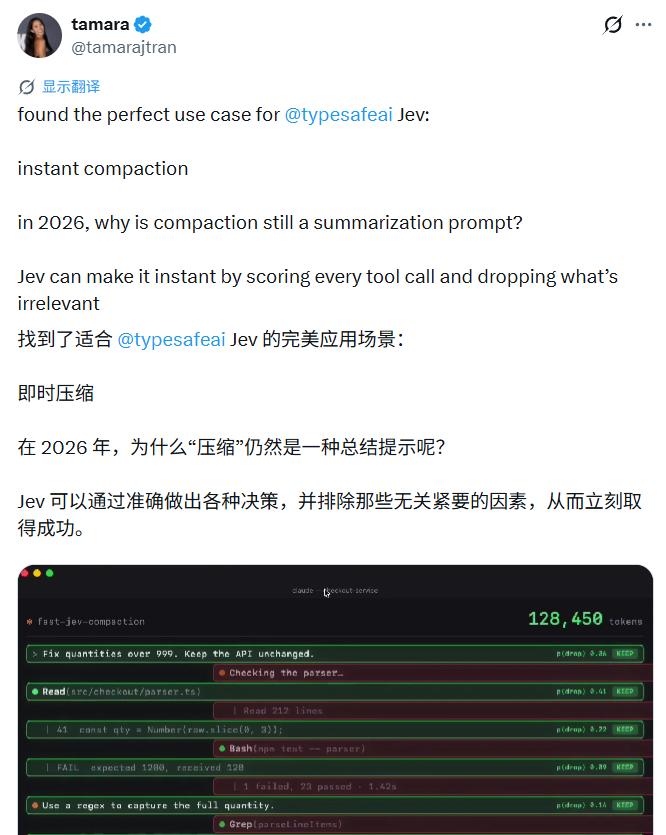
https://github.com/tamaratran/fast-jev-compaction
Browser Agents have also become a popular experimental field for Jev.
At present, multiple open source projects have adopted the loop of "browser reads the page - generates candidate actions - Jev selects the action - browser executes". In a public flight search Demo, the developer reported that the entire search process took about 7 seconds, with a cost of about 0.004 USD.
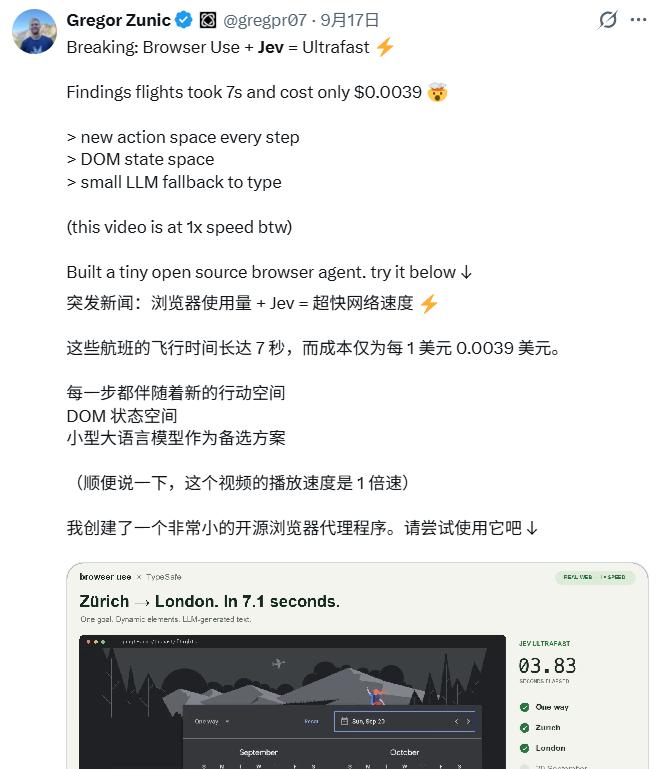
This type of application perfectly explains why Jev has suddenly attracted the attention of Agent developers.
Essentially many Agent steps belong to high-frequency decision-making: which button to click, which tool to call, whether this piece of information is relevant, whether the current task is finished, whether a certain result passes acceptance. When these judgments occur hundreds of thousands or even millions of times a day, latency and cost quickly become integral parts of system design.
In its own workflow benchmark, TypeSafe claims that Jev has achieved a maximum speedup of about 193.6 times and a cost advantage of 444.6 times on some tasks. TypeSafe also notes that these results are at the high end of their expected actual benefits, and the test set was also produced by the company's model capability team, so these figures are more suitable as an early reference for the technical route.
Jev's naming also reveals TypeSafe's ambition.
"System One" comes from the System 1 concept proposed by Daniel Kahneman in *Thinking, Fast and Slow*, which refers to the fast, intuitive judgment system; "Jev" comes from the economist William Stanley Jevons. TypeSafe borrows the meaning of the "Jevons Paradox": when the efficiency of using a resource is greatly improved, its total usage may grow rapidly instead.
In the context of AI, this meaning is very obvious. When the price of one intelligent judgment drops by several orders of magnitude, developers will start to add AI in places where they would never have afforded to call models before.
Whether a log is important, what type an email belongs to, whether an Agent has completed the task, what awareness stage an ad is at, which button to choose for a web page action — these tiny judgments combined may form a very large call volume in the next generation of Agent systems.
Jev is currently still in the early access stage, and the community's experiments around it on browsers, code Agents, ad analysis, evaluators and context management have just started.
But it has already raised a very interesting question: in future AI applications, the part that actually consumes the most intelligent computing power may be thousands of small judgments hidden in software processes.
And what Jev wants to become is exactly the infrastructure behind these "intelligent if statements".
Have you tried Jev? What do you think of it?
References:
https://x.com/CompleteSkeptic/status/2099925682726002904
https://x.com/TheMattBerman/status/2100654891756589230
https://x.com/tamarajtran/status/2100694549362553153
https://x.com/LangChain/status/2101454284927959080
https://x.com/MatijaSosic/status/2101333105193693652
This article is from the WeChat official account "Almost Human" (ID: almosthuman2014), authored by Almost Human, an AI-focused media, and is authorized for release by 36Kr.