Keynote Speech: From "Going Global" to "Surviving" | 36Kr 2026 East Forward Global Expansion Summit
In 2026, the overseas expansion of Chinese enterprises is shifting from "seeking incremental growth" to longer-term global operation. On September 17, the 2026 East Forward 2nd 36Kr Global Expansion Conference themed "Rising Tide, Meet at the Shore" was held in Shanghai. Overseas-oriented enterprises, investment institutions from the consumer, technology, manufacturing and other sectors, as well as global service providers gathered at the scene, discussing practical issues including localized operation, user insight, supply chain, compliance, channels and global organizations. When "going global" is no longer a niche choice, enterprises have to face the real core problem: how to survive and take root in overseas markets, turn one-off market breakthroughs into sustainable operations, and gradually build their own global competitiveness.
The following dialogue is sorted and edited by 36Kr:
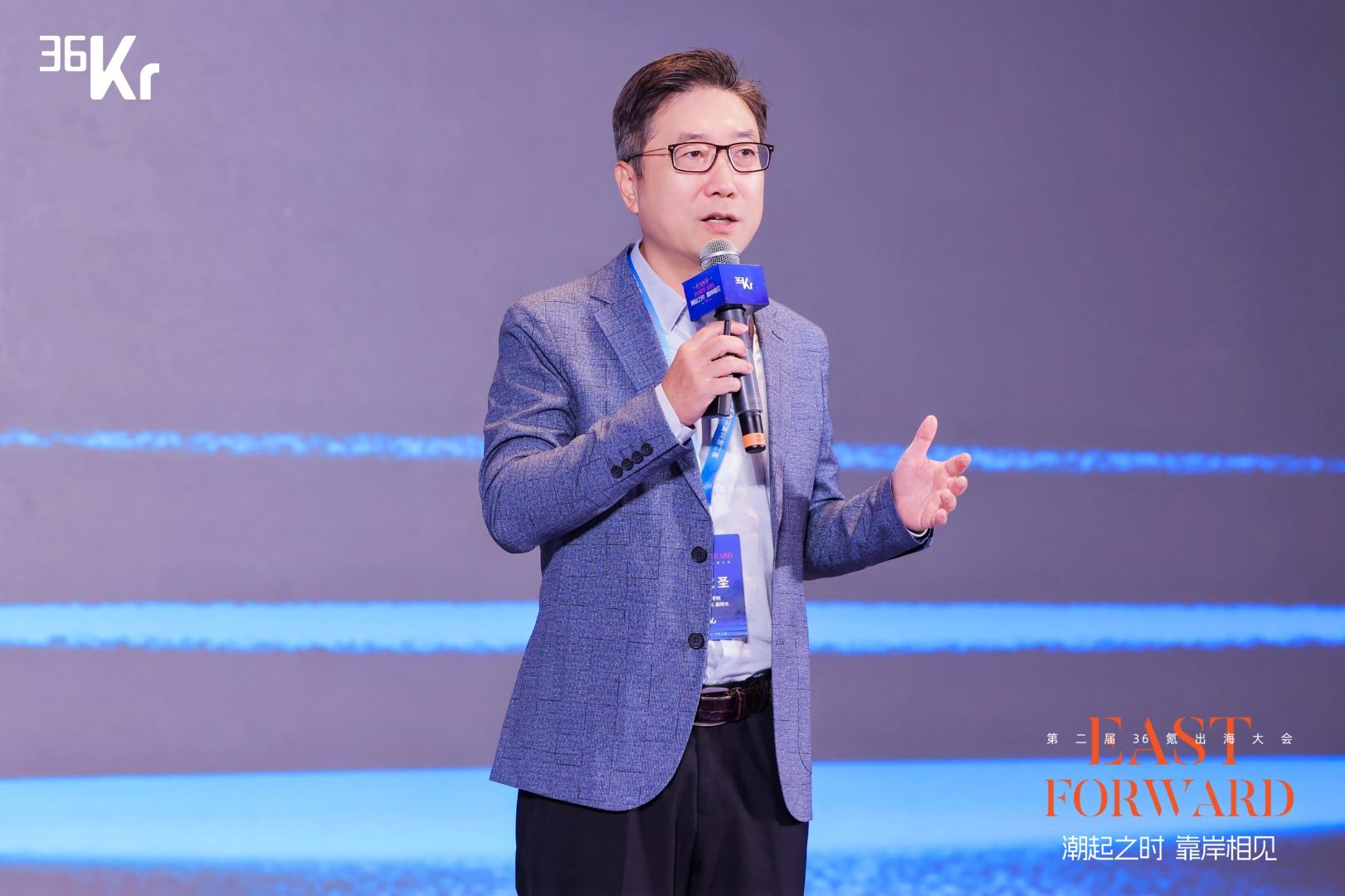
TENG Binsheng | Professor of Strategy and Associate Dean of Strategy Research, Cheung Kong Graduate School of Business
TENG Binsheng: Good morning everyone! It is a great honor to attend the 2026 36Kr Global Expansion Conference. This conference comes at the perfect time. In past few years, entrepreneurs all believed that "you will be eliminated if you do not go global". Many of them did step out, but found that problems popped up as soon as they went overseas, and the success rate was not as high as everyone expected. In the middle of storms, the probability of small boats capsizing is extremely high.
This is certainly normal. In today's fast-changing world, the flutter of a butterfly's wings thousands of kilometers away may cause a storm here. You all saw the big news this morning: the US has raised interest rates for the first time in three years, which means the long-awaited "shoe" has finally dropped, and there may be another interest rate hike before the end of the year. But will it trigger macro issues such as capital outflows and a stronger US dollar? There may not be a clear answer for now, but everyone is making small adjustments to their decision-making logic. In the AI era when facing this world, we need to constantly judge the ranking of variables and the weight of each variable, so as to draw corresponding conclusions.
Going global has obviously been one of the optimal solutions in entrepreneurs' decision-making logic in the past few years, even though its risks are quite significant. Today I would like to spend 20 minutes sharing my simple thoughts on overseas expansion and corresponding risk response strategies. This is also because I recently published a book called Overseas Expansion Models, and I will talk about some content in the book today.
Generally speaking, "globalization is dead" has been the basic consensus in the past few years, but in academia, it is generally believed that globalization has not really died, it just appears in another form, so it is called "Globalization 2.0". It is not just a change of appearance, but the overall logic has changed completely. From four dimensions: leading model, center-periphery relationship, driving factors, and value pursuit, Globalization 2.0 is very different from Globalization 1.0, just as Trump 2.0 is very different from Trump 1.0, it is the same logic.
I will pick one point to explain. The original so-called "flying geese paradigm" where the leading goose keeps shifting to lead development may have been broken, and the leading goose now also needs to bring manufacturing back. When the current becomes chaotic, how to win in chaos? I often put forward a view: when Trump plays billiards, he hits all the balls in the middle to scatter them all at once. In the past, people might hit the balls one by one in a precise way, but now it is a total mess. Where is our exact position? If we just follow the tide, risks will keep piling up.
For example, one of my students who runs a photovoltaic company has been able to supply the US market for years, because they set up a factory in Vietnam relatively early during the pandemic, while their Chinese peers were blocked by the pandemic and could not follow up, so they occupied a considerable market share in the US market for almost three years. But he foresaw very early that wherever a force rises, it will be suppressed. As more and more Chinese photovoltaic enterprises entered Vietnam, Vietnam would definitely become the target of anti-dumping and countervailing investigations, so he took up 1000 mu of land in Indonesia in advance. Sure enough, in 2022 and 2023, the business in Vietnam could not continue, he moved the production capacity from Vietnam to Indonesia in 7 months, and started supplying the US from Indonesia. Then when Indonesia could no longer support the business, he moved the production capacity to Egypt. As a region with relatively neutral geopolitics, Egypt should be able to support the business for a longer time. But no one can be sure of that. So this student is currently stepping up the layout of direct production in the United States. Since the US will suppress wherever you rise, in the end you can only carry out real production activities in their home territory. This example shows us that the overall gameplay has changed dramatically.
The trade war has also played an important role here. The constant ups and downs and uncertain restrictions have made many enterprises experience a rollercoaster ride. Now the situation has basically stabilized: we are subject to an additional 12.5% tariff, while enterprises from some other countries are subject to tariffs raised to 10% or 12.5%. Of course our treatment is relatively the worst, but not worse than many other countries, which is not that bad. As a result, exports in the first half of this year were very strong, making it the brightest highlight of the whole economy.
This shows that when facing ordinary storms, the sustainability and resilience of China as the world's manufacturing center is extremely strong. Under the current trade war situation, it is fully bearable for us.
However, the example I gave earlier also shows that if Southeast Asia is also affected by higher tariffs, various Section 301 investigations, anti-dumping and countervailing measures, its role as a "springboard" will decline. Now we can see that fewer and fewer enterprises are willing to only focus on Southeast Asia. Indonesia, which used to be an unavoidable hub for Chinese enterprises in Southeast Asia, has also seen some changes in the current situation. Enterprises need to do more homework to further diversify their layout. Overlay risks have not been fully eliminated, and the structural differentiation of trade will continue.
Of course, the current situation is like playing cards. I believe everyone is a master of Guandan. Sometimes you even need to split a pair of cards to play, you have to adjust your card type to cope with the opponent's card type. When the US plays the chip card heavily, we play the rare earth card, and trade and tariffs are the visible parts of the game. The overall structure will not change in the short term. Therefore, Chinese enterprises can play increasingly rich roles overseas.
We often say that one vest is no longer enough, because you will be recognized at a glance. That's why there are so many "born global" enterprises that are registered overseas from the very first day, do not use Chinese data or other Chinese resources. If their "origin" is overseas, they will have convenient conditions for subsequent capital operations and listings. We have seen this trend in the listing and divestment cases of Manus and SHEIN. Enterprises need to start layout at the very beginning of their establishment, so we need to look further ahead, which is closely related to geopolitical factors.
Overall, we are returning to a central position, but the overall structure has undergone tremendous changes. In the past, we were the natural "waist" of global trade, and many operations relied on the power generated by this waist. The strength of our core competitiveness is the decisive factor. As the manufacturing center of the world with no alternative, our "waist" is very strong.
The original chain-like vertical structure has been largely broken, replaced by a network structure. It is obviously much more difficult to occupy a central position in the network structure. Therefore, under a series of arrangements such as ally-shore trade, near-shore trade, and "small yard, high fence", we need to use overseas expansion to occupy a more favorable position in this big network of Globalization 2.0, which is empowered by new quality productive forces. But Chinese enterprises need to rush to the front line to select these "structural holes" first: where are the holes in the network structure, which positions are most worth occupying? Because the value of each hole is completely different, which tests the judgment of every Chinese enterprise.
But from a positive perspective, our opportunities are greater than in the original chain structure. In the past, if you were a link in Apple's supply chain, you had no other choices, most of the profits were taken away by Apple, and you only provided supporting services for it. But now, Chinese enterprises are striving to build some global industrial chains led by ourselves, which is our direction of effort. Even if we may not get the same proportion of profits as Apple, once the dominance is in our hands, such industrial chains will have extremely strong sustainability. The network structure means no single chain can be exclusive, multiple chains develop in parallel, and this will be the structure of the future.
Many countries know clearly that they cannot develop large language models on their own, but they still want to develop sovereign large language models. The logic is the same: they need to have their own "private plot" to have certain control in the face of huge fluctuations, which is what many countries want to achieve.
A few months ago, I led a team to the UK. The UK is discussing how to revitalize its old industrial hubs in northern England and Scotland. Although this task is extremely difficult, the current prime minister is from the north, which means the manufacturing industry in northern UK must revive or have greater say, which is consistent with the overall planning of many countries.
In the past, our export pillar products were the "old three categories", then they became the "new three categories", and now the "new new three categories" are industrial robots, AI and innovative pharmaceuticals. The frontier areas are evolving constantly, and the good news is that we have not lost the "old three categories" and "new three categories". Now several growth engines are running at the same time and advancing side by side, which is the new business opportunity we can seize after the original globalization order is disrupted.
In my book, I put forward a framework called "Value Compass". We often say that you can't find new waterways with old maps, you need to clearly know where you are heading. Sometimes there is an iceberg on the side, just like the Titanic, you must not let the side of your ship hit the iceberg, even a head-on collision is fine, because your ship is designed to withstand that impact, you can't let your weak links suffer such a blow.
Therefore, we need to consider five aspects of issues:
1. Market entry path.
2. What kind of core competitiveness (your inherent advantages) do you rely on to take root in the market?
3. How to use the ecosystem to build stronger links with local communities?
4. Where is your innovation point, and do you have certain moat for your business?
5. Compliance, including ESG. Can you achieve the most fundamental compliance? Otherwise, just like SHEIN was fined 200 million euros in France, which is equivalent to all its profits in one quarter, if such a penalty is really imposed. This shows that for overseas enterprises, once there is a problem in compliance, the bottom line of operation will be broken.
In terms of entry methods, there are trade, joint venture, merger and acquisition, and greenfield investment, which are the main methods. The proportion of greenfield investment is relatively high, but at some key nodes, merger and acquisition is the necessary way to enter the market. Just like the photovoltaic enterprise I mentioned earlier, the reason why it can successfully take root in the US market is that it spent 425,000 US dollars at a very low price to acquire a Chinese brand that had entered the US market long ago, which is a US photovoltaic brand operated by Chinese company. Such an entry point allows it to continue to develop the US market, so the M&A method is still very important.
Finally, more and more Chinese enterprises are now "Born Global". They do not just do well in China and transplant their successful domestic business to overseas markets. More and more enterprises' overseas business is very different from their domestic business. For example, there is a case in my book called "Ji Dong Herbal Jelly", which is a local company growing up in Shanghai. It sells herbal jelly in China, but mainly sells milk tea in the US and the UK, because overseas consumers need a process to accept herbal jelly products. Enterprises need to provide products more suitable for the local market while giving full play to their own capabilities. After all, there are common points between retail and dessert business. Even if the specific products change, they can still give full play to their core competitiveness. Such enterprises are "born global" in a sense.
Many robotics and AI enterprises target overseas markets from the very beginning, which gives them higher flexibility, because they are not only leveraging their domestic competitiveness.