Part 4 of the "CEO's Operational Intuition" Series: Building an Ecosystem
From academic origins to the AI era, why ecological thinking is a counter-intuitive required course
On July 24, 2026, Jensen Huang posted his first ever tweet on X.
As the CEO of the world's most powerful AI chip company, he had no presence on social media at all before. People guessed his first tweet would be a new product launch, a quarterly earnings report, or at least an iconic selfie in a leather jacket. But he chose something else — a joint open letter titled "Open Weights and U.S. AI Leadership".
25 companies co-signed the letter: NVIDIA, Meta, Microsoft, IBM, Dell, Mistral, Hugging Face, Perplexity, a16z, Y Combinator… covering the entire chain of hardware, models, applications and investment. However, OpenAI, Anthropic and Google — the three giants of U.S. closed-source AI — were all absent.
This tweet itself is not complicated. But if you understand the logic behind it, you will find that this is not a tweet about open source, but a manifesto about ecosystem.
The word "ecosystem" has been overused nowadays. Every company is talking about "building an ecosystem", and every entrepreneur is drawing an "ecosystem map". But when Jensen Huang defined it with his first tweet, it is worth stopping to seriously ask a more fundamental question: What on earth is an ecosystem? Where does it come from? Why has it suddenly become the underlying grammar of all competitions in the AI era?
I. The Genealogy of the Concept: From Oikos to Ecosystem
To understand the ecosystem, we must first go back to its etymology.
In 1866, German biologist Ernst Haeckel coined the term "Ökologie", derived from the Greek word oikos — meaning "home" or "residence". Haeckel's definition is simple and precise: Ecology is the science that studies the interactions between organisms and their environment. Note that the key word here is not "organism", but "interaction". From the very beginning, ecology was not the study of a certain entity, but the study of relationships.
However, Haeckel's ecology mainly focused on the relationship between individual organisms and the environment. It was another British scholar who truly brought the perspective to the system level.
In 1935, British ecologist Arthur Tansley first proposed the term "ecosystem" in his paper The Use and Abuse of Vegetational Concepts and Terms. He wrote:
"For me, the fundamental concept is the entire system (in the physical sense), which not only includes the complex composition of organisms, but also the complex composition of physical elements that we call the environment, and they together form a physical system... We can call it an ecosystem."
—— Arthur Tansley, 1935
Tansley's revolutionary contribution lies in that he broke the tradition of "separate research on organisms and the environment". Before him, biologists studied organisms and physicists studied the environment, with no intersection between their work. Tansley pointed out that this was wrong — organisms and the environment are an inseparable whole, where matter circulates between them and energy flows through them. If you take a fish out of the water to study it, that is no longer ecology.
Seven years later, American ecologist Raymond Lindeman put forward the "ecological pyramid" and the "10% law" when studying Cedar Bog Lake in Minnesota: when energy is transferred between trophic levels, only about 10% can be passed to the next level, and the rest is lost as heat. This is the first quantitative proof that an ecosystem is a structured energy flow network, not a random collection of species.
In 1953, Eugene Odum published Fundamentals of Ecology, formally establishing the ecosystem as the basic unit of ecology — with the same status as "species" in taxonomy. Since then, ecology has evolved from "studying individuals" to "studying systems".
Key Turning Point
From Haeckel to Odum, ecology took nearly 90 years to complete a paradigm shift: shifting from "studying entities" to "studying relationships". This shift later became the cornerstone of all interdisciplinary applications. When you replace "fish and water" with "enterprises and markets", "chips and developers", "models and applications" — you are using the same set of thinking grammar.
II. System Theory: Another Parallel Line
In the same era when Tansley proposed the concept of "ecosystem", an Austrian theoretical biologist was doing similar research on another track.
Ludwig von Bertalanffy published Theoretical Biology in 1932 and proposed the "organismic system theory" — emphasizing that organisms must be studied as a whole rather than being split into parts. In 1937, he first put forward the concept of "General System Theory" at a philosophy seminar at the University of Chicago.
Bertalanffy's core insight is: Systems in different fields have structural isomorphism. A biological cell, a social organization, a machine — although their materials are completely different, as "systems", they follow certain common laws: the whole is greater than the sum of its parts, a system must exchange matter and energy with the environment (open system), a system has a hierarchical structure, and a system has purposiveness.
In 1948, Bertalanffy systematically expounded this idea when he gave lectures in the United States. In the same year, Norbert Wiener published Cybernetics and proposed the concept of feedback loops. The convergence of these two forces, together with information theory, constituted the "system science" wave in the mid-20th century. In 1954, Bertalanffy, economist Kenneth Boulding, neurobiologist Ralph Gerard, and mathematician Anatol Rapoport jointly founded the "Society for General Systems Research" — four scholars from four disciplines, which itself illustrates the interdisciplinary nature of systems thinking.
In 1968, Bertalanffy published General System Theory: Foundations, Development, Applications. The core proposition of this foundational work can be summarized by a sentence from Aristotle: The whole is greater than the sum of its parts.
1866 Haeckel coined the term "Ecology" (Ökologie) and defined it as "the science that studies the interactions between organisms and their environment"
1932 Bertalanffy published Theoretical Biology and proposed the organismic system theory
1935 Tansley proposed the concept of "ecosystem"
1937 Bertalanffy first proposed "General System Theory" at the University of Chicago
1942 Lindeman put forward the ecological pyramid and the 10% law
1948 Bertalanffy lectured on General System Theory in the United States; Wiener published Cybernetics
1953 Odum's Fundamentals of Ecology was published, making ecosystem the basic unit of ecology
1968 Bertalanffy's General System Theory was published, establishing the disciplinary status of system theory
1990 Peter Senge's The Fifth Discipline was published, bringing systems thinking into management practice
1993 James F. Moore proposed the concept of "business ecosystem" in Harvard Business Review
III. The Birth of Business Ecosystem: Moore's Cross-Disciplinary Leap
Ecology has Haeckel, system theory has Bertalanffy, then who is the pioneer of the business ecosystem?
In May 1993, James F. Moore published an article in Harvard Business Review titled Predators and Prey: A New Ecology of Competition. This article won the McKinsey Award of that year — the best paper of the year from HBR.
Moore did a simple but bold thing: he directly moved Tansley's ecosystem concept to the business world. He wrote:
"A business ecosystem is an economic community of interacting organizations and individuals that produces valuable goods and services for customers. Its members include suppliers, leading producers, competitors and other stakeholders. Over time, they co-evolve their capabilities and roles, and tend to align themselves with the directions set by one or more core enterprises."
—— James F. Moore, 1993
Note the ecological metaphors Moore used: enterprises are "embedded" in the business environment like organisms, need to "co-evolve" with other companies, and their occupied "ecological niche" will be challenged by "new species". This means that companies should not only focus on competitors, but actively build "symbiotic" relationships with customers, suppliers, and even rivals.
In 1996, Moore expanded this idea into the book The Death of Competition: Leadership and Strategy in the Age of Business Ecosystems. He proposed four evolutionary stages of business ecosystems:
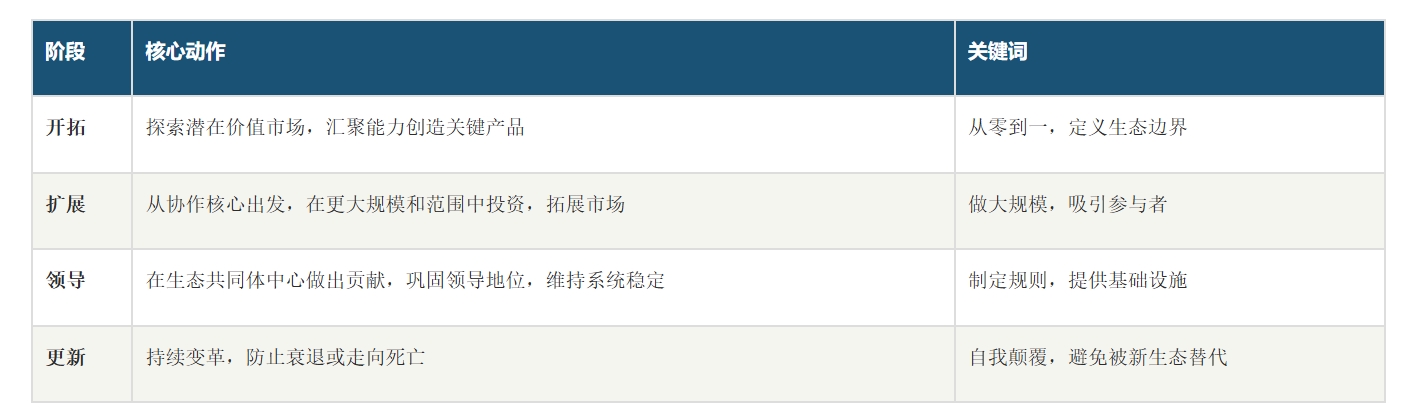
Moore's framework is still applicable today. Take NVIDIA as an example: CUDA was the seed in the "pioneering" stage, and has been in the "expansion" stage for the past 20 years — attracting developers, installing a large number of devices, and entering new industries. Now it is in the "leadership" stage — setting industry standards for AI computing. And Jensen Huang's tweet is essentially what he should do in the "leadership" stage: consolidate his core position by defending the open ecosystem.
IV. Jensen Huang's First Tweet: A Textbook Demonstration of Ecological Thinking
Let's go back to that tweet and break it down carefully.
Jensen Huang wrote:
"AI will transform every industry, empower every company, and be built by every country. Open-weight models can enhance security and cybersecurity, accelerate innovation and popularization, and achieve sovereignty. The world needs both cutting-edge closed-source models and cutting-edge open-source models."
—— Jensen Huang, X, July 24, 2026
This passage seems to be talking about open source, but it actually reveals three layers of ecological thinking:
The first layer: Translate "open source" into "ecosystem prosperity"
Jensen Huang is not an open-source idealist. NVIDIA sells chips. The more prosperous open-weight models are, the larger the developer base, and the richer the application scenarios, the exponentially expanding demand for GPU computing power. The open letter puts it very directly: the measure of U.S. AI leadership is "not how powerful a single cutting-edge model is, but whether it can build a robust and open ecosystem that penetrates all industries".
In plain language: I don't care who builds the most powerful model, I care how prosperous the entire ecosystem is — because the more prosperous the ecosystem, the more chips I sell.
This is not altruism, but the highest level of egoism. Jensen Huang's ecological logic is a perfect positive feedback flywheel: open models → influx of developers → explosion of applications → surge in demand for computing power → NVIDIA GPU in short supply → revenue growth → more investment in R&D → stronger computing power → more people relying on the NVIDIA platform.
The second layer: Mobilize the ecosystem through "25 co-signatories"
Pay attention to those 25 signatories. They are not random — hardware (Dell), models (Meta, Mistral), platforms (Hugging Face), applications (Perplexity, ServiceNow, Palantir), investment (a16z, Y Combinator), infrastructure (Linux Foundation, Mozilla), enterprise services (IBM, Box, Replit). This is a complete AI value chain.
Jensen Huang is not speaking alone, he is carrying out ecosystem mobilization — pulling the upstream and downstream of the industrial chain onto the same letter to form a community with common interests. When OpenAI and Anthropic refused to sign, the signal of this letter became clearer: This is not a technical debate between open source and closed source, but a camp confrontation between two business models. One side follows the logic of "ecosystem sharing" — the cake gets bigger and everyone gets a share; the other side follows the logic of "barrier monopoly" — locking up the most valuable things and charging high prices by relying on technological gaps.
The third layer: Embed policy games into ecosystem strategies
The timing of this tweet is by no means accidental. The U.S. government is discussing restrictions on the cross-border flow of AI model weights, and OpenAI and Anthropic are lobbying regulators about the risk of "distillation" — that is, competitors can replicate advanced model capabilities by calling APIs. Jensen Huang chose to speak out at this node, using the weight of 25 enterprises to influence the direction of policy.
This letter even uses historical analogy: comparing today's open-source AI debate to the rise of open-source software in the 1980s. Early open-source pioneers broke the traditional concept that "software progress can only rely on companies strictly controlling code" and built a transparent ecosystem. Today, open-source software supports most of the content on the Internet.
This is a delicate framework manipulation: If you support restricting open-source AI, you are opposing the next Linux and the next Internet.
The Core of Ecological Thinking
Jensen Huang's tweet reveals a CEO-level ecological thinking formula: My core competitiveness does not lie in what I own, but in how many people's success depends on my existence. CUDA has accumulated hundreds of millions of GPU installations, millions of developers, and thousands of tools and libraries over 20 years — this is not a product, but ecological infrastructure. When your existence becomes a necessary condition for others' success, you change from a "competitor" to an "ecosystem cornerstone".
V. Panorama of AI Ecosystem: Who is Building Ecosystems and Who is Building Barriers
Jensen Huang's tweet is a mirror that reflects the ecosystem pattern of the entire AI industry. Let's zoom out and look at the key players in this global AI ecosystem game.
Ecosystem Builder: NVIDIA — The Ultimate Form of "Water Seller"
NVIDIA is the most sophisticated player in the AI ecosystem. Its strategy is called "vertical integration and horizontal opening" — chips, systems, and software stacks are vertically integrated into its own hands, but fully open to developers and the application layer. CUDA is not a product, but an ecosystem operating system: accumulated over 20 years, thousands of CUDA-X libraries cover more than a dozen industries such as autonomous driving, finance, healthcare, industry, and robotics, which Jensen Huang calls the company's "pearl in the palm".
At the GTC conference in March 2026, Jensen Huang announced that he would invest 26 billion U.S. dollars in the next five years to develop open-weight AI models — not to compete with OpenAI for the best model, but to ensure that the open ecosystem is always an extension of NVIDIA's hardware ecosystem. Defending open source is defending the moat.
Open-Source Standard-Bearer: Meta — Turning from Idealism to Reality
Mark Zuckerberg once declared that "open source is Android in the AI era". The Llama series has been downloaded more than 30 million times in total, building the world's most prosperous open-source AI ecosystem. However, with an annual AI investment of more than 70 billion U.S. dollars, the enterprise licensing revenue is less than 1 billion U.S. dollars — most of the results of developers fine-tuning Llama eventually flow to Microsoft and Google Cloud. Meta has been reduced to an "ecosystem paving stone".
In the second half of 2025, Meta made a sharp turn: it acquired Scale AI's equity for 14