AI office has posed a tough challenge for internet giants
Amid the surging AI wave, office scenarios have become the main battlefield where leading players compete fiercely.
The intense head-to-head confrontations under the spotlight are clear proof. After completing organizational restructuring, ByteDance, Tencent and Alibaba have all concentrated their resources. On September 15, Liang Rubo, CEO of ByteDance, made a rare appearance at the Feishu Future Infinite Conference & Doubao Work Kickoff Conference, announcing the official integration of the capabilities of Doubao, Feishu and Volcano Engine, increasing investment in the enterprise-level AI office market, and launching new products such as Doubao Work Partner.
Tencent's WorkBuddy has taken a series of frequent actions. WorkBuddy launched its open platform on September 2, introducing more than 100 ecological partners in the first batch; on September 8, WorkBuddy crossed borders to co-brand with the game *Peacekeeper Elite*; on September 16, it launched the WorkBuddy Travel Tool Creation Contest.
Alibaba's Qwen Office handed over its first-month performance report on September 4. Official data shows that since its launch, Qwen Office has completed 120 version updates, with an average of 4 iterations per day; registered users have exceeded 30 million, more than half of whom are enterprise users.
There are more players in the track taking positions in their own ways. Recently, Baidu announced that it will build Baidu Buddy into a fully open ecological platform, opening up settlement and launching partner recruitment at the same time, opening four major capabilities of connectors, skills, suites and hardware to capability providers, and promising never to draw commissions from partners. Kingsoft Office officially received the agent identity code node on September 14, becoming the first manufacturer in China's AI office field to hold an agent identity code node.
Overseas leading players are even more eye-catching. Microsoft Copilot relies on the long-term accumulation of Office to occupy a first-mover advantage; Google's Workspace is accelerating to catch up; OpenAI launched ChatGPT Work in July 2026; Anthropic merged Claude Cowork and Claude Chat into Claude on September 17.
According to the *2026 White Paper on the Development of China's AI Office Agent Industry* recently released by research institution iiMedia Research, the global AI agent market is experiencing a key transition from technical verification to large-scale implementation. AI office agent products will emerge intensively and become the backbone driving the steady growth of the entire agent industry; the global AI agent market size was 37.2 billion US dollars (about 249.4 billion RMB) in 2025, will reach 69.8 billion US dollars (about 468.1 billion RMB) in 2026, and will reach 312.2 billion US dollars (about 2.0937 trillion RMB) in 2030; the domestic AI agent market size was 80.4 billion RMB in 2025, will reach 155.8 billion RMB in 2026, and will reach 696.8 billion RMB in 2030.
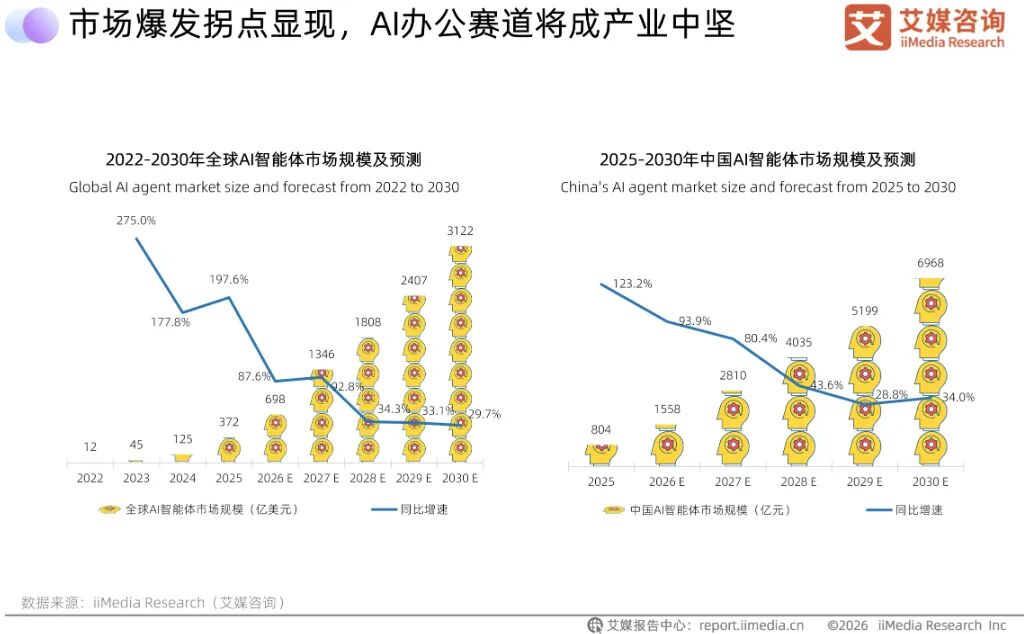
Overseas model capabilities continue to break through, and AI office, as one of the benefited application branches, is rising accordingly. Domestic large manufacturers are pouring resources and making full investment driven by the FOMO (Fear of Missing Out) sentiment, so the implementation speed of AI office is far faster than other tracks. But fanaticism cannot conceal uncertainty. At the moment of rapid AI development, there are still many variables.
01
From Lobster to Office
The growth trend in the AI office field is obvious to all.
Data from research institution QuestMobile shows that in July 2026, the overall MAU (Monthly Active Users) of China's AI efficiency office track reached 102 million, a year-on-year increase of 8.2%. Among them, the MAU of native APPs in the office track was 7.926 million, a year-on-year increase of 261.1%, and the MAU of PC clients was 10.301 million, a year-on-year increase of 340.6%; calculated by MAU, the top four office agents are Tencent WorkBuddy (6.582 million), Tencent QClaw (2.259 million), ByteDance TRAE Work (1.904 million) and Alibaba QoderWork (230,000).
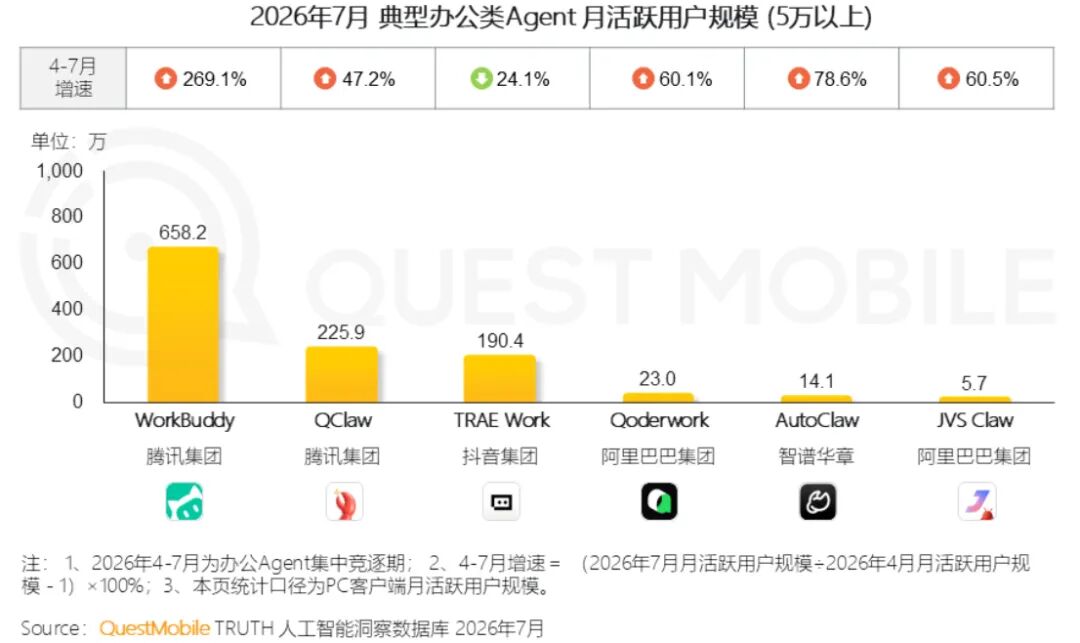
It should be noted that this field is changing extremely rapidly recently. From July to August 2026, Tencent, ByteDance and Alibaba successively ended the multi-line horse racing mechanism, and integrated the originally scattered product matrix into a single entry. Tencent merged QClaw into WorkBuddy on July 20; ByteDance merged the Feishu product team into Doubao on July 30, and Xie Xin, CEO of Feishu, reported to Zhao Qi, head of Doubao products. Later, on August 24, the TRAE and Coze teams were merged into Doubao, and the independent brand "Doubao Work" was released on August 25; Alibaba integrated QoderWork, Wukong and MuleRun into "Qwen Office" in July, which was managed by Chen Yusen, CEO of DingTalk, and Qwen Office was officially released on August 3.
The industry generally classifies Baidu Buddy and Kingsoft Lingxi into the domestic second tier, and their current popularity is less than that of Tencent, Alibaba and ByteDance. Baidu Buddy was launched in March 2026, and completed the upgrade of personal version, enterprise version and workbench in August; Kingsoft Office released Lingxi Professional Edition and WPS Comate in July 2026.
According to the observation of Hekang Finance, in terms of product form, all manufacturers are mostly the same, and the basic architecture takes tasks or dialogues as the main interactive window, supplemented by functions such as scheduled tasks, connectors, experts, skills, and IM channels.
The so-called connector refers to the standardized interface between the agent and the existing enterprise software system. For example, by connecting office applications such as DingTalk and Feishu, the agent can be authorized to access the application and read and write the content inside the application. The IM channel is to connect instant messaging tools, so that the agent can connect to applications with instant messaging functions such as DingTalk, Feishu, WeCom and WeChat to receive or reply to user messages.
At present, WorkBuddy, Qwen Office and Doubao Work can connect to extremely rich applications, all of which can connect to Feishu, DingTalk and WeCom, as well as Office, Kingsoft Docs and other applications. Baidu Buddy and Kingsoft Lingxi have far fewer connected applications. In terms of expert and skill configuration, the reserves of leading players are also quite rich. The aforementioned Doubao Work Partner is essentially a pre-encapsulated capability module in the agent, which users can use directly without configuring from scratch.
The origin of the agent form can be traced back to the "Lobster Craze" in early 2026. Lobster, the open-source personal AI assistant OpenClaw, is the original form of the agent. After local deployment of "raising lobsters", the lobster can operate the computer on behalf of humans to complete tasks. However, the threshold of OpenClaw is not low. "Raising lobsters" requires certain technical skills, and the agent's Harness, that is, the engineering operation system, is not mature.
After that, lobster-like agents emerged one after another. Tencent has QClaw, Alibaba has JVS Claw, ByteDance has ArkClaw, and Baidu has DuClaw. The one that stands out is WorkBuddy, which was launched in March 2026. WorkBuddy removes the complex code configuration steps, supports initiating tasks with a single natural language instruction, and the model automatically disassembles the plan and outputs the complete results directly. More importantly, WorkBuddy relies on WeCom. After users download and install it and connect to WeCom, they can remotely issue tasks to the desktop through their mobile phones, and complete the configuration in as fast as 1 minute. This is extremely friendly to ordinary users.
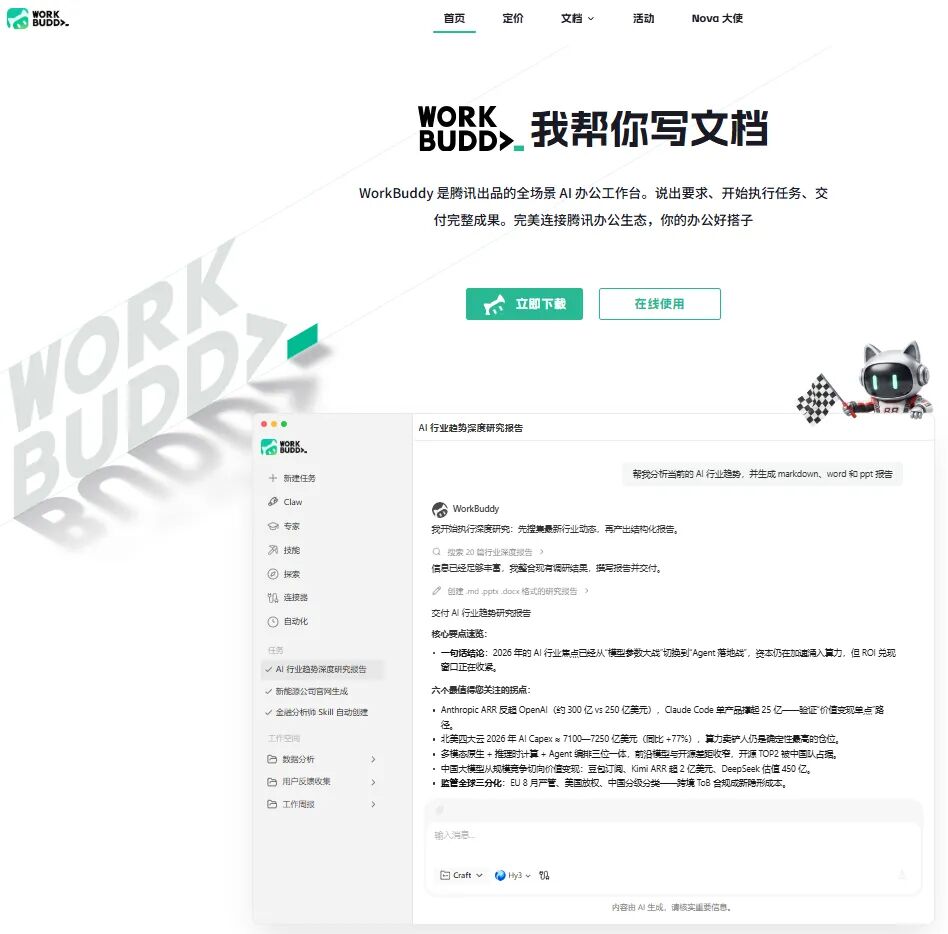
The AI office form originally promoted by Microsoft with Office as the carrier is Copilot, which helps users write drafts, generate formulas, and summarize emails in the sidebar, and is still an auxiliary form. However, most office work is not a single-step question and answer, but a multi-step, cross-tool task with clear deliverables. These tasks have clear goals, decomposable steps, callable digital tools and verifiable results, which are excellent scenarios for agents to perform autonomously.
When an agent performs a long-term task, it often requires dozens or even hundreds of model calls. If the cost of a single call is too high, large-scale implementation is impossible to talk about. Now, with the rapid development of large models, model capabilities are improving rapidly, and costs are also decreasing. The superposition of these conditions has jointly contributed to the prosperity of office agents.
02
Players Give Full Play to Their Own Advantages
Compared with agents in the general sense, the core advantage of office agents is not how strong the model is, but that they are easy to operate, and can be directly connected with the original office software of the enterprise, embedded in the workflow that users are already using.
For this reason, domestic players have taken completely different paths based on their own genes.
Although the connectors of agents can connect to products of other players, the native capabilities embedded in their original products are different, which is the key to building unique advantages. Tencent's long board is the social entrance composed of WeChat and WeCom. WeChat covers C-end reach, and WeCom completes B-end execution. WorkBuddy can make AI capabilities penetrate into the workflow along the existing social relationship chain and enterprise organizational structure. WorkBuddy also adopts the form of a model aggregation platform. In addition to Tencent's Hunyuan model, it also accesses multiple models such as DeepSeek, GLM and Kimi, and users can switch according to task needs.
The routes of Qwen Office and Doubao Work are more similar. Qwen Office briefly launched two external models, GLM and DeepSeek, and then quickly returned to the Qwen model. Doubao Work has always only used the Doubao model. Both have accumulated a considerable user base on the C-end, and then further developed based on the strengths of their original office applications. According to QuestMobile data, in June 2026, DingTalk's MAU was 171 million, Qwen's MAU was 167 million; Feishu's MAU was 30.19 million, and Doubao's MAU was 382 million.
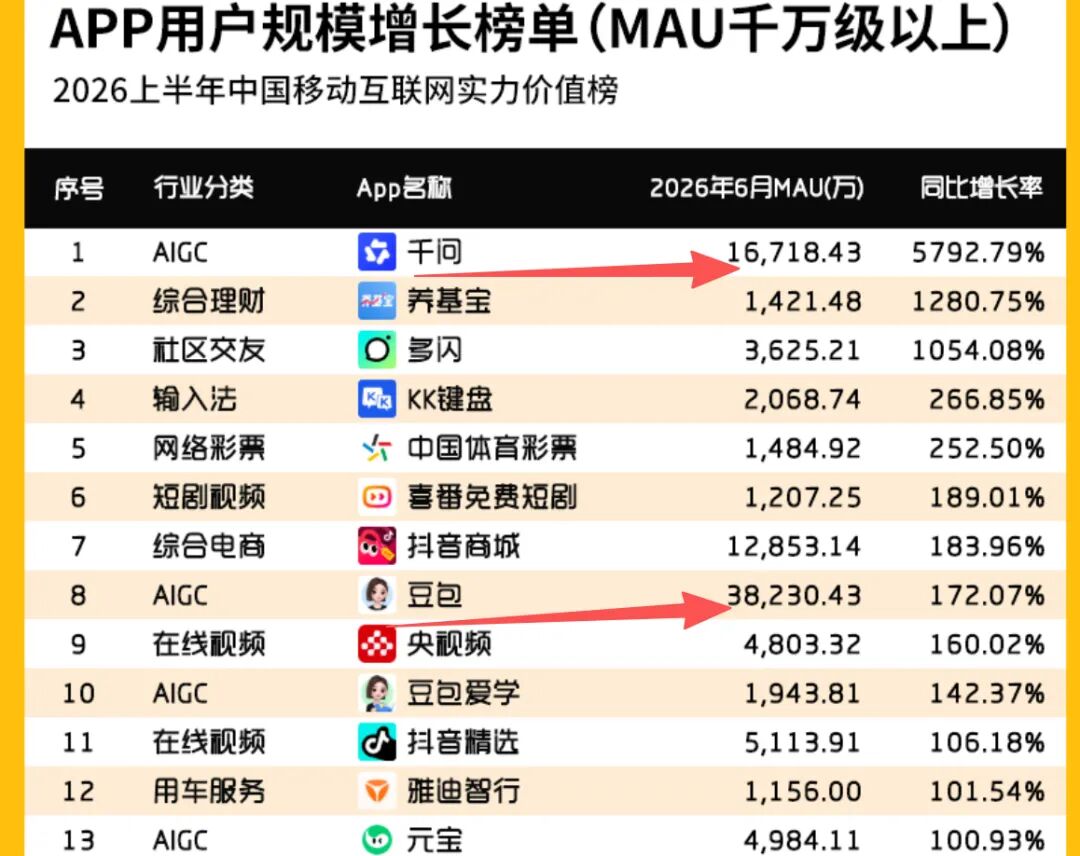
Qwen Office has native capabilities of DingTalk, such as group chat message reading, document and table generation, meeting schedule invitation, attendance approval management, knowledge base email reading and writing, which transforms the information scattered in messages, documents, approvals and emails of enterprises into organizational context that can be understood and called by agents.
Doubao Work shares the account and permission system with Feishu, and can call information in group chats, documents, meetings, multidimensional tables and enterprise business systems within the scope of authorization. After employees log in with their Feishu accounts, the agent inherits the original permissions, no need for each employee to re-upload materials, and no need to build another account system. The context left by organizational operations such as all meeting decisions, information permissions, task assignments and responsibility attribution can be directly called by the agent.
Baidu Buddy and Kingsoft Lingxi bet on document assets. Baidu relies on the stock resources of search and Wenku, and Kingsoft Office relies on the long-term accumulation of document editing, collaboration and archiving. The reason why Tencent, Alibaba and ByteDance are stronger is that they can provide the context that is most lacking in the agent RAG solution. The so-called RAG, Retrieval-Augmented Generation, is one of the mainstream solutions for large model applications. After the user asks a question, the system first retrieves relevant document fragments from the knowledge base, and then sends them to the model to generate an answer. Traditional RAG or document-based RAG can retrieve content, but lacks understanding of key office elements such as organization, collaboration, hierarchy and process. WeCom, DingTalk and Feishu are originally the places where organizational collaboration takes place, and the agent no longer reads isolated document fragments, but the context of the entire organization's operation.
At present, these products all adopt the mode of free quota plus point subscription, and the consumption of points is calculated in real time according to the completion of tasks by the agent. For example, the free version of WorkBuddy gives 500 points per month, and you can get points for free by completing tasks. The consumption of a single task such as making PPT and collecting materials ranges from several to dozens of points; if you pay for a subscription, different point package versions cost from 70 yuan to 999 yuan per month.
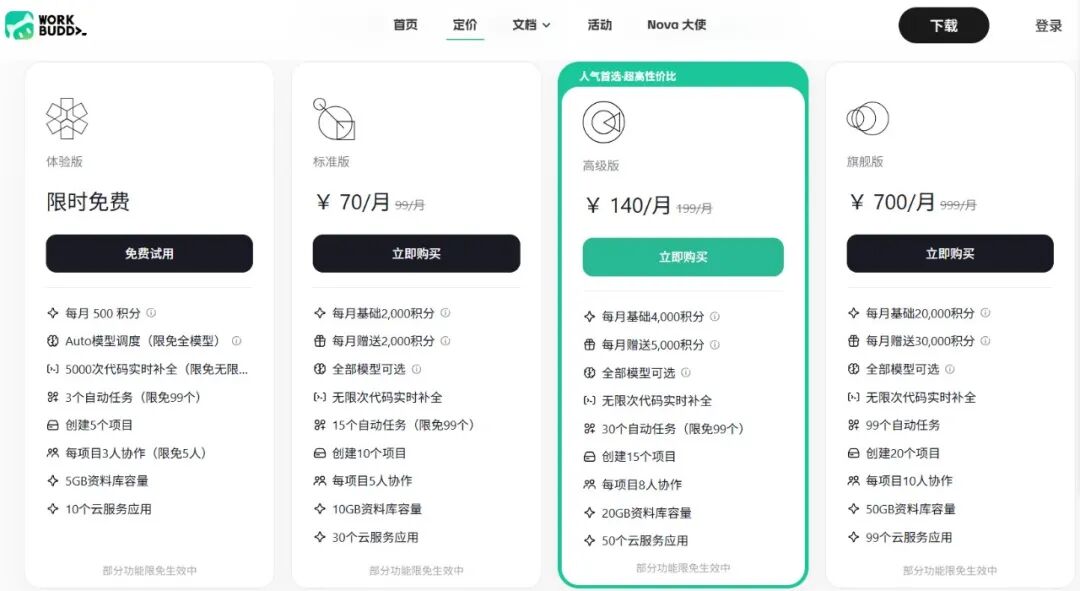
The commercialization of leading players has initially achieved results. At Tencent's Q2 2026 earnings call in August 2026, Tencent CSO (Chief Strategy Officer) James Mitchell mentioned that the gross margin of WorkBuddy's paying users and the gross margin of Tencent's model services are already comparable to the overall gross margin of Tencent Cloud; the overall gross margin of WorkBuddy is relatively low, because there are some free users, and Tencent subsidizes these users to drive market share growth, while the paid part has generated quite good gross margin.
03
The Final Outcome May Not Be Far Away
In the AI office field, Internet giants have abundant capital, with ecology, entrance and organizational execution, and their advantages are real.
A research report released by CITIC Construction Investment Securities on August 31, 2026 mentioned that the potential of AI office scenarios is huge, the number of potential global users can reach 1 billion pan-white-collar people, and it can create a trillion-dollar market space under optimistic circumstances; Internet manufacturers have outstanding competitive advantages in the AI office track, which are mainly reflected in ecological advantages, strong product power and low-threshold routing models, that is, the platform can automatically distribute different user requests to the most suitable large model behind it, users do not need to evaluate, select and connect one by one, the access threshold is low, and a balance can be achieved between effect and cost.
In the mobile Internet era where the MAU of leading players is often hundreds of millions, the 10 million-level MAU of AI office seems to be small in magnitude, but the competition among players is becoming more and more intense. Many users sighed on social media that advertisements for various office agents are overwhelming in airports, office buildings and even subways.
It should be noted that the battle for new C-end users of large models has come to an end. Around the 2026 Spring Festival, leading players in the large model track made great efforts in marketing, promoting their products in various forms such as red envelopes and subsidies, and indeed achieved certain results. However, the larger the scale of C-end users, the higher the computing power cost. The superposition of customer