In the capital market, Luckin Coffee needs to win once again.
Recently, a cross-border transaction has stirred the market: Mubadala, the top capital player from the Middle East, made a strategic investment in Luckin Coffee, with a transaction size of about 1 billion US dollars.
According to publicly disclosed information, Mubadala did not directly inject capital into Luckin to acquire shares, but purchased part of Luckin's senior convertible preferred shares from Centurium Capital, the controlling shareholder of Luckin, for a total consideration of about 1 billion US dollars.
The sellers of the transaction are two entities under Centurium Capital, CCM Lucky and Centurium Fund I, which sold 82.937 million shares and 158 million shares respectively, totaling 241 million preferred shares of Luckin.
The buyer is Success Cup Limited, a wholly-owned subsidiary of the CCM Success fund. Centurium Capital is the general partner (GP) of the CCM Success fund, and Mubadala is the core limited partner (LP).
It can be said that this transaction is just a "transfer from left hand to right hand" for Centurium Capital, which replaces the LP behind it: introducing new LPs, giving old LPs the opportunity to realize exit, and at the same time extending the investment period of Centurium's part of equity in Luckin.
Therefore, this transaction does not change the shareholding ratio of Centurium Capital in Luckin Coffee. Centurium still controls a total of 22.08% of the beneficial ownership of Luckin Coffee and continues to maintain its position as the largest shareholder.
After the share transfer is completed, as long as Mubadala's shareholding ratio remains above 5%, it has the right to appoint a director to the Luckin board of directors.
This is the first time Luckin Coffee has introduced a new strategic investor since it exposed its financial fraud in 2020. Mubadala's 1 billion US dollar acquisition of part of the equity has also set a record for the largest single investment of Middle East sovereign funds in China's ready-to-drink coffee track in recent years.
Luckin Coffee, which has achieved a remarkable turnaround in the coffee market, needs to win once again in the capital market. It is not difficult to see that it has already paved the way for restarting its IPO.
The maneuvers of Centurium Capital
Mubadala is the second largest sovereign wealth fund in the United Arab Emirates, with an assets under management of 385 billion US dollars. As the top capital player in the Middle East, its acquisition of part of Luckin's equity is bound to attract market attention.
But for Centurium Capital, this is just one of its maneuvers of Luckin Coffee's equity.
At the end of February 2025, Centurium Capital held a total of 31.3% of the shares in Luckin Coffee. As of September this year, the shareholding ratio has dropped to 22.08%.
Behind the decline in Centurium Capital's shareholding ratio, in addition to directly selling part of the equity to realize cash, more of it is directly distributing the Luckin equity it holds proportionally to the LPs behind the fund.
According to publicly disclosed information, from March 2025 to September 2026, the shareholding entities of Centurium Capital sold a total of more than 55 million Class A common shares of Luckin, cashing out more than 200 million US dollars.

However, most of the nearly 8 percentage points drop in Centurium's shareholding did not come from selling stocks, but from distributing the stocks proportionally to the LPs behind the fund.
From June to October 2025, the shareholding entities of Centurium Capital, Cameleer L.P. and Cameleer II L.P., transferred a total of about 177 million Class A common shares to their respective LPs on a pro-rata basis. That is to say, the holders of this part of Luckin Coffee's shares changed from the Centurium system to its LPs, which led to a significant drop in Centurium Capital's direct shareholding in Luckin.

As a shareholder of Luckin, Centurium Capital has always emphasized that it is long-term bullish on Luckin Coffee's business model and development prospects. Over the past 6 years, Centurium Capital has been proving this statement with real money investment.
As early as 2018, Centurium Capital invested 100 million US dollars to become the Series A investor of Luckin Coffee. Before the IPO, Centurium invested a total of nearly 180 million US dollars in Luckin, holding 11.84% of the shares and ranking as the largest institutional shareholder.
After Luckin Coffee exposed its financial fraud, in 2021 when capital generally withdrew, Centurium led a financing of 250 million US dollars for Luckin, supporting it to complete overseas debt restructuring and SEC settlement.
In 2022, Centurium led a consortium to acquire the liquidated shares of Luckin Coffee's management; after the transaction was completed, Centurium Capital became the controlling shareholder of Luckin Coffee, holding more than 50% of the voting rights. By February 2023, multiple Cayman entities under Centurium Capital beneficially held 32.7% of Luckin Coffee's shares, with 55.7% of the voting rights.
Centurium's acquisition of control over Luckin not only ended the long-term internal equity friction, but also helped Luckin complete a thorough restructuring of corporate governance. With the support of shareholders, Luckin's management led the company to gradually return to its peak. It can be said that in the course of Luckin's rebirth from the ashes, Centurium Capital is the most core driving force.
Why has Centurium Capital's shareholding in Luckin started to decline since 2025?
The key lies in the fund cycle of Centurium Capital. In March 2018, Centurium Capital's first US dollar fund started fundraising, completed the first closing of 1 billion US dollars in June, and invested in Luckin Coffee with this fund in July. 8 years have passed now, and Centurium needs to provide channels to meet the exit needs of the fund's LPs.
Luckin was delisted from the NASDAQ main board in June 2020, and then transferred to the OTC pink sheet market. Although the liquidity there is poor and price fluctuations are drastic, trading is still possible.
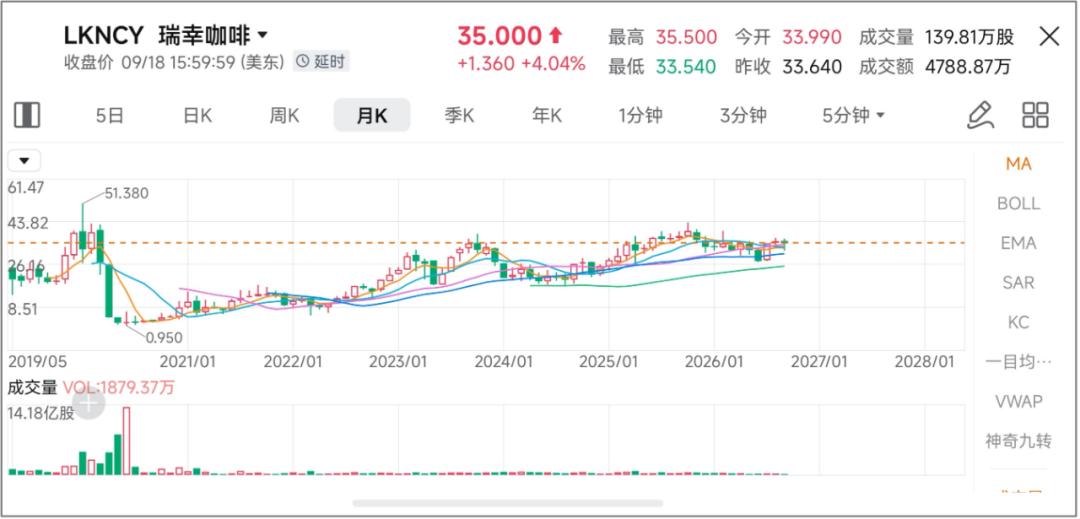
As Luckin's business continued to improve, its share price also rose sharply: the closing price on the delisting day was 1.38 US dollars per ADS; on September 18, 2026, the closing price reached 35 US dollars. Rough calculations show that the increase is more than 25 times.
To deal with the exit of LPs, Centurium Capital has multiple options: selling stocks through the public market or block trades, directly distributing equity to LPs, or "changing cages to free birds" to replace some old LPs with new LPs.
Judging from Centurium's current practice, it has chosen all three paths, but the focus is on the latter two. The recent cooperation with Mubadala is to sell a total of 241 million preferred share rights and interests of some old LPs to Mubadala, and Centurium Capital, as the GP, continues to manage this part of the rights and interests.
Mubadala is not a short-term financial investor, but a strategic investor. Through this operation, Centurium Capital is still firmly emphasizing one thing: it is long-term bullish on Luckin Coffee's business model and development prospects.
For Li Hui and his founded Centurium Capital, Luckin Coffee has become a special existence of extraordinary significance.
Centurium Capital is the starting point for Li Hui to end his more than 10-year career in foreign PE institutions and start his own business, positioned as a "new generation of local PE".
Luckin Coffee was the first project invested by Centurium Capital, and was once its representative work. The Luckin financial fraud incident not once brought shame to Centurium Capital's reputation, but also seriously affected the fundraising pace of its second US dollar fund.
Pick yourself up from where you fell. Now, Luckin Coffee, which ranks first in both store number and revenue scale in China, is the representative work of Centurium Capital that has endured hardships and made a remarkable turnaround, and is the best proof of its professional vision and ability.
Up to now, it seems that no one expects Luckin Coffee to successfully IPO again more than Centurium Capital.
Luckin's open strategy: globalization and corporate governance
It is reasonable for Luckin Coffee to plan to restart its IPO at this stage. As early as the Q3 2024 earnings call, Luckin's management responded to external concerns, saying that it would continue to pay attention to the US capital market, but there was no specific timetable for returning to the US main board for listing.
But to restart the IPO, Luckin needs a new growth story, a healthier corporate governance structure, and long-term capital willing to pay for it.
The domestic coffee market is fiercely competitive, and Luckin Coffee's growth rate has slowed down significantly. In Q2 of this year, Luckin's revenue increased by 28.57%, which can be called the lowest record in its history.
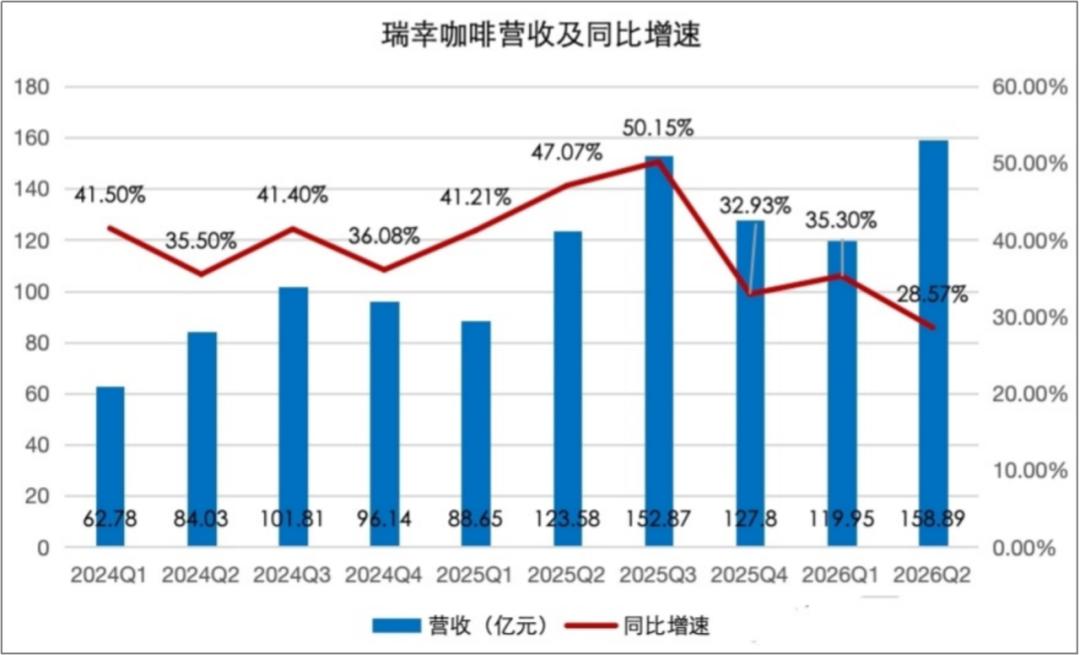
One point worthy of vigilance is that the scale dividend is disappearing. Excluding the growth brought by new stores, the same-store sales growth rate of Luckin Coffee's directly operated stores continues to decline: it was 14.4% during the food delivery war in Q3 2025, and -5.3% in Q2 of this year, which means that the same-store sales growth rate of Luckin's directly operated stores has dropped by nearly 20 percentage points in four quarters.
In order to explore new growth points, Luckin officially went overseas in 2023, with Singapore as its first stop. By the end of Q2 2026, the number of Luckin's overseas stores reached 223, accounting for 0.6% of its total global stores; 46 new stores were added in Q2, including 31 in Malaysia, 7 in Singapore, and 8 in the United States.
At present, Luckin is still in the initial stage overseas, with a very small revenue scale and a much slower store opening speed than in China. But on the other hand, Luckin has huge room for development in overseas markets, and globalization is Luckin's new growth story.
Behind Centurium Capital's introduction of Mubadala to Luckin, globalization is the consensus of the three parties. The head of Mubadala's private equity business in Asia said, "We look forward to working side by side with the Luckin Coffee management team to support the company to start the next stage of growth in China and international markets." Centurium Capital also said, "We believe that Mubadala's profound industry experience, global vision and resource network will help Luckin Coffee continue to innovate and achieve long-term development."
Mubadala's entry into Luckin Coffee's shareholders with 1 billion US dollars is also the first time that Luckin has welcomed a top international sovereign fund as a new strategic shareholder since its delisting after the scandal.
The 2020 financial fraud incident is the biggest scar of Luckin in the capital market. Introducing a top global sovereign fund like Mubadala as a new strategic shareholder has an obvious endorsement effect on repairing Luckin's historical negative label and reducing international capital's concerns about its internal control and compliance.
At the same time, overseas institutional investors prefer listed companies with diversified shareholder structures. Luckin Coffee's equity structure with a single PE holding a high proportion is an obvious shortcoming; it may make institutional investors worry about the independence of its operation and governance, which further affects valuation and subscription willingness.
After the transaction is completed, Mubadala will become the second largest shareholder of Luckin and have the opportunity to appoint a director to the Luckin board of directors. Luckin's shareholder pool will be upgraded from the "local PE holding" situation to a diversified pattern of "local PE + global sovereign fund", which will help optimize corporate governance and enhance confidence in the capital market.
Why the Middle East fund?
Mubadala is a sovereign investment platform wholly owned by the Abu Dhabi government, with current assets under management of about 385 billion US dollars, and is a typical industrial sovereign fund in the Middle East.
In the global capital market, Mubadala is a force that cannot be ignored. As early as 2015, Mubadala entered China and opened an office in China in 2023.
During the years of low-key operation in China, although Mubadala's name is not widely known, it has successively invested in many well-known projects, including Meituan, Kuaishou, BOSS Zhipin, XPeng Motors, etc. SHEIN, which recently went public, has also received investment from Mubadala.
In addition to the consumer track, Mubadala has also made in-depth layouts in China's technology fields such as AI, chips, and cloud computing; in the biomedical track, it has also successively invested in businesses such as Hissen Biopharma and UCB China.
In terms of investment style, Mubadala does not simply pursue short-term financial returns, but seeks high-quality industrial targets to share the growth dividend of Chinese enterprises, and at the same time, with the help of the globalization capabilities of Chinese enterprises, achieves Abu Dhabi's diversified transformation goals.
In other words, relying on oil wealth to promote Abu Dhabi to get rid of the shackles of a single energy economy is the underlying logic of Mubadala.
In fact, Mubadala is a microcosm of the current Middle East capital. Geopolitical risks and the strategic need for the Middle East economy to "transform away from oil" are driving Middle East funds to accelerate their eastward expansion.
According to data from Global SWF, the proportion of asset allocation of Middle East funds to the Asia-Pacific region has increased significantly. In particular, the Public Investment Fund of Saudi Arabia and the Abu Dhabi Investment Authority have shown a clear strategic shift between 2024 and 2026: from traditional European and American real estate and bonds to more active equity and industrial investment in the Asia-Pacific (especially China).
By the end of Q1 2026, the two top Middle East sovereign funds, the Abu Dhabi Investment Authority and the Kuwait Investment Authority, held a total of heavy A-share positions worth 21.762 billion yuan, a year-on-year increase of about 141.48%.
In the Hong Kong stock market, Middle East sovereign funds have also become an important "strategic ballast". Data shows that in Q1 2026, the participation ratio of Middle East sovereign funds as cornerstone investors in Hong Kong stock IPOs rose from 18.5% in 2024 to 38.8%.
