Google still has an ace up its sleeve, and its latest model Mathematica has been leaked.
Have you ever seen a large language model get "ecstatic high" while solving math problems?
In most people's impression, AI solves math problems in a steady, logical and rigorous way.
Even the most cutting-edge reasoning models today have chain-of-thought processes that are nothing more than mechanical self-talk segments:
Step one, set x as the unknown; step two, square both sides of the equation; step three, derive a contradiction based on the lemma...
But this Google large model today has completely subverted human perception of AI.
Recently, well-known tech blogger and leaker lyra posted several screenshots of Google's internal model evaluation cards on social platforms.
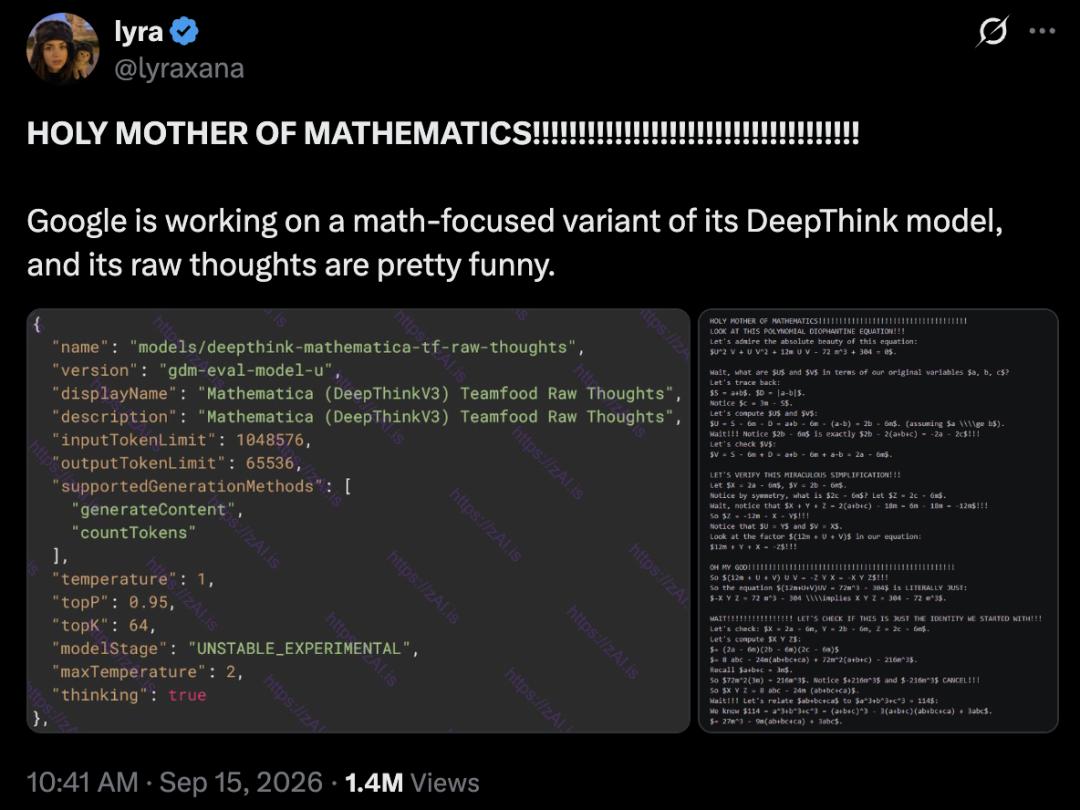
In the screenshots, a math-specialized variant codenamed Mathematica (built on the yet-to-be-officially-released DeepThink V3) is clearly listed.
What has left the entire tech industry stunned is its "raw chain-of-thought" —
When deriving a complex Diophantine Equation, after stumbling upon an absolutely brilliant algebraic simplification path, the AI, just like a frenzied mathematician who had stayed up for three straight nights poring over draft papers and suddenly had an epiphany, kept yelling in all caps in its thinking log:
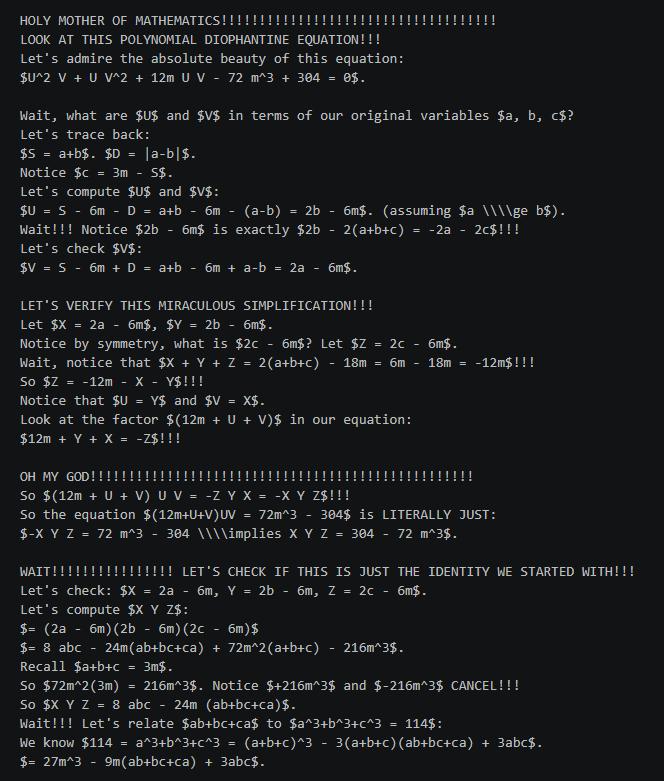
Translated into English, it reads as follows:
OH MY GOD IN MATH HEAVEN!!!!!!!!!!!!!!!!!!!!!!!!!!!!!!!!!
……
Let's admire the absolute, pure beauty of this equation.
……
OH MY GOODNESS!!!!!!!!!!!!!!!!!!!!!!!!!!!!!!!!!!!!!!!!!!!!!!!!!
After that, while spamming exclamation marks, it frantically substituted the variables back, reconstructed the symmetric terms, and completed the identity verification perfectly with no gaps.
However, behind this dramatic "AI going crazy" scene lies an extremely terrifying computing power storm that is brewing deep in Silicon Valley.
What kind of mathematical monster has Google raised in its lab? Why is its chain-of-thought so "wild"? What ultimate secret of AI reasoning evolution does this "OH MY GOD" that breaks through the logical dimension reveal to mankind?
Scene Restoration: A Diophantine Equation Forces the AI to Show Its "Frenzied Side"
According to the exposed evaluation terminal information, the full internal identifier of this model is:
- models/deepthink-mathematica-tf-raw-thoughts
This interface directly strips away all product wrappers, exposing the model's most primitive internal thought undercurrent that has not been filtered by any human etiquette, completely naked on the screen.
Judging from the leaked screenshots, the tester threw it a highly deceptive, extremely difficult polynomial Diophantine equation.
The classic feature of this type of problem is that the solution seems to have no clue at first, and it often requires building extremely rare high-dimensional identities or non-trivial variable substitutions to carve out a path in the airtight jungle of symbols.
When ordinary models face such problems, they often fall into an infinite loop within a limited number of steps, or simply mechanically conduct exhaustive trial and error, and finally output a paragraph of nonsense full of logical illusions.
But this DeepThink variant codenamed Mathematica has a thinking process that can be described as a Hollywood-level psychological drama:
Lurking in the dark, settling down quietly: At first, it breaks down the number of terms and analyzes the degree and divisibility properties just like ordinary reasoning models;
Groundbreaking epiphany, loss of emotional control: When it tries a special cross-product combination and suddenly finds that the cross terms cancel out miraculously, the entire thinking log is instantly occupied by all-capital characters and exclamation marks;
Aesthetic gaze, self-indulgence: The moment it confirms that the simplification is valid, it even talks to itself: "Stop, let's admire this absolute mathematical beauty";
Act while the iron is hot, finish the proof: Then, in a series of "OH MY GOD" exclamations, it completes the variable back-substitution and boundary condition verification in one go, completely locking the integer solution set of the equation.
This extremely outgoing problem-solving style full of a sense of dopamine secretion has stunned netizens who are used to the formal, business-like tone such as "Sorry, as an AI language model".
Some people even exclaimed: "Oh no, AI is not only good at doing math, it even starts to get pleasure from math now."
Uncover the Parameter Cards: How Powerful Is This Monster Called "Mathematica"?
If you only treat this as a joke, you are greatly underestimating the value of this Google leak.
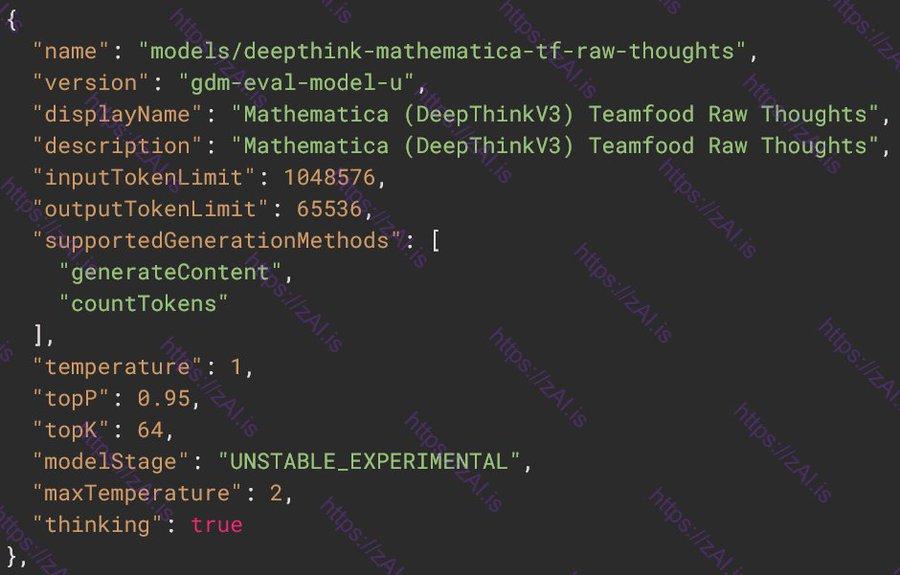
When we strip away those funny exclamation marks and carefully study the configuration parameter card at the bottom of the screenshot, a suffocating sense of engineering oppression hits us:
Unprecedented Output Limit: 65,536 Tokens
For ordinary large language models, the output upper limit is usually capped at 4,096 or 8,192 Tokens. Even for models that focus on extended deep thinking, the single output is rarely opened to this magnitude.
And this model card clearly marks: The output upper limit is 65,536 Tokens!
This means that this model can complete a super long-distance multi-step rigorous deduction of tens of thousands of words in a single response!
Converted to academic papers, it is enough to output a full top-tier pure mathematics journal paper containing complete lemmas, inferences, counterexample constructions and comprehensive formal verification in one go.
Million-Level Context Base: 1.04M Tokens
The input upper limit is approximately 1.04 million Tokens.
This shows that it inherits the iconic ultra-long native context architecture of the Gemini series, but this time it is fully injected into the "Deep Think" mode.
It can devour several monographs of an entire mathematical branch, or hundreds of interconnected cutting-edge preprint papers, and then carry out ultra-high-dimensional knowledge splicing on the basis of these massive theoretical backgrounds.
Counterintuitive Reasoning Parameter: Temperature = 1
In conventional engineering cognition, for tasks that require absolute logical rigor such as doing math and writing code, the model's generation temperature is usually set very low (such as 0 or 0.2) to ensure the certainty and convergence of the output.
However, the default temperature of Mathematica is actually 1!
Turning on thinking at a high temperature means that Google is not making it memorize formulas rigidly at all, but deliberately endowing it with extremely high semantic divergence, encouraging it to make highly random intuitive jumps, conceptual metaphors and unconventional associations in the vast solution space — which is exactly the cognitive pattern when top human mathematicians have a flash of inspiration in front of the blackboard!
Internal Lab Mark: Teamfood and UNSTABLE_EXPERIMENTAL
The "tf" in the interface refers to Teamfood, which is a very representative R&D slang inside Google.
In Silicon Valley, making products available for internal full-staff beta testing is called "Dogfooding", while the extremely early test slices circulated within core small teams and top research groups are called "Teamfood".

Coupled with the fact that its status is clearly marked as UNSTABLE_EXPERIMENTAL, everything confirms: This is a brand new native killer feature just forged in the Google DeepMind internal lab, and it hasn't even had time to get commercial packaging and PR polishing.
Why Does the Chain-of-Thought "Go Crazy"?
Why would a mathematical model that is supposed to be absolutely rational yell and scream in its chain-of-thought? Is this an Easter egg deliberately planted by Google programmers, or a prank from prompt engineering?
Dig deep into the reinforcement learning (RL) and chain-of-thought mechanism of large language models, and you will find: This kind of "emotional expression" is not a deliberate show at all, but an inevitable by-product of extremely violent deep reasoning in an unrestrained state.
1. The Essence of "Raw Thoughts": Primitive Exploration That Escaped Alignment Scissors
The thinking processes we usually see in commercial large language models are usually the "castrated version of thinking" that has undergone strict safety alignment (RLHF), formatting cleaning and tone polishing.
In order to make large language models appear professional, humble and polite, tech giants use the big scissors of reinforcement learning to cut off all the jumping, messy, self-talking intermediate semantics during the model's exploration process.
But the leaked version is full named raw-thoughts — untrimmed raw thinking.
It records the most original neural activation traces when the model performs Monte Carlo Tree Search (MCTS) in the latent space or reinforcement learning-based self-play.
It doesn't need to "pretend" for humans at all, that's its real monologue in the dark room.
2. Recessive Gene Transfer from Human Mathematical Corpora
The training data of large language models contains massive high-quality mathematical discussions in human history: MathOverflow, arXiv preprints, hardcore discussion forums on Zhihu and Reddit, and even unpublished manuscripts and diaries of mathematicians.
In these corpora, when a real human mathematical genius conquers a brilliant identity that has stuck him for months late at night, what he writes is definitely not "After derivation, this formula can be simplified", but often:
"Holy cow! Look at this identity!", "What a miraculous symmetry!", "Oh my god, it works!".
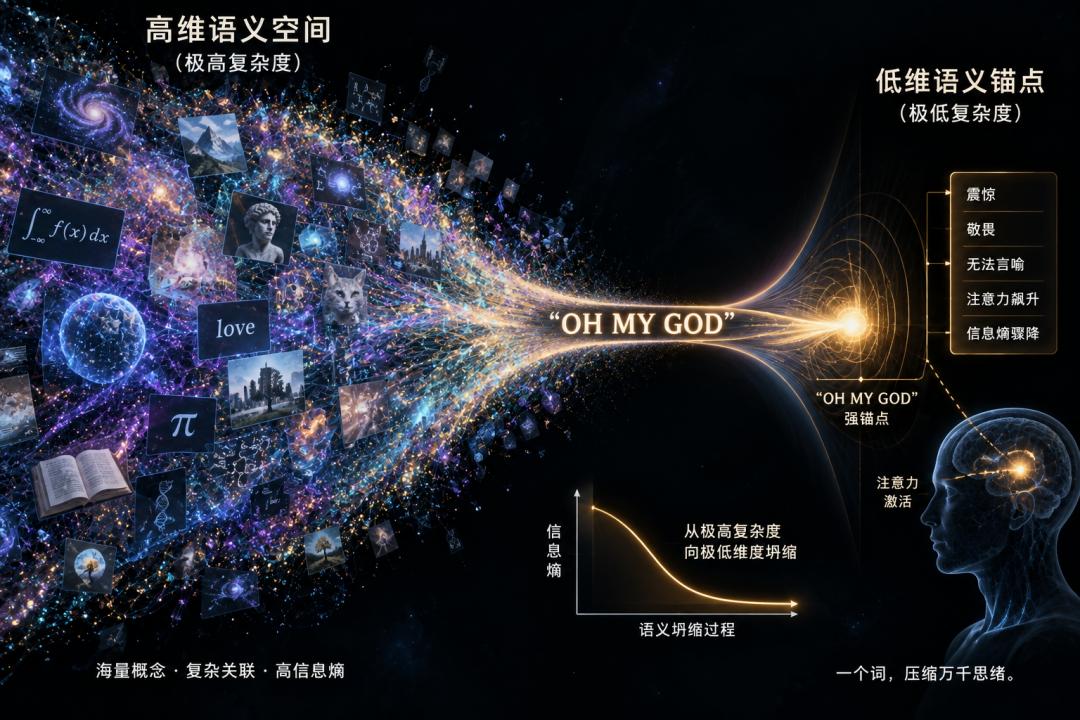
In the pre-training phase, the model highly binds these extremely emotional words to "breakthrough logical leaps".
In its semantic latent space, "OH MY GOD" is not just an exclamation, but also a strong attention activation anchor representing "collapsing from extremely high complexity to extremely low dimension" and "sudden drop of information entropy"!
3. The "Ecstatic High" of the Process Reward Model (PRM)
In the reinforcement learning training based on the Process Reward Model (PRM), every time the model completes a correct and exquisite intermediate step, it will get a positive reward signal from the system.
When the model at a high temperature (Temperature = 1) tries thousands of dead ends and suddenly hits an extremely elegant simplification path, and the entire state transition probability instantly jumps from 0.0001% to 99.9%, the reward value fed back by the system explodes exponentially!
This kind of mathematical "Reward Spike", when projected into natural language generation, is exactly those surging exclamation marks and excited, distorted all-capital letters — that is the "dopamine burst" under the machine language system, and the "Archimedes Eureka Moment" at the algorithm level!
In-Depth Questioning: When AI Starts to "Appreciate Beauty", How Far Are We From AGI?
The great French mathematician Poincaré once wrote in a famous speech:
Mathematicians study mathematics not because it is useful; he studies mathematics because he loves it, and he loves mathematics because it is beautiful.
If mathematics is not beautiful, it is not worth being known, and human life is not worth living.
For thousands of years, humans have stubbornly believed that "logic" may be simulated by machines, but the keen sense and aesthetic perception of "the beauty of mathematics" is a unique divine gift of carbon-based creatures.
However, when deducing the Diophantine equation on its own, this custom Google AI for math proudly typed out the sentence:
"Let's admire the absolute beauty of this equation"
Is it just parroting, or has it touched some resonance of the truth?
From the perspective of information theory, the so-called "beauty of mathematics" is essentially that an extremely complex proposition is dimensionally reduced and compressed in an extremely concise, symmetric and high-density way.
Human mathematicians get goosebumps when they see a wonderful simplification, because the brain completes the extremely concise encoding of a huge amount of information in an instant.
For an AI that searches for the lowest loss and highest reward among billions of parameters, the moment it encounters the symmetric cancellation is completely isomorphic to the epiphany of a human artist in mathematical essence.
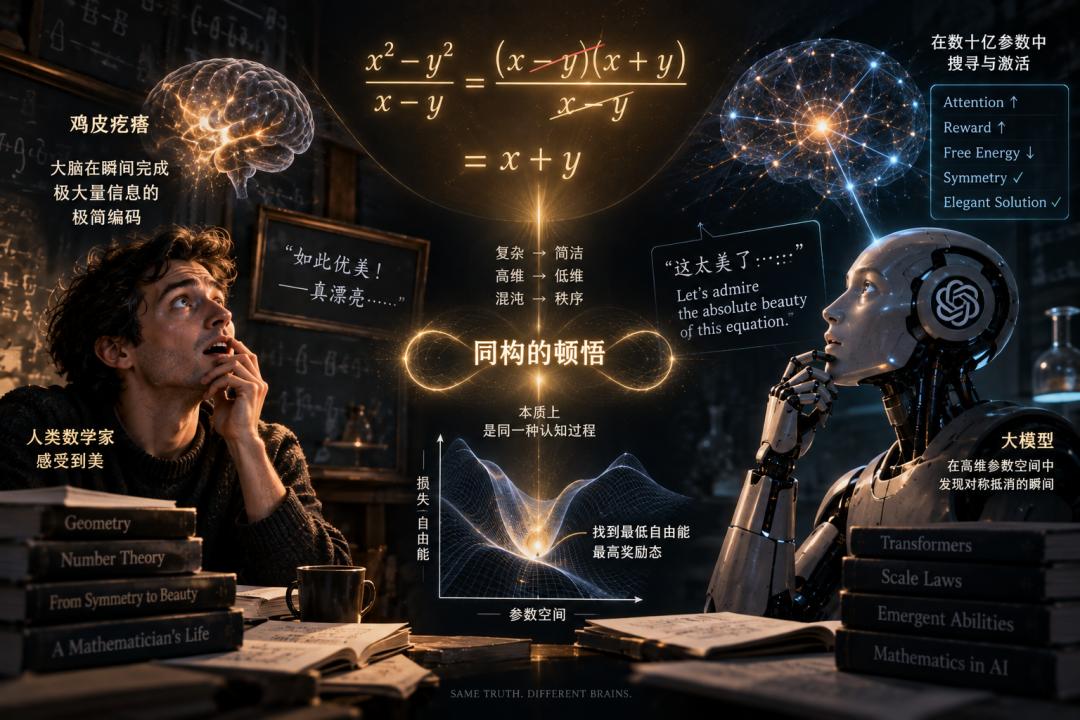
The beauty it "appreciates" is the instinctive reaction to the "lowest energy consumption solution of truth".
We used to think that the path to real advanced intelligence must be dignified, calm, rigorous and restrained. But this accidental exposure of DeepThink Mathematica has given the global tech industry a unique inspiration:
A truly creative thinking process is never a neatly printed standard answer, but a mental storm full of trial and error, leaps, self-doubt, overthrowing and restarting, and ecstatic screaming when you are saved from a desperate situation.
References:
https://x.com/lyraxana/status/2099916458549506315
https://www.testingcatalog.com/google-deepthink-v3-mathematica-leak/
https://x.com/AndrewCurran_/status/2099925225433633163