I am in Kazakhstan, witnessing the massive overseas expansion of Chinese enterprises.
In August of summer, on the streets of Almaty, a city in southern Kazakhstan, "delivery riders" can be seen everywhere. Many people deliver takeout on foot, some ride scooters, and a few ride motorcycles. Time moves slowly here, no one is in a hurry, people have enough time to cross the zebra crossing, and car drivers will definitely wait patiently. When drivers look up, they occasionally spot Chery cars passing by and the signboards of Haier home appliances by the roadside. A little further away, they can see the snow-capped peaks of the mountains on the skyline. Almaty is a Central Asian city where you can see snow in summer. In places where we subconsciously assume are deserts, tree-lined paths spread all over the place.
Between the Advances and Retreats of China and Russia
Kazakhstan is a giant among the five Central Asian countries, with an economic volume larger than the sum of the other four. In fact, its land area is more than twice the total area of the other four countries. In terms of attracting foreign investment and foreign exports, Kazakhstan accounts for a 70% share in both metrics among the five countries. The five Central Asian countries are actually an averaged concept, and in terms of economy, it presents a "1+4" structure.
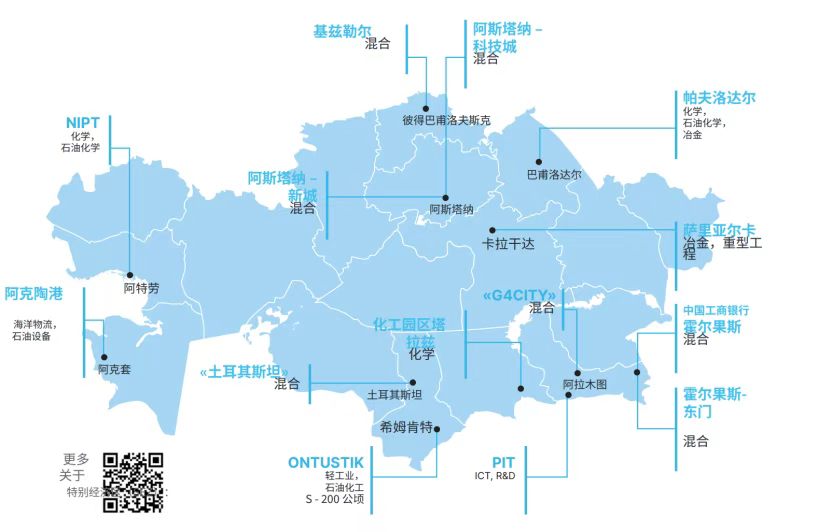
Figure: Economic Distribution of Kazakhstan's 14 Regions (Source: Kazakhstan Investment Guide Report 2024)
Kazakhstan's total trade volume in 2025 was 144 billion U.S. dollars, with a trade surplus of 14 billion U.S. dollars. More than half of the 79 billion U.S. dollars worth of exported goods are crude oil, with Italy being a major buyer. Although its largest trading partner is China, its largest importer and exporter are Russia and Italy respectively.
This three-directional trade structure represents Kazakhstan's unique economic and cultural characteristics. Its traditional economy is highly dependent on Russia, while the current economy is looking east (China) and west (Europe) at the same time.
However, China is breaking this structure, and it is expected to soon become the top country in both import and export trade.
In Kazakhstan's export trade volume in 2025, China lagged behind Italy only by a tiny margin.
In terms of Kazakhstan's import sources, China is rapidly breaking Russia's long-term monopoly. In 2024, Russia accounted for 31% and China accounted for 25%. The two together reached 56%, while Germany, the third largest source, only accounted for 5%. Kazakhstan's import trade proportion has long shown a pattern of two dominant importing countries. The focus of competition is basically on automobiles, electromechanical products and consumer goods, which are China's strong fields. Even though Russia and Kazakhstan have the zero-tariff convenience of the Eurasian Economic Union (EAEU), Russia's economic influence has decreased significantly. In 2025, the proportion of Kazakhstan's imports from China has exceeded 29%; in the first quarter of 2026, China's monthly data has begun to slightly surpass Russia. It is almost a foregone conclusion that China will become Kazakhstan's largest importer for the whole year of 2026.
For Kazakhstan, which has relied on Russian commodity imports for many years, this shift will become a turning point in the supply chain structure. It is also a result of the Kazakh government's deliberate pursuit of "de-Russification". Over the past four years, the ambitions of Central Asian politicians have been accelerating to expand. Uzbekistan has done the most thorough job in "de-Russification", and more than 60% of young people no longer speak Russian. Kazakhstan is following up, and it formally amended the constitution in 2026 to designate Kazakh as the sole national language. Although Russian is still an official language, its status is completely different from before.
However, Russia's influence still has structural solidity. More than half of Kazakhstan's total exports are oil and natural gas, and more than 80% of its exported oil needs to be transported to the Russian Black Sea ports through the Caspian Pipeline Consortium (CPC) pipeline. The transmission effect of the depreciation of the Russian ruble has forced Kazakhstan to accept imported inflation. These lifeblood dependencies are difficult to eliminate in a short period of time.
A Country Obsessed with Cars
Kazakhstan people love cars the most, which is probably inherited from the horse-loving gene of the earliest nomads.
Among the top 5 imported products, three are related to automobiles. The first is complete vehicles, accounting for 4.4%; the fourth is car bodies, accounting for 2.3%; the fifth is auto parts, accounting for 2.2%. The latter two represent the structure of Kazakhstan's automobile industry, where automobile production is completed through CKD large-kit assembly.
JAC Motors has a controlling automobile plant in Kostanay Region in northwestern Kazakhstan, with its partner being Allur, the largest automobile manufacturer in Kazakhstan. No enterprise that produces automobiles here can avoid the influence of local automobile plants. The most amazing thing is that many cars of different brands can be manufactured here. JAC, Chevrolet, BAIC and other brands can all be produced here. A single factory assembles cars of multiple brands, which means the differences between brands are far smaller than what they claim. Kazakhstan's per capita GDP is 14,000 U.S. dollars, slightly higher than that of China, but its car sales are not large. There is no scrapping deadline for local cars, so there are a large number of used cars. The annual new car sales are only 240,000 units, while China's annual new car sales are around 34 million units. The two are not in the same order of magnitude at all.
Kazakhstan is rich in oil, so Chinese electric vehicles cannot gain rapid momentum here as they do in oil-short Uzbekistan. However, fuel vehicles of JAC, Chery, Wuling and Geely have all set up important presences here, and it is believed that they will soon break a gap in the automobile market dominated by Korean brands such as Hyundai and Chevrolet. In fact, electric vehicles of BYD and Li Auto have begun to appear on the streets of the capital Astana. With the accelerated influx of Chinese automobiles, it is entirely possible to reshape the pattern of Kazakhstan's automobile market.
Busy Counting Fish by the Fish Tank
Compared with automobiles, Chinese home appliances have not yet set off a boom in Kazakhstan. The size of Kazakhstan's home appliance market is 1 billion U.S. dollars, about twice that of the Uzbek market. Both countries are basically dominated by Korean home appliance brands. LG's OEM factory in Almaty has been in operation for many years. In 2025, Samsung also completed OEM manufacturing in Kazakhstan through Artel, a leading home appliance giant in Uzbekistan. Korean brands have dug deep trenches here to consolidate their market positions. Chinese home appliance enterprises are basically in a trade-driven form, using FOB terms to let local traders complete customs clearance and distribution through domestic channel networks. Haier is the first to launch a full-frontal attack. Haier has established a physical company in Almaty, showing its determination to take root in the local market around e-commerce, logistics and express delivery, and channel deepening. In the local refrigerator and washing machine sector, Haier ranks third after Samsung and LG.
The home appliance market in Kazakhstan is different from that in Uzbekistan. On the one hand, Kazakhstan is already a member of the WTO, and its market rules are relatively transparent. On the other hand, it has mature large home appliance chain retailers such as Sulpak, which allows brand owners to penetrate into secondary wholesale and retail markets. This is different from Uzbekistan's first-level wholesale market based on the OpenMarket, where gray customs clearance prevents brand owners from effectively controlling prices.
Will there be a sudden opening opportunity in the home appliance markets of Kazakhstan and Uzbekistan? Perhaps Chinese home appliance brands are worth deploying in advance and waiting here.
After the Russia-Ukraine conflict, Western brands withdrew from Russia, leaving a huge gap for Chinese home appliance enterprises. Chinese home appliances quickly filled this gap. Leveraging the advantages of its industrial park, Haier quickly seized this part of the market. When Korean brands somewhat "regretted" and wanted to return to the Russian market, the market had almost become a solid territory for Chinese brands.
Chinese home appliance production bases in Russia are also spilling outwards. Some home appliance brands once took Russian industrial parks as production bases to supply goods to Kazakhstan. However, the situation has reversed. Russia's manufacturing environment has brought unexpected factors. First, a large number of labor forces may be recruited, pushing up labor costs. Second, fully loaded trucks heading to Kazakhstan will go through strict inspections when they re-enter the Russian border on their return trip, which greatly slows down customs clearance and makes truck logistics costs unacceptable. Manufacturing costs in Russia have become extremely high. Many home appliance products that originally went from Russia to Kazakhstan have to be moved back to Xinjiang for manufacturing before being shipped to Central Asian countries again.
In the process of production base shifting, Russia's industrial capacity will be further weakened. The Central Asian wild horses breaking away from Russia's control are galloping on the road of industrialization, with Kazakhstan and Uzbekistan taking the lead. The Central Asian home appliance market is transparent for Chinese enterprises. Chinese home appliance manufacturers are just like people busy counting fish by the bank of a flower port, closely observing and waiting for sudden opportunities.
The market sizes of refrigerators, washing machines, air conditioners and televisions in Kazakhstan and Uzbekistan are all around 300,000 units. The market size of the other three countries (Turkmenistan, Kyrgyzstan, Tajikistan) is small, with an industrial space of only 100,000 to 150,000 units, which does not support setting up independent production sites. Perhaps after Kazakhstan becomes a manufacturing hub, it can radiate to the other four countries. The book *Central Asian Travel Notes* mentions that Kazakhstan has the lowest level of corruption, but this is only compared with the other four Central Asian countries.
Breakthrough in the home appliance sector requires a longer period of penetration. In most Southeast Asian countries such as Vietnam, Indonesia, and Cambodia, sanitary conditions are generally mediocre, and these countries have not experienced long-term economic prosperity. In contrast, Central Asia has experienced the prosperity of the second largest economy in the former Soviet Union. The streets here are generally very clean, and people have a bit of an "old money" attitude towards shopping: they prefer to buy more expensive and better products that can be used for many years. This preference for brands encourages enterprises to operate with a more long-term mindset. For Chinese home appliance enterprises to achieve major breakthroughs in Central Asia, the method of assembling products with imported parts is imperative. The traditional FOB model can hardly really break the barriers of Korean home appliance brands.
In Southeast Asia, the breakthrough of Chinese industries follows a wave relay mode: home appliances first, then mobile phones, and finally automobiles make a strong push. In Central Asia, automobiles will become a breakthrough point earlier than home appliances.
Neighbors Close at Hand, Unfamiliar Business
In 2025, Xinjiang's import and export trade increased by nearly 20%, a growth rate 5 times the average growth rate of China's domestic level. The rise of the Central Asian economy has brought unprecedented opportunities for the development of western China. However, domestic enterprises do not know much about neighbors like Kazakhstan.
Tacheng City in the Kazakh Autonomous Prefecture of Ili, Xinjiang, has the famous Bakhtu Port, facing a port of Kazakhstan. The two national border gates are only 800 meters apart, and 60 kilometers after leaving China via highway is Makanchi City of Kazakhstan. These outbound trucks may travel thousands of kilometers further to Moscow. Tacheng is a key hub connecting Central Asia and continuing northward. Kazakhs account for nearly 20% of the local population, making them the largest ethnic minority here.
However, the population structure of the country on the other side is much more complex. Kazakhstan can be said to be one of the most complex specimens of ethnic integration in the world, gathering more than 100 ethnic groups, most of which are products left over from the Soviet era. The strong political leaders of the former Soviet Union did not care about ethnic differences at all. Thousands of residents from towns in Germany, Poland and other countries would be uprooted like old trees and forcibly transported by train to any land in Kazakhstan.
Kazakhstan's legal system is westward-looking, mainly learning from British law. However, its partners all come from the East. Most Chinese enterprises cannot adapt to the complex requirements for file management and extremely cumbersome document descriptions. Chinese enterprises often classify these relatively low-efficiency mechanisms as bureaucracy and poor business environment. However, this is part of Kazakhstan's state machinery, determined by the completeness of the Western legal system.
Chinese private enterprises often have a strong "boss-centered culture". There are many uncertainties in the authorization of foreign teams that expand business overseas. Most Chinese enterprises going global follow a "rise first then fall" curve: fast at the beginning, then hit setbacks, and finally slow down. At the initial stage, companies are eager to finish 100 things in one year, emphasizing speed all the time. But facts have proved that they all have to slow down eventually. From the overall result, resources are often wasted, and a pile of violation penalties may be incurred. Enterprises' response to risks is mostly emergency handling after incidents, rather than a systematic defense arranged in advance.
Is "slowness equal to weakness"? In Kazakhstan, not replying immediately is a sign of respect, but Chinese employees often feel that delayed reply means being ignored. This is exactly the profound difference in business culture between the two sides.
Chinese enterprises' overseas expansion requires the expansion of the entire industrial ecosystem, but how to integrate into the local economic system is a major challenge.
Chinese enterprises always feel that local suppliers are too slow and too expensive. Therefore, upstream suppliers are also pushed to go overseas together to drive down prices. In fact, in less than two years, Chinese logistics enterprises have significantly reduced the transportation cost of the transit corridor from inland Kazakhstan to the Caspian Sea.
Premature and excessive competition has pushed the logistics industry into a price war before a mature service system is established, and the local ecosystem has also been directly damaged. Many local logistics enterprises that used to operate well are now facing the risk of being eliminated, and local resentment will continue to emerge, breeding dangerous sentiments towards Chinese investment.
As an investment economy that Central Asian countries are increasingly relying on, China needs to spend time guiding the superstructure of these countries. We know too little about Central Asia. The United States, Turkey and South Korea have all made sufficient long-term operations here, far beyond pure commercial activities.
Kyrgyzstan, a country with an annual GDP of only about 20 billion U.S. dollars, barely has business dealings with the United States. 15 years ago, when Chinese enterprises began looking for mineral resources in Kyrgyzstan, they still relied on reports from the website of the United States Geological Survey. These reports contain basic mineral reserves and grades, and some even cover surveys of local folk customs, with very solid intelligence data. On relevant Chinese websites, it is difficult to find such complete data even now, with only fragmented content everywhere.
Many national projects in Uzbekistan have Turkish consulting firms involved. Oligarchy politics is the most suitable soil for the penetration of private think tanks. The strategists around oligarchs often shape half of the national policies. China has almost no penetration in these areas. Language is also a key factor. In Kazakhstan, if you do not speak Kazakh or Russian, you cannot communicate directly with the key figures who hold core power, and perceive each other's real thoughts. Relying purely on translators makes it difficult to build an emotional connection with the local elite circle. Only by making efforts to get familiar with these neighbors can we truly do business well with the countries close to us.
Exploration of Agricultural Resources
Kazakhstan is a large agricultural country, whose main products are wheat, barley, sunflower seeds and flax seeds. China has basically achieved self-sufficiency in wheat and rice, two of the three major staple grains. What China lacks is protein and oil, not cereals. China consumes 120 million tons of soybeans every year, 100 million tons of which are imported. This is a major hidden danger for China's food security. However, the five Central Asian countries and Russia have no advantages in soybean production. China implements quota-based import for cereals such as wheat and corn. Although Kazakhstan's annual wheat output is only 20 million tons, flour import is not a priority for China. The flour imported by China every year is mainly imported through COFCO under quota management. However, Kazakhstan is an important source of wheat flour for pig feed, which is the key market targeted by many trading companies.
In order to encourage the development of the local grain processing industry, Kazakhstan basically offers full tax rebates for the export of finished wheat feed flour, while no tax rebates are provided for the export of raw grain. Many local flour mills and oil mills are small workshop-style operations. Sometimes feed wheat flour is