The former top seller that used to be perpetually out of stock has phased out 11 brands within half a year, and the growth narrative of China's domestic robotic vacuum cleaner industry has come to an end.
The growth dividend of China's domestic robotic vacuum cleaner market is fading, and the pattern where the strong get stronger while the weak are eliminated has taken shape.
"The growth story of China's domestic robotic vacuum cleaner market has come to an end."
This is a judgment made by a fund manager who has long tracked the cleaning appliance industry, and facts have proved that this conclusion is accurate.
Data from AVC shows that in the first half of 2026, 3.09 million robotic vacuum cleaners were sold in China, a decrease of about 149,000 units compared with the same period of the previous year, with retail sales reaching 9.8 billion yuan, a year-on-year drop of 4%. This is the second time that both sales volume and sales value have declined since the first half of 2023.
The chill from the end market has spread to the production side, and brand partners have been the first to suffer. Multiple suppliers of Dreame reported that overdue payments have emerged intensively since the second quarter of this year, ranging from tens of thousands of yuan to tens of millions of yuan, involving core businesses such as robotic vacuum cleaners. Narwal postponed its listing plan and took the initiative to slow down its expansion pace in the first half of the year, leading to a reduction in the number of orders received by its suppliers.
The overall domestic market is shrinking, and upstream manufacturers are under simultaneous pressure. How are the brands performing now?
Domestic sales stagnate, niche players collectively lose momentum
China's domestic robotic vacuum cleaner market has evolved from a stage of flourishing diversity to a brutal clearing phase.
The pressure on the online market is particularly prominent. Data from RUNTO shows that in the first half of 2026, 2.438 million robotic vacuum cleaners were sold online in China, 11.3% less than the same period last year, with retail sales reaching 7.89 billion yuan, a year-on-year decline of 6.7%. In terms of brand performance, the market pattern of "the strong get stronger while the weak are eliminated" has become prominent.
RUNTO data shows that the top 10 domestic brands in the online market account for more than 95% of the total sales share. In the first echelon, Ecovacs ranks first in the robotic vacuum cleaner category with 34.2% of the online share, up 4.3 percentage points year on year.
Ecovacs summarized its growth drivers in its semi-annual report, mainly mentioning the mid-range T90 PRO and T80S dual-star series and the high-end X12 series, while low-end thousand-yuan models such as the N series and the Deebot mini series were not listed as growth engines during the period.
Roborock ranks second with a 26.1% share, with online sales volume increasing by 3.86% year on year. Roborock's financial report for the first half of 2026 discloses that its growth also relies on mid-to-high-end models such as the P20 Max, and the driving effect of low-end models on overall growth has begun to weaken.
Dreame's share fell by 2 percentage points year on year, ranking third with a 12.8% share, with a clear gap from the top two brands, showing a faint trend of falling out of the first echelon due to weak growth. In the second echelon, Xiaomi and Narwal, which focus on the track of liftable mopping pads, account for 8.8% and 6.8% of online sales respectively, both down nearly 7 percentage points year on year.
Brands in the third echelon such as UWANT, DJI, OKP, Haier and MOVA each have a share of no more than 2%, accounting for more than 4% of the market in total.
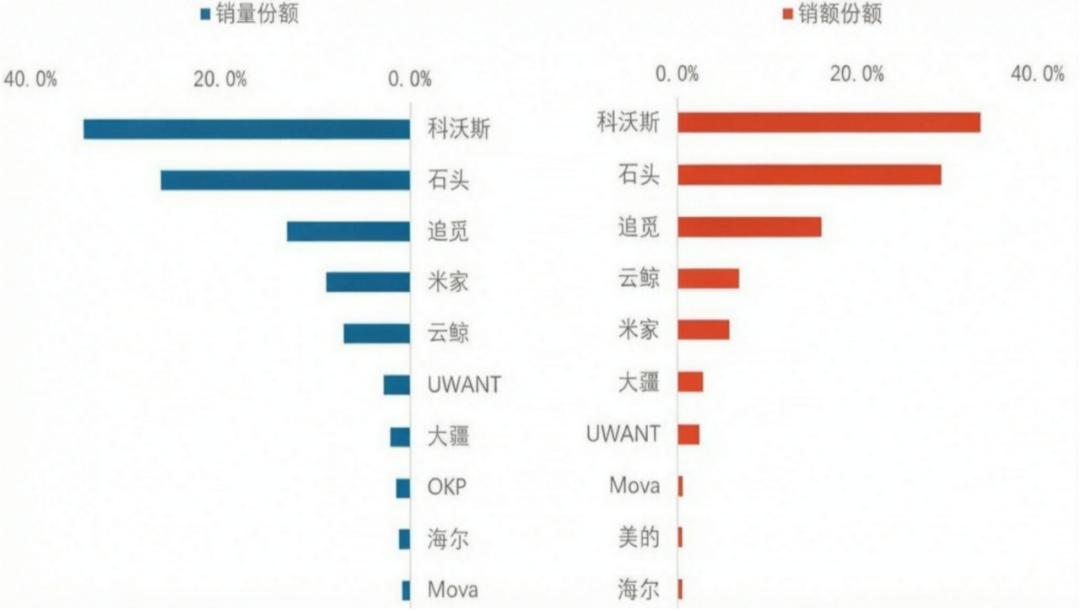
China's online robotic vacuum cleaner market pattern in H1 2026 Image source: RUNTO
The remaining brands share the remaining less than 5% of the market. With the squeeze from head players and the shrinking market, players with weak strength hardly have any chance to breathe.
In just half a year, 11 brands and 73 models have disappeared from the online robotic vacuum cleaner market, and a large number of no-name products and small and medium-sized manufacturers lacking core technologies have been accelerated to be cleared out.
The concentration of market share to super head players and the successive exit of niche players are largely due to the change in consumers' purchasing logic.
Data from China Appliance Network shows that in H1 2026, the sales share of high-end models priced above 4000 yuan rose by 3.4 percentage points; the market share of mid-to-high-end models priced above 3000 yuan increased from 54.0% in the same period of 2025 to 65.0%; while the sales share of entry-level products priced below 2000 yuan fell by 3.9 percentage points, shrinking to 13.9%.
There is a clear signal hidden behind the data: Chinese consumers no longer regard robotic vacuum cleaners as ordinary household appliances that "just need to work", but as smart devices that improve the quality of life. In other words, they are more willing to pay more for products that truly have technological content and upgraded experience.
This means that the domestic market has passed the stage where it is easy to acquire customers simply by competing on price and marketing, and has officially entered the red ocean period of stock competition. Why did the domestic robotic vacuum cleaner market suddenly slow down?
Subsidies recede, the domestic market returns to rationality
Two years ago, robotic vacuum cleaners were the standard equipment for the new middle class and popular items for sharing on social media. Brands such as Ecovacs, Roborock and Dreame once sold out of their products, and Narwal was the dark horse at that time. Official e-commerce campaign reports show that during the 2024 618 shopping festival, Narwal's omni-channel GMV exceeded 800 million yuan, a year-on-year increase of 93%, and its GMV growth rate of robotic vacuum cleaners outperformed Ecovacs, Roborock and Dreame.
Dreame even had a popular star product. During the 2024 Double 11 shopping festival, on JD Mall, a Dreame self-cleaning robotic vacuum cleaner with auto water refill function priced at 7139 yuan and 5712 yuan after subsidy required reservation for purchase.
Xiaomi also had a good performance at that time, its domestic market share reached 13.7% in 2024, which is far better than its current single-digit performance.
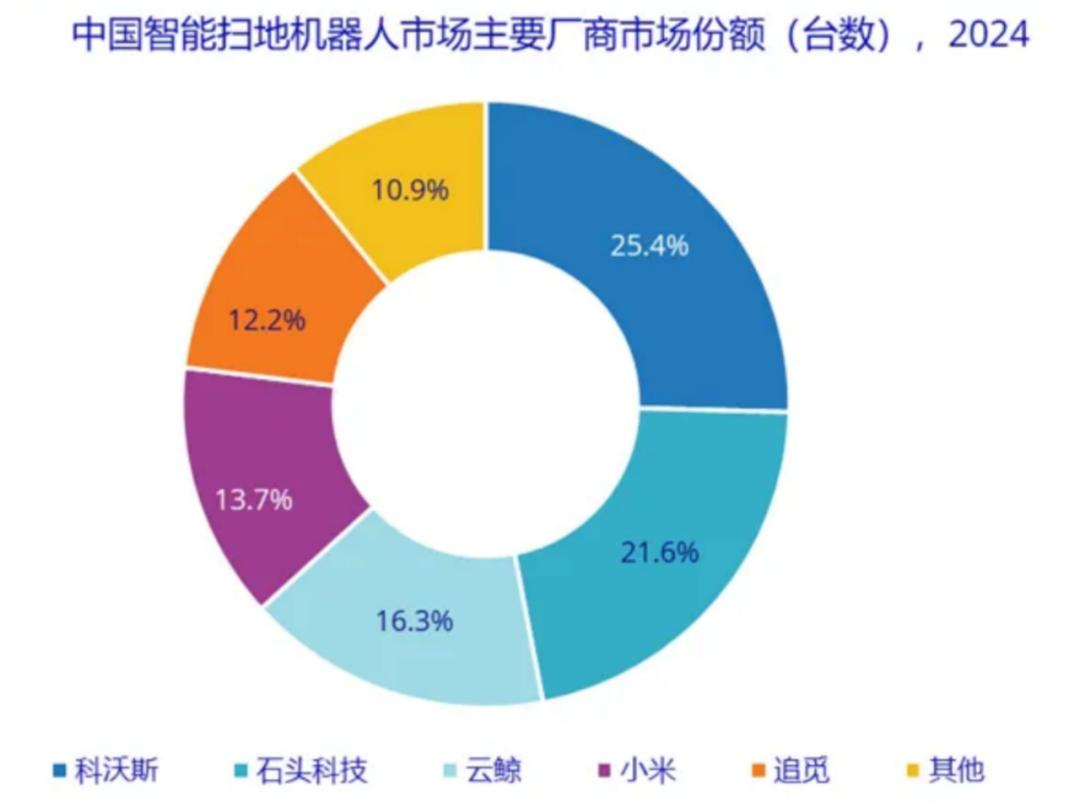
Data source: IDC China
Why did China's robotic vacuum cleaner market suddenly lose growth momentum in 2026?
The first reason is the receding of subsidies, which has advanced the overdraft of market demand.
In July 2024, the trade-in policy was introduced. Although cleaning appliances were not included in the national "8 major categories" of subsidized products, most provinces included robotic vacuum cleaners in the subsidy scope. In that year, the sales of the robotic vacuum cleaner market increased by 41.1% to 19.36 billion yuan.
In 2025, the subsidy scope was further expanded to 12 categories, and many provinces successively included robotic vacuum cleaners in subsidies, with the maximum subsidy amount in Beijing reaching 2000 yuan. Driven by this, the annual sales of robotic vacuum cleaners exceeded 21 billion yuan.
After more than a year of subsidy stimulus, a large number of demand-based and upgrade-oriented users completed their product replacement in advance in 2025.
In the first quarter of 2026, national subsidies were widely suspended across the country, entering a phased gap. The "cliff-like" withdrawal of subsidies directly inhibited the purchase willingness of price-sensitive users, and the new rigid demand was far from filling the gap left by the overdraft in the previous two years. The second reason is insufficient product innovation, so that consumers can't find reasons to replace their old devices.
After years of homogenized competition in the robotic vacuum cleaner industry, explicit hardware parameters such as suction power, body thickness, climbing and obstacle crossing performance have now approached the physical limit. All brands are highly convergent in functions such as navigation, obstacle avoidance and automatic dust collection, and the so-called "technical differences" are almost indistinguishable to the naked eye.
When you open an e-commerce platform, the flagship models of more than a dozen brands are displayed together, priced from 3000 to 5000 yuan, and their function descriptions are all focused on laser navigation, AI obstacle avoidance, automatic dust collection, hot water mopping and other functions, which are not essentially different from those two or three years ago. Parameters are expanding, but there is no substantial breakthrough in usage scenarios. Consumers would rather continue to use their old machines than spend a lot of money on an expensive new machine that performs almost the same as their old one.
The third reason is the penetration bottleneck superimposed with the outbreak of consumer trust crisis. The penetration rate of robotic vacuum cleaners in Chinese households is only 5%-7%, but low penetration does not mean high growth space. At present, the demand in first-tier and second-tier cities tends to be saturated, while the sinking markets such as towns and villages have not been opened due to the high price threshold, and the penetration rate has never been able to break through the inflection point.
Worse still, the trust in head brands is being eroded. Up to now, the total number of complaints about robotic vacuum cleaners on the Black Cat Complaint Platform has exceeded 24,000, of which the cumulative number of complaints against head brands such as Ecovacs, Dreame and Roborock has exceeded 22,000, involving problems such as obstacle avoidance failure, base station malfunction and false battery life labeling, and the after-sales complaint resolution rate of Ecovacs is less than 30%.
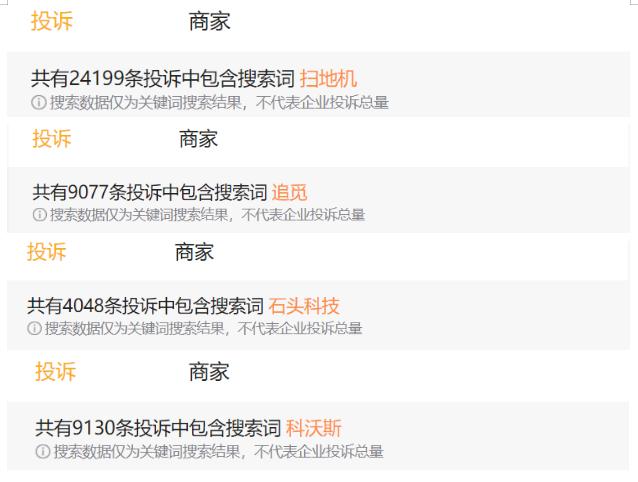
Number of complaints about robotic vacuum cleaners on Black Cat Complaint Platform Image source: Black Cat Complaint
The reduction of subsidy intensity invalidates price elasticity, product homogenization cuts off the channel for the market to generate income independently, and the terminal trust problem amplifies the contradiction between supply and demand, leading to widespread doubts about "high price with low configuration".
Affected by multiple factors, industry consumption has gradually returned to rationality, and the golden era supported by subsidies and traffic has ended.
After the domestic sales dividend faded, Chinese brands began to seek incremental growth overseas. Dreame is the most aggressive brand in overseas expansion in the first half of the year, adhering to the localized operation strategy, and spent tens of millions of dollars on advertising during the Super Bowl commercial break in February to build a high-end brand image.
IDC data shows that in the first quarter of 2026, Dreame's global sales volume exceeded 1.554 million units, a year-on-year increase of nearly 170%, ranking first in both global sales volume and sales value. Its products have entered 120 countries and regions including North America and Eastern Europe.
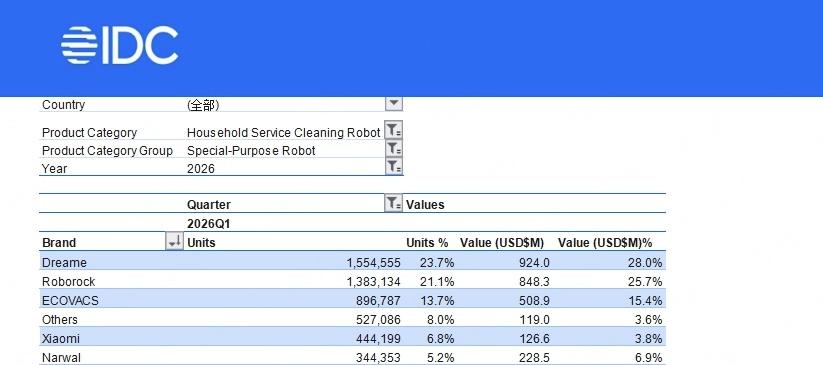
Narwal adopted a differentiated strategy, focusing on the stability performance for large-sized houses in North America, and optimizing carpet cleaning performance in Europe. Its channels shifted from DTC to offline experience, and its products have entered more than 5000 retail stores. In Q1 2026, its global shipment volume reached 344,000 units, ranking fifth, and it signed a B2B order of more than 600 million yuan with the French Groupe SEB. Ecovacs and Roborock are also betting on overseas markets. In the first quarter, Ecovacs' global shipment volume was nearly 900,000 units, 200,000 units more than that of last year.
Roborock sold 1.383 million units, up 40.8% year on year, ranking second in the world with a 21.1% share. During Amazon Prime Day, it won the first place in robotic vacuum cleaner sales in seven countries including the United States, Canada, Germany, the United Kingdom, Spain, the Netherlands and Belgium.
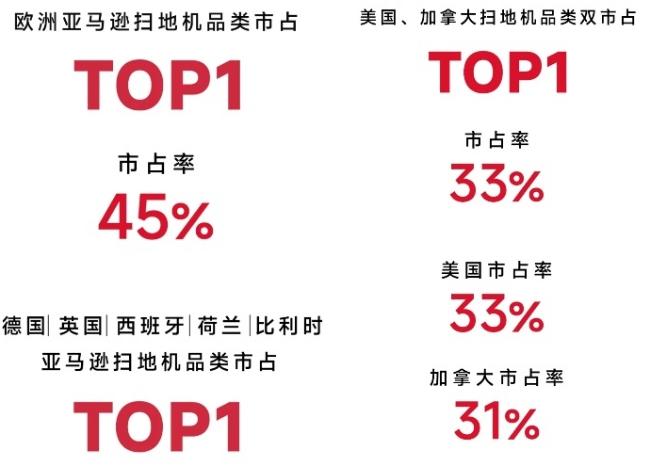
Roborock's performance in overseas markets Image source: Time Weekly
Compared with the involution and contraction in the domestic market, Chinese domestic robotic vacuum cleaner brands have obviously entered a fast growth track in the overseas market.
In the past, overseas markets were catching up with the Chinese market. Now the situation has reversed, and Chinese domestic brands have begun to shift their strategic focus overseas.
The story of overseas expansion
From "advancing triumphantly" to "treading on thin ice"
Chinese manufacturing has dominated the global household robotic vacuum cleaner track.
In the first quarter of 2026, the world's top five robotic vacuum cleaner brands are all from China, and the five brands of Dreame, Roborock, Ecovacs, Xiaomi and Narwal together account for nearly 70% of the market share.
The once prominent overseas veteran robotic vacuum cleaner players such as iRobot, Shark, Neato, Samsung, LG and Philips have now been squeezed out of the first echelon by the top five Chinese brands. Q1 2026 data shows that the total share of these overseas brands has fallen to less than 20%, and some brands have even retreated steadily in the global market, forced to shrink back to their local niche markets.
Chinese players are growing so fast that overseas authorities have begun to build barriers to resist.
At the end of July 2026, the US Federal Communications Commission (FCC) issued Notice No. DA 26-786, officially including "advanced robotic equipment manufactured by foreign entities" into the regulated list.
The defined criteria include: capable of autonomous movement, weighing more than 2kg, with environmental perception and network functions, and equipped with navigation and data collection software, which almost all robotic vacuum cleaners meet.
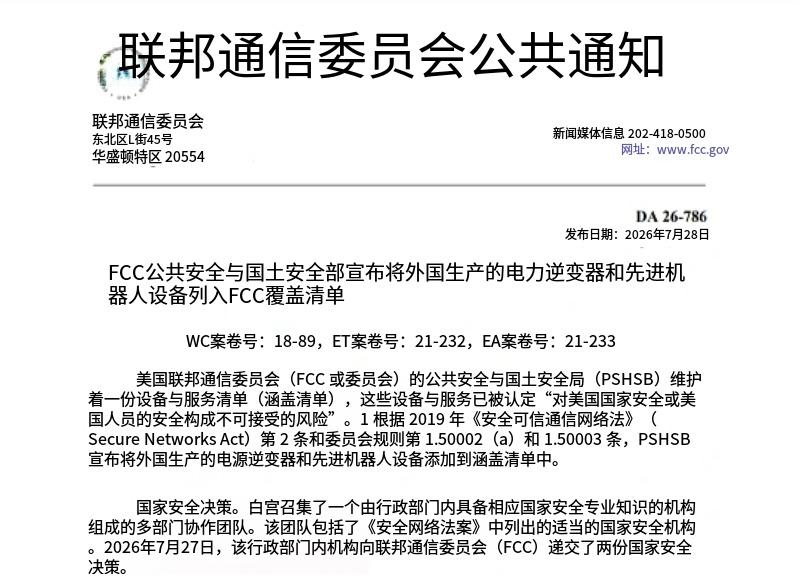
Notice that advanced robotic equipment