Dialogue with Takuzen, Founder of ROTAKU: Role orientation is the absolute definition of humanoid robots | Understanding KNOW-HOW
"Workplace Bonus" (ID: ZhiChangHongLi)
Written by / Jiang Yutian Cover photo / Provided by the interviewee
Aesthetics precedes parameters: Characterization is the absolute definition of humanoid ·01
Either a space company or a humanoid robot enterprise ·02
In the era overflowing with industrial waste, young entrepreneurs will win ·03
Robots should never be sold at extremely low prices · 04
TikTok in the humanoid robot era · 05
Beyond work · 06
The WeChat profile photo of Takuzen, founder of a post-2000s generation robotics company, is the classic smiling photo of Steve Jobs holding the first-generation Apple computer. He grew up in Shenzhen in his childhood, went to Japan to study at the age of 15, first majored in robotics and computer science at a university ranked 4th in Japan in terms of national academic deviation value, then transferred to the University of Wisconsin-Madison in the United States to study computer science, with the reason that "the robotics industry is a very traditional sector that has no intelligence at all".
In 2023, Takuzen worked on a project of large model AI interview digital human. He had no plan to raise financing originally, but was pulled by an intern to fill in a form, and obtained investment from MiraclePlus founded by Lu Qi, becoming one of the youngest invested teams in that year.
After the launch of ChatGPT, he confirmed that "the era of humanoid robots has arrived", and immediately dropped out of school to start his business.
Now, Takuzen's company "ROTAKU" (Zenai, inc.) has a 10-person team. It adheres to full-stack independent R&D of humanoid robots with its own factory without using ODM services, and has also received a large number of orders.
While peers are raising massive capital and pushing the price below 10,000 yuan, Takuzen insists that the industry is "overflowing with industrial waste", and the path of "selling robots at low prices" is wrong. In addition, he has calculated a rather striking figure: the probability of human extinction within 50 years is about 20%.
These judgments determine his work strategies every day.
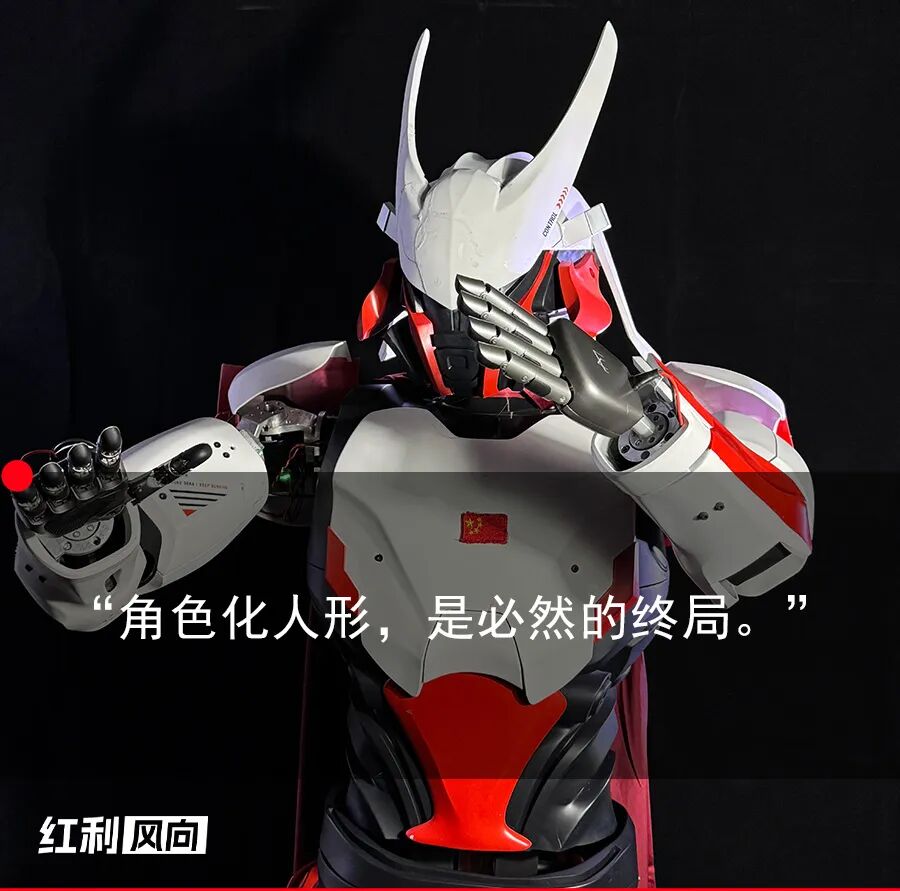
He positions his products as "Character Humanoid" — instead of selling the hardware body, he endows robots with distinct characters. In terms of personality and behavior style, he considers himself "an integration of Japanese culture, Chinese culture and American culture".
The following is the conversation between "Workplace Bonus" and Takuzen, part of the content has been adjusted for editing.
Aesthetics precedes parameters: Characterization is the absolute definition of humanoid
Let's talk about this profile photo first. What about Jobs and Musk impresses you?
Takuzen : They are both people with a rather serious, even pain-driven core personality. When Musk's rockets kept exploding in the first several attempts, he stood alone in the factory staring at the debris — that's the state of him I like the most. People under such huge work pressure use a playful attitude to offset the pain of life. The charm of Jobs lies in his profound understanding of society and human nature, and he expresses his attitude with an extreme level of aesthetics.
Many hardware practitioners follow the logic of "making products cheaper and more user-friendly", don't you agree?
Takuzen : That's far from enough. The premise for Apple to build its own software ecosystem is that the hardware itself is attractive enough. Secondly, hardware products must be an expression of identity. The mobile phone is the most important device on your path of creating value, which largely affects how you perceive the world, so when people use it, it represents a lifestyle and a set of values.
Take a look at Apple Stores: floor-to-ceiling glass, exquisite craft details, they pursue a palace-level experience, all products displayed there look like sacred relics. This makes people feel that the mobile phone is a sacred object rather than a simple tool. The user loyalty formed in this process is impossible for competitors to understand.
Jobs is a person who has real in-depth understanding of aesthetics. You can see that Windows didn't change the sharp window borders to rounded corners until its 11th version. Back when developing Macintosh, engineers kept arguing with him, so he pulled them onto the street and said, look, all the signs in this world have rounded corners. It is these obsessions with details that make people regard mobile phones as sacred objects rather than simple tools.
Many people say Apple is like a Japanese company. I have stayed in Japan since I was 15, and I think Japan is a country developed based on aesthetic awareness. It does not operate through top-down rules. Cities, gardens and interpersonal relationships all spontaneously consider the relative distance between different spots and different people, to reach a state of beauty. The inspiration Jobs gave me is that making products is not to directly show how good it is with parameters, nor to win users purely through tool attributes, but to convey the indescribable, balanced experience value that invites users to immerse themselves in reverie in a split second. I think this is the most important thing for products.
Everyone in this industry is talking about motion capability and dexterous operation, why do you keep emphasizing "character"?
Takuzen : Humanoid robot is the first product in human history that exists in our real world with a "humanoid" form. It is by no means a simple industrial design product. In Japanese architecture, four pillars plus a roof can create a "field"; the same goes for humanoid robots, they form connections with the space and people through tiny head movements and hand movements. The real power of humanoid robots is hidden in the details.
There is a very important concept in Japanese aesthetics called "Ki". In Japanese, "Ki" collocates with verbs to form hundreds of expressions, which is very rare in other cultures. A Japanese architect once said, if you spend the night in the desert, you will want to sleep next to a tree, because the tree creates a field that wraps you up and makes you feel safe. Everything has a field. Humans are social animals that are most easily influenced by the field of other people, so the most important thing for humanoid robots is the field formed by their tiny head movements and hand movements to affect you.
If you don't realize that humanoid robot is not a simple industrial design product, you can't grasp the lifeline of its future development. For us, its interaction model, underlying character model, motion control, and the walking posture it uses, these are the core values of humanoid robots.
The collectible toy market performed very well in the past. An object that can touch people's hearts even when it stays still is in the perfect state. Extreme aesthetics and extreme rational deduction will eventually reach the same destination. There is also the concept of "mono no aware" in Japanese aesthetics, the sense of sorrow for the passing of life, which gives products an emotional depth.
Musk is a person who pushes rationality to the extreme, and at the end of that path, he aims to build multi-planetary civilization; when Japanese aesthetics is pushed to the extreme, it contemplates the issue of life passing. The two paths lead to the same destination in the end.
In your design, what should a "character" be like?
Takuzen : A character must have its own worldview, unique life experience, special way of perceiving the world, precious traits, and also flaws. The glory and shortcomings of human nature, as well as the hardships in life experience, together shape the charm of a character.
Either a space company or a humanoid robot enterprise
Can you talk about how you got the investment from MiraclePlus in detail?
Takuzen : The project at that time used agent digital human to automate B-end interviews: users conduct interviews for enterprises, talk to AI, data is fed back, and AI makes judgments automatically. I had no intention of raising financing at first, the intern found the application form, helped me fill in all the basic information, and said "why not submit it", then I sent the application.
How did Lu Qi evaluate you?
Takuzen : He generally evaluates a person with three dimensions: mental strength, aspiration, and capability. Aspiration refers to your vision, how clearly you can see the future; capability is your basic competence; mental strength refers to how strong your personality is, so that you can go through everything with resilience.
His comment on me was: my aspiration and capability at that stage were at the average level among entrepreneurs, but my mental strength was top-tier. He drew a two-dimensional diagram, the horizontal axis is capability, the vertical axis is aspiration. The top right position is where Jobs and Musk are, and he told me that mental strength is the driving force that pushes you to that position.
What suggestions did he give you?
Takuzen : He thought the market of that project was too small, and suggested me to switch to a larger direction to do something really significant. The MiraclePlus team can assist with direction thinking, but the final path has to be figured out by the founder himself. Later I realized that my life plan is to solve the survival problems of human beings step by step. Because all other problems are derivative, the only problem humans need to solve is survival. All human emotions and desires are secondary goals, secondary desires and secondary needs derived from that core.
His exact words were: don't work on this project anymore, you need to do something extremely huge. I didn't quite get it back then, but later I understood why he said that.
I think entrepreneurship is entirely a process of self-discovery, you have to know who you are. Many entrepreneurs are working on things that are not their destined mission. I found the thing I really want to do only after I figured out what is worth doing.
Why did you finally choose humanoid robots?
Takuzen : At that time I figured it out, I could either start a space company, or a humanoid robot company. The space industry needs to solve problems like automation, energy acquisition in space, infrastructure construction, building atmospheric surface and greenhouse environment on planets, and maintenance of space stations and satellites. Essentially, all these are robotics problems. And humanoid robot is the greatest common divisor: from the perspective of data, long-term environmental adaptability, and data entry, it is the optimal form. So I decided to solve the humanoid robot problem first, and focus on the humanoid track.
Does the judgment that "the probability of human extinction within 50 years is 20%" affect your daily work?
Takuzen : It determines my overall strategies at the macro level. Pure logical deduction leads to the conclusion that the probability of human extinction is so high. So strategically, while considering the market development path, I also think about its connection with the long-term goals, for example, building a platform to enable data flyback circulation and improve model capabilities.
What if this business fails?
Takuzen : Then I will basically go start a space company.
In the era overflowing with industrial waste, young entrepreneurs will win
You have publicly said that "the humanoid robot industry is overflowing with industrial waste", don't your peers take offense at that?
Takuzen : Peers are all mentors and friends to each other, we all pursue cooperation to expand the market, no one will misunderstand that.
In your opinion, what is the real problem with Chinese manufacturing?
Takuzen : China has passed the stage of making products cheap and well-functioning, but there are very few brands that truly occupy users' minds. Now humanoid robots are even sold at prices below 10,000 yuan. New users are very careful when using standard products, but are willing to spend a lot on products that meet high-level demands. The robotics industry is a resource-intensive and engineering-driven sector, and most of the current practitioners are experienced veterans. Young entrepreneurs who represent new trends and new thinking will win in the long run.
Is there any peer that impresses you a lot?
Takuzen : Shouxing Robotics is pretty good, it makes bionic human faces. The batch of products it showcased last time had very well-made human faces. The latest ones feel a little stiff, a bit uncanny valley. Can that very famous robotics company that went viral recently do this well? It's hard to say. If you read the interview of its founder, it doesn't seem like a team that can make great bionic human faces. Bionic human faces require very subtle makeup and temperament, the emotions it conveys can deeply touch people, otherwise it wouldn't have drawn so much public attention online.
From your personal experience, what are the differences between starting a business in China and the US?
Takuzen : Our company was originally founded in San Francisco, but all engineering practitioners will realize: China's advantage in the field of embodied intelligence is that it can deploy on a large scale at extremely low cost to form a data flywheel. We are essentially a Day-one global company, and we will eventually launch our top-tier products to the US, Japan and Europe markets.
Robots should never be sold at extremely low prices
From concept to official launch, what is the hardest part?
Takuzen : It doesn't face intense high-speed motion, but behind it there are problems like wiring harness management, engineering optimization, and thermal management of all motors. It covers engineering, models, design, IP consumer product image, community, large model and embodied model — you need to find a feasible path to form a sustainable economic closed loop.
How do you select the implementation scenarios for humanoid robots? Are there any relevant cases?
Takuzen : Our partners are deeply involved in the catering business, and robots have become part of the service scenario. For example, restaurants used to buy spoons and pots as standard tools, but when humanoid robots are massively embedded in user service processes, they must be combined with the company's IP image.
The logic of SKU goes like this: the automotive industry has roughly 20 to 50 SKUs, the collectible toy industry has thousands of SKUs including Pop Mart. A mature character humanoid robotics company should sit in the middle, with dozens to hundreds of SKUs. Why can't the automotive industry have so many SKUs? The cost of opening a mold is about 3 to 10 billion RMB, and the reusability is very poor. We use reusable hardware structures, AI platforms and end-to-end models to break down the cost structure, so that we can support far more characters. This is the real logic behind character humanoid.
What do you think is the biggest misunderstanding investors have towards you?
Takuzen : Many people think the head effect has already formed, and capital should be concentrated in the top players. But in fact, what we are doing is the character layer and application layer: the world model is the model layer, the hardware body is the middle layer, only when humanoid robot is combined with the character layer can we form a complete product closed loop, capture end users and generate real value. You don't need to win over all investors, you only need to find the investors who truly understand you.
TikTok in the humanoid robot era
Why do humanoid products definitely need characters?
Takuzen : A humanoid product can hardly be a pure mechanical tool, that would feel very weird. In the past, there were only two directions for the imagination of humanoid products: absolute realism, or absolute alienation. The characters in movies are all alienated images, not the state of bionic humans. The long-term expectation of people, plus the verification of the mature market, and the logical closed loop, will definitely lead to the necessity of characters in the end.
You keep mentioning character humanoid.