Irreversible human aging is about to be cracked by AI.
In September 2026, 42 people with an average age of 67 became younger simultaneously on six different clocks.
These clocks are not on the walls, but in their blood.
After taking a drug named rentosertib for four weeks, nearly 3000 proteins in patients were tested, among which 326 showed significant changes. Six sets of models developed by different teams all agreed that their bodies were moving towards a younger direction.
Most of the clocks turned back 3 to 4 years. One of them turned back nearly 6 years.
What is even more incredible is that this drug was developed by AI.
It comes from Insilico Medicine, an AI pharmaceutical company that has been listed on the Hong Kong Stock Exchange and is currently one of the global leaders with the fastest clinical progress in AI drug development. AI helped it identify targets from massive biological data and then design molecules that can act on these targets. Today, rentosertib has entered Phase III clinical trials.
GeekPark interviewed Alex Zhavoronkov, founder of Insilico Medicine. He told us that he publishes an average of one paper every six days.
But when talking about this research, he did not hide his excitement: "This is the most important paper in my life."
In many ancient legends, there is a Fountain of Youth hidden somewhere in the world.
As long as aging people drink the spring water, they can regain their youth and let time flow backward in their bodies again.
For thousands of years, people in different countries have been obsessed with seeking the power of the Fountain of Youth.
The Fountain of Youth has of course never been found.
But this time, in a real human trial, we saw for the first time the traces of where it might have flowed.
01
The age in the blood has been turned back by six years
How old you are this year is a very easy question to answer.
How old your body actually is, is not.
Two people who are both 67 years old, one may run, work and travel every day; the other has suffered from lung disease, diabetes and cardiovascular disease at the same time. They have lived the same length of time on the calendar, but the time inside their bodies has passed completely differently.
Modern medicine can measure almost everything in the human body.
Blood sugar has numbers, tumors have images, and lung function can even be accurate to milliliters. But to this day, doctors still do not have a thermometer that can be inserted into the human body to read exactly "how old a person is".
This is also the reason why anti-aging drugs have always been difficult to prove: it is difficult to wait for people to take anti-aging drugs for half a century to confirm the efficacy.
In the 1950s, scientists began to formally discuss "biological age": the number on the ID card only represents how long a person has been born, and the age in the body should reflect how far he is from weakness, disease and death.
But how to measure this age has troubled researchers for decades.
The real turning point occurred around 2013. Steve Horvath, a professor at UCLA, found that as long as hundreds of chemical markers on DNA that change with age are observed, a person's age can be calculated quite accurately. This method was later called "epigenetic clock".
These clocks do not look at birthdays, but at what is left after time passes through the body.
Tiny markers on DNA, metabolites in blood, and thousands of proteins all change with age. Give AI the data of enough people, and it can guess from a tube of blood: this person's body is more like 50 years old, or 70 years old.
In the past, aging clocks were mainly responsible for telling the time.
On September 8, Insilico Medicine announced that for the first time in one of its drug trials, it saw six clocks moving backward at the same time.
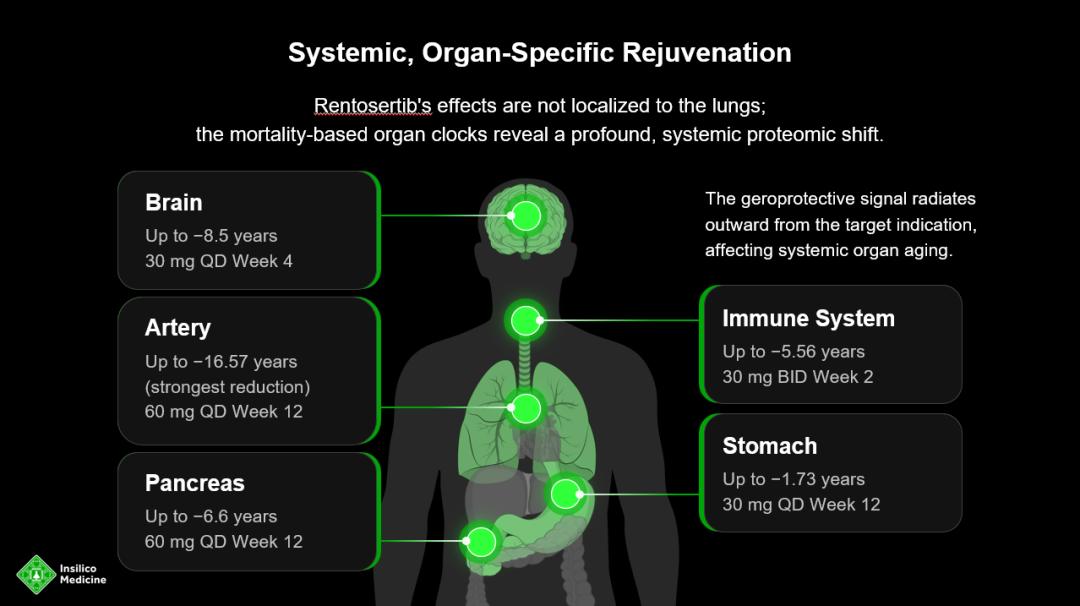
This drug from Insilico Medicine is called rentosertib. Before that, it has always appeared in another identity: a new drug for the treatment of idiopathic pulmonary fibrosis (IPF), which is a TNIK inhibitor.
TNIK can be understood as a biological switch that the drug needs to suppress. It participates in promoting pulmonary fibrosis, causing lung tissue to scar and harden under repeated damage, leading to idiopathic pulmonary fibrosis. Existing drugs usually can only slow down the deterioration, and it is difficult to regain the lost lung function.
And rentosertib has achieved part of it. In the Phase IIa trial completed in China, 71 patients took different doses of rentosertib or placebo for 12 weeks. In the best-performing group, the forced vital capacity increased by an average of 98.4 milliliters. In July this year, this drug officially entered Phase III clinical trials.
But from the very beginning, Insilico Medicine hid a second question in this disease trial:
Can a drug for treating lung disease intervene in aging at the same time?
The researchers collected informed consent for proteomic analysis from 55 patients who completed the trial, 43 signed it, and 1 person was excluded due to missing data at week 12. Finally, 42 people were included in the analysis. They drew blood before treatment and at the 2nd, 4th, and 12th weeks after taking the drug, and a total of 2841 proteins were tested.
Then these data were handed over to six sets of aging clocks developed by different teams.
Some clocks are trained according to actual age, some observe organ status, and others were originally used to estimate the risk of death.
Alex told us that in previous studies, they often talked at cross-purposes. This time, the answers were surprisingly consistent.
At the fourth week of taking the drug, most clocks believed that the predicted biological age of the patients decreased by 3 to 4 years. The maximum number given by one of them was close to 6 years.
Rentosertib was originally intended to prevent a person's lungs from continuing to age. As a result, it seems to have turned back the time in the blood for a while.
Of course, a simpler explanation is: these patients already had severe lung disease. The drug improved the disease and reduced inflammation, and the proteins in the blood naturally became healthier.
The experimental data is a little more interesting: the lungs and the clocks did not select the same group of people.
The group with the most improved lung function was the 60 mg once daily group. The group with the most stable aging signal was the 30 mg twice daily group.
The two groups took the same amount of medicine every day, but the administration method was different. If the aging clock is just another expression of lung function, the two curves should roughly coincide. In fact, they did not.
Another suspicion comes from the evaluation system itself. The aging clock is not the real lifespan. Evaluating drugs with the aging clock can easily make people wonder: is this an exam where the model sets the questions and answers them by itself?
This is why the team chose "six clocks".
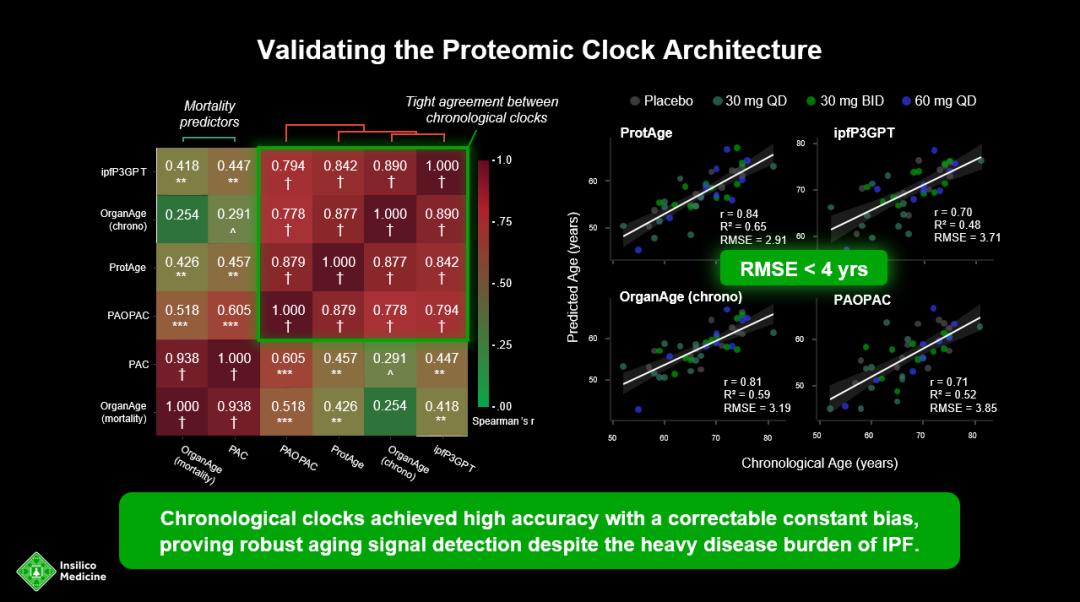
They do not all come from Insilico Medicine, but are developed by different teams from Harvard University, University of Oxford, Peking University, and Insilico respectively. The proteins, algorithms and training targets used are not the same.
If only one clock turns backward, it may just be that the model prefers several proteins that happen to be changed by the drug. When all six clocks turn backward together, it at least shows that they are not seeing the same narrow statistical coincidence.
The paper reviewers also took a step further: all participants were patients with pulmonary fibrosis. How do we know these changes are also related to the aging of normal people?
The researchers found data from more than 55,000 elderly people in the UK Biobank.
These data record how the proteins in the blood of people change little by little during the normal aging process. When the data of rentosertib patients are superimposed, a set of opposite trajectories appears.
Some proteins that usually increase with age begin to decrease after taking the drug; those that originally gradually decrease begin to rise.
They are moving back along the path that aging has traveled.
02
AI has found a way for longevity drugs that does not require waiting for people to die
Why would a lung disease drug measure aging from the very beginning?
The answer actually comes from long before rentosertib was born.
In 1979, Alex Zhavoronkov, founder of Insilico Medicine, was born in Latvia. Since he was a child, he has had a strong obsession with longevity.
In the 1990s, young Alex studied diet, exercise, sleep and various alternative therapies. According to him, he read a lot of "nonsense".
Finally he chose computer science. Aging involves too many genes, proteins, organs and diseases, which is difficult to sort out by the human brain alone.
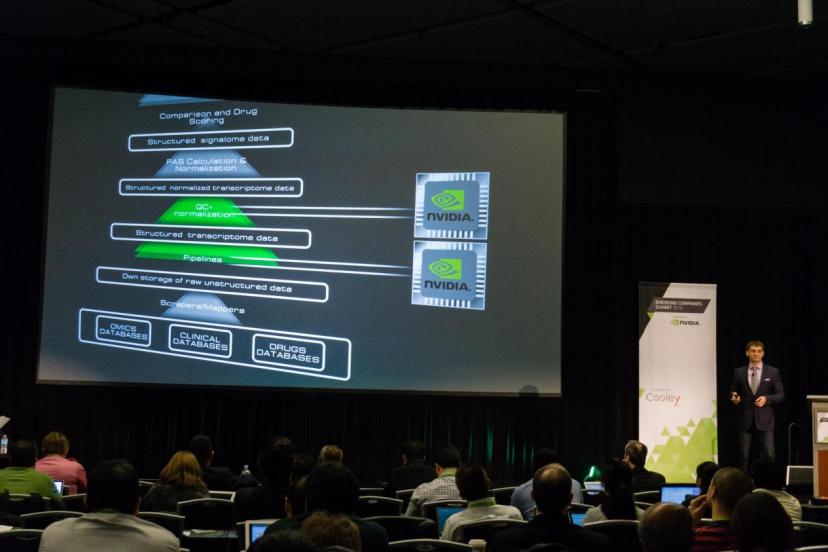
In 2014, he gave a speech at NVIDIA GTC Conference. At that time, most people were concerned about whether deep learning could recognize images and understand human speech.
Alex asked: "Can NVIDIA help solve aging?"
In the same year, he founded Insilico Medicine.
The company was initially more like an algorithm lab for calculating aging. In 2016, Alex and his team collected more than 60,000 physical examination data and trained a set of neural networks. With only 41 indicators such as blood sugar, albumin, urea and red blood cells, AI can guess a person's age with an average error of about 5.5 years. This is one of the earliest human aging clocks based on deep learning.
What really made Insilico Medicine step out of the small circle of longevity research was an experiment three years later.
In 2019, the company used generative AI to design inhibitors for the DDR1 target. The early molecular screening, which usually takes several months or even longer, took AI 21 days.
The researchers synthesized these molecules. Some of them were effective in cell experiments, and one entered mouse experiments. After the paper was published, Forbes directly wrote the title as:
"A startup designed a drug with AI in 21 days."
This title is somewhat exaggerated.
What Insilico completed at that time was mainly early molecular design, which is still far from a real new drug. But it made the outside world intuitively see for the first time that the molecules generated by AI are not just a computer picture.
It can be synthesized and may also function in living organisms.
The so-called AI pharmaceutical industry is ultimately a business of selling molecules.
What pharmaceutical companies buy is not a few grams of powder in a bottle, but the development and commercialization rights of a candidate molecule. This molecule must be synthesizable, patented, experimentally verified, and preferably has taken several steps towards human clinical trials.
In 2021, Fosun Pharma became the first large partner of Insilico Medicine. In 2022, Sanofi reached a $1.2 billion drug R&D cooperation with Insilico Medicine. Later, Insilico Medicine's partners added many large pharmaceutical companies such as Exelixis, Menarini, Servier, Eli Lilly, Novo Nordisk, etc. At the end of 2025, Insilico was listed on the Hong Kong Stock Exchange.
An algorithm team that studied aging clocks has gradually become a listed company that can send candidate drugs into the human body and then sell the development rights to large pharmaceutical companies.
It seems that Alex has finally moved from unrealistic anti-aging to more realistic cancer, fibrosis and metabolic diseases.
In fact, he never left.
Alex told us that among Insilico's about 40 drug projects, at least half started with treating diseases and are related to aging in different ways.
Rentosertib is one of the most important ones.
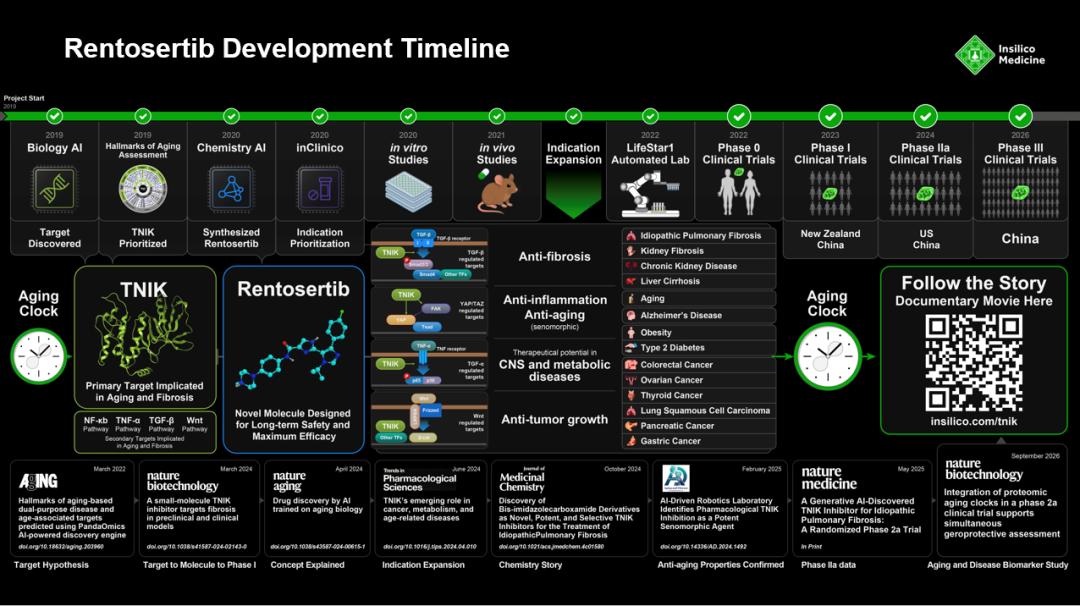
Insilico initially noticed TNIK not only because of the lungs. It also appears in age-related processes such as inflammation, cellular senescence and fibrosis.
IPF, a disease that mainly affects the elderly, lacks therapies that can truly reverse the disease, and at the same time has a very clear clinical figure: how much air the patient can inhale can be measured by vital capacity.
It doesn't have to wait for decades to see if the drug works.
After a few months, you can see the direction.
Therefore, rentosertib has had two identities from the very beginning.
In the clinical registration, it is a drug for pulmonary fibrosis; in Alex's original vision, it is an anti-aging candidate that affects the human body by regulating lung diseases.
And with the release of this paper, Alex believes that a meaningful phased achievement has finally emerged.
03
Let the disease business support longevity research
To this day, no drug has been proven to extend human life by one year by changing aging itself.
The first problem faced by longevity research is not even how to extend life, but how to send a drug into the human body.
Before a new drug enters clinical trials, it must state what disease it treats, which patients to recruit, and what results count as effective. But "aging" is not an indication with a clear approval path, nor is there a clinical endpoint recognized by regulatory agencies that can read results within a few years.
You can study aging, but it is difficult to write "treating aging" into a new drug application.
In the past, researchers usually looked for life-extending effects from already approved old drugs. Rapamycin was originally used for organ transplantation, and metformin was originally used to treat diabetes. They have been taken by a large number of patients for many years, so it is easier to find human clues.
But most of these drugs have lost patent protection.
Even if the experiment is successful, any pharmaceutical factory can produce generic drugs. Few companies are willing to spend hundreds of millions of dollars and then spend decades verifying it for everyone.
Calico and Altos Labs chose another way: spend billions of dollars to pay for the lengthy longevity research.
Alex believes that rentosertib shows a third possibility.
It did not take off the shackles, but tried to dance with the shackles on.

First, find targets from human aging data, use