GLP-1 Market Undergoes a Seismic Shift: The Weight-loss Drug War No Longer Competes Around Weight Loss Efficacy
A drug that has been called the "weight loss injection" for many years is quietly redefining its identity.
Recently, Novo Nordisk's Wegovy (semaglutide, Chinese brand name Rybelsus) has been approved in China for the treatment of non-cirrhotic adult MASH patients with moderate to severe liver fibrosis (stage F2-F3).
This is the first GLP-1 receptor agonist approved in China for the treatment of MASH.
It should be noted that for ordinary consumers, the most prominent label of Wegovy is still the "weight loss injection".
However, in the hands of pharmaceutical companies, the applicable scope of this drug is expanding rapidly.
In December 2025, Wegovy has obtained the cardiovascular indication in China, which is used to reduce the risk of major adverse cardiovascular events in adult patients with confirmed cardiovascular disease and a BMI of ≥27kg/㎡.
Earlier, in December 2024, the US FDA approved Zepbound (tirzepatide) for the treatment of moderate to severe obstructive sleep apnea in adults with obesity.
In 2026, Eli Lilly's next-generation triple-target drug retatrutide is being studied in multiple directions including obesity, type 2 diabetes, sleep apnea, knee osteoarthritis pain, and cardiorenal outcomes.
In the past period of time, the most intense competition for GLP-1 also focused on weight loss rate, 10%, 15%, 20%... Every percentage point may become the most prominent selling point of a new drug.
Nowadays, the record of weight loss rate is still being refreshed, and the competition arena has changed.
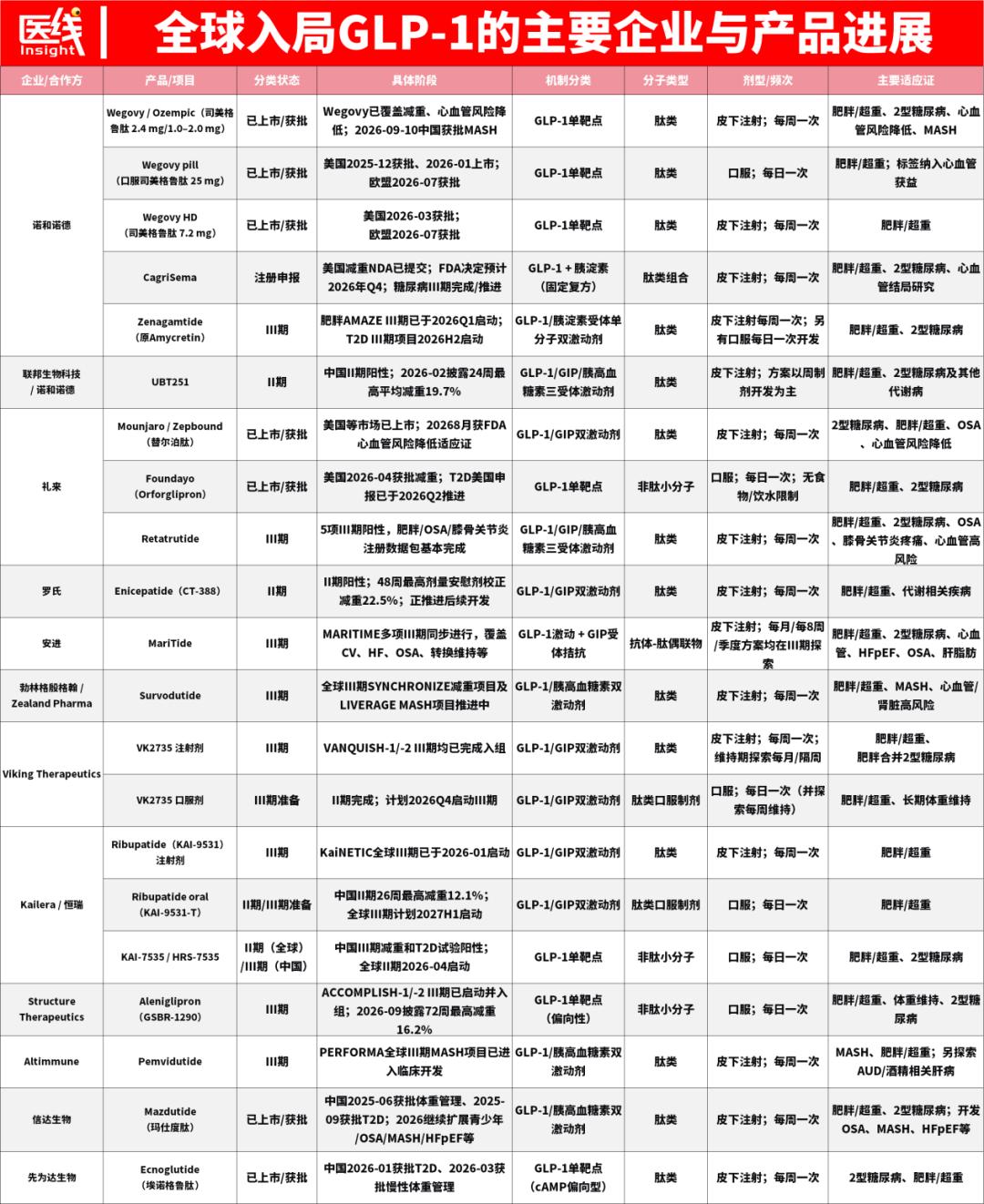
GLP-1 Inflection Point: When Weight Loss Rate No Longer Determines Everything
The previous stage of GLP-1 competition focused on continuously pushing up the weight loss rate.
The STEP 1 study published in the New England Journal of Medicine in 2021 showed that among overweight or obese adults without diabetes, after 68 weeks of treatment with 2.4mg semaglutide, the average weight loss was 14.9%, while the placebo group lost 2.4%.
More than a year later, the SURMOUNT-1 study of tirzepatide pushed the figure up by a large margin. After 72 weeks of treatment with the 15mg dose, the average weight loss was 20.9%, and the 10mg group had an average weight loss of 19.5%.
20% is still not the end point.
Eli Lilly first disclosed in May 2026, and further released the Phase III TRIUMPH-1 data in June, showing that calculated according to the efficacy estimand, the average weight loss of the retatrutide 12mg group at 80 weeks was 28.3%; if calculated according to the treatment-regimen estimand, the figure was 25.0%.
Ten years ago, it was hard to imagine that pharmaceutical weight loss could reach such a range.
Of course, a simple equal sign cannot be drawn between these numbers. There are differences in population characteristics, treatment courses, doses, endpoints, and statistical estimation methods across different studies, so it is not rigorous to directly convert them into the "combat effectiveness" of weight loss drugs.
But the trend is clear enough.
The competition for pharmaceutical weight loss is no longer satisfied with crossing the clinical significance threshold of about 5%, but has entered the competition of weight loss amplitude of 15%, 20% or even higher.
Chinese companies have also quickly joined the competition.
In the Phase III trial disclosed by Hansoh Pharmaceutical in 2026, the GLP-1/GIP dual receptor agonist Olatorepatide achieved a maximum average weight loss of 19.3% after 48 weeks of treatment, and its NDA for weight loss indication has been accepted by the National Medical Products Administration (NMPA) in June.
UBT251, a GLP-1/GIP/GCG triple-target drug jointly developed by Federal Biotech, a subsidiary of Federal Pharmaceutical, and Novo Nordisk, achieved a maximum average weight loss of 19.7% after 24 weeks of treatment in a Chinese Phase II trial.
Similarly, these two figures cannot be simply compared horizontally with semaglutide, tirzepatide or retatrutide.
But the problem has surfaced: when more and more drugs can deliver double-digit weight loss data, or even approach or exceed 20%, how long can the competitive advantage brought by "losing a few more percentage points" last?
The answer given by pharmaceutical companies has been written into the new round of indication expansion.
Wegovy is the most typical sample.
In 2024, the US FDA approved Wegovy to reduce the risk of cardiovascular death, myocardial infarction and stroke in specific overweight or obese patients with cardiovascular disease.
One of the bases is the large-scale cardiovascular outcome study SELECT: Wegovy reduced the relative risk of major adverse cardiovascular events by about 20%.
In 2025, the FDA further approved Wegovy for the treatment of MASH with moderate to severe liver fibrosis. After entering China, the cardiovascular indication was approved at the end of 2025, and the MASH indication was approved in September this year.
Tirzepatide has also crossed the boundary of weight management.
In December 2024, the US FDA approved Zepbound for moderate to severe obstructive sleep apnea in patients with obesity, becoming the first FDA-approved drug therapy for such patients.
Eli Lilly's retatrutide has gone further, and its development plan continues to include obesity-related diseases such as knee osteoarthritis pain and sleep apnea into the same development system.
Myocardial infarction, stroke, liver fibrosis, sleep apnea... Once the competition enters these fields, the efficacy is still important, but its role has changed.
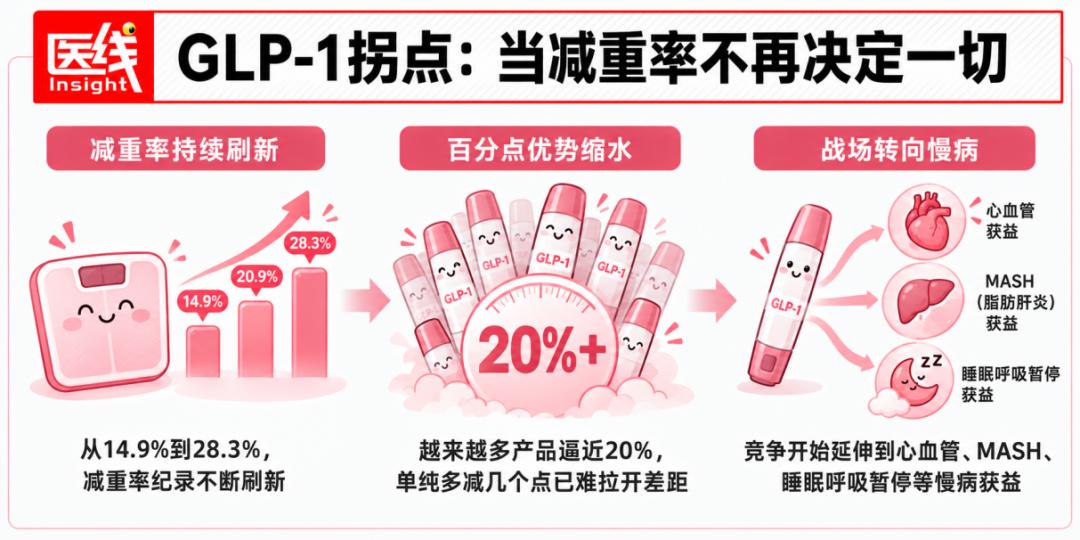
Payment Re-evaluation: Indications Determine Who Will Pay
The most intuitive value of indication expansion is to expand the patient pool.
For GLP-1, there is a more important layer: it may change the payment identity of a drug.
A person taking medication to lose 10 kilograms, a diabetic patient taking medication to control blood sugar, a MASH patient taking medication to delay disease progression, and an obese patient with existing cardiovascular disease taking medication to reduce the risk of myocardial infarction and stroke...
In the eyes of medical insurance and commercial insurance, the nature of demand in the above scenarios is not the same.
This also explains a long-standing contradiction.
"Obesity is a chronic disease" does not automatically lead to the conclusion that "all weight loss drugs should be included in medical insurance".
A very representative sample has emerged in China. The 2025 edition of the National Reimbursement Drug List has been implemented since January 1, 2026, and tirzepatide has been included in it.
In July this year, the National Healthcare Security Administration clearly stated at a press conference that it was "tirzepatide injection for the treatment of diabetes", and disclosed that as of May, the drug had sales records in more than 12,000 designated medical institutions and retail pharmacies.
The payment system first opens a disease treatment scenario with clear boundaries.
Eli Lilly's financial report translates this change into more intuitive commercial figures.
In the second quarter of 2026, Mounjaro's global sales reached 9.943 billion US dollars, a year-on-year increase of 91%; Zepbound's sales reached 4.928 billion US dollars, a year-on-year increase of 46%.
The combined sales of the two tirzepatide brands in a single quarter have approached 14.9 billion US dollars.
In the same quarter, Eli Lilly's revenue from markets outside the United States increased by 80% year-on-year, sales volume increased by 113%, and the actual realized price decreased by 36%.
The company explained that the drop in actual overseas prices was mainly affected by Mounjaro's inclusion in China's National Reimbursement Drug List.
At the same time, Eli Lilly's revenue from markets outside the United States for Mounjaro increased by 172%, mainly driven by the increase in sales volume.
This set of figures reveals an arithmetic problem that Chinese pharmaceutical companies are likely to face repeatedly in the future: medical insurance will lower the unit price, but it may also rapidly expand the accessibility and sales volume of drugs.
A drop in price does not naturally mean a smaller business scale.
Therefore, the significance of indications has also changed.
By continuously proving the benefits of GLP-1 in cardiovascular, liver, sleep and other fields, enterprises are not only gaining new patients, but also accumulating reasons to enter the public payment and commercial payment systems.
Take the key study for Wegovy's approval of MASH as an example.
The US FDA disclosed that at 72 weeks, 63% of the subjects in the Wegovy treatment group achieved MASH remission without worsening of liver fibrosis, compared with 34% in the placebo group; 37% of the subjects in the treatment group achieved improvement of liver fibrosis without worsening of MASH, compared with 22% in the placebo group.
The study will continue to observe the long-term clinical outcomes of the liver.
Such results already belong to two completely different sets of commercial languages compared with "losing a few more kilograms".
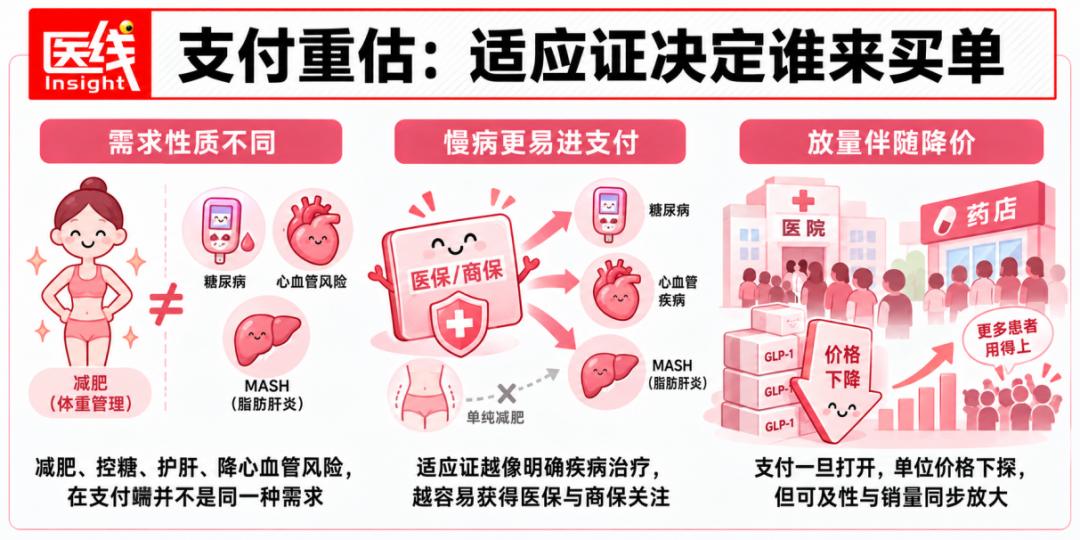
Of course, the expansion of indications does not necessarily make GLP-1 widely covered by medical insurance.
Clinical value, budget impact, patient scale, and fund affordability all need to be recalculated.
Especially when the potential user population is large enough, any expansion of the payment scope may quickly turn into a budget problem.
Reuters cited JPMorgan Chase analyst forecasts in August this year that China's GLP-1 weight loss treatment market is currently about 3 billion to 4 billion yuan, and may grow to 30 billion yuan in the next five to seven years.
This is still an institutional forecast. But it just points out the most critical variable on the payment side: the size of demand only determines the imagination space of the market; how much demand can enter the disease treatment system will truly affect the market ceiling.
Weight loss indications create demand, while chronic disease indications push the competition to the payment side.
Once the payment channel is opened, the following competition will turn to price.
Deep Water Zone of Price: The Chinese Market Enters the Elimination Round
China is likely to become one of the first markets to bring "volume growth" and "price reduction" of GLP-1 to the forefront at the same time.
The first pressure comes from the patent cycle.
Novo Nordisk's 2025 annual report discloses that the active ingredient patents of Wegovy, Ozempic and Rybelsus in China all expire in 2026.
China Intellectual Property Protection Network disclosed that the basic patent related to semaglutide expired on March 20, 2026.
The expiration of patents does not mean that generic products can be launched collectively the next day.
Novo Nordisk specifically stated in its annual report that in addition to the active ingredient patents, the company also has other patents related to production processes, formulations or uses, and regulatory data protection may also affect the actual market exclusivity period; China Intellectual Property Protection Network also mentioned that the data protection issue still affects the approval process of some generic products.
But the market's psychological expectation has changed. The window for original research drugs to enjoy high premiums exclusively is narrowing.
The second pressure comes from an extremely crowded domestic product pipeline.
The Wall Street Journal reported in September that more than 250 GLP-1 related therapeutic projects are currently under research and development in China.
It can be seen that the track is already extremely crowded.
The more critical change is that domestic competition has passed the stage of "whether there are products" and entered the contest of "whether the data is strong enough".
Mashdutide from Innovent Biologics was approved by the NMPA in 2025 for long-term weight management in adult patients with overweight or obesity, and became the world's first approved GLP-1/GCG dual receptor agonist.
Hansoh's Olatorepatide has entered the NDA stage; Federal Pharmaceutical's UBT251 represents the triple-target direction.
Single-target, dual-target, triple-target, oral, long-acting... Almost all possible product routes are pouring into the same market at the same time.
The third pressure comes from the payment volume growth itself.
Eli Lilly's second-quarter financial report has shown a clear "volume-price exchange" sample: after Mounjaro was included in China's medical insurance, the company's sales volume in markets outside the United States increased significantly, and the actual price decreased significantly.
This is also likely to be one of the most prominent scenes in China's GLP-1 market in the next few years: the number of users is getting larger and larger, and the unit treatment price is getting lower and lower.
The most popular topic in the industry in the past was who can achieve 20% weight loss.
Next, the problems that pharmaceutical companies will face will focus on, with sufficient efficacy, who has a lower manufacturing cost?
And who can complete hospital access and distribute products to a wider off-hospital retail network?
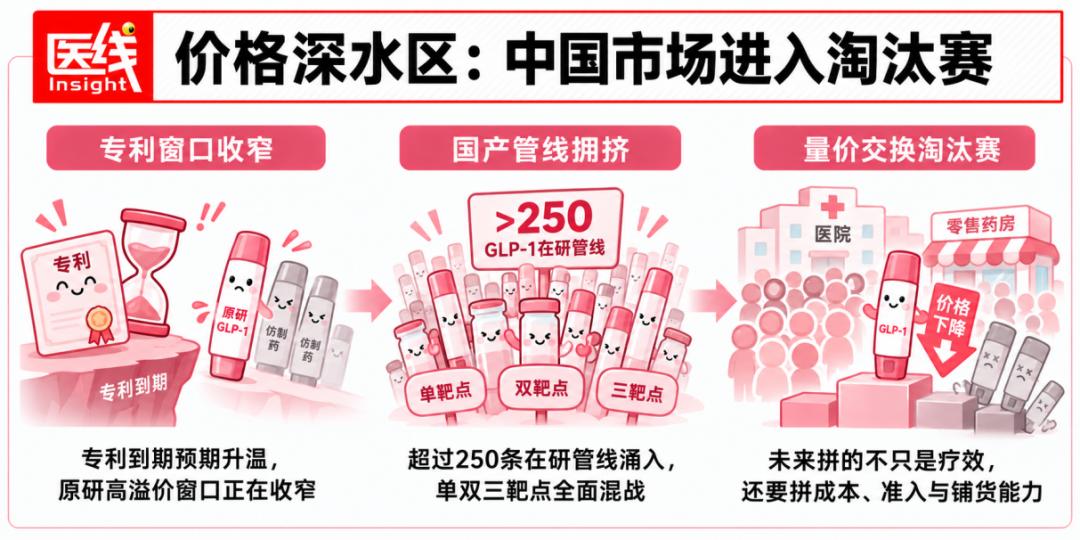
For a market with more than 250 pipelines under research, this is the real elimination round.
Final Showdown: Who Can Occupy the Chronic Disease Entrance
From the perspective of the industry, the part of GLP-1 that is really worthy of revaluation may be hidden outside the "weight loss drug market".
A global disease burden prediction study published in The Lancet in 2025 estimated that in 2021, the number of overweight or obese adults aged 25 and above in China was about 402 million, the largest number in the world.
The National Health Commission has clearly regarded obesity as an independent chronic disease, and it is also an important pathogenic factor for many chronic diseases.
This means that pharmaceutical companies are facing a group of highly complex people with overlapping diseases who may receive long-term treatment.
They may be accompanied by diseases such as diabetes, cardiovascular disease, fatty liver, and sleep apnea at the same time.
It is increasingly difficult to describe what pharmaceutical companies are doing by continuing to summarize GLP-1 with the three words "weight loss drug".
Weg