In the downturn of education financing, which AI education products did capital place bets on in the first half of the year?
EdTech financing is still in a trough, yet AI education has ushered in a financing boom in the third quarter of this year.
HolonIQ data shows that in the first half of 2026, the total global venture capital for edtech reached approximately 1 billion US dollars, down 26% year on year. Meanwhile, AI is becoming a more active direction in education financing.
From AI tutoring and language learning on the student side, to grading and assessment on the teacher side, and further to children's AI hardware, funds are flowing to increasingly specific education scenarios. Against the backdrop of overall pressure on education financing, AI education has become a key point for capital to rediscover education projects.
01
Financing speeds up in the third quarter,
early-stage projects account for most of the market
The changes in AI education financing this year are mainly concentrated in the third quarter.
According to incomplete statistics from Duojing, there were at least 33 AI education-related financings worldwide in the first 9 months of 2026. Among them, 14 were in the first half of the year, and 19 from July to September, accounting for 57.6%. Especially starting from July, AI education financing has remained above 6 cases for three consecutive months, and the financing rhythm has accelerated significantly compared with the first half of the year.
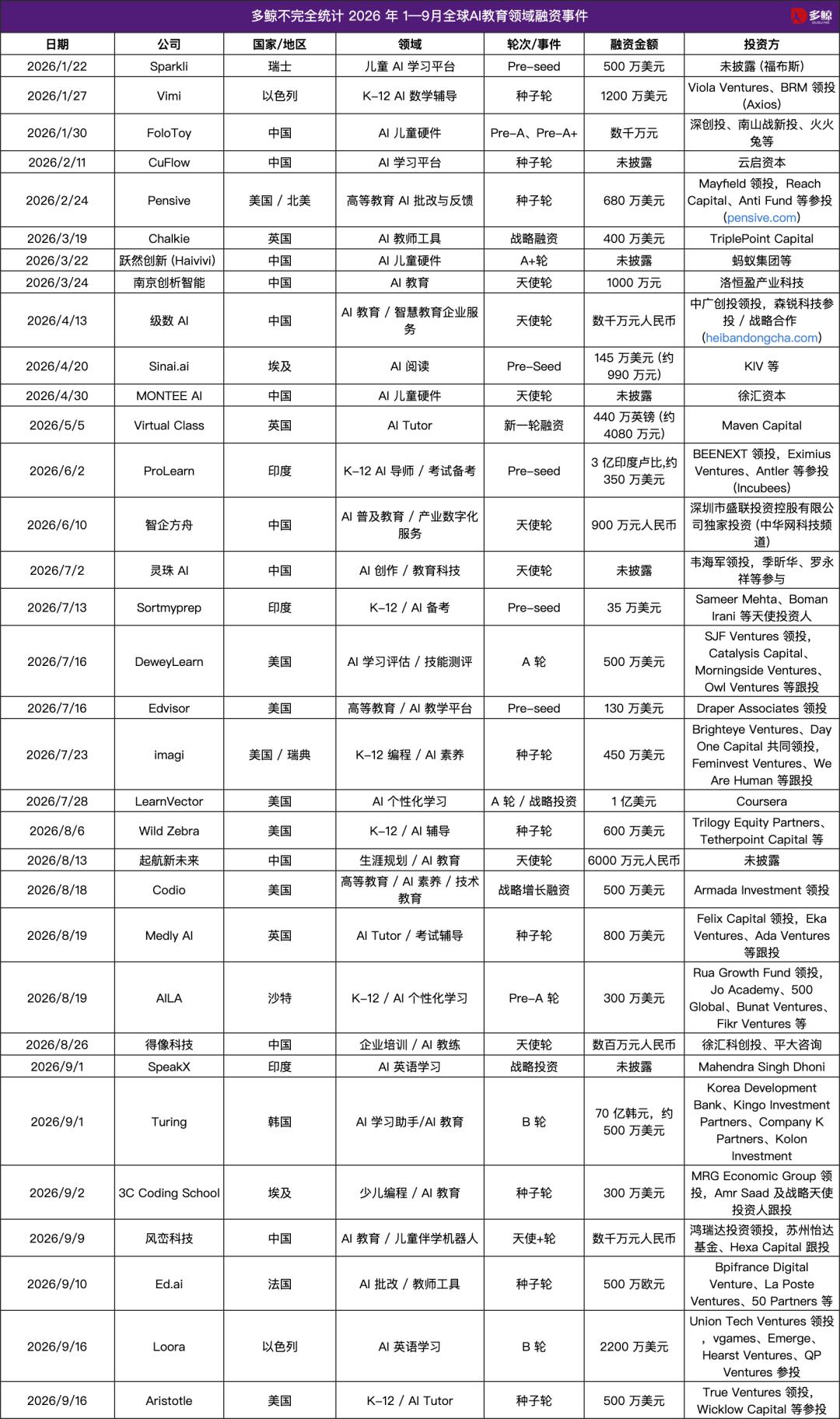
The newly available funds first flow to early-stage projects. Of the 33 financings, Pre-seed, seed round, angel and angel+ rounds totaled 22, accounting for 66.7%. From new companies that have just obtained start-up capital to start-up projects that are expanding their product and user scale, early-stage financing constitutes the most important part of AI education financing this year.
Along with a large number of early-stage projects, there are also a small number of financings with higher amounts. In the first 9 months, most of the disclosed projects are still at the scale of millions of US dollars or tens of millions of RMB, but ten-million-dollar level financings have emerged: a K-12 AI math tutoring project received 12 million US dollars in the seed round, and an AI English learning product completed a 22 million US dollars Series B round. In July, Coursera invested 100 million US dollars in LearnVector founded by Andrew Ng, further pushing the single financing to the 100-million-dollar level.
The resulting financing structure is more distinct. On one side are the early-stage projects that occupy the main body in quantity, with capital continuously entering at the scale of millions of US dollars; on the other side, a small number of projects that already have a certain product and user base have begun to obtain larger amounts of financing. After the number of financings increased in the third quarter, the capital flow within AI education has become clearer, and different products such as student learning, teacher teaching and children's hardware have all obtained funds in this round of financing.
02
AI Tutor moves towards verticalization,
financing for grading and children's hardware increases
Student learning products account for the largest share of AI education financing this year.
Among the 33 financings in the first 9 months, 15 are directly oriented to students, involving products such as AI Tutor, personalized learning, language learning, exam tutoring and reading. Among them, there are 12 projects related to AI Tutor, personalized learning, language and exam preparation, accounting for 36.4% of all financings.
Specifically for products, mathematics, language and exam tutoring are the emerging directions with the highest frequency. In January this year, Israeli K-12 AI math tutoring company Vimi completed a $12 million seed round of financing; in August, Medly AI, a London-based exam tutoring provider for middle school students, completed an $8 million seed round; in September, Israeli AI English learning company Loora completed a $22 million Series B round of financing.
The three companies all correspond to relatively mature education demands, but their product scopes are significantly narrowed. Vimi focuses on mathematics, Medly AI mainly serves exam review, and Loora concentrates on English speaking training. Taking Loora as an example, users can directly have English conversations with AI and get feedback on pronunciation, grammar and expression. The company disclosed that about 15 million learners have used Loora so far, and the total financing after this round reaches 43.25 million US dollars.
The language learning projects that obtained financing this year also include Indian AI English learning product SpeakX; in the K-12 field, there are personalized tutoring products such as Wild Zebra, AILA and Aristotle. Compared with comprehensive learning assistants that cover multiple subjects and tasks, this batch of products mostly starts from a single subject, exam or language demand. Education categories with mature curriculum systems and payment habits have also become the fields where AI learning products have concentrated financing earlier.
Another group of projects targets grading, feedback and learning assessment.
In the first 9 months, a total of 5 financings involved AI grading, teaching feedback, learning assessment and teacher tools. In February, Pensive, which provides AI grading and feedback services for universities, completed a $6.8 million seed round of financing. At the time of financing, its products had entered more than 100 schools, served more than 1,000 teachers, and processed more than 3 million questions in total. Pensive's products have been used in university courses. A data science course at the University of California, Berkeley with about 1,000 students uses its tools, and a mathematics course at Columbia University has also accessed related products. Teachers can pre-set grading standards, and the system assists in processing assignments and exams and generating feedback.
Similar financings continued to appear in the second half of the year. In July, DeweyLearn, a US AI learning assessment and skill evaluation company, completed a $5 million Series A round of financing; in September, Ed.ai, a French AI grading and teacher tool company, completed a 5 million euro seed round of financing. In addition, teacher tool company Chalkie and higher education AI teaching platform Edvisor also obtained financing this year.
Grading, feedback and assessment were originally mostly embedded in digital teaching platforms, in this year's financing list, many companies that specifically provide AI grading, learning assessment and teacher tools have emerged. Pensive has entered more than 100 schools, DeweyLearn has reached the Series A round, and Ed.ai has completed the seed round with 5 million euros. Teacher-side products have covered different stages from early financing to Series A.
The distribution of domestic financing is different. In the first 9 months, there were 11 AI education-related financings in China, 4 of which involved children's AI hardware, accounting for 36.4%.
In January, AI children's hardware company FoloToy completed tens of millions of RMB in Pre-A and Pre-A+ rounds of financing; in March, AI children's companion product company Yueran Innovation completed Series A+ round of financing; in April, MONTEE AI obtained angel round financing; in September, children's companion robot company Fengluan Technology completed tens of millions of RMB in angel+ round of financing. The four financings are distributed in the first three quarters, with the round extending from angel round to Series A+ round.
Among them, Yueran Innovation has entered the continuous financing stage. The company was founded in 2021, and its brand Haivivi has launched AI companion products such as BubblePal and CocoMate. As of March this year, the cumulative sales of related products have exceeded 300,000 units. This Series A+ round of financing is about seven months away from the company's previous 200 million RMB Series A round of financing.
In terms of quantity, children's AI hardware has accounted for more than one third of the domestic sample; in terms of financing stage, there are both angel round projects and companies that have entered Pre-A and Series A+ rounds. Compared with the financing structure of student-side products dominated by AI Tutor, language and exam preparation applications, children's companion toys and companion learning robots constitute the relatively concentrated hardware category in domestic AI education financing this year.
03
AI accounts for nearly half,
new changes have taken place in education financing
The financing data for the first 9 months also provides a window to observe the position of AI education.
According to incomplete statistics from Duojing, among the 67 education and related capital events collected from January to September this year, there are 33 AI education-related financings, accounting for nearly half. The financings in the same period also cover many fields such as language learning, vocational education, higher education, and overseas study services. AI-related companies have become a category of projects with a relatively large number in education financing this year.
First of all, the financing activity of AI education is somewhat different from the overall edtech market.
Since 2026, global edtech financing is still at a relatively low level, but AI education has maintained a high number of projects, and new companies continue to obtain early-stage funds such as seed rounds and angel rounds. This year's large-scale financings are concentrated in a small number of companies. In the AI education sector, LearnVector received a $100 million investment from Coursera, Loora completed a $22 million Series B round, Vimi completed a $12 million seed round; more projects have financing scales of millions of US dollars or tens of millions of RMB.
Secondly, domestic and foreign capitals focus on different directions.
Overseas financings are more concentrated in software products. Among the 33 financings, 15 are directly oriented to students, 12 of which are concentrated in AI Tutor, personalized learning, language learning and exam tutoring; the teacher side is mainly focused on grading, assessment and teaching tools.
Among the 11 domestic AI education financings, 4 are related to children's AI hardware, accounting for 36.4%. FoloToy, Yueran Innovation, MONTEE AI and Fengluan Technology have entered scenarios such as AI toys, children's companions and companion learning robots respectively. Compared with overseas markets that are dominated by learning software and teacher tools, children's AI hardware has become a relatively concentrated financing direction in China this year.
Finally, the number of investors behind AI education is also expanding.
This year, there are not only professional funds that have long focused on edtech such as Owl Ventures, but also comprehensive investment institutions such as Mayfield, Felix Capital and BEENEXT entering the AI education field. At the same time, Coursera directly invested in LearnVector, and domestic institutions such as Shenzhen Venture Capital, Nanshan Emerging Industry Investment and Xuhui Capital also appeared in related projects. This makes the capital source of AI education more diverse than traditional education financing. Behind student-side software, teacher tools and children's hardware, there have been different types of investors such as education funds, comprehensive VCs, industrial capital and local capital.
The dense early-stage financings this year have pushed more AI education projects to the commercial verification stage. As products enter real teaching and learning scenarios, market performance will also become a more direct measure of project value.
This article is from the WeChat Official Account "Duojing" (ID: DJEDUINNO), author: Si Luo, published with authorization from 36Kr.