AI office, the first "down payment" for salaried workers who go to work at their own expense
In the past, an ordinary office worker's income planning was to allocate one-third to rent, one-third to daily expenses, and one-third to savings.
But starting from this era, more and more people's income has been divided into four equal parts, with one part reserved for AI top-ups.
All people who need to work at their desks have, actively or passively, gone through the baptism of AI.
Office workers with career pursuits have probably paid out of their own pockets to subscribe to ChatGPT Pro and Claude Pro to see if there is room for cost reduction and efficiency improvement in their work.
Some people spend as much on AI tools every month as they do on rent. Their subscription bills cover memberships on three or four platforms, plus pay-as-you-go calling services. Starting from the cheapest tier, they find after a week of use that the quota is not enough to support their daily work, so they can only grit their teeth and upgrade tier after tier. What was originally a matter of personal choice has gradually become a group issue.
The AI era has become the first era where people pay out of their own pockets to go to work.
01
How Many Tokens Do You Need to Burn,
To Prove That You Are Working Hard
The first thing Li Yue does when he gets to work is to give instructions to AI.
He first uses Claude to generate a version of the plan. During the half minute when AI is thinking and generating, he sends the same instructions to the dialog boxes of Deepseek and ChatGPT. He first checks which AI's finished product is closest to the ideal version, then extracts the ideas and copies them to Claude's dialog box.
Waiting for the 80% qualified plan to be generated, this content will be fed into another dialog box that highly simulates his work habits, and finally it only takes half an hour of tweaking to basically get the work done.
For the price of a cup of coffee, you can save at least 3 hours of high-intensity mental work. It is not hard to understand why being unable to work without AI has become a common sentiment among office workers today.
In the past, when people talked about office workers paying their own way to work, at most it was to improve the work experience. For example, treating yourself better means buying an ergonomic chair to move into the office, buying a mechanical keyboard as a productivity tool, and spending money on two cups of coffee a day to ensure your working condition.
But AI's intervention in work is silent. At the very beginning, people's use of AI was limited to asking basic questions. Soon, they began to use AI to organize materials and write weekly reports, which are unskilled but highly repetitive tasks. Using the free version of the AI dialog box, they experienced for the first time what cost reduction and efficiency improvement in the AI era mean.
Immediately after that, AI began to intervene in the "work" itself: people use it when organizing ideas, writing plans, and even writing code. AI tools have gradually upgraded from the role of a cyber assistant to the main force.
Li Yuan is very confused about the meaning of his work. Guided by AI's extensive and imaginative knowledge, he finds it difficult to keep his work expenses within a reasonable range, whether in terms of energy or money.

Although OpenClaw has long disappeared from public view, its breakout success popularized the concept of large models shifting from dialogue tools to efficiency tools, letting the general public know the value of tokens.
AI is no longer just a tool and an assistant. When used properly, it is equivalent to an all-around employee who charges per use.
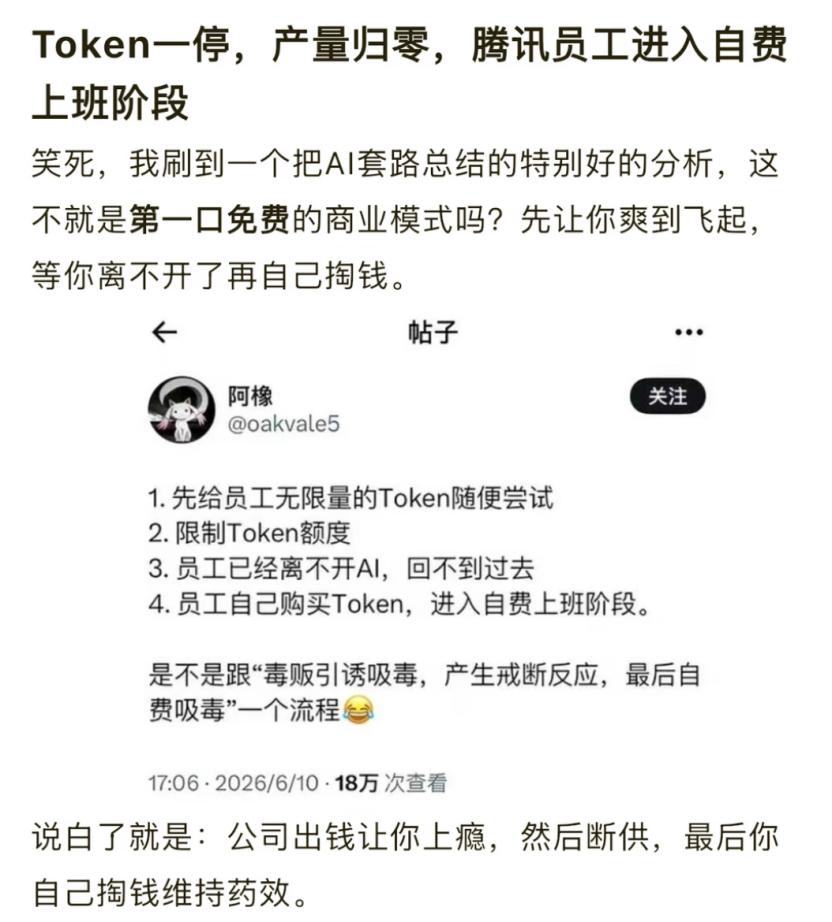
Almost at the same time, major manufacturers established usage consumption ranking lists in March - calling on employees to "burn as many tokens as possible" and taking token usage as a new criterion to measure whether one is working hard.
A Tencent employee once broke the news on the Maimai community that the company allocated an average of 220,000 yuan of usage resources per person per year, including 700 USD of Cursor quota, 700 USD of Claude quota, and 1000 USD of CodeBuddy quota per month, aiming to encourage all employees to use AI to improve efficiency.
However, the trend began to change in June. Rumors spread online that Tencent was cutting employees' AI quotas, changing the "unified quota for all staff" to "dynamic allocation according to tasks".
Domestic and foreign tech giants including Microsoft and Meta have stepped on the brakes on unlimited internal AI use, monitoring, restricting and dynamically adjusting employees' usage.
Once you get used to writing code with AI, it's hard to go back to the era of manual coding, so many programmers start paying out of their own pockets for tokens every month.
No one has ever thought of quitting. Although their work ability is still online, once the efficiency is improved, it is difficult to reduce it again. Efficiency improvement is a group event. After everyone speeds up, the remaining person will appear very slow.
All that can be done is to let out a long sigh when looking at the paid bill.
AI-powered office work has become a trend, non-technical personnel are also the main force using AI for office work. In job links such as financial analysis, market operation, new media, and design, AI is used to participate in at least one step of the work.
People ask AI to help polish weekly reports, sort out ideas for making PPT. Many design positions have begun to worry that AI has advanced so fast that everyone is in danger of being replaced.
No matter it is the efficiency improvement that bosses force employees to obtain by using AI, or employees take the initiative to learn out of a sense of crisis, the trend that "people who can't use AI are being replaced" has spread to every workstation.
Everyone is catching up on AI collectively like attending night school. If you use it well, AI is a military advisor, and even if you are not very familiar with it, you will have a handy cyber assistant.
AI has not completely replaced office workers, but it has indeed reconstructed the way office workers work.
02
The AI Down Payment for Office Workers,
Starts When the Free Quota Runs Out
The process of office workers gradually spending money on AI is typical of "pay for VIP to watch 6 episodes in advance".
Free users have a daily dialogue limit, which is definitely not enough for work. Since work cannot be separated from AI, you can first buy a basic package to see the effect. When office workers realize that they have spent a lot of money on AI, they usually have upgraded to paid tiers to maintain a normal workflow.
Work habits are formed day after day. In the past, when receiving work tasks, people would split priorities in their brain first. Now when receiving work tasks, the brain will almost instinctively generate a prompt like AI output: "I need XXX now, I need you to help me with XX, and several precautions XXX."
You can't start working without discussing ideas with ChatGPT, and you can't get the work done without Claude. It seems that without AI, humans are unable to finish organizing materials, writing emails, and building a clear framework within 10 minutes.
AI has changed from a novelty to a rigid demand, and office workers have become the most direct paying group for large model commercialization.

Addicted office workers need a clear-thinking AI assistant that can get real work done, while enterprises that have spent enough tokens for their employees need safe, controllable and profitable solutions after burning a large amount of tokens.
Major domestic tech giants successively launched their own self-developed AI Agent products during this period.
Tencent, Alibaba and ByteDance almost simultaneously launched the "horse racing" mode: they first built multiple business lines in their own companies, ran them separately for a while, and then integrated them centrally.
WorkBuddy was originally a branch line incubated internally by Tencent Cloud, alongside QClaw from the PC Manager team and CodeBuddy from another Tencent Cloud team.
QClaw focuses on remote file organization and mobile office, CodeBuddy is positioned as an AI programming assistant, and WorkBuddy is an all-scenario AI office workstation. But WorkBuddy, which is directly connected to WeChat, Tencent Meeting, Tencent Docs, WeCom and QQ Mail, finally won the competition.
For most office workers, this kind of compressed package-style AI tool that can do the work of ten people is the easiest to get started. There is no need to learn extra installation steps, no need to spend a lot of time adapting to the AI tool, and even no need to change your existing work habits.
For heavy users of the Tencent ecosystem, WorkBuddy is almost deeply embedded in their workflow.
Just because of the ability to connect to WeChat, WorkBuddy has already taken the lead.
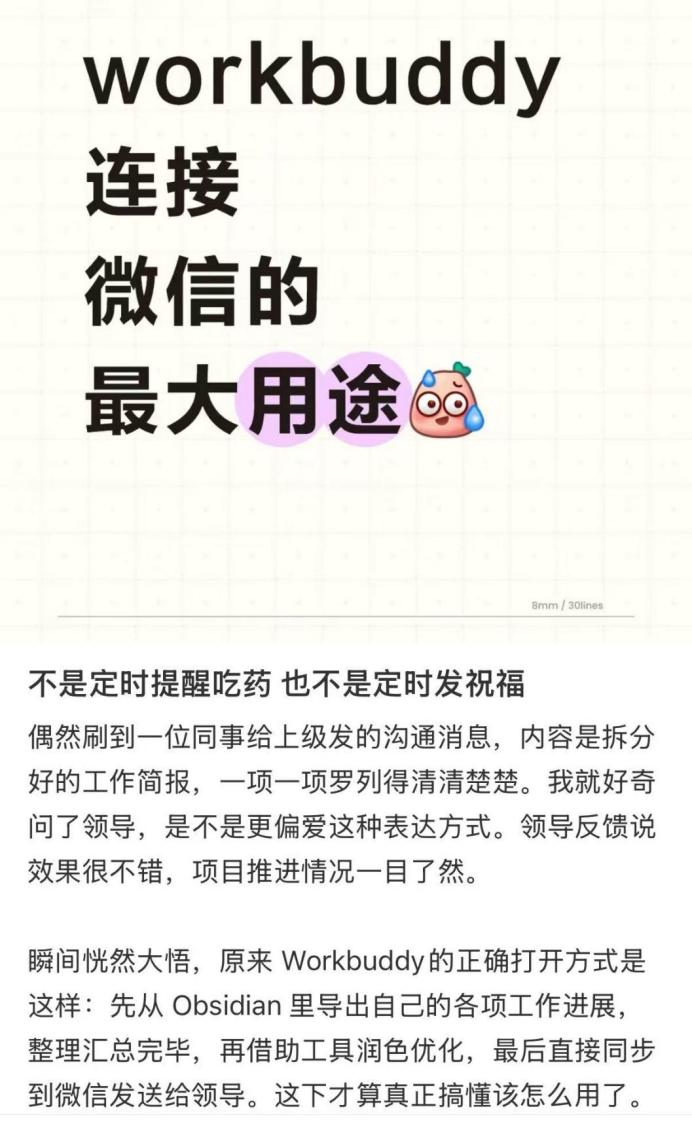
It is natural that within a few months, WorkBuddy's monthly visits rose from 8.85 million to 20.97 million, ranking first among domestic desktop AI office agents.
The next step after the horse racing ends is to integrate multiple lines into one. On July 20, Tencent issued an internal notice to transfer all the business and part of the team of the QClaw product center to the 6th Cloud Product Division where WorkBuddy belongs, under the same management system.
At this point, it is not difficult to understand why all giants choose the "horse racing" mode: although the direction of AI office is clear, the specific functions it should have are still vague.
Functions need to fit users' demands for AI office, and be so easy to use that people are willing to upgrade to paid versions voluntarily.
Rather than betting on one direction, it is better to let several teams run at the same time, use actual data as the end point of the competition, and complete the most intuitive and most efficient survival of the fittest.
Several other giants have gone through similar processes. Alibaba has Tongyi Office, and ByteDance has launched Doubao Work, which all prove that the usage habits cultivated by office workers paying out of their own pockets have let giants see a definite market.
The real AI office war has just begun, and numerous AI Agents are competing to become the default workstation for the vast number of office workers.
03
After the Down Payment of AI Office,
How Long Will the Monthly Payment Last
Domestic professional AI tools have not been charging for a long time, while ChatGPT launched the Plus subscription plan as early as 2023.
The time point when a wide range of domestic users began to feel the pressure of AI payment was in June this year, when Doubao officially launched the professional version paid subscription.
Everyone was shocked that Doubao, which used to have a playful personality, even dared to charge users, and the highest annual fee could reach 5088 yuan. Everyone thought that Doubao was starting to "calculate" users in the most straightforward, clearest and most uncircumvented way.
Soon after, domestic AI office tools for personal subscriptions began to collectively cross the free line.

Tencent WorkBuddy personal membership is divided into three tiers: Standard, Advanced and Flagship, with monthly fees of 99 yuan, 199 yuan and 999 yuan respectively. Alibaba Tongyi Office personal version has two tiers: Standard and Advanced, with monthly fees of 98 yuan and 198 yuan respectively.
After calculation, Doubao is actually the cheapest office software among them. What's more surprising is that in the evaluation of Doubao's paid version, Doubao Work has changed its usual casual style, and is indeed very useful.
At present, WorkBuddy seems to be the most famous, but Tongyi Office and Doubao Work also have the momentum to catch up.
Domestic AI office tools have the confidence to charge fees, which is inseparable from the formation of user habits. Looking at various products, if the functions are not as outstanding as Claude Pro, it depends on which ecological giant the office software behind it relies on.
Users who really pay for Doubao Work will first aim at its "deep integration with Feishu".
It can independently split tasks and call tools around user goals, and deliver work based on the context of chat records, documents, meeting minutes and other content naturally deposited in Feishu. Anyone who has worked knows how much efficiency improvement can be brought by no need to transfer files back and forth.
Alibaba Tongyi Office is backed by DingTalk, where functions such as message group chat reading, attendance approval, meeting schedule, and document and form generation are completed in a closed loop in the enterprise collaboration link. It will be more popular for enterprises that have been running on this system for many years.
While the domestic players are fighting fiercely, a major event has just happened in the overseas market that makes all office workers who pay for their own AI recalculate their accounts.
On September 3, OpenAI officially released GPT-6 Astra, calling it "the most intelligent and highest-aligned model in the world at present".
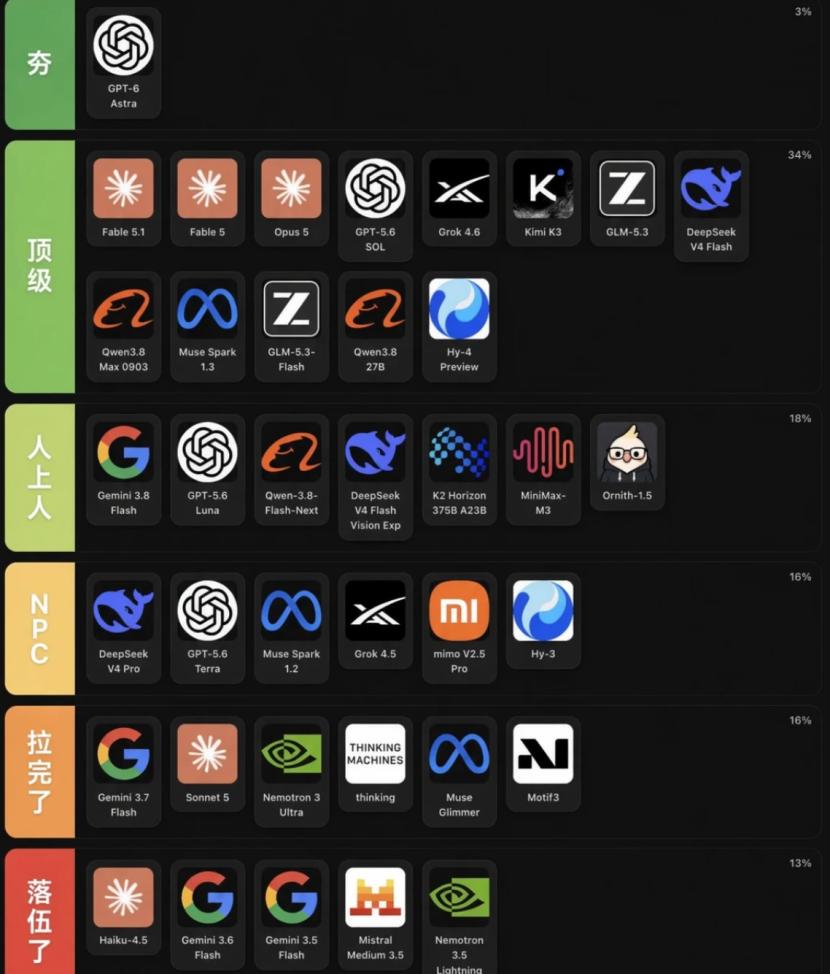
After the release, a large number of users switched from Claude to ChatGPT for a simple reason: Astra's performance in programming tasks has overtaken Claude Fable 5.1, and the amount of tokens consumed to complete the same task is only a quarter of the latter. For office workers who pay out of their own pockets every month, this account is very easy to calculate.
Many people said after using it that OpenAI can start preparing for a $10,000 per month subscription, because the $200 one is not enough at all.
Office workers know that the money they spend on AI every month is increasing, but it is still a hard question to answer whether AI really helps people earn more money.
AI office has developed to this stage, it seems that office workers' choices don't matter. After all, the dozens or hundreds of yuan that office workers pay on average every month for their own AI down payment is just a small amount for giants. The real money-making opportunity depends on which product enterprises are willing to pay for.
An enterprise customer may only spend tens of thousands or hundreds of thousands of