AI has crushed the books just like it crushes your brain.
After Anthropic's Panama project was exposed, the most disturbing photo on social media showed a stack of books with their spines cut off.
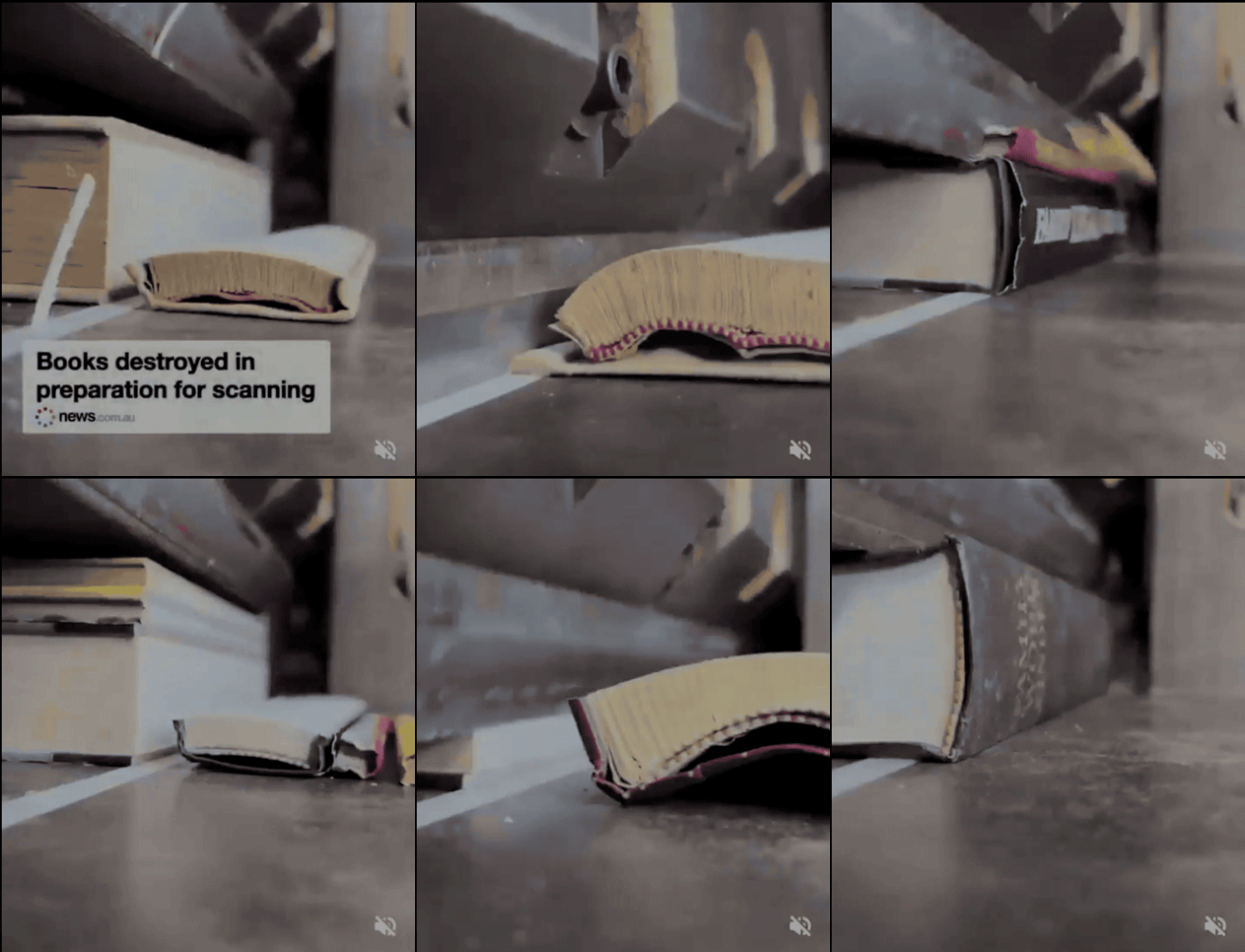
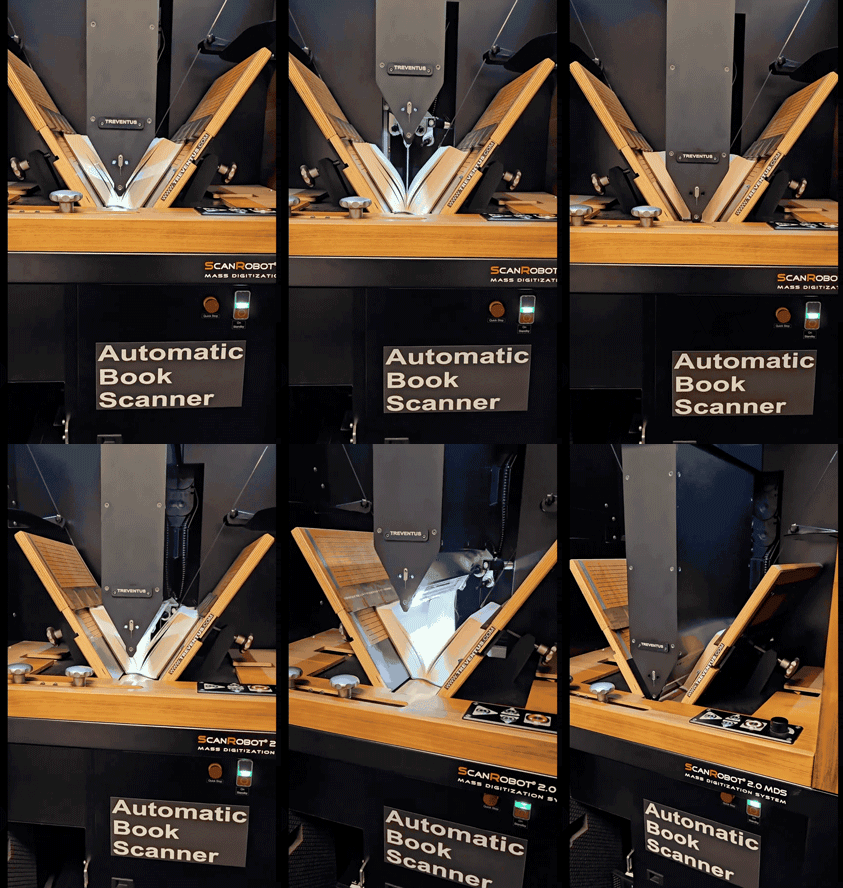
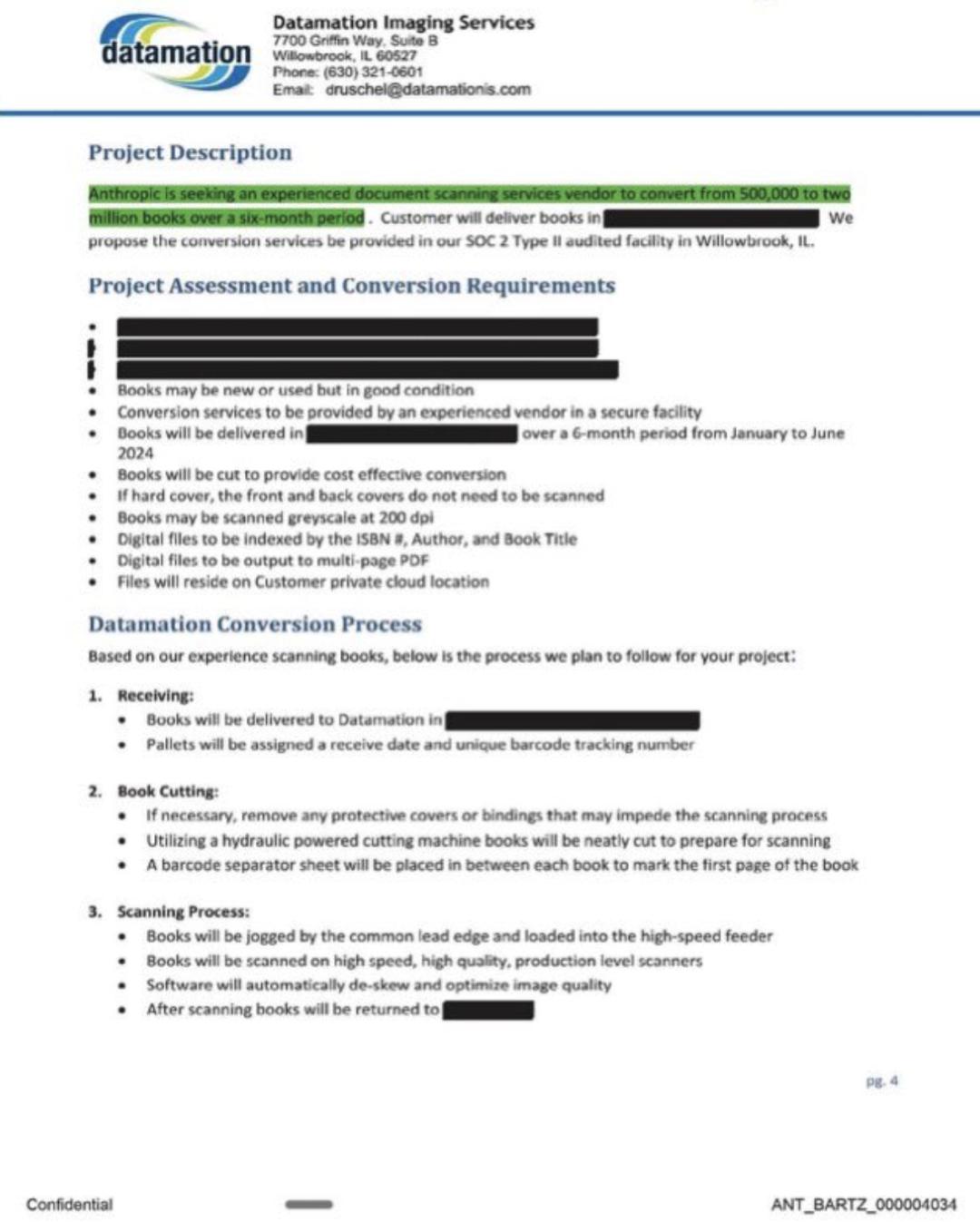
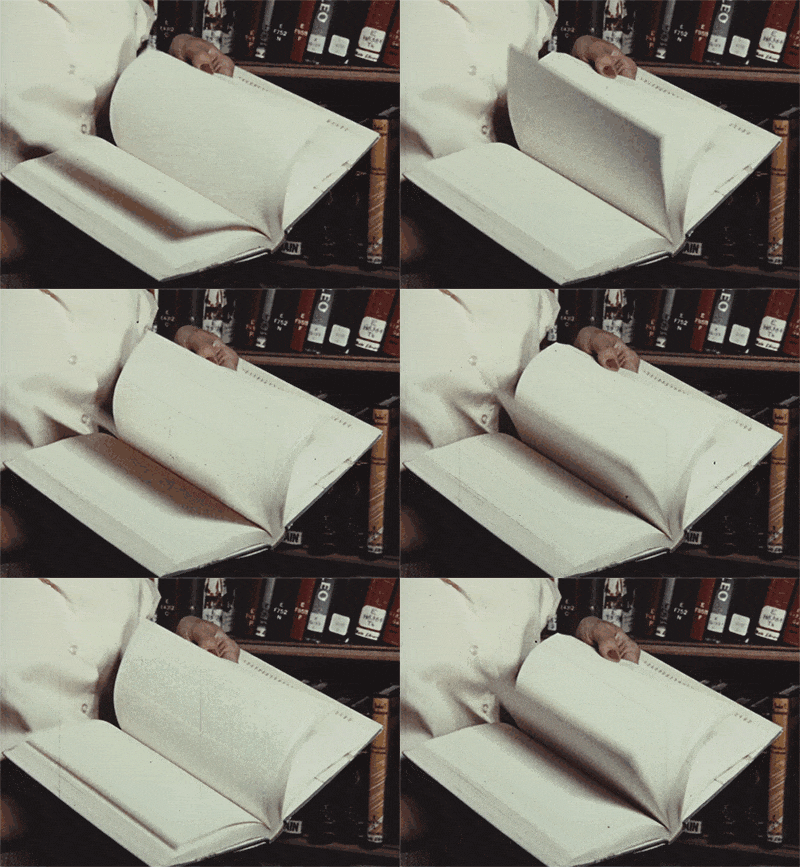
Those books used to be complete. Covers, title pages, copyright pages, tables of contents, main texts, postscripts — all the components that make up a book were still intact. But in the photo, they were no longer books. Their spines were sliced off by a hydraulic cutter, the loose pages were fed into a high-speed industrial scanner, processed page by page, their images captured, text OCRed, and data fed into the model. The remaining paper sheets were sent for recycling, pulped, and turned back into paper — which could be the raw material for the next book, an express waybill, or a roll of toilet paper.
As the saying goes: The book is dead, long live the book.
Shredding books is nothing new
Twenty years ago, the grand master of science fiction Vernor Vinge precisely predicted this scenario.
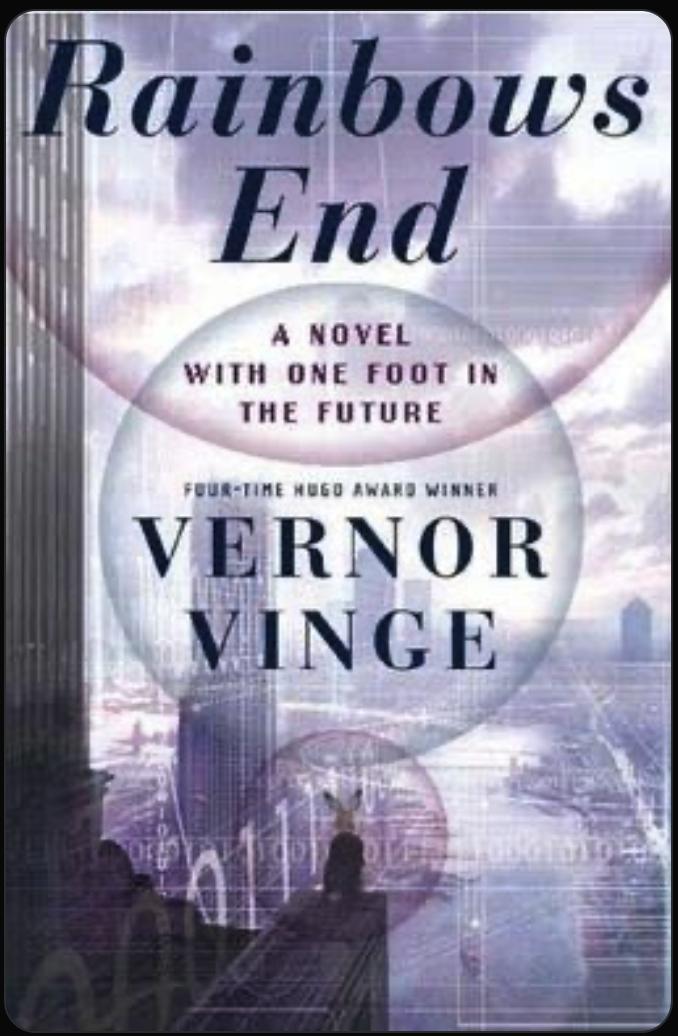
In his 2006 work *Rainbows End*, the novel is set in 2025 — which was last year. There is a bizarre scene in the book: a company wants to digitize the collection of a library, and instead of using a page-turning scanner, it uses an industrial shredder. The books are shredded into tiny fragments, a fan blows the fragments into a box full of high-speed cameras, every piece of scrap paper is photographed, and then the algorithm reassembles the text according to the texture and shape of the fragment edges.
The inspiration for this method comes from the shotgun sequencing method for DNA sequencing — the genome is broken into fragments, each fragment is sequenced, and then the algorithm stitches them back together. Applied to books, this method is efficient, brutal, and leaves no room for manoeuvre. In the novel, this incident sparked public protests and was eventually replaced by gentle page-turning scanning. But when Vinge wrote this passage, he probably never imagined that twenty years later, reality would skip the gentle page-turning scanning and directly adopt the shredder solution — except that the step of reassembling fragments is omitted, because AI can learn from a book without the complete order of its pages.
Anthropic's Panama project was launched in early 2024. Within a year, it spent tens of millions of dollars purchasing millions of physical books, scanned them after cutting off their spines, and then destroyed all of them. Claude took this approach to exploit a loophole in copyright law: if the scanned digital version is considered a "copy", then this would be illegal piracy; but if the original book is destroyed after scanning, theoretically no extra copy of the original book exists in the whole world, so this does not violate copyright law.
At the same time, Anthropic also downloaded a large number of pirated e-books for training. The court later approved a $1.5 billion settlement agreement, which was essentially targeted at the act of downloading pirated e-books; while the act of purchasing physical books, scanning them and then destroying them was not penalized.
The judge stated in the ruling that training AI with legally purchased books constitutes fair use, just like human reading. This analogy reveals a fundamental blind spot.
Two Deaths of Reading
Human reading is a linear, immersive cognitive behavior that allows for doubt and backtracking. You open the first page of a book, follow the author's train of thought, and when you reach page 30 and realize you don't understand a concept mentioned earlier, you flip back to re-read it before moving on. This is a directional, rhythmic process with a clear subject.
AI training is parallel, statistical, and irreversible extraction. Millions of books are simultaneously cut, scanned, and vectorized, their content broken down into tokens, and the model weights updated. The model has never "read" any complete book; it only extracts statistical patterns from the fragments of the books.
When the judge said AI reads like humans, he was describing a behavior that is disappearing. Most people's attention has been rewired by short videos and information feeds. Today when you pick up a book and open the first page, you might still be able to keep reading. By the fifth page, a subtle restlessness starts to rise, your fingers unconsciously make sliding motions, and your eyes begin to instinctively look for bolded subheadings or paragraph breaks. By the tenth page, your brain is automatically generating questions: What is the core argument of this book? Can it be summarized in three sentences? Is there a shorter version? This is not because you don't want to read, but because your nervous system has been trained into another mode. Attention has not been scattered, but reallocated — from the continuous focus required for deep reading, to the rapid switching required for fragmented information retrieval. When knowledge exists in the form of tokens, when answers pop up in chat bubbles, when complex arguments are compressed into lists of key points, the brain no longer pays the cost for continuous attention. The neural circuits that maintain deep reading, like any acquired skill, will atrophy due to lack of practice.

*Rainbows End* also predicted this. In Vinge's depiction of 2025, children of the new era no longer read books, and they rely entirely on videos to acquire information. They can't even write or speak properly, and all their expressions rely on countless video clips from the internet, just like Bumblebee in *Transformers*, exactly the same as the present day. When Vinge wrote this book, YouTube had just been founded for a year, and the iPhone had not yet been released.
The Cost of Efficiency
As the designated prophet of the AI era, Vinge also conceived of a completely opposite technology: Focused Activation.
In his short story *Fast Times at Fairmont High*, he imagined a world where people are locked into a single task through neural modulation. People with Focused Activation can exert superhuman efficiency in their designated field — at the cost of losing the freedom to choose what not to pay attention to. You can't get distracted, can't wander off, can't suddenly remember that you haven't washed the clothes. Your attention is forcibly focused like a laser beam. You gain extreme concentration, but at the cost of no longer being able to choose what to ignore. People with Focused Activation can reach unprecedented depth in a field, write great mathematical proofs or engineering solutions, at the cost of losing the freedom to choose what not to see, losing perception of the world outside the task, and losing the autonomy of a complete personality. They are no longer distracted by the flood of information, because they have lost the ability to notice other things. In the world of Focused Activation, there is only one task, one goal, one focus, and everything else — emotions, relationships, physical needs — is shielded. This is not repairing attention, it is imprisoning attention.
There is a drug called "Adderall" used to treat ADHD — and Focused Activation is, to some extent, the pro-max-ultra version of Adderall. We have long seen this in reality: many parents of students, even students themselves, are willing to actively use "smart drugs" similar to Adderall to gain advantages in exams and academic performance. In the era of hyper-competition, if this technology appears, many people will inevitably be willing to modify themselves. Then comes the Red Queen effect: you have to run as fast as you can just to stay in place. The threshold will get higher and higher until it submerges everyone.
Today's AI models are completing a kind of collective Focused Activation on behalf of humanity. They read millions of books for us, extract key information for us, summarize them into three sentences for us, and generate content that humans would take days to digest in just a few seconds. We give up the autonomy of reading, give up the right to get lost and discover in the full text, give up the patience to wrestle with complex ideas head-on, in exchange for efficiency. On the machine side, what happens is Focused Activation — the model processes massive amounts of text with concentration and speed that humans cannot match, reorganizing fragmented information into seemingly coherent outputs; on the human side, what happens is fragmentation — our attention is cut into fragments and fed to various interfaces, and our cognition is outsourced to the system's Focused Activation. This is a two-way reinforcement process: the more focused the machine is, the more fragmented people become; the more fragmented people are, the more they rely on the machine's Focused Activation to understand the world for them.
Too Lazy to Turn Pages
From *Fahrenheit 451* to *Rainbows End*, science fiction's imagination about the death of books has undergone a paradigm shift.
In Bradbury's world, burning books is a political act. The job of firefighters is to burn books, because books make people unhappy, make people question authority, and make people remember things that should not be remembered. Fire is the enemy, and memory is the weapon of resistance. The scene where Montag steals, reads, and memorizes books is the classic image of knowledge resistance throughout the 20th century — the books are burned, but people remember them, so the books are not dead.
In Vinge's world, destroying books is an engineering act. The shredder is not an ideological weapon, but only an optimization solution for outdated processes. No one needs to resist, because no one wants to read books anymore. Books are shredded not because someone hates them, but because someone is too lazy to turn pages.
Anthropic's Panama project has realized both of these futures at the same time. It completes the destruction of fire through physical shredding — the books are indeed destroyed, the paper pages are indeed pulped. But it also dispels the moral urgency of reading through legal and compliant processes — there are no firefighters, no tyrants who burn books and bury scholars alive, only hydraulic cutters, high-speed scanners, and court-approved fair use rulings. No one burns books, books are just optimized. No one bans reading, people just don't read anymore.
This is just like the dystopia in *1984* that never appeared, while the dystopia in *Brave New World* is getting closer and closer to reality. The physical fragments of books and the spiritual fragments of cognition are actually the same thing.
A Future Without Books
It's not that books don't exist anymore — books will still be printed, sold, and placed on the shelves of bookstores. It is the act of reading that disappears.
In that future, knowledge is unprecedentedly rich. Any fact, any theory, any text can be retrieved, summarized, and paraphrased in a few seconds. You ask a question, AI gives you the answer. You don't need to know how the answer came about, don't need to judge whether it is correct, don't need to understand it in a larger framework. You just need to accept it.
But understanding is unprecedentedly scarce. Understanding requires time, requires immersion, allows you to get lost, go the wrong way, and then come back. Understanding requires you to read a book from beginning to end, even if there are fifty pages in the middle that you find boring. Understanding requires you to be changed by a book, not to rewrite a book into a three-sentence summary.
We will survive by relying on things we don't understand.
But on second thought, modern society is inherently made up of things we don't understand. You don't understand how mobile phones connect to the internet, but you use them; you don't understand how the power grid is dispatched, but you turn on the lights; you don't understand how the central bank prints money, but you spend it... We have always lived in a state of relying on things we don't understand. The future without books just takes this state one step further.
The difference is that before, what we didn't understand was technology, but now what we don't understand is knowledge itself.
After the Book Spine Breaks
We have to ask: Then what? In another ten/twenty/fifty years, what will reading become?
The answer in ten years may be differentiation, which is no different from today. Some people will completely abandon the act of reading — there will be no continuous, long-form understanding, everything is short-range, fast information flow, compressed into "three-sentence summaries" in LLMs or 15-second voice broadcasts in short videos. While others will access technologies similar to "Focused Activation" — they will extremely