Doubled within two months, massive capital has collectively gone into a frenzy.
While baijiu stocks are collectively slumping and tech stocks are fluctuating wildly, yellow rice wine has woken up.
On September 18, Kuaijishan hit the 10% price limit again, notching up three limit-up moves in four trading days, with its share price surging to 32.84 yuan, hitting an all-time high since its listing in 2014.
Calculated from the rebound starting point on July 27, the price of this stock has doubled in less than two months.
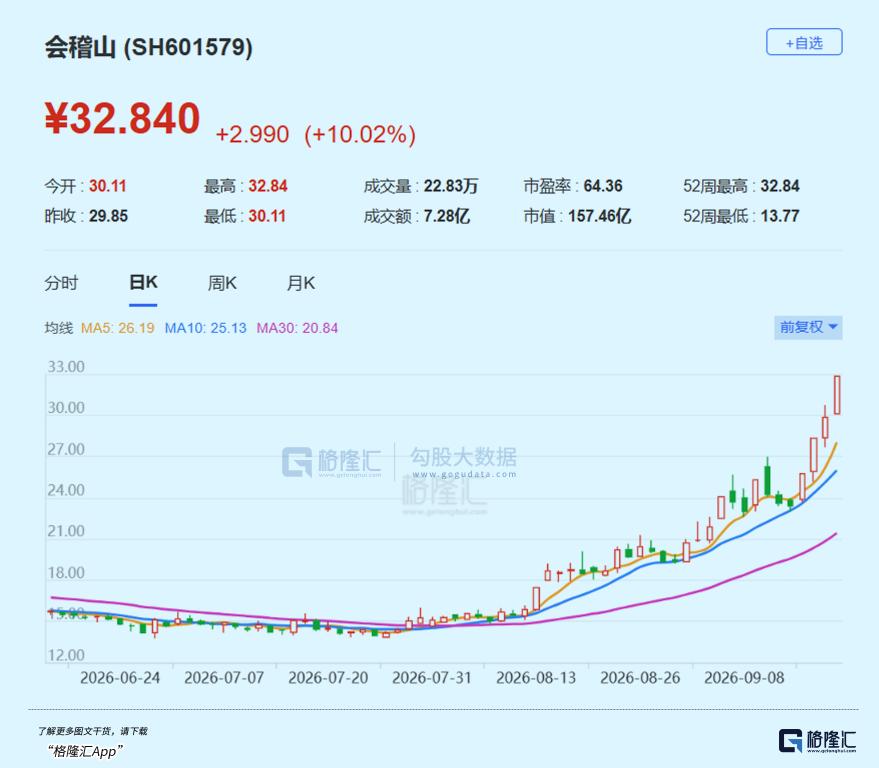
The "three leading players" in the yellow rice wine sector, Guyue Longshan and Jinfeng Wine, also rallied in tandem, and even collectively hit the 10% price limit rarely on September 16, with their share prices soaring by more than 50% in the past two months.
Looking at the entire food and beverage sector, the baijiu sector continues to bottom out, and the performance of listed liquor enterprises is generally under pressure.
Yellow rice wine, which has long been regarded as a niche, low-priced product that cannot even break out of the Jiangsu-Zhejiang-Shanghai region, has suddenly become the focus of capital pursuit?
01
To understand the origin of this round of yellow rice wine market rally, we may need to take a broader perspective.
The 2026 baijiu industry can be described in one word: "enduring hardship".
In the first half of the year, the total operating revenue of 20 A+H share listed baijiu companies decreased by 6.7% year on year. Nearly three-quarters of offline terminal stores saw a drop in turnover and customer unit price, and more than 86% of them suffered profit shrinkage.
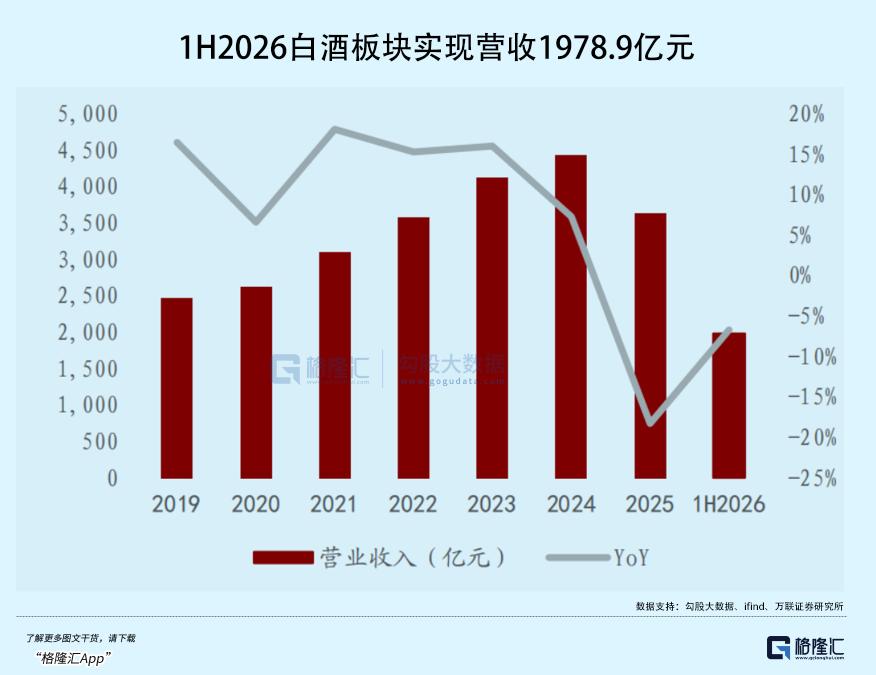
When the upstream and downstream of the entire baijiu industry, and even the capital market, are going through a painful bottoming-out process, capital has to find a place to go.
This is true for both the capital market and distributors.
In the cycle of deep adjustment of the baijiu industry, a large amount of capital has begun to withdraw from baijiu targets under performance pressure, and turn to seek segmented tracks with small volume, low valuation and sufficient story space.
The yellow rice wine sector just meets all these conditions, as there are only three A-share listed yellow rice wine companies in total, with small tradable shares, low long-term attention, and valuations staying at a low level.
Once a large amount of capital pours in intensively, it is easy to trigger a series of limit-up moves.
However, the logic of capital support alone is not enough. Baijiu distributors are also looking for new outlets for their funds.
In the past few years, the biggest change around the baijiu industry lies in the channel side.
Baijiu distributors, who used to make money easily without much effort, suddenly find themselves in the most awkward position in the industrial chain: overstocked inventory, price inversion, occupied capital, and shrinking consumer groups.
Financial data shows that from 2024 to the first half of 2026, the number of distributors of 20 listed baijiu companies has decreased by more than 6,000 on a net basis.
Yellow rice wine has become the choice of these distributors.
Since April this year, Kuaijishan has successively reached strategic cooperation with Henan Maowujian Trading, Northeast Baishan Fangda Group, Guangdong Guangxinghu Wine Industry, Beijing Sugar & Alcohol Group and other enterprises, covering the traditional weak yellow rice wine markets in Central Plains, Northeast China, South China, Southwest China and other regions, with its high-end Lanting series as the core promoted product.
In early September, Kuaijishan · Lanting signed a strategic cooperation agreement with Sichuan Shengshi Quyun in Chengdu. The head of this company, Yang Bo, is also the president of the Sichuan Distributors Association of Moutai, controlling more than 5,000 terminal outlets across Sichuan province.
Guyue Longshan is not to be outdone. It signed a cooperation agreement with Beijing Sugar & Alcohol Group in May, and reached a tripartite strategic cooperation with Guangdong Yueqiang and Chongqing Agricultural Means of Production in September.
In less than half a year, a number of leading large liquor distributors across the country who hold core resources of Moutai, Wuliangye and other famous liquors have entered the market one after another, covering almost all the main baijiu consumption regions in Central Plains, Northeast China, South China, Southwest China and North China.
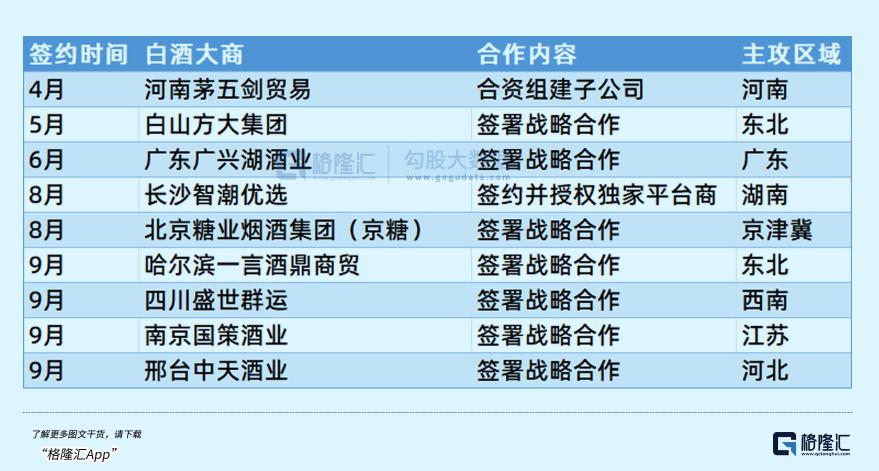
When the sales of baijiu industry slows down and high-end liquor enterprises turn to direct sales, large distributors who hold a large number of high-net-worth customers and circle resources are in urgent need of profitable, refreshing products to enrich their product portfolio.
The growth stories told by Kuaijishan's Lanting series and Guyue Longshan's Guo Niang series are just like what Moutai had 20 years ago.
Back to the yellow rice wine industry itself, the biggest shortcoming of yellow rice wine in the past is the insufficient penetration in high-end social circles.
The government, enterprise and entrepreneur circle resources held by Moutai's large distributors just make up for this shortboard.
In other words, what yellow rice wine lacks is not only consumers, but also the access to bring yellow rice wine to high-end dining tables.
Now, this access has come.
The imagination space for the yellow rice wine industry has thus been opened up.
Take Kuaijishan, the leader of this round of market rally, as an example. The reason why Kuaijishan's share price doubled in two months is its steady growth in the past three years.
In 2023, its operating revenue reached 1.411 billion yuan, and net profit 167 million yuan; in 2024, its operating revenue rose to 1.631 billion yuan, and net profit 197 million yuan; in 2025, its operating revenue hit 1.822 billion yuan, net profit 245 million yuan, representing a year-on-year increase of 24.7%.
It was in 2025 that Kuaijishan's net profit surpassed that of the long-time industry leader Guyue Longshan (222 million yuan) for the first time, and the gap in operating revenue between the two also narrowed to less than 9 million yuan.
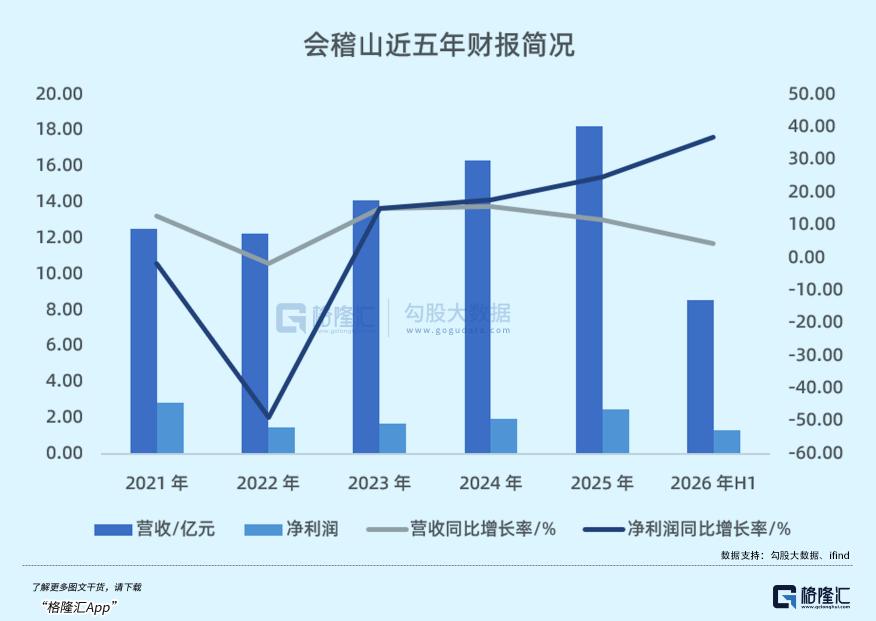
By the first half of 2026, a historic reversal officially took place.
Kuaijishan posted an operating revenue of 853 million yuan, up 4.43% year on year, and a net profit of 129 million yuan, surging 37.04% year on year. Both its revenue and profit outperformed Guyue Longshan's 787 million yuan and 92 million yuan respectively.
The decades-long ranking of "top player in yellow rice wine industry" has been rewritten.
The core reason why Kuaijishan's profit growth rate is far higher than its revenue growth rate lies in the upgrading of its product structure.
In the first half of the year, the sales revenue of Kuaijishan's mid-to-high-end yellow rice wine reached 595 million yuan, up 14.17% year on year, accounting for nearly 70% of the total revenue. The investment promotion scale of its core high-end single product "Lanting" nearly doubled.
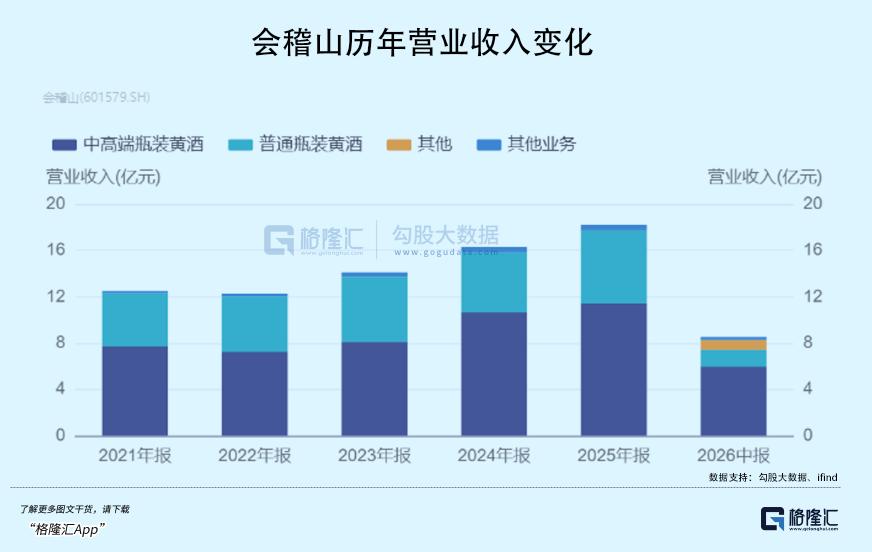
In 2025, Kuaijishan's gross profit margin reached 58.45%, hitting a new high since its listing.
However, for all the hype, yellow rice wine remains what it used to be.
Looking at the fundamentals of the yellow rice wine industry, there is always a temperature gap between the enthusiasm of capital and the reality of the industry.
02
The cold winter of the baijiu industry has arrived now, but this does not mean that yellow rice wine will usher in its spring alone.
At present, the total size of the yellow rice wine industry is about 20 billion yuan, while the size of the baijiu industry is dozens of times that number.
The revenue of Kuaijishan's mid-to-high-end bottled yellow rice wine in the first half of the year was 595 million yuan, while the total size of the entire high-end yellow rice wine market is only 200 million to 300 million yuan at present.
Facing the high-end baijiu market with a size of 300 to 400 billion yuan, yellow rice wine does have huge room for growth in terms of volume flexibility, but on the other hand, its foundation is indeed very weak.
More importantly, the consumption scenarios of yellow rice wine are quite limited.
In the past, yellow rice wine consumption was highly concentrated in the Jiangsu-Zhejiang-Shanghai region. In the first half of 2026, Kuaijishan's revenue in its home market Zhejiang decreased by 9.85% year on year, while its revenue in Shanghai increased by 20.95%.
Although the growth rate in other regions outside the three provinces reached 76.59%, the proportion of revenue from regions outside Jiangsu, Zhejiang and Shanghai is still less than 17%, which means that the high growth rate outside the core market is based on a very low base.
Large baijiu distributors across the country can help promote the product, but yellow rice wine is still far from achieving real national market penetration.
There is also an unavoidable question: do young people drink yellow rice wine at all?
Industry survey data shows that 73% of yellow rice wine consumers are over 40 years old, and the gap in young consumer groups is a long-term dilemma for the entire category.
The sparkling yellow rice wine "Yiri Yixun" launched by Kuaijishan was a hit for a while, with its sales exceeding 10 million yuan within 72 hours during the 2024 618 shopping festival, and its total GMV across all platforms exceeding 50 million yuan during the 2025 618 shopping festival. Guyue Longshan's "Wugaodi" series has also entered 52 cooperative bars across the country.
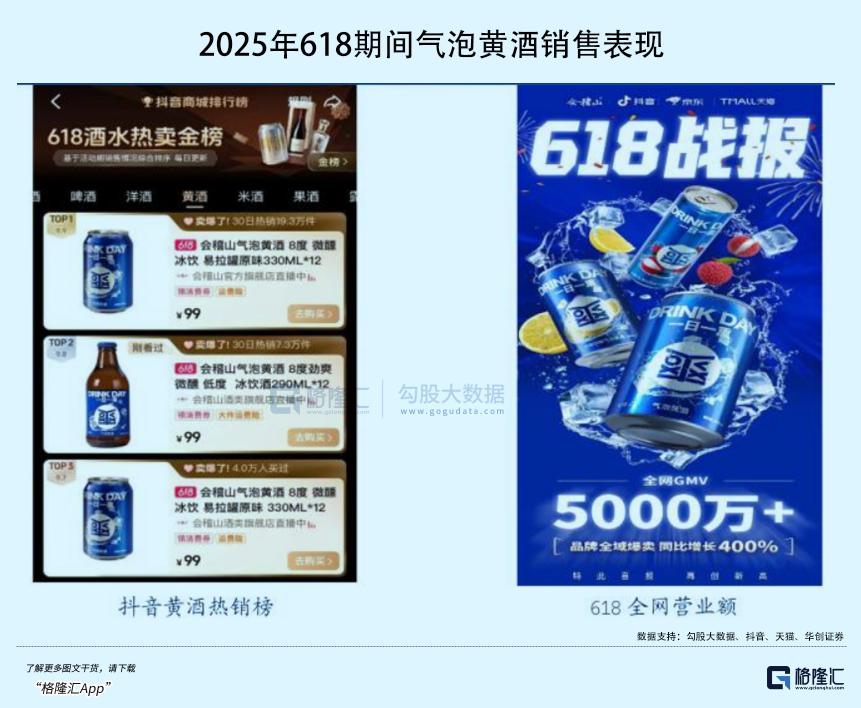
However, according to the analysis of Huachuang Securities, the current new yellow rice wine products targeting young consumers are mainly driven by novelty-seeking demand, their taste still needs to be cultivated, and the repurchase rate is relatively low.
In the final analysis, young people may buy a can of sparkling yellow rice wine out of curiosity to try something new, but there is still a long way to go before they form a daily consumption habit of drinking it just like craft beer or low-alcohol cocktails.
In this regard, the problem faced by yellow rice wine is exactly the same as that of baijiu.
It can also be seen from Kuaijishan's financial report that in the first half of the year, its sales expenses reached as high as 236 million yuan, with a sales expense ratio of about 27.7%, and its advertising and promotion expenses hit 132 million yuan, about 6.6 times that of Guyue Longshan.
This model of burning money for growth can produce a beautiful growth curve in the short term, but how long it can last is a real problem.
From an investment perspective, the baijiu industry has now fallen into a severe adjustment far more drastic than that of 2013 to 2015. But even in such a downturn, the profitability of the baijiu sector is still far higher than that of the yellow rice wine sector.
Although the median gross profit margin of the baijiu sector dropped from 75% to 67.35% in 2025, it is still much higher than Kuaijishan's 56.65%.
In terms of ROE, Kuaijishan's 3.36% in the first half of 2026 is also lower than the median 4.95% of the baijiu sector.
In fact, this round of yellow rice wine market rally reflects a growth narrative, since the baijiu industry has already entered a stock game, while yellow rice wine still has room for growth from 0 to 1, and then from 1 to 10.
At present, the size of the high-end yellow rice wine market is only 200 million to 300 million yuan, while the high-end baijiu market is 300 to 400 billion yuan. Even if it can capture a tiny fraction of the high-end baijiu market, it is enough for the high-end yellow rice wine market to double its size.
Such flexible imagination space is indeed attractive, but the problem of the growth narrative also comes from this, that is, whether such growth space can be converted into real and tangible performance.
At the end of the day, large distributors can bring yellow rice wine to high-end dining tables, but whether consumers will accept the taste and whether they will buy it again after drinking are all issues that need time to test.
03
Conclusion
Back to the question at the beginning, is this round of rise of the yellow rice wine sector a short-term carnival of capital, or a value revaluation of an ancient liquor category?
Honestly speaking, it may be both, but the element of short-term carnival is probably greater.
Capital withdraws from the baijiu sector to seek undervalued targets, and yellow rice wine just provides a target with small volume, appealing growth story and dense positive catalysts.
The entry of large baijiu distributors has indeed brought imagination space for channels and social circles, and the policy that six national departments have included yellow rice wine in the support framework for historically classic industries has also provided additional positive sentiment support.
But from the perspective of industrial fundamentals, the national market expansion, high-end positioning and youth-oriented transformation of yellow rice wine are all