Li Auto bids farewell, Geely completes the integration, CATL remains exactly the same as it always was.
On the morning of September 18, CATL opened higher and moved lower, with its share price falling all the way from 310 yuan to a low of 300.27 yuan, putting the 300-yuan mark under renewed pressure. On September 16, it had just fallen by more than 5%, hitting an intraday low of 299 yuan, a new low in a year; on the same day, Sunwoda's share price rose by more than 13%, while second-tier manufacturers such as Tianhong Lithium Battery, Jinyang Precision, and Gotion High-tech rose in tandem. The weak rebound on September 17 only lasted for one day.

After the sharp drop, sell-side institutions are speaking out in unison. CLSA maintains a target price of 535 yuan for A-shares, Bernstein gives 800 yuan, and 47 analysts surveyed by Bloomberg unanimously give a "buy" rating. The market value has evaporated by about 785 billion yuan in four months, yet no analyst has turned bearish.
In the first half of the year, CATL's operating revenue reached 2769.17 billion yuan, a year-on-year increase of 54.80%; its net profit attributable to shareholders was 432.84 billion yuan, a year-on-year increase of 41.98%, making an average of 240 million yuan per day.
Its performance is the best in the same period in history, but its share price is at the lowest level in a year.
On September 16, Geely responded to the Chongqing Yaoning transaction for the first time, stating that the "8.5 billion yuan investment" is not true, it has not abandoned self-development, let alone sold the factory, and "this is just a small move in Geely's entire battery strategy".
A "small move" was exaggerated into "selling the factory", and the misreading itself is more thought-provoking than the refutation. When the narrative of "de-CATLization" grows bigger and bigger, any asset action of an automaker will be taken as new evidence of this story. Is CATL's throne really about to change hands?
01 A misinterpreted transaction
On September 11, the State Administration for Market Regulation made a public announcement that the "case of CATL acquiring the equity of Chongqing Yaoning" was approved unconditionally, with the trial conclusion date being September 3. The real buyer is not CATL, but Time Geely.
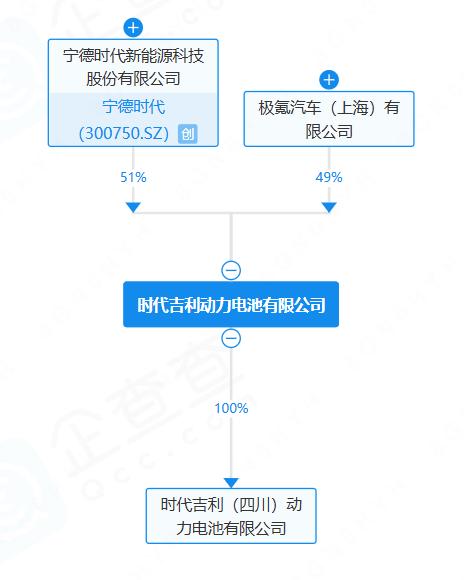
Time Geely is a joint venture between Geely Auto and CATL, with CATL holding 51% of the shares and Zeekr, a subsidiary of Geely, holding 49% of the shares.
The case name says "CATL's acquisition" because CATL holds the controlling stake. Relevant Geely personnel clearly stated to Shanghai Securities News that after the transaction is completed, the daily operation of Chongqing Yaoning will be taken over by Time Geely, and Geely will still play an important role in the project. "This move is a normal asset optimization under the framework of the existing joint cooperation between the two sides."
Many people may be unfamiliar with Chongqing Yaoning, but its background is not trivial.
Chongqing Yaoning was formerly known as Chi Hang New Energy, which was jointly established by Geely Technology Group and Farasis Energy in 2021.
This is the starting point for Geely to build its own cell production capacity in southwest China. In May 2022, the project officially started construction. The initial planned annual production capacity was 12GWh, with a building area of 310,000 square meters, a construction period of 24 months, and it was scheduled to be completed in 2024.
Unfortunately, the project did not go into operation as originally planned. The company changed its name several times, and its equity was gradually transferred to Jiangsu Yaoning, and finally incorporated into Geely's integrated battery platform Ji Yao Mobility. The project capacity was adjusted from 12GWh to 18GWh, and the completion time was postponed to December this year. The main body of the plant was only capped in June this year.
Now, Geely has chosen to cooperate with CATL. In five years, this plant has experienced three owners. The three transformations of one plant are the epitome of Geely's five-year battery strategy.
There are two numbers that were misinterpreted this time: First, the "8.5 billion yuan investment". Geely responded that there is no such thing as 8.5 billion yuan at all, "I don't know where this 8.5 billion yuan came from", and it may be a comprehensive assessment including factors such as land prices. Second, the "30GWh production capacity" does not match the energy conservation review opinions.
There is one denied characterization: Geely abandons self-development. Geely said that Yaoning is a newly built factory. Do not mistakenly think that Geely no longer develops batteries independently and abandons self-development because of the Yaoning incident. Geely's battery strategy has always been three parallel lines of "self-development + strategic cooperation + diversified supplementation", and self-development is still the core.
This transaction has an even bigger background. In April 2025, Geely integrated its battery business into Ji Yao Mobility, and uniformly launched the Shield Golden Brick battery brand, aiming to concentrate R&D and production, and eliminate redundant investment and marginal production capacity. The integration has achieved results. Ji Yao Mobility has built ten intelligent manufacturing bases and three research institutes. As of the second quarter of this year, the cumulative shipment of cells has reached 75 million units. The production capacity landed since the beginning of this year is 70GWh, and the future production capacity will be further expanded to 150GWh.
The market is accustomed to binary thinking. If the factory is handed over to the platform controlled by CATL, it is equivalent to abandoning self-development. But the actual situation is that Geely is walking on two legs, expanding self-development and deepening cooperation at the same time. The Galaxy TT launched on September 10 is fully equipped with CATL's Shenxing battery, and the Galaxy Battleship 700 pre-sold on September 15 uses CATL's 6C battery as standard.
From CATL's perspective, the capacity utilization rate in the first half of the year was 94.86%, running at full capacity; the approval of new production capacity is tightening, and the under-construction projects that can start trial production by the end of the year are more cost-effective than new construction in terms of time and policy.
51% vs 49%, CATL holds the controlling stake, and Geely is also at the table. The equity structure of this factory is like a microcosm of the entire industry's status quo.
02 A decent farewell: Automakers no longer work for CATL
Geely chooses to deepen the bond, while Li Auto takes a different path.
On September 4, Li Auto invested 2.65 billion yuan to increase capital in Sunwoda Power and became its second largest shareholder. Three days later, Li Auto issued an announcement: all models will be successively equipped with self-developed batteries. The already equipped models include L8, L6, i8; the new generation MEGA will switch from the order locking after 15:00 on September 7; the first batch of i9 uses CATL batteries, and will be fully switched after the production capacity ramps up; the 2026 i6 series will all use self-developed batteries. After the fourth quarter, CATL will basically withdraw from Li Auto's supply system.
The so-called self-development means that Li Auto takes the lead and second-tier manufacturers do the OEM. In October 2025, Li Auto and Sunwoda established Shandong Li Auto Battery Co., Ltd. at a 50:50 ratio. Li Auto takes the lead in material system, cell structure, Pack integration and BMS algorithm; Sunwoda is responsible for the engineering and large-scale manufacturing of cells, and the battery pack is self-developed and self-made by Li Auto.
Looking further back, as early as 2022, Li Auto's affiliated entity invested 400 million yuan to participate in the financing of Sunwoda Power. From the first investment to the full model switch, this farewell has been prepared for four years.
Li Xiang stated at the Q2 earnings conference and in the explanation of this self-developed battery that "self-developed batteries do not affect CATL being a leading battery brand". This "nice guy card" makes this breakup look quite decent.
In the same week, Xiaomi held a press conference for its Longjia battery. CALB and Sunwoda built dedicated production lines according to the specifications set by Xiaomi. The Longjia battery is currently clearly installed in the Pengcheng range-extended series, and no adjustment has been announced to the existing CATL and FinDreams battery supply systems for SU7 and YU7.
However, CATL basically did not get a share of Xiaomi's incremental business. According to industry estimates, CATL supplied more than 8GWh of batteries to Xiaomi in 2024, and the figure rose to about 30GWh in 2025, making Xiaomi its third largest customer. After that, the new cake was distributed to other players.
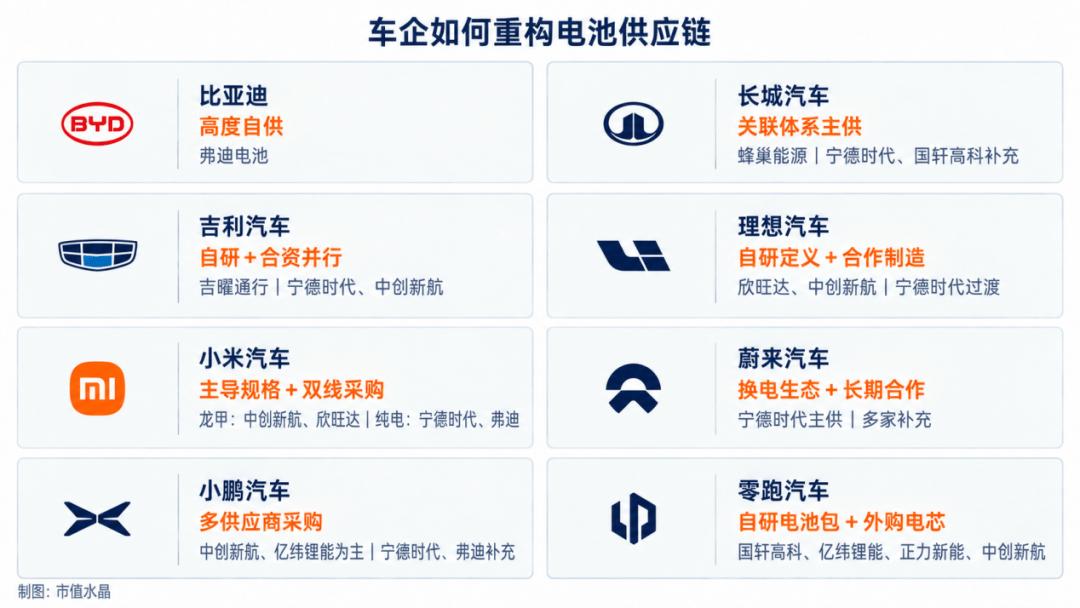
Why do automakers do this?
First of all, to master core technologies. Li Xiang said that batteries and chips are the most core technical barriers, and the three-electric technology, intelligent driving model and excellent product power will be the core competitiveness of the company.
Secondly, there is no doubt about cost reduction. In the first half of the year, Li Auto's net loss was 3.98 billion yuan; the operating loss of the division where Xiaomi Auto is located totaled 5.7 billion yuan. Automakers want to minimize the cost of batteries. Batteries are the most expensive components in vehicles. It is widely circulated in the industry that second-tier manufacturers quote 5% to 10% lower for battery packs of the same specification, and the price difference of a 53-degree ternary battery pack is nearly 2000 yuan. Saving 2000 yuan per car, with an annual sales of 300,000 units, the total savings reach 600 million yuan.
Interestingly, while automakers are giving up working for CATL, consumers are choosing CATL. In the early stage of i8's launch, some versions adopted dual suppliers of CATL and Sunwoda, and the battery versions were shipped randomly, which caused consumer dissatisfaction, and the Sunwoda version was cancelled; when the i6 tried dual suppliers again, the CATL version required queuing, while the Sunwoda version had ready cars and a free 3999-yuan extended warranty.
GAC and Mercedes-Benz also once gave up CATL as the main supplier, choosing CALB, Farasis or their own battery factories as the main suppliers, but after two or three years, they all returned to the situation where CATL is the main supplier.
In addition, according to the latest "2026 Global New Energy Vehicle Consumer Research Report" released by the world-renowned research institution Nielsen IQ, 37.1% of Chinese consumers said that they would give up buying their favorite models if they are not equipped with CATL batteries.
Zeng Yuqun launched the "CATL Quality" Global Open Month on September 3, shifting the battlefield from price to quality, and the confidence probably comes from here.
03 The first place is still there, but what "first place" can exchange is changing
There is no doubt that the top spot in the battery industry still belongs to CATL.
Among the top ten global power battery shipments in the first half of the year, Chinese enterprises occupy seven seats, with a combined market share of 72.4%. CATL alone accounts for nearly 40% of the global market share, 2.8 times that of the second-ranked BYD, ranking first for the ninth consecutive year.
It is also gaining share in overseas markets, with its share in non-Chinese markets rising from 30.0% to 33.6%. Its global share of energy storage shipments is 27.1%, which is also the first in the world.
In an interview with The Wall Street Journal around the age of 58, Zeng Yuqun said: "Without CATL, the US electric vehicle market is doomed to fail."
Back in China, its market share in the first half of the year reached 46.04%, and 46.7% in terms of passenger vehicle caliber. The share is still rising.
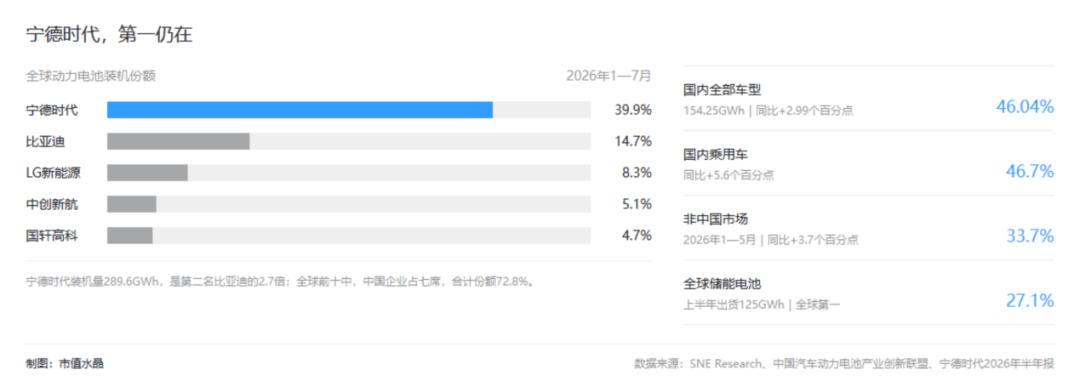
How does the outside world view this throne?
Bing Yuan, a fund manager at the foreign institution Edmond de Rothschild, told Bloomberg: "In the past, many automakers have tried to promote de-CATLization, but none of them succeeded. It is extremely difficult to replicate CATL's technology and reliability. Smaller suppliers may be able to meet the needs of mass-market models, but not flagship and high-end product lines."
However, the net profit of 43.284 billion yuan needs to be viewed from the other side: the gross profit margins of both power and energy storage have declined; net profit increased by 42%, but operating cash flow only increased by 2.61%; inventory increased by nearly 40% compared with the beginning of the year.
When the semi-annual report was released, the market's attention was all on the 43.284 billion yuan. Looking back more than a month later, the direction of capital smashing the market is precisely these three lines of small numbers on the back.
From the intraday high of 468.75 yuan on May 7 to the low of 299 yuan on September 16, the decline was about 36.2%. Based on a static estimate of the total share capital of about 4.627 billion shares, the market value difference is about 785 billion yuan. The company launched a share repurchase plan of 20 billion to 40 billion yuan, the repurchased shares will be used for cancellation and capital reduction, and the first operation was carried out on September 11, buying 200 million yuan of shares.
The market value has evaporated by 785 billion yuan in four months, but none of the 47 analysts surveyed by Bloomberg turned bearish. CLSA gave a target price of 535 yuan for A-shares, and Bernstein gave 800 yuan, both nearly twice the current price.
However, ratings and positions are not always synchronized: the disclosure of the Hong Kong Stock Exchange shows that BlackRock recently reduced its holdings of CATL's H shares, and the proportion of long positions dropped to 5.92%. The phenomenon of shouting to buy while reducing positions appeared in the same time window.
CLSA believes that the recent share price decline is mainly affected by investor sentiment, especially the "reverse FOMO" phenomenon observed during the promotion in the UK and European markets, which led to market sell-offs. The report believes that the forces of bulls and bears will continue to wrestle in the short term, and the share price may remain volatile until the company releases its third-quarter 2026 results in mid-October.