A new drug that took eight years to develop is described by the marketing department as having "no story to tell": Why is the content in the biomedical industry always indulging in self-entertainment?
A friend of mine who works in R&D at a biomedical company complained to me some time ago: "We spent eight years advancing a targeted drug project, and completed three phases of clinical trials. But the tweet written by the marketing department was full of talks about 'innovative therapy' and 'precision treatment', with the core mechanism mentioned in a perfunctory line. Doctors could not find where its advantages lie compared with existing regimens after reading it, and patients only knew it was a new drug."
This is not an isolated case.
Surveys show that more than 75% of biomedical enterprises regard R&D as their core competitiveness, but less than 15% of them can effectively translate R&D achievements into market-friendly language. The R&D team is immersed in researching targets and pathways in the laboratory, while the marketing team piles up jargon and concepts in the cloud, separated by an invisible wall.
On one side of the wall is self-indulgent science, on the other side is the confusion of doctors and patients.
01 The Disconnection Between R&D and Marketing: Science Cannot Speak for Itself, and the Marketing Team Cannot Translate It
The biomedical industry is unique in that it is both a high-end manufacturing industry and a content industry under strict regulation.
The competitiveness of a product lies half in its molecular design and clinical data, and half in medical communication and market expression. However, the organizational structure of most enterprises naturally separates these two aspects.

What the R&D team focuses on in the laboratory are target selectivity, biomarkers, pharmacokinetics, and clinical endpoint data. What the marketing team pays attention to in the office are doctor awareness, patient education, payer value, and competitor positioning. Both sides are highly professional, but they do not speak the same language.
A biomedical enterprise once launched a candidate drug focusing on "microecology regulation". The R&D team carried out a large number of solid experiments on flora balance, but the selling point written by the marketing department was "boosting immunity", which left no impression on doctors. The head of R&D remained silent for a long time after reading the material, and said: "What we are developing is not a health supplement."
The problem does not lie in anyone's lack of effort, but in the absence of a translator between the R&D and marketing teams.
02 What is FDE? Why Does the Biomedical Industry Need It?
FDE, the full name of which is Forward Deployed Engineer/Expert, refers to the role of forward-deployed engineer/expert.
This concept first emerged in the technology industry, referring to roles that do not sit in the headquarters writing code, but are directly embedded in the customer's business site to understand real problems and deliver solutions quickly. They are not technical support staff, but business translators.
Dazhaoxiang is introducing the FDE model into the content service sector of the biomedical industry.

In short, the FDE content service of Dazhaoxiang means dispatching content experts to settle in biomedical enterprises, and go deep into the front lines of R&D and manufacturing. They are not writers waiting for briefs at their workstations, but go into the laboratory with the R&D team, inspect the production lines with the factory staff, and discuss data with the clinical team. Then they translate technical language into market language, and turn mechanism logic into stories that doctors and patients can easily understand.
Content is no longer top-down "packaging", but "expression" that grows out of R&D and manufacturing practices.
03 How Does Dazhaoxiang's FDE Content Service Work?
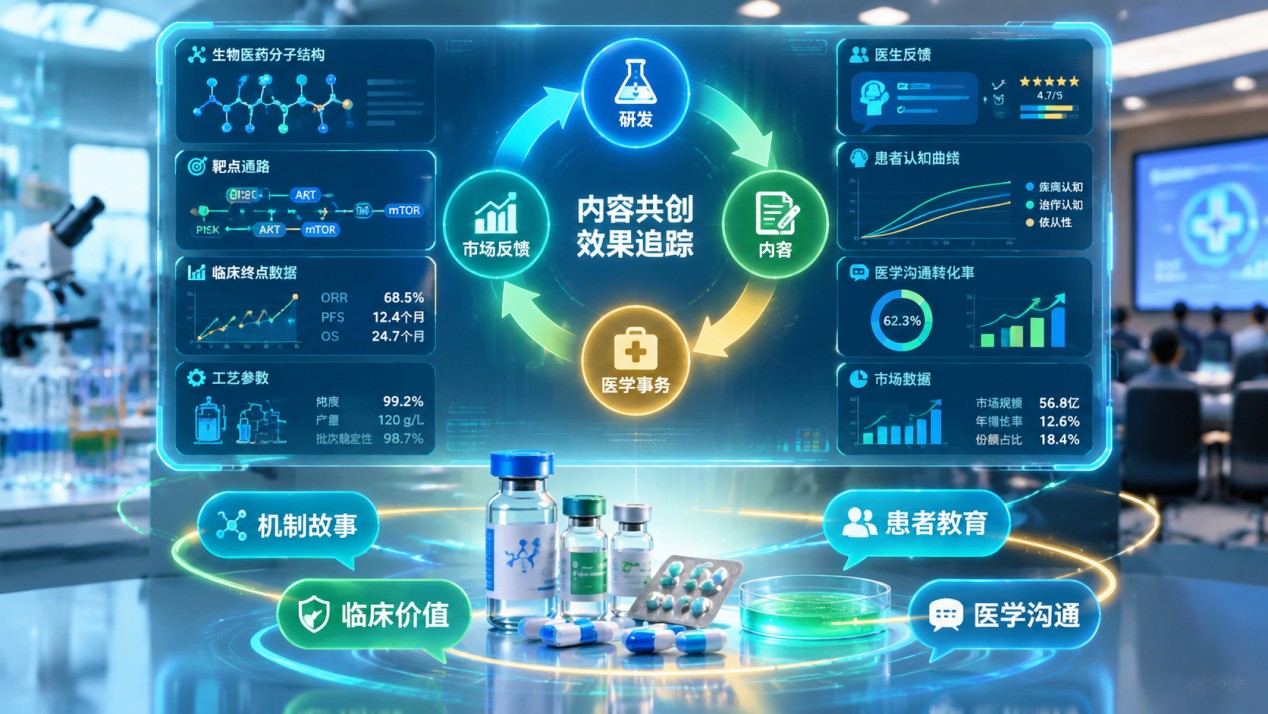
It follows three steps: on-site diagnosis, co-creation of content, and closed-loop effect management.
On-site diagnosis. FDE experts spend one to two weeks going deep into the R&D and manufacturing sites, attending project review meetings, reading clinical research reports, discussing process difficulties with production line staff, and even participating in raw material screening. The goal is to find the breaking points between R&D and marketing: where the technical advantages lie, what is missing in market expression, and what content needs to be supplemented.
Content co-creation. It is not the FDE who writes behind closed doors, but polishes the content together with the R&D, marketing and medical affairs teams. Each piece of content must be able to answer a real clinical question, and every material can become effective ammunition for medical liaison officers and sales staff. The head of R&D of a biomedical enterprise said: "In the past, the marketing department submitted drafts and we put forward suggestions; now we discuss together, and the content produced by the content team is professional enough for the R&D team to recognize, and easy to understand for doctors."
Closed-loop effect management. After the content is released, track doctors' feedback and awareness data to see which mechanism points are remembered and which expressions resonate with the audience. Use data to support content iteration, so that R&D investment can be truly recognized.
After an enterprise adopted the FDE model, doctors' awareness of its core mechanism increased by more than twice, and the efficiency of medical communication improved significantly.
04 Who Needs FDE Content Service?
If your biomedical enterprise meets any of the following conditions, the FDE content service may be exactly what you need:
- You have strong R&D capabilities but weak market expression, and cannot clearly communicate your technical advantages;
- Your products face severe homogenization, and you want to build differentiated recognition through mechanisms and clinical data;
- The communication cost between the marketing department and the R&D department is high, with slow content output and serious information distortion;
- You want to transform from "marketing-driven" to "R&D-driven + content-driven".
Biomedical manufacturers, R&D-driven pharmaceutical companies, and players in the innovative therapy track are all natural demanders for FDE content services.
05 The Next Stop of Content Services: From the Office to the Laboratory
In the past, content services followed the mode of "you raise the demand, I write the draft". Now, the FDE content service of Dazhaoxiang follows the mode of "I understand R&D, and we write it together".
When content experts move from the office to laboratories and production lines, and transform from writers to technical translators, biomedical content will no longer be a castle in the air, but real expression supported by molecular mechanisms, endorsed by clinical data, and verified by production processes.
Dazhaoxiang is now opening up cooperation opportunities for FDE content services. If you are tired of the disconnection between R&D and marketing, you are welcome to contact us for discussion.
After all, high-quality biomedical content should not only be seen, but also trusted.