Frontline | Coronal Kaiwu Super Workstation Has Been Deployed on Yuantu Production Line, and the POC Verification Success Rate Exceeds 99%
Author丨Qiao Yujie
Editor丨Yuan Silai
On September 16, Corono AI, a company focused on foundational models and solutions for the physical world, and Guangdong Yuntu Future Technology Co., Ltd. (hereafter referred to as "Yuntu"), a global leading server manufacturer and full-stack AI infrastructure solution provider, held the unveiling ceremony of the POC cooperation super workstation and joint laboratory at Yuntu's Dongguan Intelligent Manufacturing Base.
The two sides announced the establishment of the "Yuntu × Corono Industrial Embodied Intelligence Joint Laboratory", and demonstrated the real machine operation of the Corono super workstation on Yuntu's ICT production line on site. According to the introduction, the super workstation completed the POC verification half a month ago with a success rate of over 99%; in the on-site demonstration, the learning of new materials and operation switching were completed in only 15 minutes.
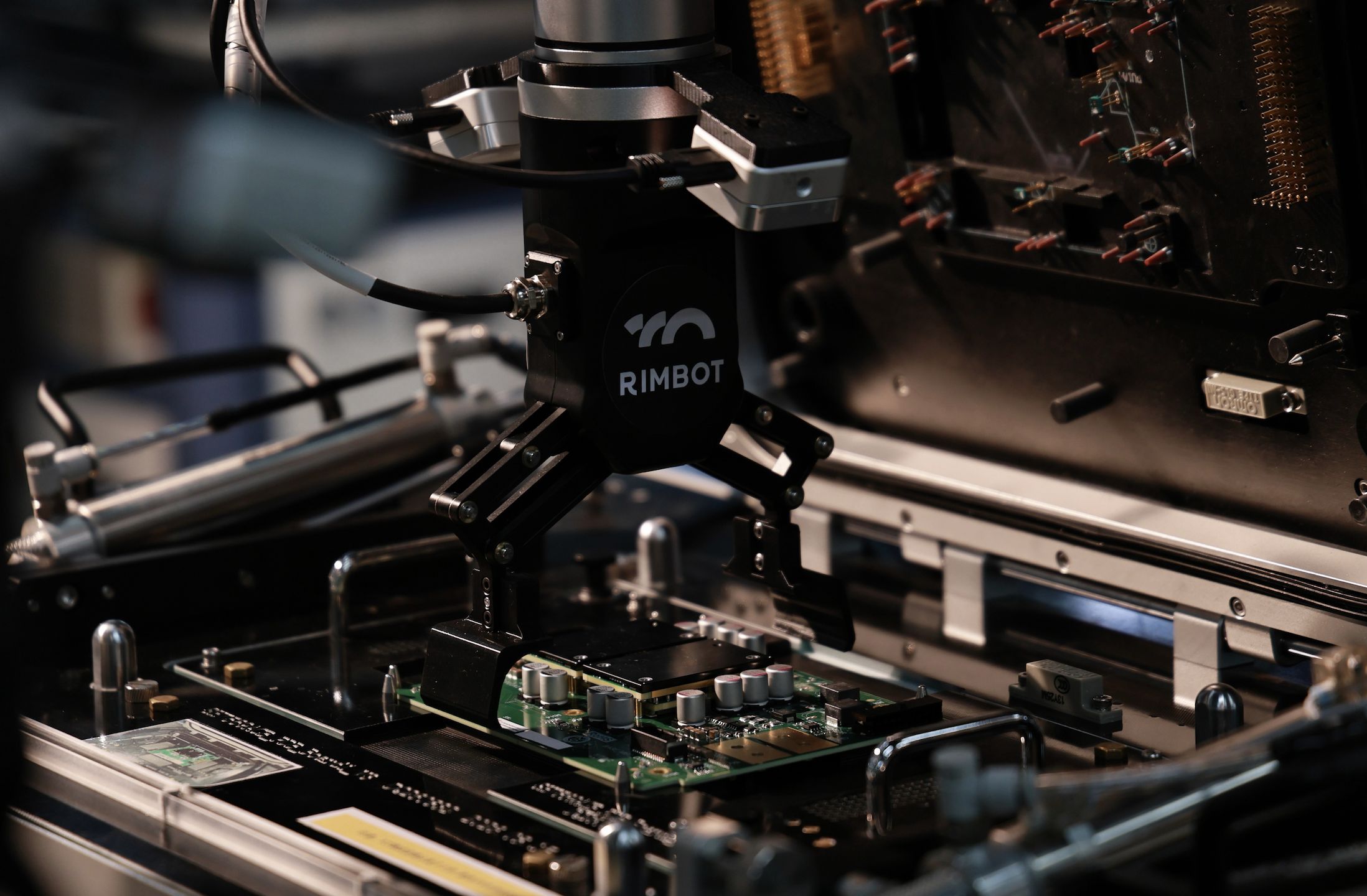
The super workstation performs ICT test operations
Through this cooperation, the two sides aim to answer a specific question, that is, how embodied intelligence can truly be integrated into industrial production, rather than remaining only at the technical verification stage of single-point tasks.
Zhou Caiqing, Vice President of Yuntu, said that as AI servers evolve toward multi-chip integration, high-power power supply and high-density heat dissipation, server manufacturing is characterized by a wide variety of order categories, small batch sizes, and fast iteration speeds, which puts higher requirements on manufacturing processes and flexible production capabilities.
At present, the overall automation rate of the server manufacturing industry is about 30%, and the production and testing links account for about two-thirds of the total working hours in the whole process. Each product model change usually means investment in dedicated equipment or production line transformation. In the past, Yuntu compressed the whole machine delivery cycle to 48 hours through lightweight flexible intelligent manufacturing, but relying solely on traditional automation and production line optimization is still difficult to meet the rapidly changing manufacturing demands, and the manufacturing model itself requires a generational upgrade.
Founded in March this year, Corono AI focuses on foundational models and solutions for the physical world. Its core team consists of four Tsinghua doctors, who have previously led the development of NIO NWM1.0 and Huawei ADS5.0 world models, and delivered the industry's first batch of real embodied robot operation clusters. The company proposed the embodied-native LaMPA foundational model architecture and Recursive Speedup Evolution System (Physical RSI).
The super workstation is the first standardized product launched by Corono AI, positioned as a new-generation Physical AI production workstation for flexible manufacturing. Its core capabilities include "mastery after one learning", "extending knowledge to similar scenarios" and "surpassing manual work": the deployment of new processes can be shortened from the week or month level of traditional automation to hour-level on-site real machine reinforcement learning; at the same time, failure cases in the production process are converted into learning signals to continuously update the model, and further optimize in stability, consistency and efficiency.
The underlying technology supporting the above capabilities is Corono's Physical RSI (Recursive Speedup Evolution) system. Its core logic is to enable robots to continuously obtain feedback in real operations: when encountering unknown scenarios, the system independently identifies cognitive gaps, updates the world model, trains new strategies and completes real machine verification. The verified experience is then precipitated back to the base model and synchronized to the robot cluster.
"The core problem that the joint laboratory needs to solve is to let the robots go through those complex and practical industrial problems such as equipment interface, process connection and exception handling one by one without interrupting production, and precipitate them into replicable methods. All problems come from the production line, and all results go back to the production line for verification," said Xiao Zhongyang, Founder and CEO of Corono AI, at the unveiling ceremony.
At the event, the two sides jointly demonstrated the real machine operation of the super workstation on the ICT production line. The alignment accuracy of ICT (In-Circuit Test) needs to be controlled within ±0.05mm, and the requirements for compliant force control are relatively high. In addition to completing standardized operations, the super workstation can also identify position deviation and mixed-in materials.
In the model change link, the super workstation completed the learning of new materials and operation switching in only 15 minutes. For comparison, a single line change of the traditional SMT production line usually takes 2 to 4 hours. This is also one of the core problems that the super workstation tries to solve: to reduce the deployment cost of new materials and new processes in the face of manufacturing demands with multiple categories, small batches and frequent iterations.
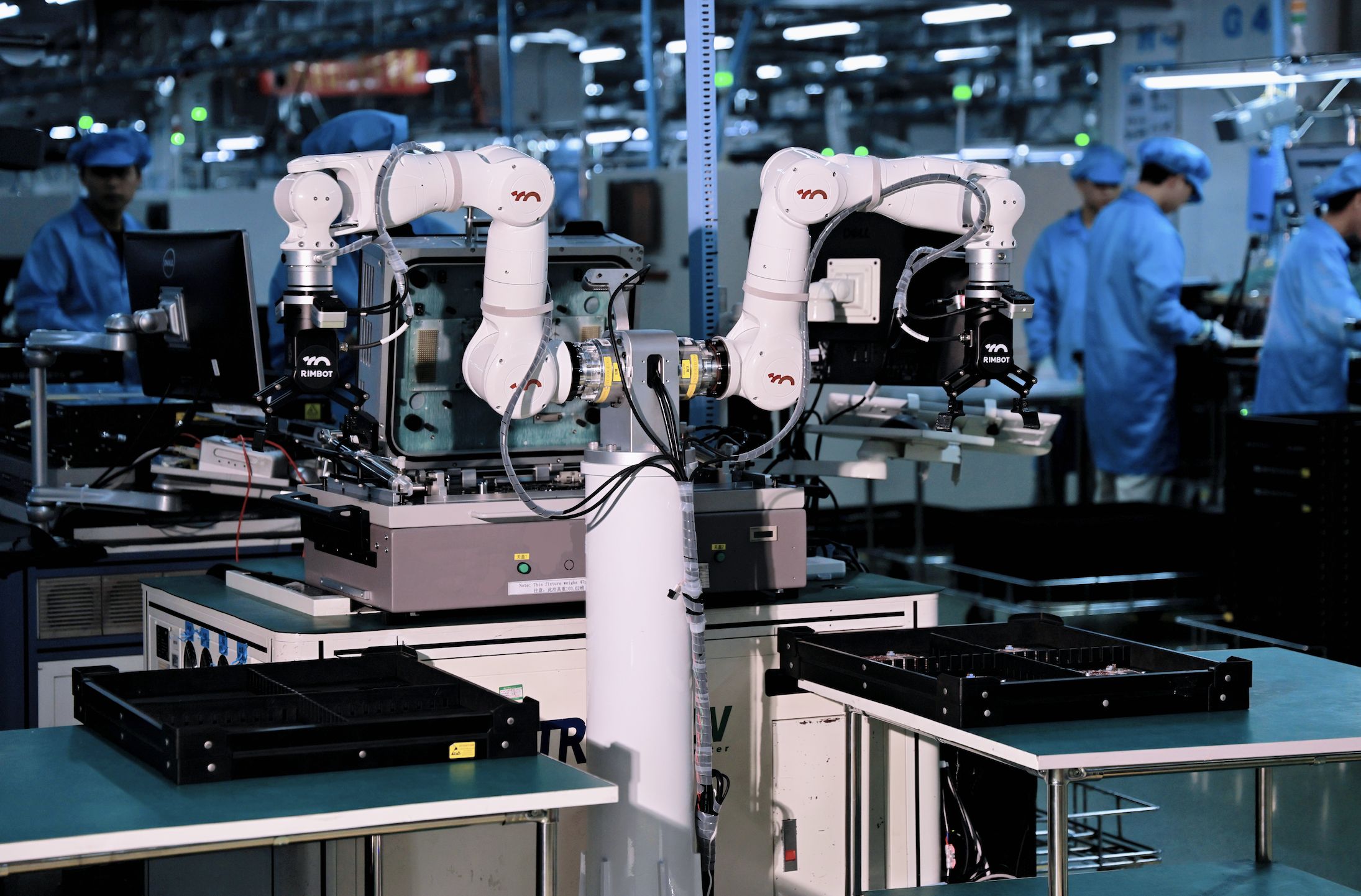
The super workstation performs real machine operations on Yuntu's ICT production line
The two sides plan to take the ICT process as the starting point, gradually cover more processes in Yuntu's factory, realize the deployment of hundreds of super workstations in 2027, and further move towards the cluster application of ten thousand units in 2030.