Chat with meteorologists from the 10-billion-yuan private equity firm about El Niño
In 2026, Shanghai has been hit by typhoons for countless times, and extreme weather has also disrupted the global financial market.
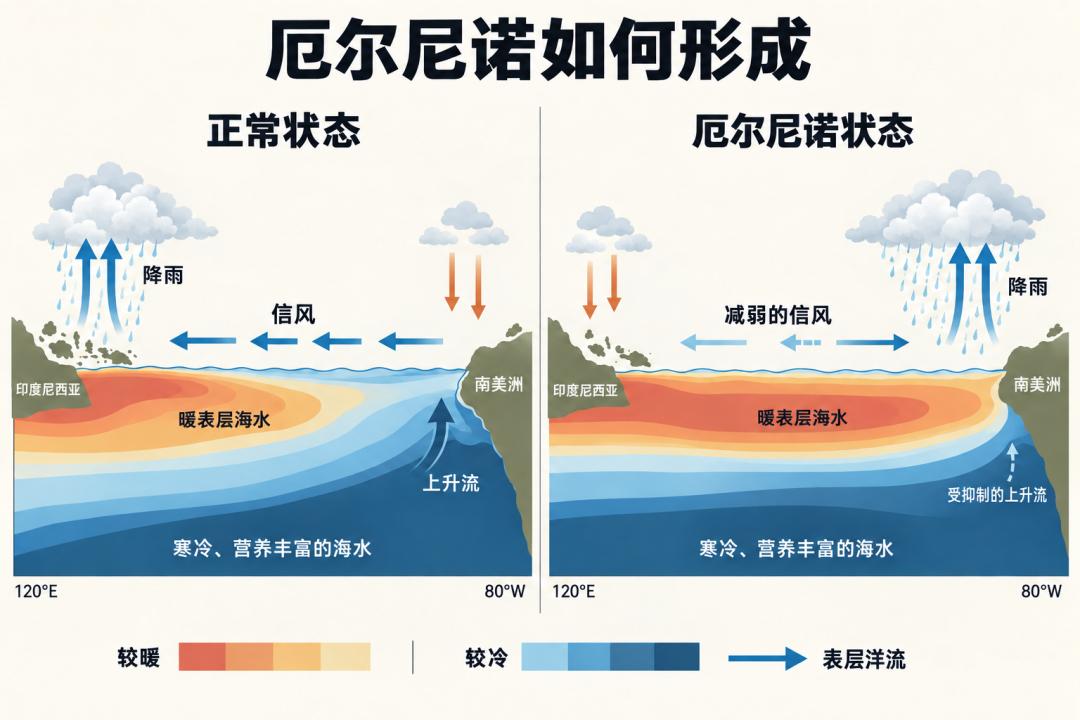
NOAA estimates that the probability of El Niño occurring in autumn and winter exceeds 90%, and the probability of the strongest El Niño since 1950 occurring in the fourth quarter has risen to 69%. JPMorgan Chase warns that a global food crisis may break out in 2027, and the next inflation shock may not appear at gas stations, but on the food shelves in supermarkets.
Since July, as expectations of El Niño have heated up, agricultural products and agricultural stocks have ushered in a sharp rally, and capital preference has shifted dramatically: not long ago the market was still chasing high-growth tracks, and in the blink of an eye, all attention turned to the agricultural sector.
However, the market rally came fast and faded even faster. Right at the time when domestic and overseas brokerages intensively released "El Niño" themed reports, agricultural products and agricultural stocks quickly pulled back. This round of El Niño rally that was once called a historic-level event has suddenly become full of uncertainties.
It is exactly at this highly divergent point in time that Yuanchuan had a new conversation with Liu Chuanxi, chief meteorological researcher of KaiFeng Investment, 5 years after their last interview.
Liu Chuanxi is one of the earliest meteorological analysts in China's private equity market. He graduated from the Chinese Academy of Sciences with a doctorate, and later went to the University of California, Los Angeles to conduct postdoctoral research. During his further study, he was recruited by Gloria L. Manney, chief scientist of NASA, and joined NASA/JPL (Jet Propulsion Laboratory), an institution co-founded by Mr. Tsien Hsue-shen. In 2015, Liu Chuanxi just joined KaiFeng Investment and experienced an El Niño event immediately.
Five years have passed, Liu Chuanxi says he has made progress. Compared with the early stage when he only focused on weather research, he has gradually learned to combine his understanding of weather data with commodity supply and demand and the macro environment, to find the correlation mapping between them. This practical meteorological analysis reminds people of Stagg in *72 Hours of Normandy*.
In March this year, Liu Chuanxi deduced along the El Niño transmission chain and predicted the possible decline of the Panama Canal's transportation capacity. In his deduction, the interweaving of multiple factors including global warming, frequent wars and blocked logistics will push the impact of this round of El Niño to an unprecedented result.
El Niño Amid Warfare
Yuanchuan Investment Review: What are the differences between this round of El Niño and the previous two cycles in 1997-1998 and 2015-2016?
Liu Chuanxi: First, the global average temperature may hit a new historical record. Against the background of global warming, the global average temperature may reach a new high in the El Niño year.
Second, according to historical statistics, droughts caused by El Niño basically occur in equatorial regions, such as Southeast Asia, India, and the Caribbean. But this year, in addition to droughts in these traditional regions, extreme droughts have also appeared outside the tropics.
For example, the drought and heat wave in Europe are beyond imagination; another example is the United States. Historically, in El Niño years, the corn and soybean producing areas in the United States usually have favorable weather and basically no yield reduction. But this year, the continental United States experienced hot and rainless weather in July, the average temperature of the whole summer refreshed the historical record, and the southern part of the plain area suffered severe drought.
Yuanchuan Investment Review: What uncertain variables does war bring to El Niño?
Liu Chuanxi: At the beginning of the year, we believed that the probability of El Niño was relatively high. At the end of February, the Middle East war broke out, pushing up international oil prices, and energy prices were transmitted to fertilizers along the industrial chain. The Middle East is an important sulfur export region, so both the cost and supply difficulty of fertilizers have risen.
We thought at that time that extreme weather occurs frequently in El Niño years, and now energy prices are high, the usage of fertilizers may decline due to supply bottlenecks and rising costs, which will weaken the ability of crop planting areas to resist extreme weather, and further aggravate the risk of yield reduction.
In March, we judged that the Middle East war would amplify the risk of global grain and agricultural product yield reduction, and in August, investment banks such as JPMorgan Chase also gave similar deductions.
Yuanchuan Investment Review: What changes have exceeded the expectations of the original deduction?
Liu Chuanxi: From July to August, the Russia-Ukraine situation intensified again. Ukraine attacked Russian refineries, causing diesel supply shortages. Russia struck grain export ports along the Black Sea coast of Ukraine, such as Odessa and other terminals.
A realistic contradiction is: the planting area in the Black Sea region has expanded, the output has increased, and there is no abnormal weather, but due to frequent warfare, the export of grains such as wheat and corn has dropped significantly compared with expectations, further aggravating the global supply shortage of grain and agricultural products this year.
The superposition of extreme weather and geopolitical black swan has jointly boosted the popularity of agricultural products and the agriculture, forestry, animal husbandry and fishery sector.
Yuanchuan Investment Review: Foreign investment banks have started to write reports intensively, and after sorting out the war transmission chain, does it prove that all positive factors have been priced in?
Liu Chuanxi: First of all, the situation on the Russia-Ukraine battlefield is not covered in most investment research reports, and the situation is highly uncertain. Whether the blockade lasts until the end of the year or is lifted immediately has a completely different impact on global grain prices.
Secondly, the current market is mostly trading on the expectation of yield reduction, but the actual implementation of yield reduction still requires a gradual process of confirmation or falsification.
The yield reduction of palm oil in Indonesia and Malaysia may be realized in the first and second quarters of next year, 8 to 10 months after the drought; the output data of cotton and sugarcane in India is disclosed with a lag, and the specific value of yield reduction can only be verified at the end of the pressing and processing season.
In addition, this round of El Niño is still in the intensity climbing period, and its peak usually appears from November to December. Its impact will not disappear immediately with the attenuation of El Niño, and may continue until the middle of next year or even longer.
In this process, the frequency of global extreme weather will remain at a high level, and it is not excluded that extreme weather outbreaks will continue to be seen in the media. This is more likely to be a market trend lasting for 3 to 6 months or even longer, rather than the pulse-like conceptual speculation in the past.
There is also an easily overlooked variable: as extreme weather occurs frequently, many countries will take active defensive measures. For example, recently officials from Nordic countries and the United Kingdom have called on the public to stock up on grain and canned food in advance.
If many countries follow suit, the apparent global grain demand will be pushed up, and a large amount of demand will be converted into end-user household inventory, then the supply in the trade link will decrease, and the supply and inventory perceived by the market will be tighter than imagined.
Panama Canal and Crude Oil
Yuanchuan Investment Review: In your recent article *How Does the Energy Market Price Risks Under Extreme El Niño*, you mentioned that the water level of the Panama Canal indirectly affects the crude oil market?
Liu Chuanxi: That article was co-written by me and another expert. What I want to express is not that it will push up energy prices, but to explain the special situation this year.
In El Niño years, drought occurs in the Caribbean, and the water level of the canal drops. The Panama Canal Authority limits the draft depth of each ship, the load capacity is restricted, and the cargo volume of each ship decreases. At the same time, the number of ships passing through every day is limited, more ships are needed to transport the same amount of cargo, the transportation capacity declines, and the freight rises.
This is the transmission logic of El Niño in previous years, but the special situation this year is the Middle East war.
The Middle East is the most important energy hub in the world. In addition to the Strait of Hormuz, the Red Sea and the Bab el-Mandeb Strait have recently been closed due to attacks by Houthi armed forces. As a result, since March, a large part of the energy procurement of Asian countries such as Japan and South Korea has turned to the United States, and the crude oil exports from the United States to Japan and South Korea increased significantly in the second quarter.
The freight demand for energy and chemical products through the Panama Canal has risen sharply, superimposed on the drought in El Niño years, which may make the Panama Canal more congested this year. Not only crude oil is affected, but container ships, dry bulk carriers and natural gas ships passing through the canal are all affected.
The special feature of the Panama Canal is that it does not adopt an equal queuing mechanism. A certain proportion of quotas are auctioned every day for priority passage, and the cost is very high. In the news, ships carrying energy, crude oil, natural gas, LPG, LNG and other goods may pay 1 million or even 5 million US dollars for passage fees.
This leads to the fact that during the queuing process, more and more ships are willing to pay high prices to jump the queue, while ships transporting low-value goods such as soybeans, corn and grain cannot afford the high queue-jumping fees. The ship charter is billed by day, and they cannot wait all the time, so they have to detour via the Cape of Good Hope.
It takes about 30 days to transport goods from the U.S. Gulf Coast to Japan and South Korea via the Panama Canal, and about 50 days via the Cape of Good Hope. Even if there is no congestion, it will take about 20 more days of sea time and fuel cost, which will be transmitted to the Asian end market as higher freight cost, and further push up the inflation of demand countries.
Yuanchuan Investment Review: It sounds like the biggest impact of this round of El Niño is not on agricultural products. Under the superposition of war and supply chain disruption, crude oil and copper may be more affected?
Liu Chuanxi: Copper will indeed be disturbed. From July to August this year, blizzards occurred frequently in Chile, affecting mineral production and exports in a single month. But overall, agricultural products are still the most sought-after by the market, and the logistics link will spread the impact to a wider range of commodities.
Yuanchuan Investment Review: The logistics link amplifies the impact of El Niño.
Liu Chuanxi: That's right. The fourth quarter is the tightest period for global logistics. The demand for Asian energy imports rises in winter, and agricultural product exports are seasonal. The fourth quarter is exactly the listing window for U.S. agricultural products, plus the stocking demand for Christmas and Thanksgiving in the United States. Since people usually stock up 2 to 3 months in advance, container shipping enters the peak season in the third and fourth quarters. The probability of congestion in the Panama Canal in the fourth quarter is already very high.
Prices Move Ahead of Weather Changes
Yuanchuan Investment Review: Why have agricultural products and agricultural stocks fallen so sharply recently?
Liu Chuanxi: Various research reports have been released intensively recently, and the market has discussed a lot. But the core reason may be the adjustment after excessive short-term rise. In addition, the biggest negative factor for the entire commodity and stock market before was the Fed's interest rate hike triggered by U.S. inflation.
Yuanchuan Investment Review: Without considering the war, from a purely climatic perspective, are palm oil, rubber and sugar most deeply affected by El Niño?
Liu Chuanxi: In several El Niño cycles in history, these varieties are prone to yield reduction. The core reason is that they mainly grow in tropical regions, concentrated in India, Southeast Asia and other places.
But the problem is that a large number of macro funds and non-industrial funds entered the market very early this year. They bought as early as March or April when the El Niño expectation just emerged, and the prices have risen quite a lot. Now even people who don't pay special attention to commodities know these varieties.
Just like when everyone thinks they should buy AI-related assets, it is often the peak of short-term sentiment.
Yuanchuan Investment Review: Is there any variety that has risen but is not supported by your data?
Liu Chuanxi: In the past few months, the trading of most varieties was based on El Niño expectations. The output of palm oil is not poor, but the price has been rising. Both varieties are in the contango structure (the price of near-month contracts is lower than that of far-month contracts), and natural rubber and sugar also have similar characteristics.
Yuanchuan Investment Review: We know that there is an 8-10 month lag period for the palm oil yield reduction effect, so where is the mismatch between market expectations and reality for rubber and sugar?
Liu Chuanxi: Due to the global inventory surplus of international raw sugar, in the first half of this year, overseas managed funds held net short positions. El Niño may have a greater impact on the yield reduction of sugarcane producing areas overseas, while domestic output increased this year and demand was weak, so the price performance was weak. When international raw sugar rose sharply, the increase of domestic sugar was relatively small.
However, sugar has the possibility of "dilemma reversal". The key depends on whether the drought and yield reduction in Thailand and India can digest the global inventory. In addition, sugarcane is a perennial crop. After the sugarcane is cut, the root system remains in the soil and can grow next year. Therefore, the problems caused by drought this year may affect the output of next year.
Therefore, the sugar cycle usually does not only last for one year. If the producing areas such as India and Thailand have yield reduction due to drought this year, it is not excluded that the weather will still have a negative impact on the output of next year.
Rubber is divided into three varieties: domestic natural rubber, Shanghai Futures Exchange No. 20 rubber (benchmarked against Southeast Asian rubber), and cis-polybutadiene rubber (synthetic rubber, affected by energy prices).
The rise of natural rubber in this round is on the one hand due to the long-term sluggish rubber price in the early stage, the global rubber production capacity has shrunk, and it has entered a price rise cycle; on the other hand, it is superimposed on the energy price rise brought by the Middle East war and El Niño expectations.
In reality, drought has occurred in the producing areas of Indonesia and southern Thailand this year, and only periodic drought has occurred in inland Thailand and Vietnam. Moreover, the drought in central and northern Thailand and Vietnam this year occurred in the rainy season, and moderate less rainfall is conducive to rubber tapping in the rainy season. Therefore, there is no serious yield reduction of natural rubber this year for the time being.
However, the peak production season of natural rubber in Thailand is concentrated in the fourth quarter. If the drought impact of El Niño continues into the fourth quarter, it may lead to drought in the inland producing areas of Thailand so severe that rubber tapping cannot be carried out, and the output of natural rubber in the peak production season may still have certain uncertainties.
Does Private Equity Need a "Weather Expert"
Yuanchuan Investment Review: At the beginning of this year, what opportunities did you judge correctly through meteorological research that were finally verified by the market?
Liu Chuanxi: There are mainly two types.
One type is targets with strong energy attributes. The agricultural product with the strongest energy attribute is vegetable oil, such as palm oil and rapeseed oil. Foreign countries will mix vegetable oil into diesel oil in a certain proportion to make biodiesel, which can be directly used as fuel for automobiles and trucks. Therefore, when energy prices rise, superimposed on El Niño expectations, vegetable oil prices will rise sharply.
The other type is nitrogen fertilizer and chemical fertilizers driven by rising energy prices. The main cost of urea production abroad is natural gas, which may account for 70% or even 80%. The rise in fertilizer prices also led the market to generally believe that the cost of corn has risen, and then yield reduction pushes up prices, so corn performed relatively well this year.
But the direct driving reason is not entirely the cost. When the war broke out in March, the agricultural material preparation of northern