The former number one player in the women's footwear industry is making a strong comeback.
By He Zhexin
Edited by Qiao Qian
The Legend
In the 1990s, every American woman had a pair of Nine West in her shoe cabinet.
This is no exaggeration, as The New York Times wrote in 1997. In the women's footwear category, Nine West was the earliest and most thorough beneficiary of the global industrial chain division of labor. Before Zara, H&M and Uniqlo swept across the world, it had already practiced this business model two decades in advance.
In 1969, Italian-American Vince Camuto received an invitation from Sumitomo Bank of Japan. The bank hoped to diversify its investments and asked him to go to Brazil to design and import shoes under its own brand — where raw materials were sufficient, labor was cheap, and a large number of factories were idle. During multiple trips to Brazil, Camuto met Jerome Fisher, who was also a contractor of Sumitomo Bank.
In May 1977, Fisher Camuto Corporation was established in New York. When the two founded their own business, they summed up their model in one sentence: Japanese capital, Italian design, and Brazilian manufacturing.
In the first year of its establishment, the company's revenue reached 9 million US dollars. In 1978, it moved to 9 West 57th Street in New York. Camuto said he looked out the window and saw the number "nine", hence the brand name Nine West.
At its peak at the end of 1995, Nine West accounted for 35% of women's shoe sales through US department store channels. For reference, Nike held a 32% share of the US branded sports shoe market in the same period.
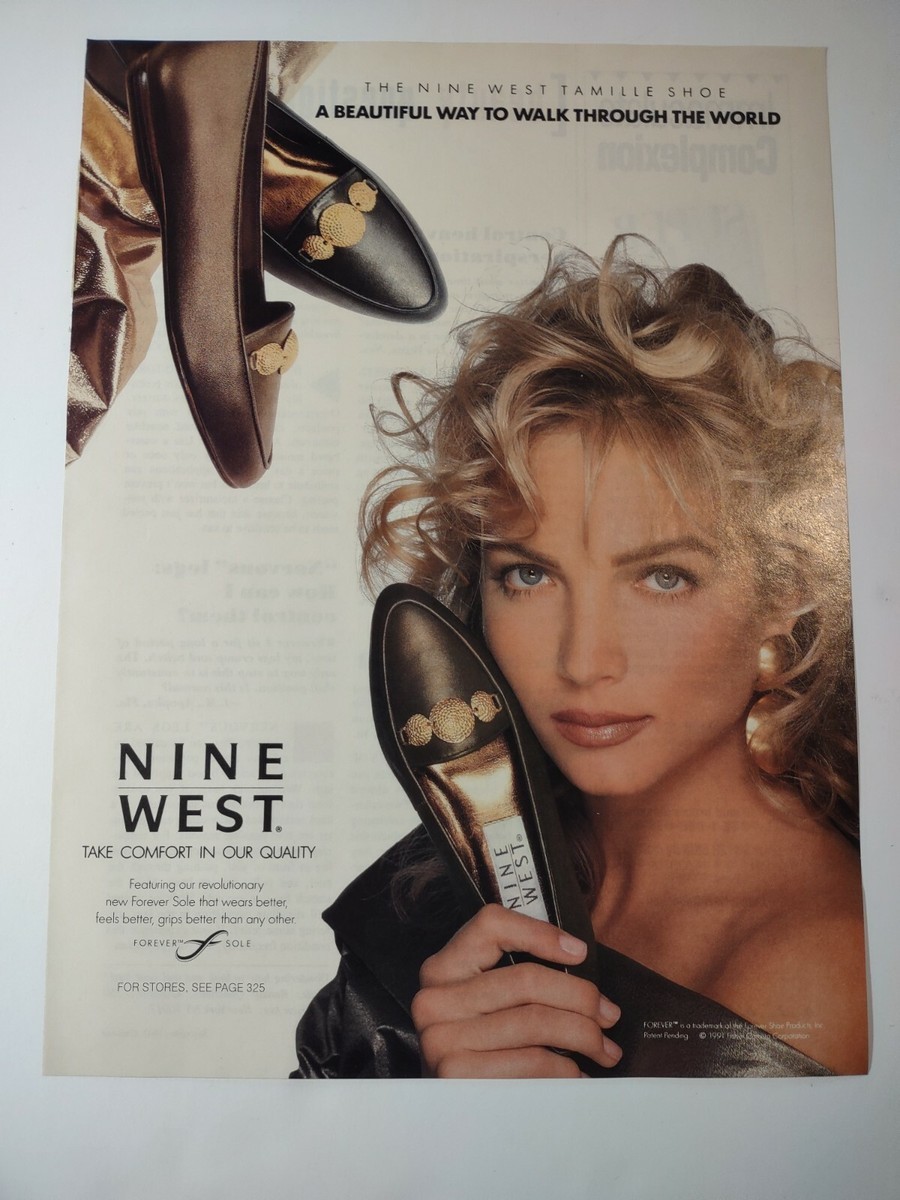
Nine West's advertisement in the 1990s
In 1999, Nine West was acquired by apparel group Jones Apparel for 1.92 billion US dollars in annual revenue. In the following two decades, the North American department store channel declined systematically, fast fashion brands such as Zara eroded its market share, and it failed to respond effectively to changes in consumer trends. In 2018, Nine West declared bankruptcy, and the brand was later acquired by international brand management firm Authentic Brands Group (hereafter referred to as Authentic) for more than 340 million US dollars, together with its sister brand Bandolino.
Nearly 50 years later, Josh Perlman, Executive Vice President and Head of Greater China at Authentic, recalled to 36Kr the original intention of the brand's founding and the values that have continued to this day:
"Vince Camuto and Jerome Fisher founded this brand in New York to bring New York style and a new professional lifestyle to women — so that they look and feel great when they go to their first job interview. That is truly the cornerstone of this brand, and it will remain so in the future."
Our conversation took place on September 9. On this day, Nine West launched an optimized new version of its "9×9" technology born in 2017, a set of technology that claims to make high heels comfortable "from 9 a.m. to 9 p.m."
Authentic's office on West Nanjing Road in Shanghai was rearranged for this purpose, and every space was set up as a themed exhibition of different periods of Nine West. Looking out from the 42nd floor window, the three iconic high-rises in Pudong in the distance and the dense skyscrapers nearby also bear a faint resemblance to the Manhattan skyline.
The move to redesign the products happened to fall at a delicate point in time. The latest retail tracking data from market research firm Circana shows that sport lifestyle shoes, which led the market trend in the past decade, have obvious signs of slowdown, while products that can be smoothly transitioned from casual to formal occasions — ballet flats, thick-soled slip-on shoes, mules — have seen rising sales. Circana judges that this segment still has upside potential in the second half of the year, and comfort will remain the primary driving factor for consumers to buy shoes in the future.
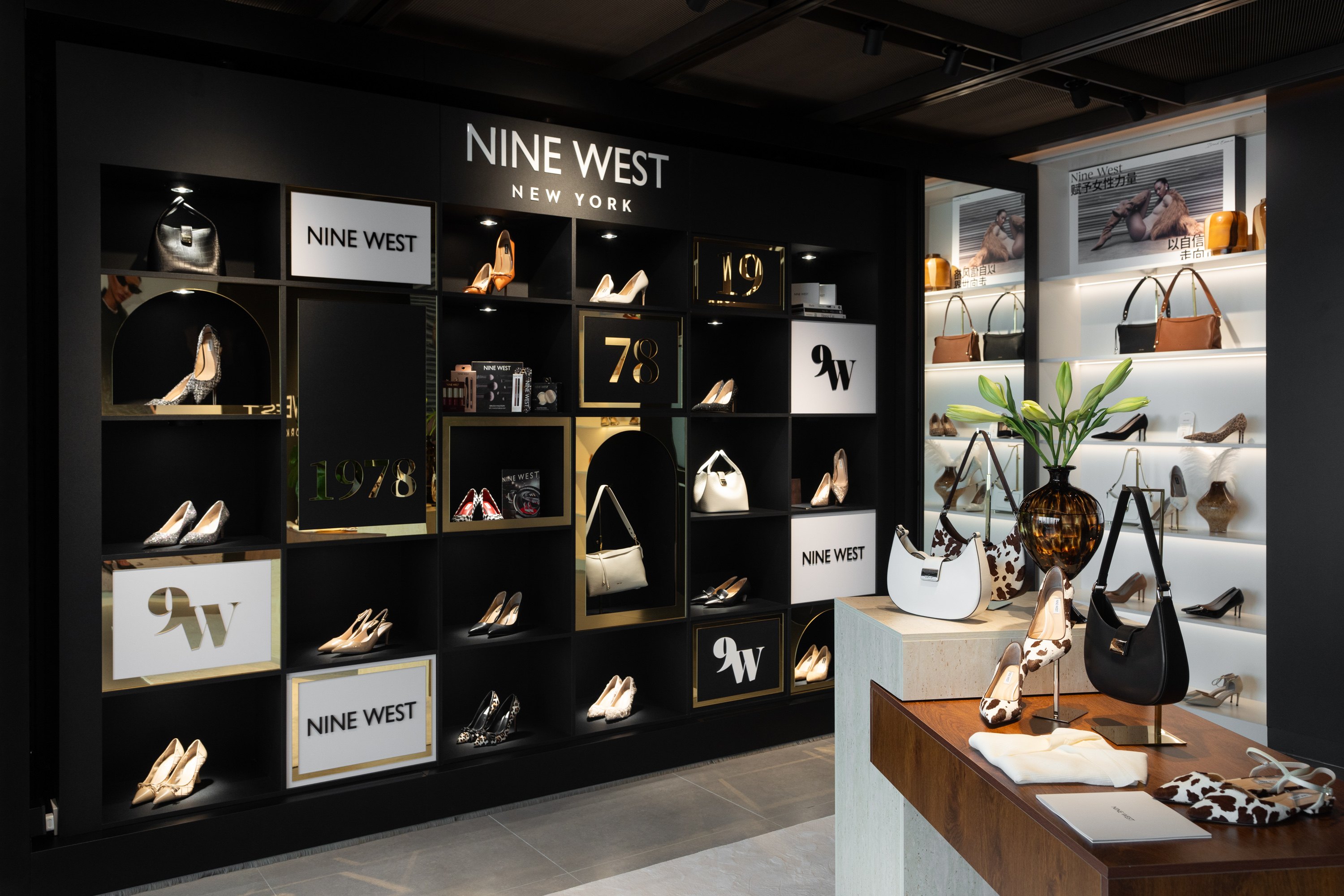
Nine West's exhibition at the Authentic office
However, Josh Perlman understands that even if high heels are labeled as comfortable, it is not easy to return to their former peak. The goal he set for Nine West is very practical: it would be quite good enough if one pair out of ten pairs of shoes owned by consumers is Nine West.
"Our challenge is: that kind of truly high-heeled, truly decent professional look, maybe you won't wear it too many times. But we will expand outward based on this DNA, and maybe we can get two or three pairs out of your ten pairs of shoes, which will be a very good result. But we hope you have at least one pair of Nine West in your shoe cabinet."
To achieve this goal, Authentic needs to find a partner in China.
Polishing
In Huang Wenhui's view, in the past five years, Nine West has only just completed the initial brand building in China.
In 2021, Meixi Industrial, a company under Giant Group founded by Huang Wenhui, took over the China operation right of Nine West. This Quanzhou-based retail operator previously focused on online business, and most of its clients were local domestic sports brands — ANTA, Xtep, Deerway, K-Bird. "Because these brands are the benchmark enterprises in our Quanzhou footwear and apparel industry."
At first, Huang Wenhui was engaged in online distribution of these brands without exclusive authorization. Around the 2008 Beijing Olympics, the national sports boom raised brand expectations to a high point, followed by a large number of store openings, massive inventory, and then large-scale online dumping. It was at that node that China's e-commerce platforms grew rapidly, and what they lacked was exactly brands, so the two sides hit it off. Huang Wenhui's team grew up in that wave.
But there will always be a day when inventory is cleared. After that, brands no longer have overstock, and turned to produce exclusive online products. Most of the domestic brands he represented also became online operation and online authorization brands under listed groups. Until May and June 2020, the pandemic pressed the pause button for everything, forcing him to rethink the future.
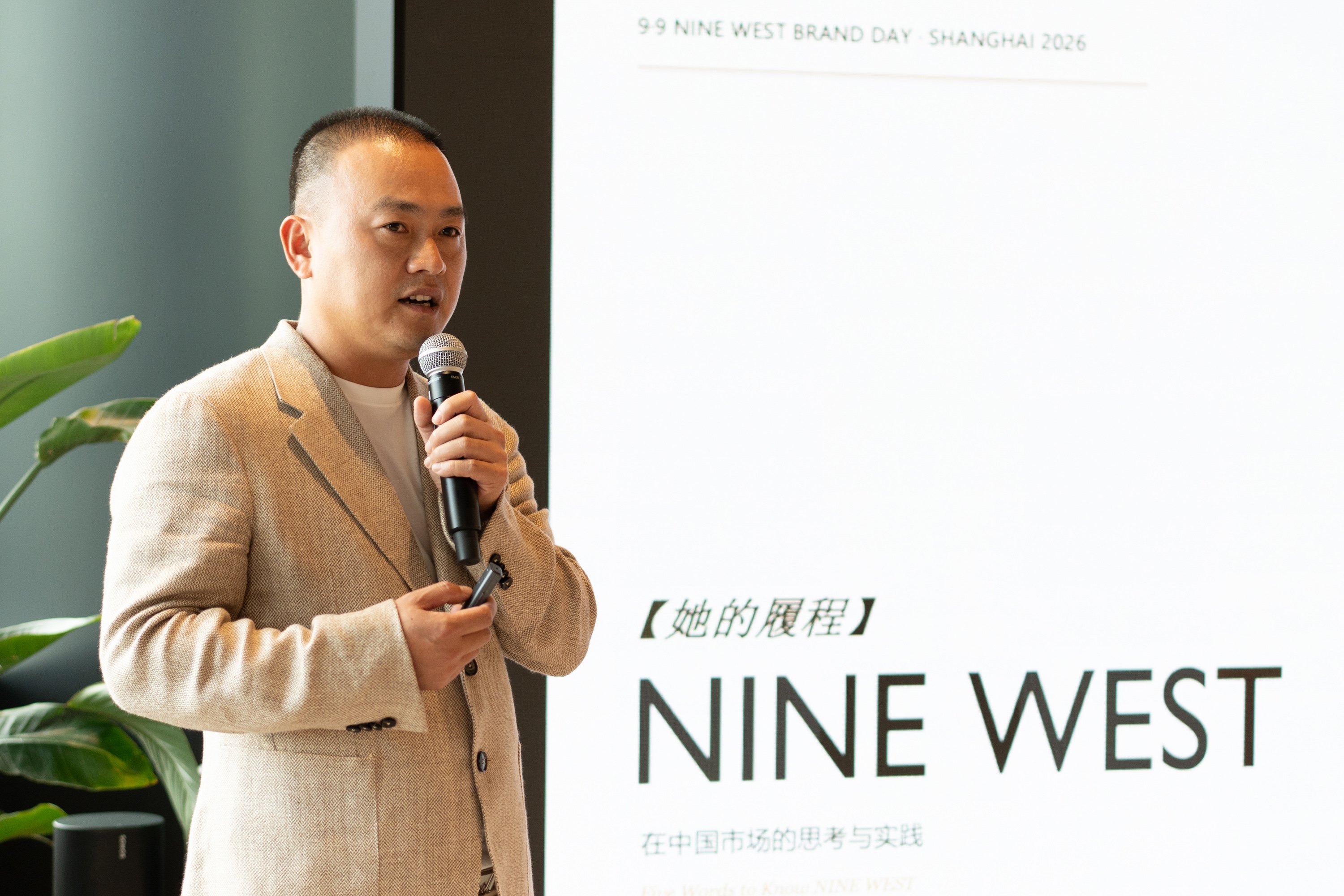
Huang Wenhui at the scene of Nine West's "9X9" technology launch
"At that time, we began to think that if we had the opportunity to operate a more valuable brand. A more valuable brand has to meet several points: first, the brand must have had a certain influence before, no matter how glorious it was in the past, at least it had a certain original foundation; second, it still has influence in the Chinese market; and then we must have considerable authority to carry out product development and channel construction."
Nine West thus came into Huang Wenhui's view. The only person in his team who had experience in women's shoes told him that this brand performed extremely well on Tmall — during the Double 11 shopping festivals in 2011 and 2012, it always occupied the most prominent banner advertising positions on the platform. "If we can operate this brand, our team will definitely be very confident."
Historically, the mainland operation right of Nine West has changed hands several times with the change of parent company ownership. Around 2011, the mainland operation right of Nine West belonged to Hong Kong company GRI, which was the exclusive Asian distributor of Nine West's then parent company Jones Apparel. GRI's mainland distribution right ended with Nine West's bankruptcy in 2018, followed by a three-year blank period.
When Huang Wenhui actually took over, the first problem the team had to solve was: how to respond to the current comfort trend while maintaining the brand's DNA. "Casual shoes account for more than 50% of the Chinese market, and Chinese people's demand for casual footwear is far greater than that of Americans."
Huang Wenhui's team has the right to develop products, but the final approval right belongs to the New York headquarters. He told 36Kr that the Chinese design team sends physical samples to the New York headquarters twice a year, plus multiple rounds of pattern review back and forth, and some "too casual" shoe models will be rejected — but "the overall pass rate of footwear products is very high".
The main products of Nine West are priced between 1,000 and 2,000 RMB, which is a comfortable range for offline transactions. As a result, a team that used to be good at online operation began to study store display.
This is a new topic for them: apparel has a naturally larger display area, and the display surface of one piece of clothing may be equivalent to three pairs of shoes; once given space, clothing will continue to expand in the limited retail area, and shoes will be squeezed to the edge. Huang Wenhui said that some of their stores that only sell shoes have higher store efficiency than stores that sell both shoes and apparel. But apparel also has a significant effect on enhancing brand image and driving conversion rate and customer unit price, which is an indispensable part of the retail space.
"We have been adjusting the proportion of the two areas. Our ideal state is that apparel accounts for 30% to 40%, and shoes account for 60% or even 70%, which I think is a very ideal state."
In addition to mixed display, stores also need to maintain a sense of freshness. Nine West is not a fast fashion brand, but Huang Wenhui requires new products to be put on the shelves "every one to two weeks", and pays special attention to maintaining full-price sales in flagship stores and image stores. Products with unsatisfactory performance will have a 30-day market response period. If they still do not perform well, they will be successively distributed to platforms such as outlets, Vipshop and Pinduoduo.
"At present, the team's reorder rate is 50%, and we hope to reach 60% or even 70% in the future."
Nine West currently has 20 to 30 stores, and will expand both online and offline in the future, focusing on first-tier and second-tier cities — "Key cities, key breakthroughs, focus on the footwear category." Talking about Nine West's expansion strategy, Huang Wenhui told 36Kr.
The Future
Looking back, the rise of Nine West can be described as the right time, place and people.
After the 1970s, more professional women entered the office, transforming from traditional "family purchasing agents" to powerful consumers with independent financial autonomy, and the demand for professional formal wear and high heels exploded.
Print media and TV hyped European luxury goods from "tailor shops for a few people" to "global desire labels", and what Nine West did was to "translate" this desire into products priced at 50 to 65 US dollars. Brazilian factories enabled it to achieve this: it only took eight weeks from delivering design specifications to receiving finished products, and the cycle "from T-stage to store" was compressed to within one quarter. These factories initially produced 200 pairs of shoes per day for Nine West, and by 1993, the number was 130,000 pairs per day.
At the same time, the wave of post-war American middle-class moving to the suburbs reached its peak in the 1970s and 1980s, and department stores were ushering in their golden age in history. Nine West was one of the first companies to propose the "shop in shop" format in department stores, which helped the brand save labor and rent while greatly enhancing its brand value. When it went public in February 1993, the company already had 236 retail and outlet stores, and supplied more than 2,000 department stores, specialty stores and independent stores.
Half a century later, these three conditions are met again at the current node in China. The proportion and level of young Chinese women entering the workplace are rising. The proportion of women receiving higher education has exceeded that of men, and more than 50% of women are employed in the tertiary industry. The overall timeline of marriage has been pushed back, which makes the period from when they enter the workplace to when they start a family several years longer than the previous generation, which is exactly the age when formal wear is needed.
And Chinese factories (to be precise, factories in Fujian) provide speed comparable to that of Brazil back then. The eight-week cycle in Brazil is now one to two weeks. Huang Wenhui's team launches four seasons of products a year, with new products available almost every one to two weeks. After women's shoe enterprises such as Belle closed a large number of stores, they left behind space for department store counters — the number of stores shrank from 20,800 in the 2017 fiscal year to 8,361 in November 2023.
And the demand itself, in Huang Wenhui's view, has never disappeared: "In fact, formal, business high heels, boots and other products still have market demand, especially in some very formal occasions, including social occasions, people still need a pair of high heels that are really comfortable to wear. But at present, there are few brands on the market that can provide comfortable high heels with a heel height of 7.5 cm or even higher, which is also a pain point."
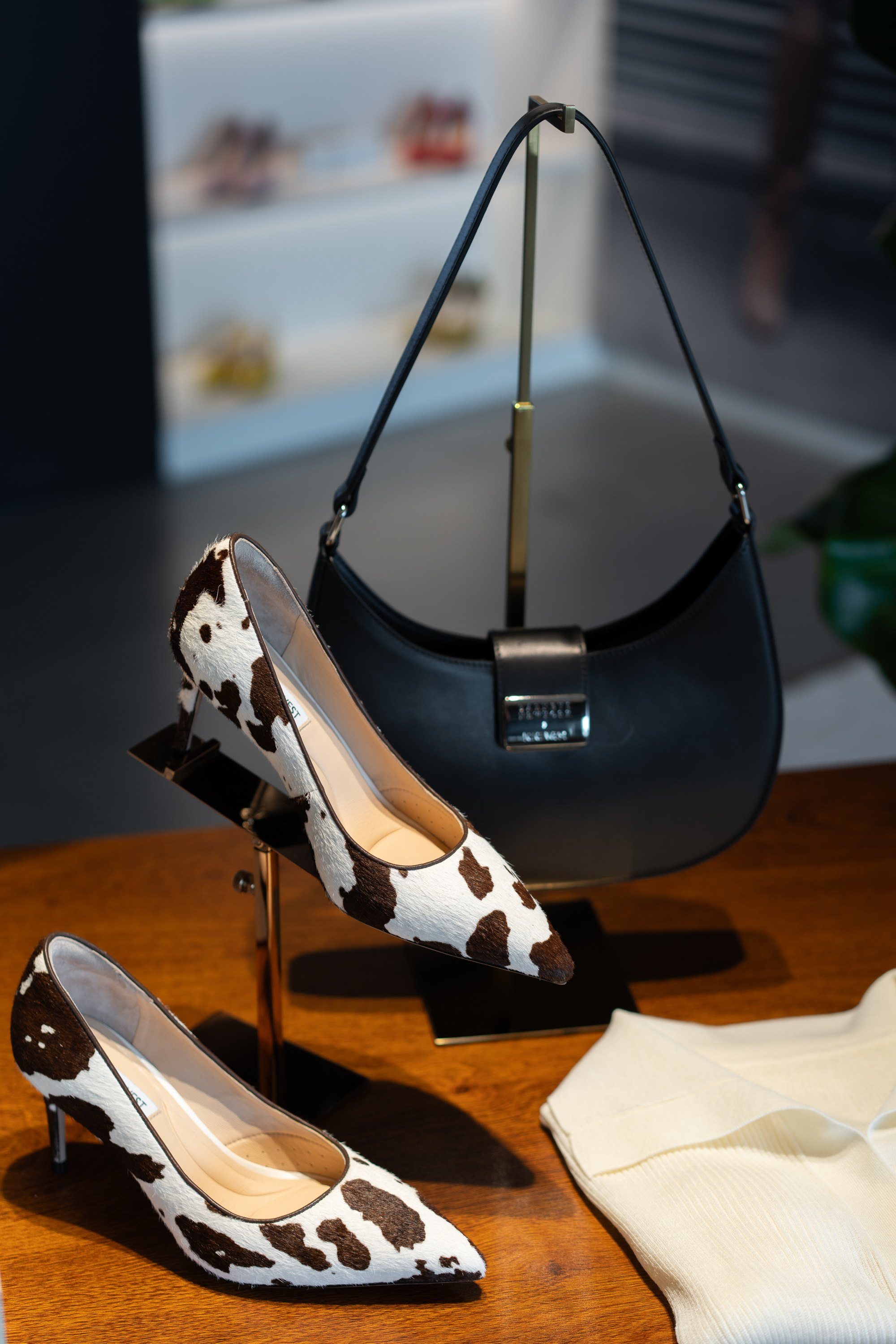
Image source: Nine West
This is not just an operator's judgment of his own business. The same observation has appeared in sell-side research reports.
Last year, Williams Trading analyst Sam Poser said when upgrading the peer brand Steve Madden's rating from "Hold" to "Buy" that the fashion footwear cycle is coming, because "it seems that women open their wardrobes and find they have no new formal shoes". In the US market, these new platform shoes and kitten-heel formal shoes are priced 30% to 70% higher than the fashionable sneakers that have been popular in the past two years — which means higher unit price and thicker gross profit margin.
In January 2026, the BNP Paribas analyst team led by Laurent Vasilescu wrote in a research report that the great sportswear cycle is returning to normal, and consumers are switching back to more formal categories. This judgment was summarized by SGB Media as "Wall Street's latest institution to call for the return of formal wear", based on statements from retailers on quarterly earnings calls and Google Trends search data.
Perhaps women never intended to give up high heels, what they gave up was enduring discomfort.
What Nine West bets on is exactly this gap — nine technologies, 9 a.m. to 9 p.m., 7.5 cm high heel, all in all, are answering the same question: can we make a pair of high heels that no longer need to be worn with gritted teeth.