How much pressure is Luo Fuli under? She even integrated live streaming into Xiaomi's model training process.
That's incredibly thrilling. Everyone knows that model training costs a fortune, but watching the number on Xiaomi's "live stream" tick upward in real time still makes people wince a little for the company.
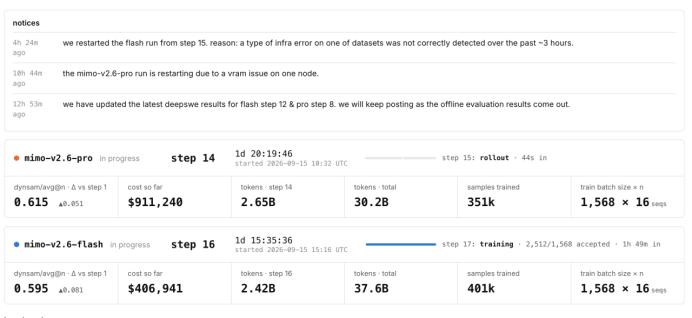
On the evening of September 15 Beijing time, Xiaomi launched the training of its two new models one after another. By the afternoon of September 17, less than two days later, the accumulated cost shown on the page had exceeded 1.3 million US dollars, and it was still rising. Fortunately, viewers don't have to foot the bill, otherwise people might have to close the webpage for a break halfway through watching.
The person who shared the public viewing link is Luo Fuli, head of Xiaomi's large model team and former researcher at DeepSeek.
Earlier that day, she posted on X: "It's been nearly half a year of silence." She then explained that during this period, her team had been researching how far reinforcement learning could be scaled.
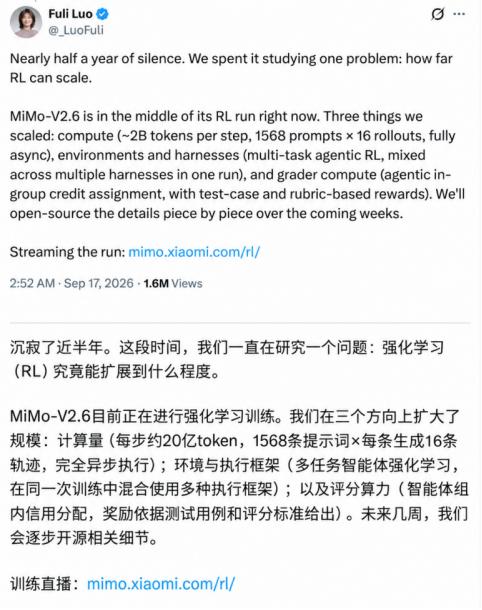
Before the new model MiMo-V2.6 finished training, Luo Fuli started the "live stream" for the public, which is undoubtedly a very bold move.
However, the rapidly rising cost is definitely not the only information revealed by this "live stream". What Luo Fuli has been working on in the past few months, and how much progress Xiaomi can make to catch up with peers through this round of training, are far more critical points.
Training Not Finished Yet, Live Stream Goes Live First
The "live stream" page is easy to understand: the Pro and Flash versions of MiMo-V2.6 each take up a separate section.
As of 15:47 Beijing time on September 17, the Pro model had been running for more than 45 hours in this round of training, with a total cost of about 930,000 US dollars. The Flash model, which started training a few hours later, had run for about 40.5 hours and cost around 416,000 US dollars. The cost of Pro is already more than twice that of Flash.
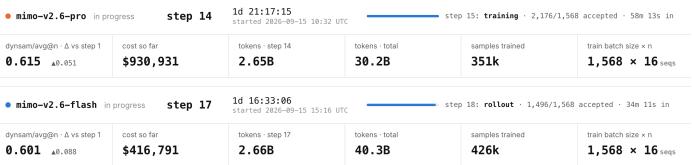
In terms of progress, Pro has completed the 14th step and is working on the 15th. Flash has finished the 17th step and is proceeding to the 18th. Flash seems to be running faster, but simply comparing the number of steps cannot tell which model is performing better, and we need to check the test results below.
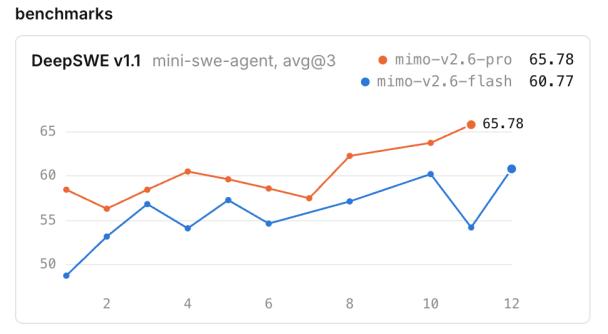
The page publishes a software development test called DeepSWE v1.1. It requires the model to add features and fix bugs in real open-source projects, then checks whether the submitted code meets the requirements. Even if the new feature is implemented, the test will not be passed if the original function is broken.
According to the pass rates currently announced on the page, Pro stands at 65.78% and Flash at 60.77%. That means in this test, both models can complete more than 60% of the tasks, with Pro leading by about 5 percentage points. These results will be updated as the phased tests are completed. The model is still in training, and what we see now is only the mid-term test scores.
More interestingly, the webpage also serves as a fault notification board, and Xiaomi even posted all the problems that occurred during the training on the page.
The announcement at the top of the page says that Pro needs to be restarted due to a video memory issue on one of its computing nodes. Flash encountered a certain type of infrastructure error on a set of data, failed to correctly identify the problem for about 3 hours, and finally restarted from the 15th step.
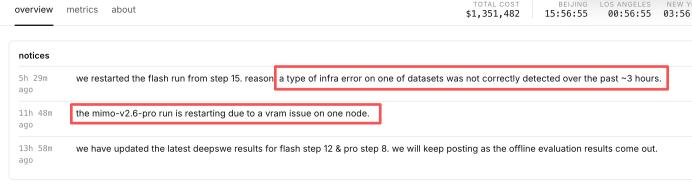
Normally when a model is released, what people get is a well-organized report card, and they rarely get to know what problems occurred during training or how many restarts the team did. This time Xiaomi even posted the fault notices, so the public can intuitively see that while the model's scores are rising, the team is still busy troubleshooting and restarting training. It is almost a form of performance art.
This kind of "live stream" soon attracted attention from industry peers.
Lucas Beyer, a Meta researcher and former OpenAI researcher, saw Luo Fuli introduce the three directions to expand training scale and could not help re-"translating" them for her: computing power, computing power, and more computing power. After the joke, he specifically praised that Xiaomi even made public "how much money has been spent so far".

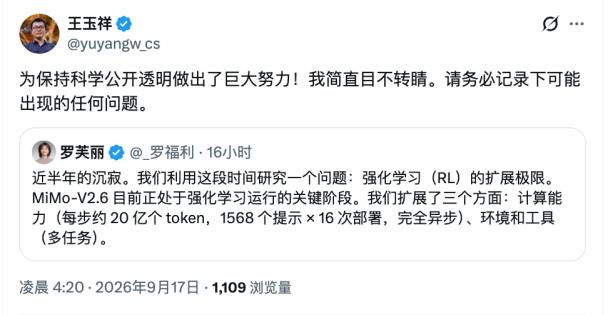
Yu-Xiang Wang, associate professor at the University of California, San Diego and reinforcement learning researcher, also said he "could not take his eyes off it", and specifically requested that the team record all kinds of problems encountered during the training process. Those previous restart announcements are exactly the content he wants to learn about.
Sasha Rush, former professor at Cornell University and participant in the development of the Cursor model, also stared at the live stream on his phone. He joked that watching the response length of a programming task made him feel like a gambler getting overly invested, then he murmured about the change of numbers: "Jumping from 80k to 120k, that range feels way too big."
With such a high level of openness, the public can already discuss the training methods with specific details.
Speaking of which, Xiaomi once let its new model play a "guess who I am" game back in March this year. At that time, an anonymous model called Hunter Alpha appeared on the model service platform OpenRouter. A week later, Xiaomi revealed its identity on March 18: it was the early test version of MiMo-V2-Pro.
This time, Luo Fuli simply made the training process public in advance, and announced that relevant details will be gradually open-sourced in the coming weeks. As for what problem this training is intended to solve, she said in her post that the team has been researching how far reinforcement learning can be scaled for nearly half a year.
Half a Year of Silence: What Exactly Has Luo Fuli Been Busy With?
In April this year, the MiMo-V2.5 series was released and open-sourced. In the same month, in the program "Zhang Xiaojun Jùn | Business Interview", Luo Fuli mentioned that domestic teams are accelerating the exploration of post-training for Agents, and one of the key points is to scale up reinforcement learning. When the host asked if there were any preliminary results, she only said at the time: "It's not convenient to share for now."
A few months later, Xiaomi put the entire training process online. The model is spending so much money every day, what exactly is it learning?
Take website maintenance as an example. If a user finds that they cannot log in to the website and asks AI to fix it, the AI has to find the relevant files, check where the problem is, modify the code, and then run tests. Sometimes the error still exists after modification, and it has to continue troubleshooting. What the user wants is to be able to log in, and a simple message saying "I've fixed it for you" obviously does not count as a job well done.
This type of AI that can use tools and handle tasks continuously is what we often call an Agent. During training, the model will repeatedly try to complete tasks, the system will score its performance, and then use these feedbacks to adjust the model parameters, so that effective practices are more likely to appear in the future. This is one of the applications of reinforcement learning in Agent training.
According to the configuration announced by Luo Fuli, Xiaomi arranges 1568 prompts for each training step, each corresponding to 16 attempts, totaling 25088 trajectories.
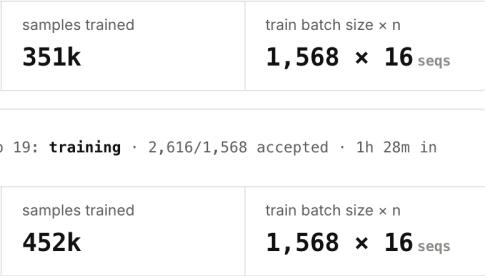
A trajectory here refers to the complete process from when the model receives a task to when it finishes. When fixing a website, even if the model modifies the code several times and runs tests repeatedly, it still belongs to the same attempt. When a large number of such processes are accumulated, one training step involves about 2 billion tokens. All the text, code and other content read and written by the model are measured in this unit.
Therefore, a seemingly insignificant "step" on the page may have involved a huge amount of work for a long time.
There is also a preparation work for these practices: the model needs an environment to operate in.
For example, to fix a website, the training system needs to provide project files and tools to run the code. After the model modifies the code, the system must also feed back the result of whether the program can run normally. If there is only a request saying "please fix the login failure" without any files to check or programs to run, the model can do nothing.
Luo Fuli mentioned in the interview that the team will first let more internal employees use the model to discover actual demands, then build training data around these scenarios. The difficult part is to restore the usage environment as much as possible, so that the model can operate continuously in it, and set corresponding scoring standards.
The expanded training environment and execution framework of MiMo-V2.6 in this round of training exactly involve these tasks. Multiple types of tasks can be mixed in the same training session, and the tools, operation processes and completion requirements the model faces will also vary.
Moreover, judging whether the model performs well also consumes a lot of computing power. As tasks get more complex, grading the model's work also becomes more laborious.
Whether the program can pass the test can be checked by the system. If the task is to let AI analyze a company's operating status, the system has to verify the data and conclusions. For example, if the model takes last year's revenue as this year's, no matter how reasonable the rest of the analysis is, the conclusion is invalid. The scoring system needs to be able to identify these problems, otherwise if the wrong reward is given, the model may continue to learn the wrong practices.
This is also the reason why Luo Fuli listed "scoring computing power" as a separate item. It takes computing power for the model to try to complete tasks, and it also needs to invest computing resources to judge how well these attempts perform.
At present, programming accounts for a considerable proportion in this training. At 17:49 Beijing time on September 17, code-related prompts in the 14th step of Pro accounted for 67.7%, more than two-thirds, and tasks such as vision and chat were also mixed in.
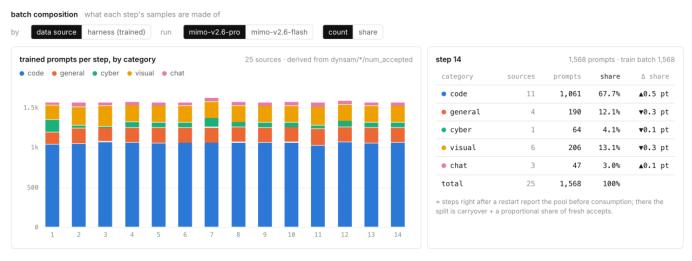
Why make the model write so much code? Luo Fuli gave an explanation: Software development usually requires handling many problems continuously, and the planning ability and context management methods formed around it can also help AI complete other complex tasks.
For example, when a project is halfway modified, the model has to remember which parts have been modified and which methods have been tried but failed. When there are too many tasks, it also needs to sort out and retain key information to facilitate subsequent work. These requirements also exist in multi-step tasks such as document research.
Of course, good performance in code training does not mean the model can directly handle other types of work. Luo Fuli also emphasized that to make the model perform stably in more scenarios, corresponding targeted training is still needed.
What Xiaomi wants to figure out in this round of training is exactly how much progress these investments can bring: with more attempts, expanded task environments, and more computing power spent to judge results, how far can the model's capabilities be improved. The cost on the live stream is rising, and what we need to see next is whether the capabilities the model has learned can be improved accordingly.
60 Billion Yuan in Three Years: What Results Will Xiaomi Deliver?
In April this year, Luo Fuli mentioned that which parts of the training scale to expand next and what chips to use will affect who takes the lead in half a year or more. A few months later, Xiaomi chose to continue investing in reinforcement learning, and the results of this research are gradually coming out.
From a researcher at DeepSeek to the head of Xiaomi's MiMo team, Luo Fuli's technical judgments now affect far more things. Once a direction is deemed worth trying, the team has to arrange manpower, allocate computing resources, and then decide whether to continue based on the experimental results. If the direction is not chosen properly, the time of the entire team will also be wasted.

She mentioned in the interview that training MiMo-V2-Pro and Flash each requires thousands of computing cards, but the