Doubao smartphone? In your dreams.
On September 16, the Nubia NaviX Ultra officially went on sale. Starting from 5999 yuan, after national subsidies starting from 5499 yuan, Nubia later announced that its first-day sales "exceeded 100 million yuan in one second". This mass-produced device dubbed the "Doubao Phone Gen 2" once again pushed the expectation of "mobile phones handling affairs on behalf of users" to the public spotlight.
However, some of these expectations came to a halt right after users opened the apps.
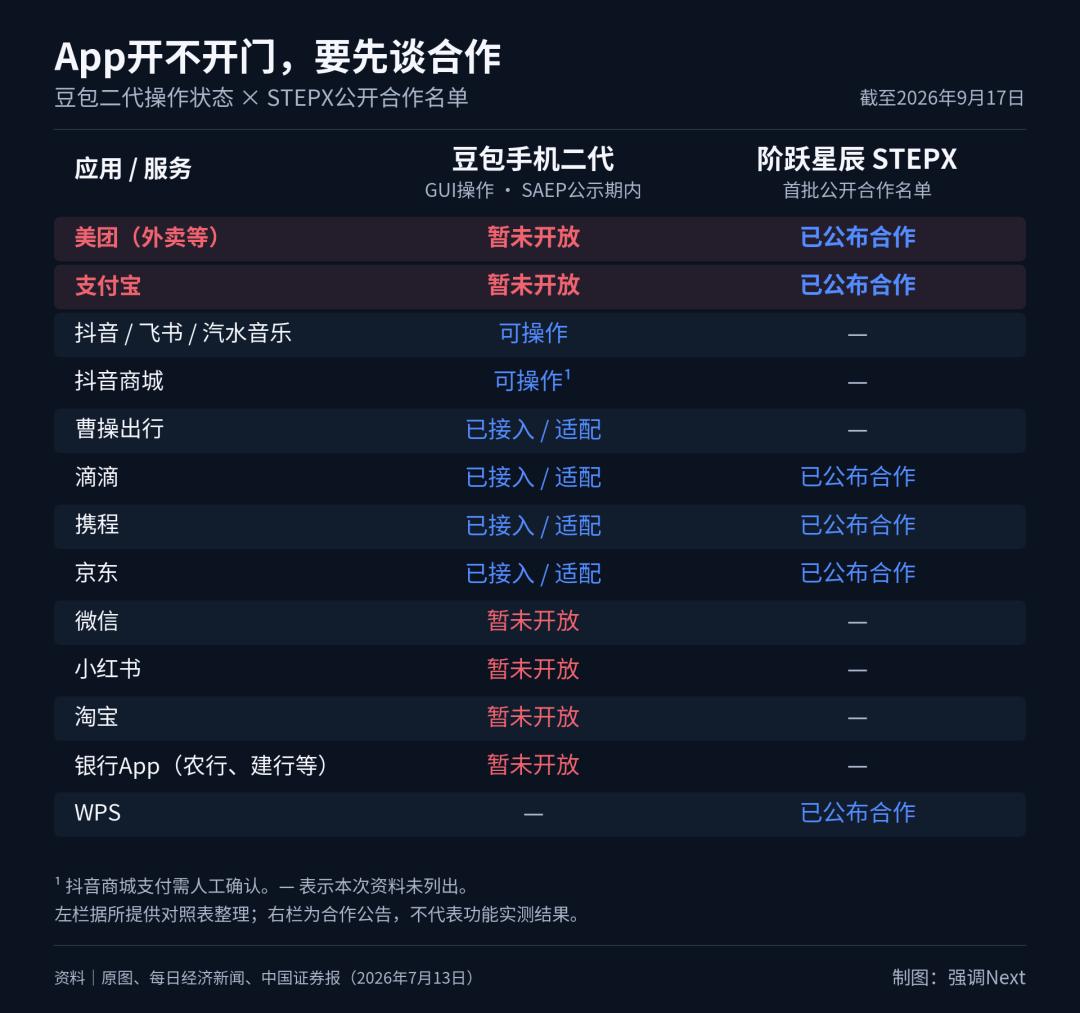
Media outlets including National Business Daily ran real-device tests, asking the phone to open WeChat and post on Moments. The assistant could launch the application, but was unable to proceed with in-app operations. Actions such as shopping on JD, posting on Xiaohongshu, placing food delivery orders on Meituan, and shopping on Taobao were all restricted.
A joke is going around: it's a dedicated phone only for ByteDance's own apps. The unfunny part is that this statement is true.
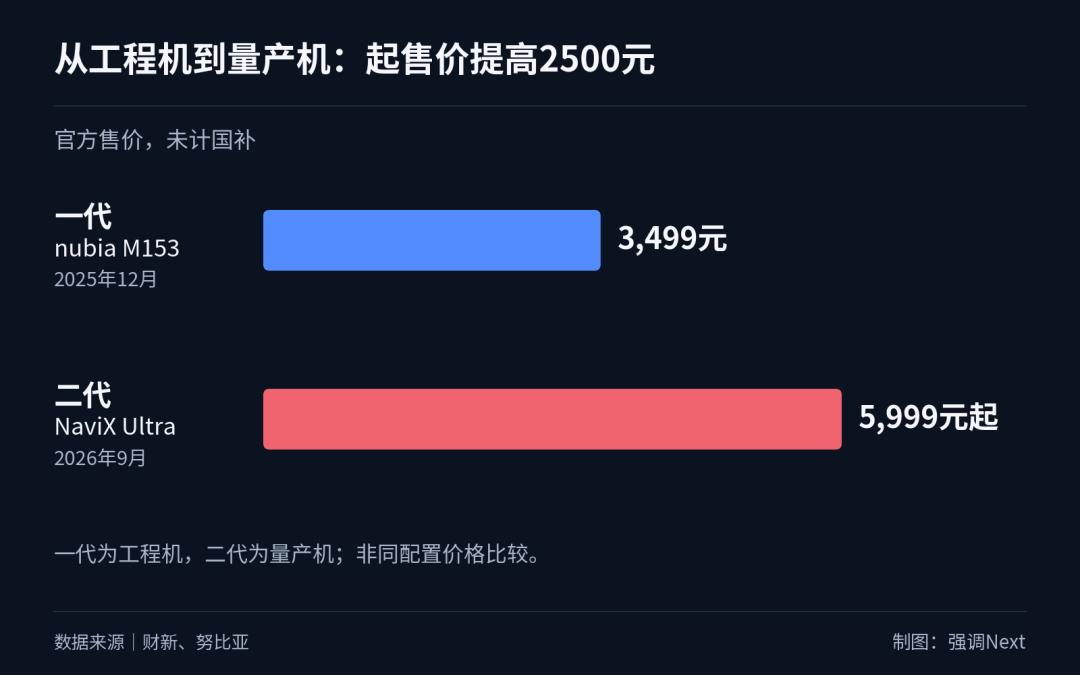
From the first-generation engineering prototype priced at 3499 yuan to the second-generation mass-produced model starting at 5999 yuan, the starting price has risen by 2500 yuan, yet the promise of cross-app task handling has not been fulfilled accordingly. After consumers buy the phone, they still have to perform the most frequently used services manually themselves.
Doubao wants to operate the entire phone on behalf of users, but the platforms within the phone all have their own business interests to safeguard. The model's ability to recognize buttons does not mean ByteDance has the right to press them on behalf of users. Even if mobile phone manufacturers are willing to cooperate, it does not mean WeChat, Taobao and Meituan will choose to comply.
The Doubao phone has a beautiful vision: users state their needs, and the AI crosses one app after another to get things done. The reality is rather harsh: those steps it tries to eliminate happen to be the very positions where platforms control users, allocate traffic and make profits.
The first generation hit a wall in four days, the second generation starts to negotiate rules
On December 1, 2025, the technical preview version of the Doubao Phone Assistant was released. The Nubia M153 engineering model equipped with this assistant went on sale on a small scale at a price of 3499 yuan and sold out on the same day. On the same day, ZTE's stock price hit the 10% daily limit.
Two days later, users reported abnormal WeChat login issues. On the evening of December 3, Doubao announced that it would take down the function that allowed the phone assistant to operate WeChat.
On December 5, Doubao further announced standardized adjustments covering scenarios such as point farming for rewards, financial applications and games. Only four days passed from its release to the active narrowing of its operation scope. The unobstructed path shown in demo videos turns out to have access barriers set by every single application in the real internet world.
Nine months later, the response from the second-generation Doubao phone is to write app willingness into formal rules. On September 14, Doubao launched the Screen Automated Operation Protocol (SAEP), allowing third-party applications to declare whether they accept GUI agent operations.
The rules are divided into two phases: during the 30-day public notice period, applications are not operated by default, and the operation access is only opened when they actively accept it; after the public notice period expires, applications that do not declare refusal via email or the protocol will be granted corresponding operation capabilities. Applications that explicitly refuse will not be automatically operated.
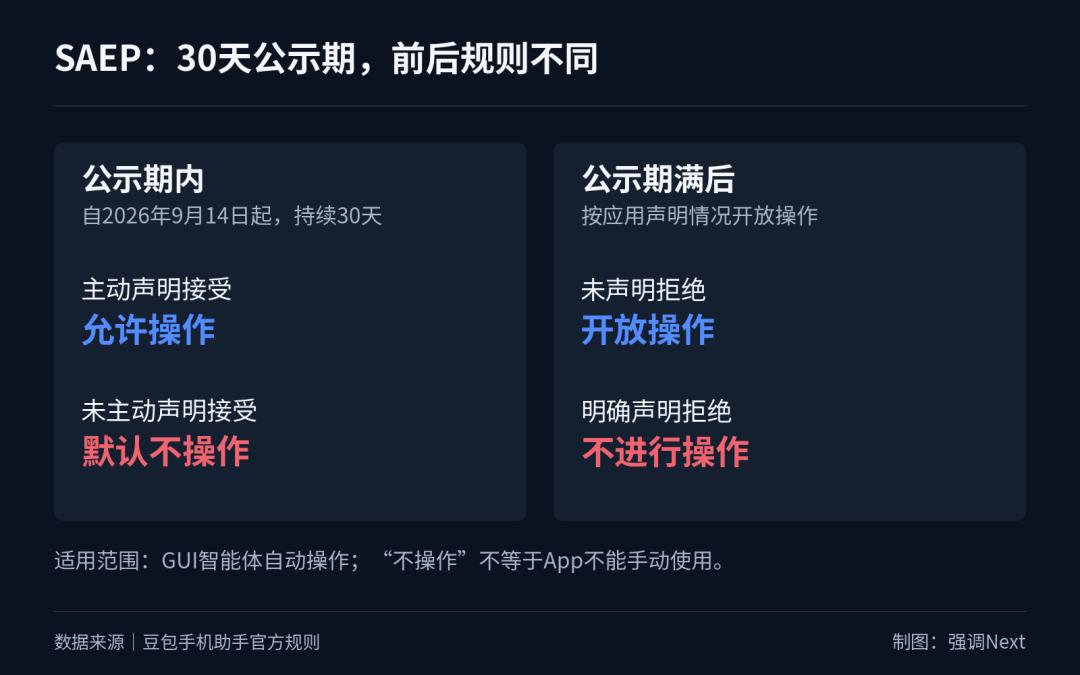
This set of rules gives all parties a clear window for negotiation, and also reveals how Doubao's product capabilities are determined: ByteDance is responsible for developing the functions, and applications can decide whether to allow them to run.
The launch restrictions include the default arrangement during the public notice period, but how many functions can be used in the long run still cannot bypass the attitudes of application platforms.
For users, this means the most attractive selling point of the Doubao phone still needs to be fulfilled along with the progress of cooperation.
What apps want is orders, not to hand over their access portals
The restrictions between mobile phone manufacturers and applications are not absolute.
On July 13, StepVerse released the STEPX terminal brand and the STEPX Neo mobile phone solution, and announced that its first batch of ecological partners include Ctrip, Alipay, Didi, Meituan, JD, WPS and others.
In June this year, WeChat also started A2A capability cooperation with Huawei, Honor, Xiaomi, OPPO and vivo. According to media reports, Honor YOYO can already initiate WeChat audio and video calls, and send messages to specified contacts.
These cases show that application platforms accept AI participation in services, but what the AI can do and how it makes calls must be agreed in advance.
Application platforms welcome an additional channel that brings orders, but will not easily welcome a superior that allocates orders on their behalf.
When a user says "help me buy a pair of headphones within 300 yuan", the AI assistant can first enter the designated platform, call the products and sorting rules provided by the platform, or search for candidate products across platforms, compare prices, brands and after-sales services on its own, and then decide which platform to send the order to. What is saved is just several clicks, but what is transferred is the most valuable decision-making right before the transaction.
The essence of advertising relies on this very decision-making right. Tencent's marketing service revenue in the second quarter of 2026 increased by 22% year on year, and AI improving advertising efficiency within the WeChat ecosystem is one of the driving forces for this growth. Internet companies are using AI to monetize their traffic better, so they naturally need to calculate the cost of letting external assistants take over users' choices.
ByteDance is also a negotiating party with special weight. Douyin already has e-commerce and local life services under its belt. Once Doubao masters users' shopping demands, budgets and consumption preferences, it gains an additional path to influence transaction flows. For other platforms, opening call permissions is equivalent to adding chips to their competitors, which is an obvious contradiction.
Doubao wants to be the general assistant for users, while internet platforms are more willing to let it be one of their own service channels. The core of the contradiction is who gets to decide the next step after a user puts forward a demand.
This negotiation will not end automatically just because model parameters increase. ByteDance needs to present transaction increments, allocation rules and cooperation terms to make the platforms see the benefits of the deal.
382 million monthly active users cannot buy system permissions
Then, given the obvious resistance, why does ByteDance still push forward the second-generation mobile phone?
According to QuestMobile data, in June 2026, Doubao's monthly active users reached 382 million, while Qwen had 167 million monthly active users. Doubao's user scale is more than twice that of Qwen, but no matter how many users it has, it is still constrained by system permissions and application cooperation conditions on mobile phones.
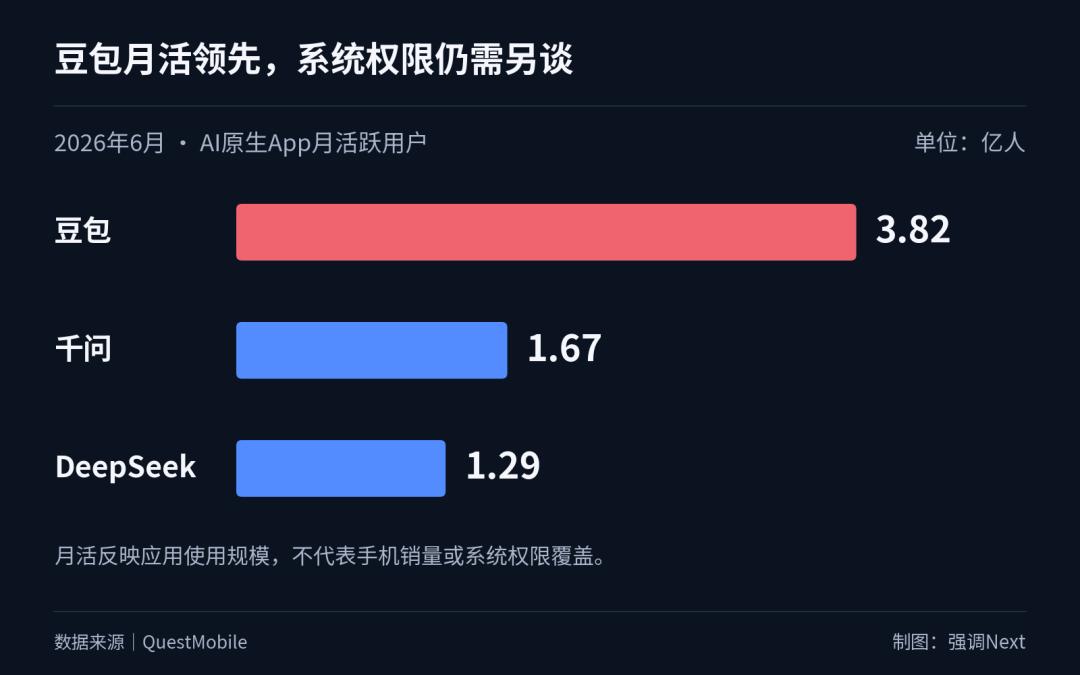
A chat application can wait for users to open it before answering questions. A to-do assistant needs to be awakened at any time, understand the progress of the ongoing task, continuously operate different services, and take over when errors occur. The party that controls the system gets to decide how these capabilities enter users' daily use.
This Doubao phone co-developed with ZTE gives ByteDance a test field: it can deeply participate in the design of where the assistant is awakened, how it executes tasks, and how it remembers user preferences. What ByteDance is striving for is the right to define the next generation of mobile phone interaction. Otherwise, even if the Doubao model is integrated into more mobile phones, it may only become a supplier behind the self-developed assistants of phone manufacturers.
The problem is that mobile phone manufacturers are also competing for this exact position.
AI assistants that master user habits, connect devices and allocate services are the very tools for manufacturers to differentiate their products. Adopting the Doubao model can enhance their own assistants, but handing over the default assistant position to Doubao will let ByteDance directly control users.
Application platforms guard the service portals, and mobile phone manufacturers guard the system portals. Doubao has to get through at least these two gates to directly control users' right of choice.
Nubia provides a window, but the terminal scale is still very small. According to media reports, the total stock of Doubao AI phones is about 200,000 units, with less than 100,000 units for the first batch. IDC data shows that the top six manufacturers in China's smartphone market in the second quarter of this year already accounted for about 96% of the total shipment volume. Huawei takes 22.6%, Apple 18.1%, OPPO and vivo both 16.0%, Xiaomi 12.4%, and Honor 11.3%. Even calculated based on the entire ZTE group, the market share is only 0.3%.
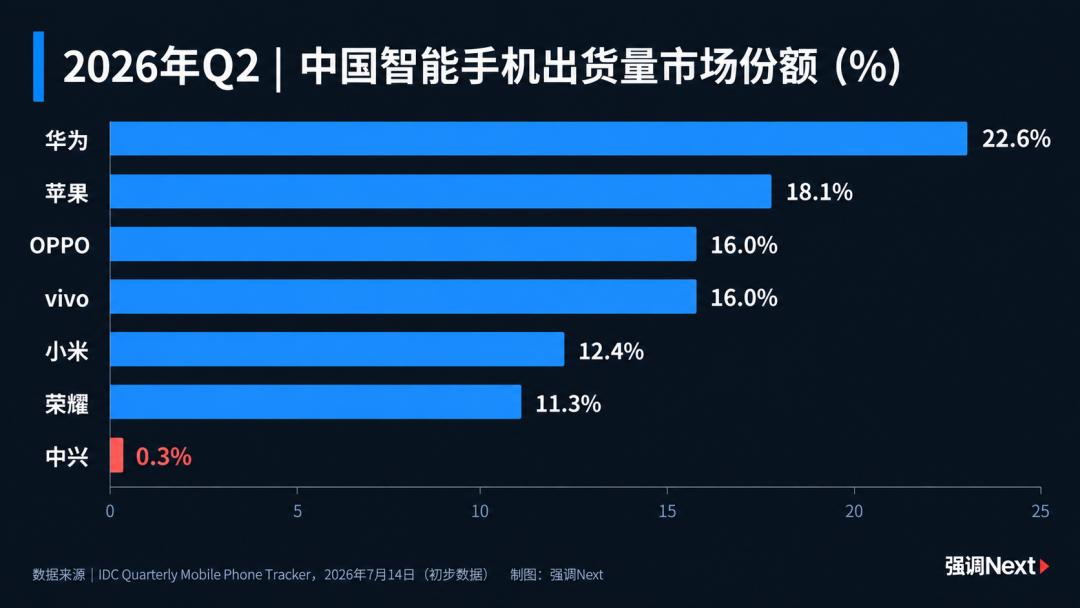
This also puts ByteDance in a dilemma: only with complete service capabilities can users have stronger reasons to switch phones. Only with a sufficiently large user base will service providers be more motivated to invest in adaptation. Although Doubao has 382 million monthly active users on apps, this number cannot be directly converted into mobile phone users. Even WeChat with 1.4 billion users does not mean that the custom WeChat phone business is a viable success.
ByteDance has enough capital to subsidize hardware to attract users, but WeChat's social graph, Meituan's service supplies, and Taobao's merchant resources will not be delivered along with a single hardware subsidy.
Users have no obligation to wait for the cooperation to be finalized
Furthermore, even if all applications grant access permissions, consumers may not immediately get a reliable to-do assistant. Because another challenge for Doubao is how much trouble it can actually save users from?
The AndroidDaily study released in May this year tested 350 daily tasks across 94 real Android applications, and the strongest participating model only achieved a 62% success rate. This benchmark study demonstrates the difficulty of continuous operation: there is still a big gap between recognizing a single button and completing an entire task properly.
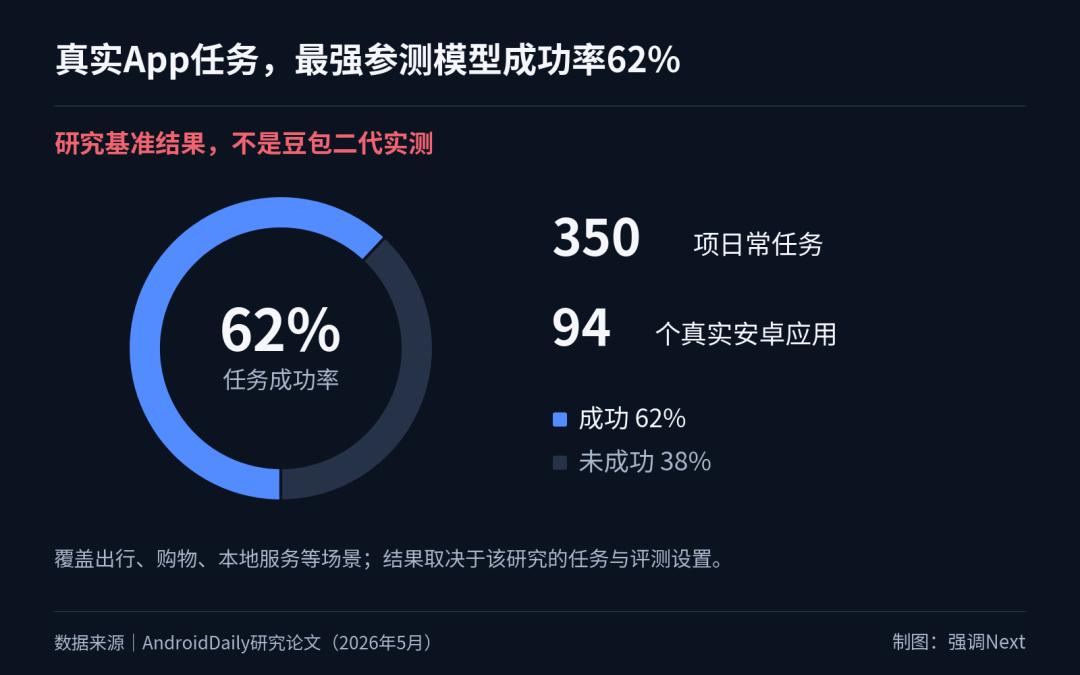
Scenarios such as no remaining tickets for booking, ambiguous product specifications, and unavailable coupons all require the assistant to make new judgments. Users do not care how many steps the assistant has completed, they only care whether they have bought the wrong product or booked the wrong service in the end, and whether it is more hassle-free than operating on their own.
In the actual test of the Doubao phone, the second-generation model still needs to hand over control to users for manual completion in links such as payment and real-name authentication. For the product, whether the handover is smooth and whether errors can be corrected determine the user experience just as much as the number of accessible applications.
As cooperation expands, another constraint will also emerge: the assistant's selection scope is limited by the scope of its cooperation agreements.
The same command "help me book a hotel" can be packaged as one-click order placement either by comparing prices and cancellation policies across multiple platforms, or by only picking an option from the pre-approved cooperation channels. Users tap fewer times on the screen, but they may not necessarily get a better choice.
If Doubao can only handle affairs within the negotiated cooperation scope, it has to prove that this scope is sufficient to fulfill the promise of being a "universal assistant".
From the first generation to the second generation, the Doubao phone has demonstrated the intensity of competition for AI portals: system permissions need to be fought for, platform interests need to be coordinated, and task execution needs to be reliable. ByteDance can treat all these investments as the cost to seize the future, but consumers are paying for the product of today.
A mobile phone starting at 5999 yuan should convince users with the tasks that it can already complete stably. The "exceeding 100 million yuan in one second" first-day sales created huge public attention, but whether it can stably support WeChat operations, shopping, and food delivery ordering afterwards will determine how many of these users it can retain.
The Doubao phone has a nice vision of allowing users to traverse the entire internet with one sentence. But the first problem it needs to solve is why the companies in the internet would allow it to do that.
Note: All data in this article comes from public sources and does not constitute investment advice.
This article is from the WeChat official account "Emphasize Next" (ID: leo89203898), author: Dingshan, editor: Xiaobai, published with authorization from 36Kr.