After China Datang Corporation dissolved its International Business Department and upgraded its Digital Intelligence Center, and posted a 20% year-on-year net profit growth against the trend in its interim report, this central state-owned power enterprise has rolled out a major overhaul of its organizational structure.
China Datang Corporation restructures its organizational framework, deploys digital intelligence for risk control, and advances transformation.
According to Energy Insight, China Datang Corporation recently launched an in-depth adjustment of its organizational structure: The number of headquarters departments has been adjusted from 16 to 18, second-tier entities have been streamlined from 48 to 45, the entire International Business Department has been abolished, and the Digital Intelligence Center has been upgraded from a second-tier unit to a headquarters department.
Prior to this, the semi-annual reports of central power generation enterprises were released. Huaneng Power International's net profit attributable to shareholders fell by 28.89% year on year, Huadian Power International's dropped by 20.47%, GD Power Development's decreased by 18.25%, while only Datang Power posted a net profit attributable to shareholders of 5.509 billion yuan, representing a 20.31% year-on-year increase. The total net profit attributable to shareholders of the four enterprises reached 18.214 billion yuan, a year-on-year decrease of 3.218 billion yuan. Is the counter-trend performance superimposed on organizational restructuring a coincidence or a causal relationship? When the fading of coal power dividends becomes a consensus, the adjustment direction of organizational structure often reveals the enterprise's real strategic judgment more clearly than profit figures.
The abolition of the International Business Department is the most signal-significant variable in this round of Datang's adjustment.
Abolish one department and split its functions into two separate lines
16 functional departments of China Datang Corporation headquarters are adjusted to 18 — the number increases slightly, but the core has undergone substantial restructuring. The former International Business Department (Foreign Affairs Office) is no longer set up independently, and its functions are divided into two parts: foreign affairs functions are incorporated into the General Office, which is concurrently branded as "Party Leadership Office, Board of Directors Office, and Foreign Affairs Office"; overseas compliance and risk prevention and control functions are separated and incorporated into the Corporate Governance and Legal Compliance Department, which is additionally branded as "Overseas Risk Prevention and Control Department".
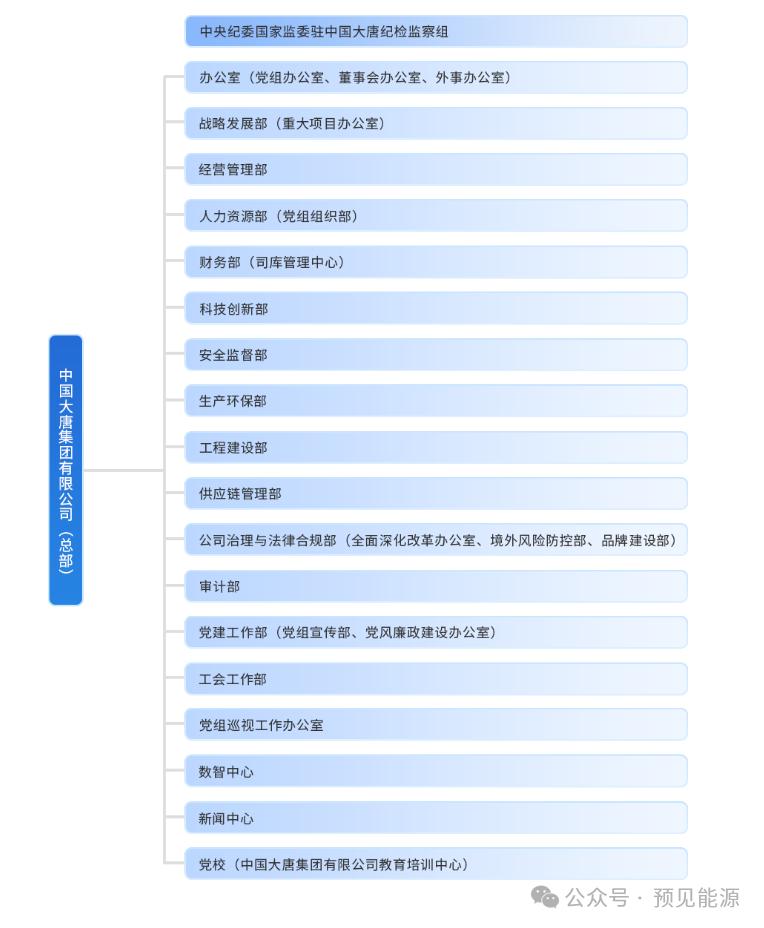
New Organizational Chart of China Datang Corporation
Separating overseas risk control from the business line and incorporating it into the compliance system essentially acknowledges that the risk management of overseas projects has become so complex that it cannot be "managed incidentally" by the business department.
This judgment is supported by practical cases. The Nam Ou 2 Hydropower Project of Datang Overseas Investment Co., Ltd. in Laos has an installed capacity of 912 MW, located in Oudomxay Province, Laos, and is a key energy project under the country's 9th Five-Year Plan. The project team built a limited-recourse cross-border syndicated loan financing structure covering four legal jurisdictions of China, Laos, Thailand and the UK, and completed financial closing entirely relying on overseas syndicates. In July 2026, the project won the IJGlobal "Asia-Pacific Hydropower Deal of the Year Award".
The complexity of this transaction structure far exceeds the simple traditional mode of "domestic guarantee + overseas lending" for overseas power stations. It is necessary to deal with the regulatory rules, tax arrangements and foreign exchange control of four legal jurisdictions at the same time — keeping the risk control function in the business department is no different from requiring a forward to also serve as a goalkeeper.
This step of Datang is highly synchronized with the regulatory rhythm of the State-owned Assets Supervision and Administration Commission of the State Council. In April 2026, the State-owned Assets Supervision and Administration Commission of the State Council officially established the Overseas State-owned Assets Work Bureau, which is responsible for guiding the international operation of central enterprises, optimizing the layout of overseas assets, and strengthening the prevention and resolution of risks in overseas investment and operation. Interviewed experts predict that the current scale of overseas assets of central enterprises may have reached 10 trillion yuan, accounting for more than 10% of the total assets. The bureau has four internal divisions: International Operation Division, Risk Prevention Division, Supervision and Governance Division, and Emergency Management Division.
Li Jin, chief researcher of the China Enterprise Research Institute, positioned it as "a full-time command post, regulatory department and emergency office for central enterprises' global expansion", the core of which is to solve the long-standing problem of fragmented operations and duplicated layout of overseas businesses in the past. Datang's independent setup of the overseas risk control department and its integration with the compliance line has made organizational preparations at the headquarters level to align with this new regulatory framework.
Digital Intelligence Center included in headquarters departments, power distribution map to be redrawn
If the abolition of the International Business Department is a subtraction, the upgrading of the Digital Intelligence Center is the most important addition in this round of adjustment.
The Digital Intelligence Center was originally only a second-tier unit, and this time it is directly included in the sequence of headquarters departments, alongside the General Office, the Finance Department, and the Strategic Development Department. In 2026, the State-owned Assets Supervision and Administration Commission of the State Council clearly stated that it will further deepen and expand the digital intelligence transformation action of central enterprises, thoroughly implement the "AI+" special action, and promote the deep integration of digital intelligence technology with enterprise production and operation. Central enterprises have jointly built more than 1,000 application scenarios with leading enterprises in key industries such as energy, manufacturing, and communications.
The organizational logic of upgrading digitalization from "technical support" to "headquarters function" is clear. But clear logic does not mean smooth implementation.
After the Digital Intelligence Center is upgraded, the core challenge it faces is not technology, but power. A department promoted from a second-tier unit to the headquarters needs to coordinate the existing information systems and data resources of all business segments, which essentially means redrawing the digital power map within the group. This is not a problem that can be solved by a single official document.
Let's look at the practices of peers. State Power Investment Corporation's strategy is to set up the "Science and Technology and Digital Intelligence Department" with additional brands of "Heavy Gas Turbine Major Special Project Office" and "Thorium Molten Salt Reactor Office", binding digitalization with national-level scientific research breakthroughs, and promoting organizational upgrading with the momentum of major special projects. China Three Gorges Corporation is more decisive: its directly affiliated institutions have been streamlined from 10 to 2, only retaining the Digital Intelligence Management Center and the Audit Center, elevating digitalization to the same important position as audit supervision.
Different paths point to the same direction: Digitalization is no longer allowed to remain at the level of technical departments. But upgrading is only the first step. Whether it can truly break through business barriers and prevent the Digital Intelligence Center from becoming a "more advanced information center" will be tested by the implementation effect in the second half of 2026.
Integration without abolition, accounts that may not be fully settled
The number of second-tier units has been reduced from 48 to 45, and the whereabouts of the three units reveal the underlying logic of this round of adjustment.
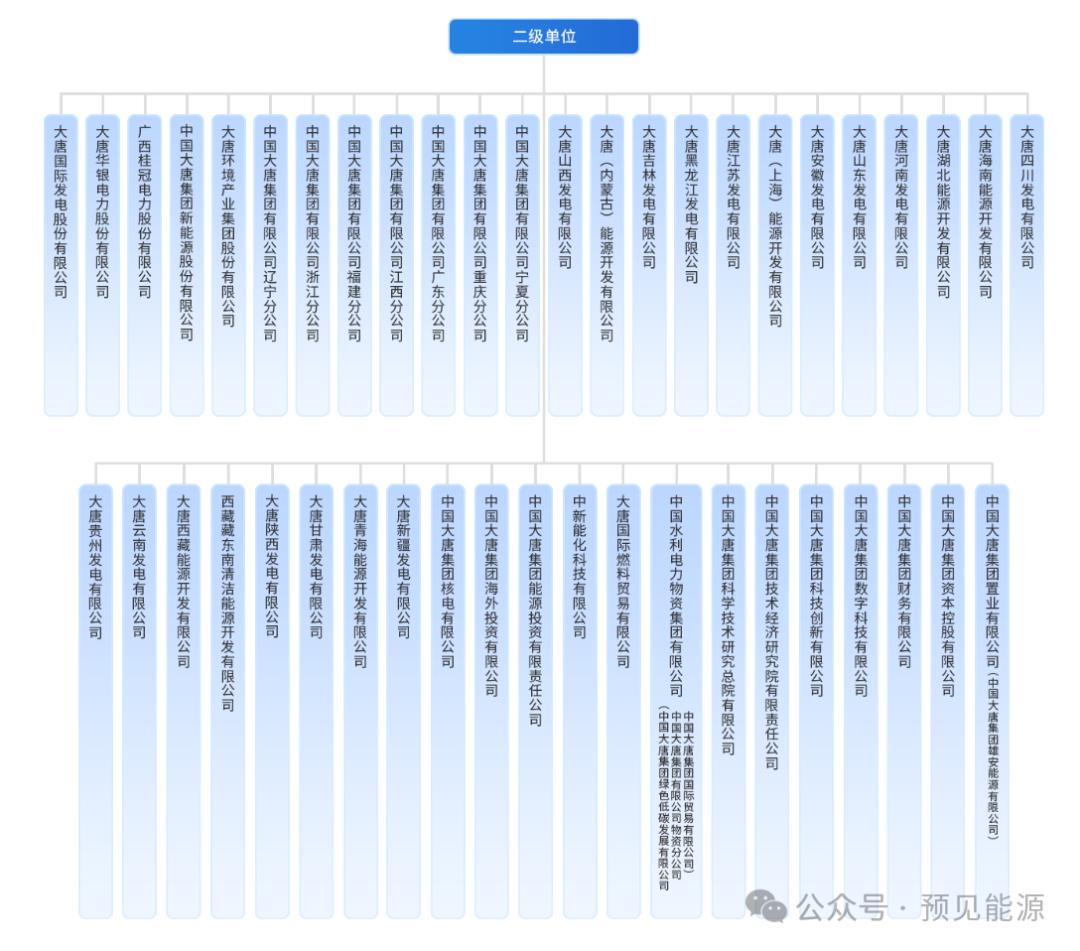
Organizational Chart of Second-tier Entities of China Datang Corporation
The Digital Intelligence Center and the Party School have been upgraded to the headquarters, which does not count as "disappeared". The real integration takes place in the green and low-carbon development field — China Datang Green Low-Carbon Development Co., Ltd. and China Water Resources and Power Materials Group Co., Ltd. have formed business coordination and co-located operation, with in-depth linkage in carbon assets and green low-carbon businesses. In the trade sector, the group promotes the expansion of business boundaries from fuel trade to bulk commodity trade and cross-border trade, and Datang International Fuel Trading Co., Ltd. continues to undertake the group's fuel trade function. The Real Estate Company focuses on the construction of the group's Xiongan headquarters project, and China Datang Xiongan Energy Co., Ltd., as an independent legal entity, is responsible for related energy businesses, and the two operate independently.
There is no abolition, only integration. What is reduced is duplicate functions, and what is increased is business depth.
However, this mode of "one team with multiple brands" may reduce explicit management costs while pushing up implicit coordination costs. The co-located operation of multiple businesses requires managers to master the business logic of different fields at the same time, which actually puts higher requirements on the level of internal governance.
A more noteworthy variable is the adjustment frequency. Datang completed a round of headquarters function adjustment in 2023, when the number of headquarters departments expanded from 17 to 22. Less than three years later, it made major adjustments again, and the repeated change of direction itself constitutes a consumption of organizational memory.
The risk of frequent adjustments has not yet appeared at the performance level. In the first half of the year, Datang Power's total hydropower profit increased by 42.71% year on year, gas turbine profit surged by 225.64%, the Hohhot Aluminum Power segment alone contributed a net profit of 806 million yuan, and the comprehensive financing cost rate dropped to 2.28%, a year-on-year decrease of 15 BP. With solid performance, the reform has sufficient confidence.
However, the effectiveness of organizational structure adjustment never depends on the organizational chart itself, but on whether the newly established departments can deliver quantifiable efficiency gains in the next financial reporting cycle. Whether the Digital Intelligence Center can break through data barriers, whether the Overseas Risk Prevention and Control Department can substantially reduce overseas compliance costs, and whether the co-located operation platforms can generate synergies, are the real answers to this round of adjustment.
At the level of the State-owned Assets Supervision and Administration Commission of the State Council, the "slimming and fitness" reform of central enterprises has been clearly defined as the core starting point of the reform offensive. Since 2026, a number of power central enterprises including State Power Investment Corporation, China Three Gorges Corporation, and China Energy Engineering Corporation have intensively adjusted their headquarters structures, with different directions but convergent logic: From "scale optimization" to "quality improvement". Datang's organizational restructuring is a cross-section of this industry-wide adjustment, and also an experiment for power central enterprises to redefine "what the headquarters should manage" in the period of new and old kinetic energy conversion. The success or failure of the experiment does not depend on the exquisiteness of the organizational chart, but on whether those newly established departments that have just been unveiled can prove that they are not an expensive business card in the next fiscal quarter.