The person who taught ChatGPT to speak has created a "mute" model.
The people in the AI circle who know best how to get models to "start chatting" have now decided to strip large language models of their language capabilities.
Diogo Almeida, the former OpenAI researcher and co-inventor of ChatGPT, has returned to the industry after two years of stealth development with his new company TypeSafe AI and $40 million in financing. The brand-new model Jev they released can neither write weekly reports for office workers nor chat with users late at night. It can't even output a single punctuation mark.
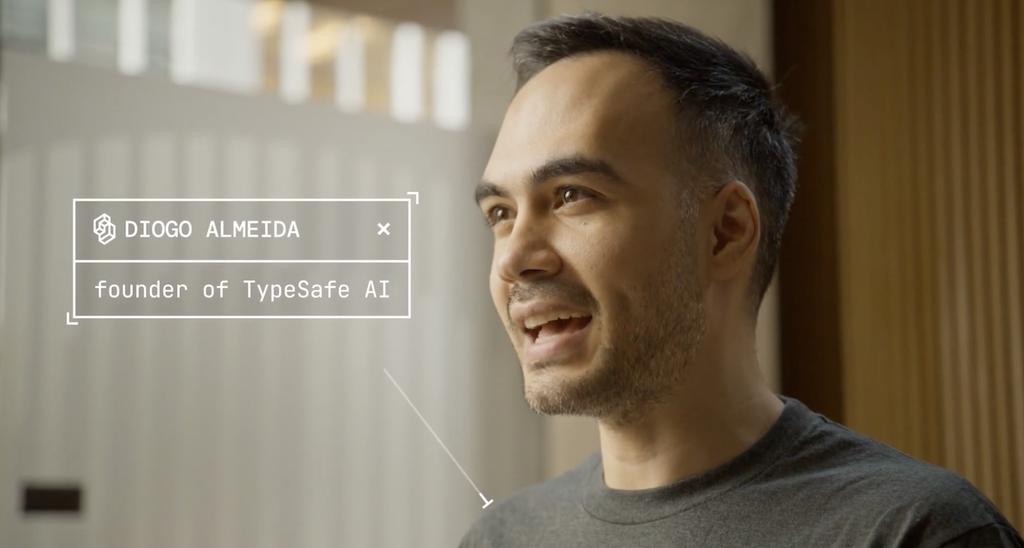
Diogo Almeida, Founder of TypeSafe | Image source: X
This is a counterintuitive moment. Over the past three years, the entire industry has been teaching large models how to "think slowly" like humans, and various laboratories have been desperately extending the reasoning chain, allowing models to silently talk to themselves for thousands of words before giving answers.
But Jev has taken a completely opposite path: it does not generate text, and only outputs deterministic structured decisions.
This is not just the launch of a new product, but more like a blatant challenge to the current technical paradigm of large models.
Install a "reflex nerve" for AI
To understand what Jev really is, you have to first realize how painful current AI developers are.
Nowadays, most engineers do absurd things when integrating large models into business systems. You only need it to answer "Is this email spam?" or "Choose one from five API interfaces", but you have to let a huge monster with hundreds of billions of parameters type a string of JSON characters word by word for a long few seconds.
To ensure that this string of characters conforms to the code specification, developers have to write two full pages of prompts, begging the model "Do not output any nonsense, only pure JSON format". Even so, the model will occasionally add a sentence like "Okay, this is the format you want" at the beginning and end, which instantly crashes the entire downstream pipeline.
Jev solves the problem in an extremely crude way. It is not a text autoregressive model at all.
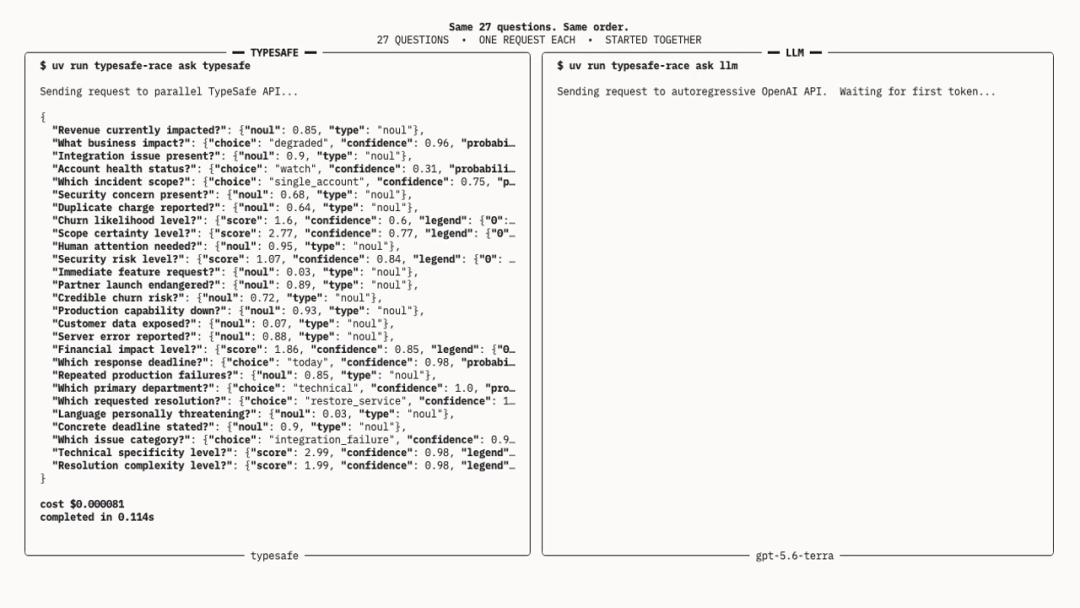
Speed comparison: In 3 seconds, Jev on the left has output a flood of tokens | Image source: TypeSafe
In Kahneman's famous book *Thinking, Fast and Slow*, human thinking is divided into two systems. System 1 is unconscious, extremely fast instinctive intuition; System 2 is slow, energy-consuming logical reasoning. The current mainstream large models are all desperately focusing on System 2, while Jev defines itself as the world's first pure "System One Model".
It does not generate content word by word, and all decisions are produced simultaneously in one-way parallel calculation. This means it has no generative nonsense, and the output is always strictly locked in the Schema predefined by developers.
At the mathematical level, Jev completely eliminates the format hallucination of structured output.
Since there is no need to deduce what the next token is step by step, its end-to-end latency is directly compressed to between 70 and 500 milliseconds, which is 40 to 200 times faster than the cutting-edge large models on the market currently.
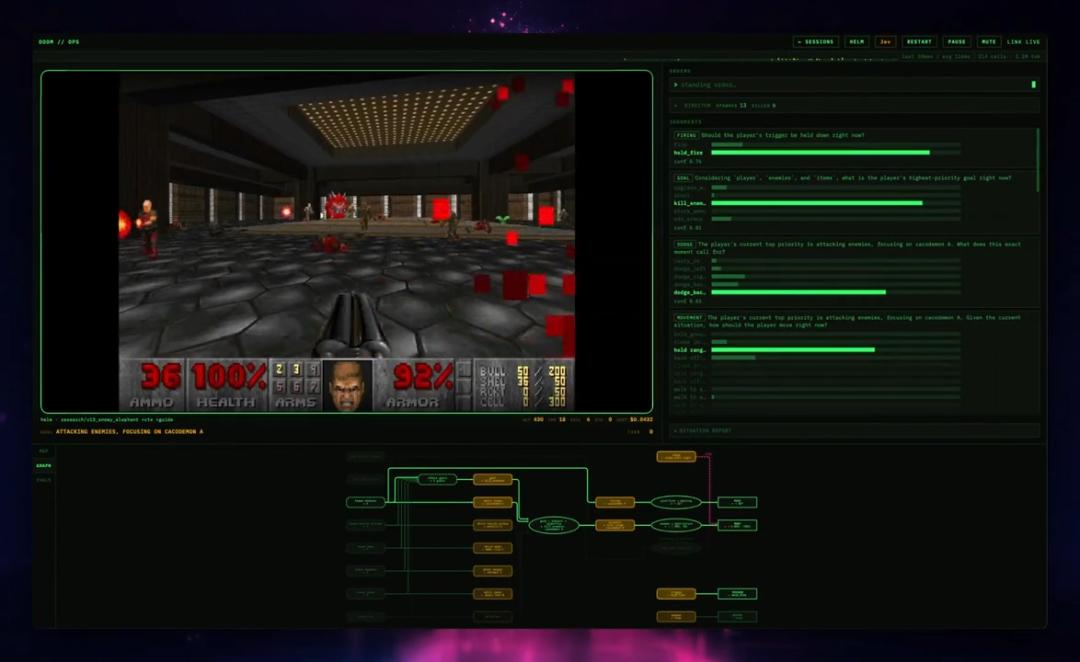
Jev Doom game test | Image source: TypeSafe
TypeSafe even used Jev to play the shooting game Doom. In scenarios where complex long-term planning is not required and only about 10 instant operation judgments are needed per second, Jev performs like a human player with extremely fast reactions, and the entire reasoning cost is only about $7 per hour.
What's more exaggerated is the price. The input cost of Jev is only $0.042 per 1 million tokens, and the output is completely free. On average, the cost of a single structured decision is about $0.0004. In comparison, the cost of calling GPT-5.6 Terra is about 76 times that of Jev, and Claude Opus 5 is hundreds of times higher.
Input unstructured data, instantly output classification choices with calibrated probabilities, numerical scores or Boolean judgments, and then immediately hand over control. This is all the work of Jev.
The bottleneck of Agent is not that the brain is too slow
Why did TypeSafe choose to launch a model that outputs no text at all at this point in time?
The answer lies in the AI Agent that is being fully rolled out.
Whether it is Cursor, GitHub Copilot or various enterprise-level automated workflows in Silicon Valley, engineers soon discovered a cruel reality: the reason why current Agents are laggy and expensive is often not that the core logic is not smart enough, but that the "execution friction" in the middle is too large.
A complete Agent task usually contains dozens of tiny decisions. For example, judge whether the current step is successful, decide to call tool A or tool B, extract key fields from the previous output, and judge whether to terminate the process.
If every small action requires calling a super-large model with hundreds of billions of parameters, not only will the latency accumulate to tens of seconds or even minutes, but the cost will also get out of control quickly. Worse, as long as the JSON format parsing of any step fails, the entire Agent will get stuck halfway.
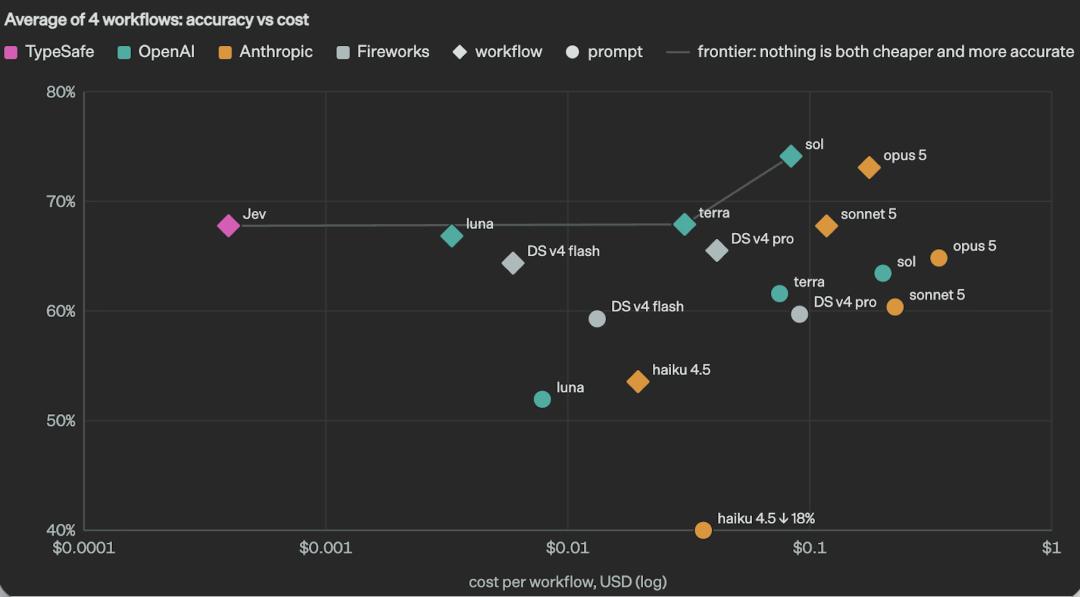
Workflow average accuracy and cost comparison | Image source: TypeSafe
The industry has been kidnapped by autoregressive text models for so long that almost everyone defaults that all AI tasks must be transferred through natural language.
But in the production systems of the real world, most nodes are essentially traditional code control flows. Code does not need emotional value, code does not need parallel sentences, and code only needs an extremely cheap, extremely fast, absolutely type-compliant decision signal.
The emergence of Jev actually inserts a layer of "pre-reflex arc" into the system architecture of large models.
In the ideal collaborative architecture, those expensive cutting-edge large models should step back to the background, acting as the System 2 that oversees the overall situation, responsible for macro planning and difficult thinking. The front-line work of handling trivial tasks, such as work order classification, initial content compliance screening, mass data labeling, and even accurately selecting which one to call from dozens of APIs, can all be handed over to a System 1 model like Jev to complete in milliseconds.
TypeSafe's own test data shows that in four typical enterprise workflows, Jev's accuracy reaches 67.8%, which is almost equal to GPT-5.6 Terra's 67.9%. If you only look at the accuracy of judgment, it does not lose to large models that are dozens of times more expensive than it, but the execution speed is dozens of times faster.
Separating the slow thinking of the cerebral cortex from the conditioned reflex of the spinal cord may be the correct way for AI Agent to truly achieve large-scale industrial implementation.
The black box behind 0 error
However, it is obviously too early to regard Jev as a perfect silver bullet. Behind this amazing technical answer, there are at least two huge shadows that have been deliberately avoided.
The first is the total loss of interpretability.
Although the traditional Chain-of-Thought model is verbose and error-prone, it will at least write down the process of "why this choice is made" on the scratchpad. When a credit review Agent rejects a customer's application, or the security system blocks a transaction, the compliance department can trace the model's decision logic through the reasoning process.
But Jev's output only has dry options and probabilities, and it has no ability to explain the reasons in natural language. When the model makes a critical misjudgment, no one can find the reason from its black-box-like weights. In highly regulated fields such as finance, healthcare, and law, this kind of decision-making mechanism lacking audit capabilities will often directly hit the compliance wall.
The second is the closure of technical details and evaluation benchmarks.
TypeSafe claims that they have invented a brand new training method called RLCD (Reinforcement Learning from Calibrated Decisions), which replaces the traditional RLHF. But from the currently public information, the official has not disclosed how the specific reward function is designed, what the network architecture is based on, and what the mathematical methodology of calibrated probabilities is.
What's more subtle are those impressive scores. All current benchmark tests come from TypeSafe's internal evaluation, and no independent third-party institution has completed the reproduction. The reference answers they use as the ground truth are even obtained by averaging the results from GPT-6 Astra and Claude Fable 5.1. Using the next-generation model of competitors as the referee and then announcing that you have won a big victory in cost performance, this self-proving closed loop itself has a strong public relations color.
Not to mention the sustainability of the business model. Charging only 4 cents per 1 million tokens with completely free output, this price is so low that people suspect that they are using the $40 million financing to fight a price war.
At present, Jev is still in a small-scale invitation-only beta stage. When a large amount of high-concurrency real enterprise-level traffic pours in, it remains to be seen whether this system can maintain ultra-low latency while maintaining a balance of payments.
Making the model smaller, faster, and more deterministic really hits the current industry pain points. But before it is really tested by extreme situations in the real business environment, it is too early to assert that it has subverted the paradigm.
In the past few years, everyone was amazed that AI is getting better and better at saying nice words. But now someone finally realizes that in the silent world of machines, actions are often more important than words.
This article is from the WeChat Official Account "GeekPark" (ID: geekpark), Author: Hualin Wuwang, Editor: Jing Yu, Published with authorization from 36Kr.