Lei Jun and Liu Qiangdong have teamed up to invest in Liu Qin.
A check issued more than a decade ago has gone full circle and ended up back with Liu Qin.
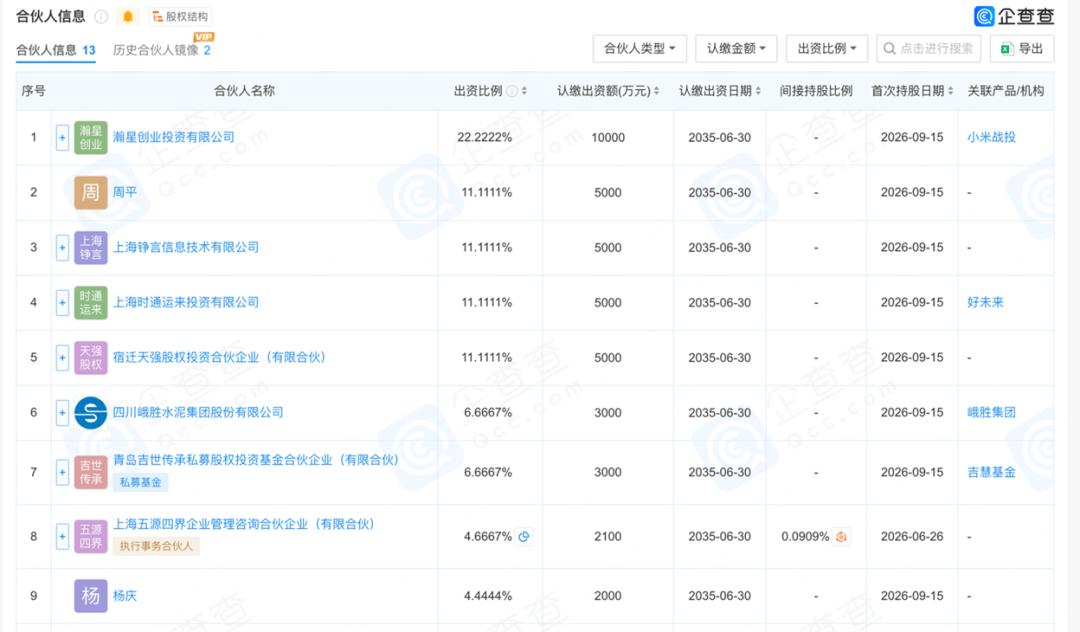
On September 15, Shanghai Wuyuan Shiyuan Private Fund Partnership (Limited Partnership), a new fund under 5Y Capital, completed industrial and commercial changes, with the subscribed capital contribution increasing from 10 million yuan to 450 million yuan, and 11 new partners were added on the same day.
Source: Qichacha
Two eye-catching names are on the list of newly admitted partners:
Hanxing Venture Capital Co., Ltd. under Xiaomi subscribed 100 million yuan, accounting for 22.22% of the total contribution, making it the largest LP;
Suqian Tianqiang Equity Investment Partnership (Limited Partnership), owned by Liu Qiangdong and Zhang Zetian, subscribed 50 million yuan, accounting for 11.11% of the total contribution.
Lei Jun and Liu Qiangdong have entrusted their capital to the same person — Liu Qin, founding partner of 5Y Capital.
Liu Qin was Xiaomi's first investor, whose $5 million investment back then brought an 866x return. Now it's Lei Jun's turn to entrust his capital to Liu Qin for management.
Sixteen years ago, Morningside Capital (now 5Y Capital), led by Liu Qin, invested in Xiaomi. Later, Lei Jun in turn became a capital contributor to Liu Qin. This time, Hanxing controlled by Lei Jun even subscribed 100 million yuan, becoming the LP that contributed the most in 5Y's new fund. Suqian Tianqiang, the investment platform of Liu Qiangdong and his wife, also used to be an LP of Shunwei Capital under the Lei Jun ecosystem. After going full circle, the capital of the three parties is now pooled into the same fund.
A new fund of 450 million yuan
According to Qichacha, Shanghai Wuyuan Shiyuan Private Fund Partnership (Limited Partnership) was registered in Yangpu, Shanghai on June 26, with the actual controller being Liu Qin, founding partner of 5Y Capital. On September 10, this fund completed the filing with the Asset Management Association of China.
On September 15, the industrial and commercial change of the fund took effect, with 11 new partners joining, and the subscribed scale of the fund expanded from 10 million yuan to 450 million yuan. In addition to Xiaomi's strategic investment and Suqian Tianqiang, the LP list also includes Qingdao Jishi Heritage Fund under Jihui Fund, industrial entities such as Sichuan Esheng Cement Group Co., Ltd. and Jiangsu Hubao Group Co., Ltd., as well as two natural persons. The subscribed deadline for all parties is June 30, 2035.
As for where the 450 million yuan will be invested in the end, no public information has been disclosed so far.
Let's turn the clock back to 2008 first.
In this year, Liu Qin and Shi Jianming co-founded Morningside Capital, and Morningside Group became an important capital contributor to the fund. Since then, Liu Qin has embarked on his career of independently managing VC funds.
From the very beginning, Morningside Capital's investment focus has been on Chinese internet and technology entrepreneurs. Later well-known companies such as Ctrip, Xiaomi, Kuaishou and Kingsoft Office have successively appeared in its investment portfolio. Among them, the $5 million invested in Xiaomi in 2010 has become the most iconic investment in Liu Qin's career.
12 years after its establishment, this institution changed its name.
In October 2020, Morningside Capital was officially renamed 5Y Capital. Liu Qin explained at that time that the name "Morningside" came from Morningside Group — a family investment group established by the Chen family in Hong Kong, which was also the most important LP at the beginning of Morningside Capital's establishment in 2008. The two parties agreed that the brand name would be borrowed for 12 years; 12 years later, the team decided to launch its own brand. The new name "5Y" comes from Wuyuan Road in Shanghai — where Liu Qin has worked and lived for more than 20 years. The name changed, but the core team and investment logic have been retained.
Before the name change, it had already consciously extended from the familiar consumer internet to a broader industrial boundary, with investment directions gradually entering cloud computing, enterprise services, semiconductors, biomedicine and other fields. Liu Qin positioned 5Y at that time as a platform fund that spans multiple industries and investment stages.
Looking at 5Y Capital's past investment portfolio, we can roughly know the path along which Liu Qin's capital flows.
Ctrip, Xiaomi, Kuaishou, Kingsoft Office, Horizon Robotics, XPeng Motors, Pony.ai, WeDoctor, Didi, SenseTime... from internet platforms to smart vehicles, from consumer technology to autonomous driving, 5Y has bet on a number of leading companies in the industry later. Looking at recent years, companies such as Moore Threads, Galactic Space, Synthace Technology and Bambu Lab have extended this list to semiconductors, aerospace, biomedicine and intelligent manufacturing.
This is the epitome of the iteration of 5Y Capital's investment style.
After internet platforms became infrastructure, 5Y Capital began to look for next-generation industries such as new energy vehicles, autonomous driving and chips; and today, more early-stage technology directions such as AI, robotics, AI for Science and quantum computing have begun to frequently appear in 5Y's investment portfolio.
In the past two years, 5Y has participated in the financing of projects such as Moonshot AI, Droid Robotics, Jike Technology, and also appeared in the investment list of projects such as Xunming Bio and Zean Biomedicine; in 2026, it participated in multiple rounds of financing of Valhalla Technology, as well as the over 100 million yuan angel round financing of Vector Singularity, a neutral atom quantum computing enterprise.
Judging from these moves, 5Y's investment boundary is still very wide, but technological innovation is occupying an increasingly important position in this portfolio map.
Public information has not yet given an answer as to where this new 450 million yuan fund will eventually invest its capital. But at least from 5Y's moves in recent years, AI, robotics and more cutting-edge early-stage technologies have become important directions for this veteran VC to continuously seek new opportunities.
He invested in Lei Jun back then, now Lei Jun becomes his LP
Lei Jun and Liu Qin have a friendship of more than ten years.
In 2010, Xiaomi was just starting out. Both of them are from Hubei Province. Before Lei Jun decided to found Xiaomi, the two had known each other for many years. After Lei Jun shared his idea of making smartphones, the two once talked on the phone for 12 consecutive hours, and Liu Qin finally decided to invest.
Liu Qin later recalled in an interview with LatePost that this investment was quite controversial at that time, but Morningside still participated in three consecutive rounds of investment. According to 36Kr's report, Liu Qin once withstood the collective doubts of LPs and bet 45% of the capital of the first fund on Xiaomi.
Later, the $5 million invested by 5Y obtained an 866x return when Xiaomi went public. This investment has also become one of the most representative cases in Liu Qin's investment career.
Sixteen years have passed, and now it's Lei Jun's turn to invest in Liu Qin.
This is not the first time that Lei Jun has entrusted capital to Liu Qin. According to Qichacha, Hanxing was previously a capital contributor to Guangdong Hengqin Wuyuan Zhenzhi Equity Investment Partnership (Limited Partnership) under 5Y, subscribing 300 million yuan, accounting for 23.2486% of the total contribution.
Hanxing itself is an important investment platform under the Xiaomi ecosystem. It is 100% held by Xiaomi Technology Co., Ltd., with a registered capital of 1.5 billion yuan. Its actual controller is Lei Jun, and its legal representative is Steven Lam, CFO of Xiaomi Group.
Xiaomi has formed a relatively clear investment portfolio over the years: Shunwei Capital covers early-stage startups, tracks trends and invests in the future; Xiaomi Yangtze River Industrial Fund bets on semiconductors and underlying technologies; Xiaomi's own investment platform undertakes industrial investment and ecological collaboration.
However, there are too many scattered early-stage projects for its own team to cover all of them. Especially in fields such as AI, robotics and semiconductors, the number of projects is increasing, and the technical routes are constantly changing. Many opportunities have entered the vision of VCs before they become industrial hotspots.
According to Qichacha, in Hanxing's external investments, in addition to 5Y, there are also funds of institutions such as Shunwei Capital, Matrix Partners China, Sinovation Ventures, and Lihe. Entrusting capital to trusted leading VCs is equivalent to inviting more pairs of eyes to help track cutting-edge technologies, which brings not only returns but also an additional path to observe the industry.
Liu Qiangdong is a "hidden LP" in the venture capital circle. Suqian Tianqiang is not only an LP of MiraclePlus, but also previously invested in GL Ventures and Shiyu Capital. At the same time, Liu Qiangdong also invested in Lei Jun — Suqian Tianqiang is an LP of Shunwei Capital, subscribing 50 million yuan in Tianjin Chulin Equity Investment Partnership managed by Shunwei, accounting for 22.5734% of the total contribution.
What is special about 5Y's LP list
First of all, among the contributors of Wuyuan Shiyuan this time, there are no common LPs in the current market such as government guidance funds and local state-owned assets platforms.
According to Qichacha, excluding the two partnerships owned by 5Y itself, the remaining 11 contributors include industrial companies, other private funds and natural persons.
In the RMB private equity market, state-owned assets have become one of the most important sources of capital. Government guidance funds usually have functions such as industrial guidance and investment attraction, and some funds will put forward corresponding requirements on investment directions and regional return investment ratios; industrial capital and market-oriented LPs make allocations more based on factors such as their own industrial layout and capital returns. In the fundraising market where state-owned assets occupy an absolute dominant position, Wuyuan Shiyuan has gathered a group of industrial companies, entrepreneurs and market-oriented capital contributors.
The second special point is that Lei Jun and Liu Qiangdong appear on this list at the same time. Neither of them is a first-time LP, but this time they entrusted their capital to the same GP.
In fact, this is not the first time that 5Y has seen such capital reflux. In 2017, the LP list of Morningside Capital's first RMB fund included invested enterprises such as Xiaomi and YY; when 5Y raised its first dual-currency fund after the name change in 2021, Kuaishou also became an LP.
At the same time, He Xiaopeng once contributed to institutions such as Morningside Capital, Kunzhong Capital and GGV Capital through Shanghai Binhe Investment Management Center, all of which previously participated in the investment of XPeng Motors or the enterprises founded by He Xiaopeng. The relationship between 5Y and He Xiaopeng is particularly direct: back in the Morningside era, Liu Qin participated in multiple rounds of financing of XPeng Motors; after XPeng Motors went public, He Xiaopeng became an LP of 5Y.
In 2010, Liu Qin invested in Xiaomi with $5 million; sixteen years later, Hanxing under Lei Jun subscribed 100 million yuan to enter Wuyuan Shiyuan and became its largest LP. The capital relationship has gone full circle, and the positions of investors and entrepreneurs have also changed.
This kind of relationship is not uncommon in the venture capital circle. At the beginning of the establishment of Source Code Capital, Wang Xing and Zhang Yiming once participated in the capital contribution; at the beginning of the establishment of GL Ventures, it also took "founder fund" as its feature, attracting internet enterprise founders and core executives to become LPs.
Why do entrepreneurs who already have industrial and investment capabilities still entrust their capital to professional VCs?
Entrepreneurs are familiar with their own tracks, but the investment boundary of a single enterprise is limited after all; professional GPs have long-term continuous tracking across industries, accumulating wider project sources and the ability to continuously judge early-stage startups.
What Lei Jun and Liu Qiangdong are really betting on this time is Liu Qin's ability to continuously explore, screen and judge the next generation of innovative companies.
Conclusion
In the past, VCs were looking for entrepreneurs; now, entrepreneurs who have gone through the entrepreneurial cycle are also starting to look for VCs worthy of entrusting their capital to.
On the surface, this 450 million yuan fund is a new fundraising, but behind it is a network of relationships that has lasted for more than ten years: Liu Qin once used capital to invest in Lei Jun, Liu Qiangdong once became an LP of the fund managed by Shunwei Capital through Suqian Tianqiang, and now they are on the same LP list.
For a VC, its relationship with entrepreneurs is constantly changing, but what really remains unchanged is whether it can continuously find the next batch of entrepreneurs worthy of investment.
This article is from the WeChat official account "Thecapital" (ID: thecapital), written by Li Bingzhi, edited by Wu Ren, and published with authorization by 36Kr.