Joseph Tsai and HSG have co-invested in a unicorn valued at 40 billion yuan.
Top family offices and top venture capital firms have set their sights on the same unicorn.
Recently, Tabby, a Saudi Arabia-headquartered fintech company, completed a $233 million financing at a valuation of $6.5 billion (approximately RMB 43.64 billion).
In terms of popularity, Saudi-based Tabby is naturally not as well known as a host of North American unicorns that are more familiar to the public. But when it comes to business logic, Tabby is by no means unfamiliar: its flagship product focuses on Buy Now Pay Later, with functions similar to Huabei in China.
Tabby plans to use this round of financing to further expand its two core markets, Saudi Arabia and the United Arab Emirates. Meanwhile, this financing also includes an equity liquidity arrangement for employees. Tabby has regularly carried out old share swap programs since 2023, facilitating a total of more than $100 million in equity transactions, with both current and former employees eligible to participate in the share sale.
Founded in 2019, this round is Tabby's Series F financing. The latest round was led by Blue Pool Capital, an existing shareholder, with participation from other existing shareholders HSG, Wellington Management and Arbor Ventures.
Headquartered in Hong Kong, Blue Pool Capital was founded by Joseph Tsai, Chairman of Alibaba Group, which manages the family assets of Joseph Tsai, Jack Ma and some senior executives of Alibaba, and has long been regarded as the ceiling of family offices in the Asia-Pacific region. The status of HSG in the investment industry goes without saying.
Interestingly, although the two institutions have very different positioning, Blue Pool Capital and HSG have appeared on the same investment list for the second time this year.
Founded 7 Years Ago, Valuation Exceeds RMB 400 Billion
At present, Tabby has an annualized transaction volume of $18 billion, 25 million registered users, and more than 70,000 global and local brands including SHEIN, Amazon, Apple, IKEA, Jarir, Samsung and noon have integrated with its platform.
As a company that cooperates in depth with a large number of e-commerce platforms, Tabby itself has e-commerce genes, which can be traced back to the experience of Tabby's founder.
Hosam Arab, the founder of Tabby, like many entrepreneurs, is a natural fit for starting a business. According to his description in a previous interview with HSG, he used to work at General Electric, studied at Harvard Business School, worked as a management consultant, and also entered the private equity field, but found that none of his past career paths suited him. Eventually, he came to a realization: "The problem is not the industries I tried, but myself. Starting a business is the only way out for me."
Inspired by the U.S. B2C website Zappos in 2011, Hosam Arab co-founded Namshi, an online fashion retailer. When Namshi was established, the online fashion sector in the Middle East was still a blank market. Through a combination of measures including developing dedicated apps, cooperating with internet influencers, and building self-operated logistics, Hosam Arab developed Namshi into the leading e-commerce platform in the Middle East. By 2018, Namshi's annual sales reached approximately $230 million. In February 2019, Emaar, the largest real estate developer in Dubai and an existing shareholder, acquired all shares of Namshi at a total price of about $280 million.
Like most restless entrepreneurs, Hosam Arab quickly launched his next project. His original intention of founding Tabby was to solve the business problems that he failed to address during the operation of Namshi.
While running Namshi, Hosam Arab tried various methods such as credit card discounts to get customers to form the habit of online payment, but consumers always lacked trust in online retailers and still relied heavily on cash transactions. From 2011 to 2019, the proportion of cash transactions on Namshi only dropped from about 85% to about 75%. In an era when everyone thought cash would eventually disappear, such a decline rate was extremely slow.
After founding Tabby, Hosam Arab launched the equal installment "Buy Now Pay Later" model. Most installment products on the market charge interest or have various hidden fees, while Tabby focuses on zero interest and zero late payment fees. Relying on this product advantage, Tabby quickly accumulated a large user base and cooperative merchants, and its core revenue comes from transaction commissions charged to merchants.
Benefiting from the booming e-commerce industry, Tabby's business took off rapidly. In March 2022, Tabby only had more than 1 million active users and covered more than 3,000 brands. By the end of 2023, the number of Tabby's users had reached 10 million, and the number of cooperative brands had grown exponentially to more than 30,000.
However, in Hosam Arab's mind, the ultimate goal of Tabby is far more than an installment payment company. In an interview in June this year, he admitted that Buy Now Pay Later was only a springboard from the very beginning, not the end point:
"Buy Now Pay Later provides customers with a very clear value proposition and can effectively attract them to transact with us for the first time. Once this relationship is established and we have a customer acquisition model that does not rely on expensive paid promotion, the next question becomes: how to develop other products for the same customer, so as to simplify their financial life?"
In other words, what Hosam Arab really wants to build is a platform-based fintech company with diversified businesses.
In 2024, the second year after the company achieved profitability, Tabby acquired Tweeq, a licensed digital wallet company in Saudi Arabia. Over the past year, Tabby has successively obtained multiple financial licenses from the Central Bank of Saudi Arabia and the Central Bank of the United Arab Emirates. At present, Tabby's business has expanded from the initial installment payment to fields such as loans, transfers and payments.
The continuously expanding business boundary has also raised Tabby's financing scale and valuation.
Since its establishment, Tabby's investor lineup is very strong, including HSG India, PayPal Ventures, Mubadala Investment Company, the sovereign wealth fund of Abu Dhabi, and Blue Pool Capital. In October 2025, two leading Chinese institutions, HSG and Boyu Capital, also entered the market by acquiring old shares from early investors, when Tabby was valued at about $4.5 billion. Compared with the latest valuation of $6.5 billion, Tabby's market value has increased by more than 40% in less than a year.
HSG and Blue Pool Capital, Second Joint Investment This Year
This round of financing is also Blue Pool Capital's third investment in Tabby. As early as October 2023, during Tabby's Series D financing, Blue Pool Capital had already participated in the investment. In February 2025 and this month, Blue Pool Capital successively increased its holdings. Including the acquisition of old shares of Tabby in October 2025 and this round of financing, HSG has invested in Tabby twice within one year.
In fact, Tabby is already the second cooperation between Blue Pool Capital and HSG this year. In April this year, the Asian University Basketball League (AUBL) completed its Series A financing, which was led by Blue Pool Capital, with HSG also on the list of follow-up investors.
Blue Pool Capital and HSG have certain similarities in the selection of investment fields and targets.
Both institutions prefer emerging digital financial infrastructure. In addition to continuously investing in Tabby, Blue Pool Capital also participated in the investment of Stable, a U.S.-based stablecoin blockchain company in 2025. HSG has placed bets on Airwallex, a cross-border payment platform originating from Australia, Opay, a Nigerian mobile wallet company, and Monzo, a UK digital bank, in this track.
Both institutions have also targeted destination travel platforms. Among them, GetYourGuide, a German company invested by Blue Pool Capital, focuses on the European and American markets, while Klook, a Hong Kong company invested by HSG, focuses on the Asia-Pacific region.
In the consumer track, Blue Pool Capital and HSG even invested in the same target one after another. At the beginning of 2025, Blue Pool Capital took a strategic stake in Italian fashion brand Golden Goose and acquired 12% of its equity. By the end of 2025, HSG announced that it would take controlling stake in Golden Goose with a transaction amount of about 2.5 billion euros (approximately RMB 20 billion).
However, the overlap in fields and projects is more like an occasional intersection of Blue Pool Capital and HSG on their investment paths. The two institutions have different positioning, and their overall investment strategies are far apart.
As a leading venture capital and private equity institution, HSG's business covers seed investment, venture capital, growth investment, buyout and infrastructure investment, and is highly focused on the equity investment field. In recent years, in HSG's overseas investment activities, the controlling buyout model has become more and more common: since 2021, HSG has successively taken controlling stakes in French designer brand AMI, British audio brand Marshall and Golden Goose.
Compared with institutions that actively disclose their asset size and investment portfolio, Blue Pool Capital, as a multi-family office, has always maintained a mysterious image. Blue Pool Capital's official website only has one page, and no other information is disclosed except the company address, contact number and license information held by the company.
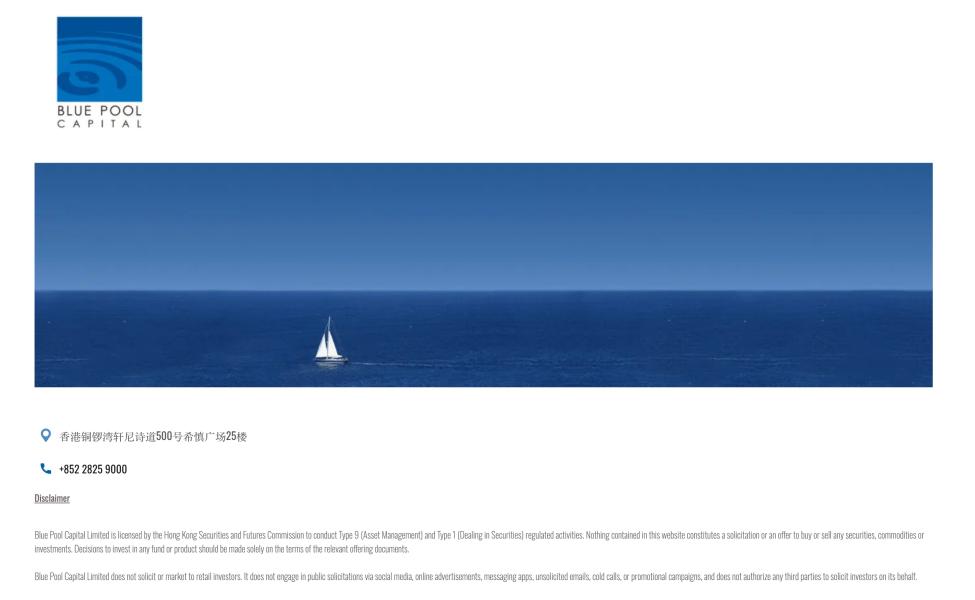
(Official website of Blue Pool Capital)
However, combined with multiple reports, it can be seen that as a multi-family office undertaking the mission of family wealth inheritance, Blue Pool Capital has allocated a large number of alternative assets in addition to private equity.
The most typical asset is real estate, the favorite of the wealthy. Public information shows that in 2022, Blue Pool Capital acquired the penthouse at 220 Central Park South, the most expensive luxury apartment building in New York, as well as a utility room on the lower floor. At the same time, Blue Pool Capital is also the largest investor in a five-star hotel in Porto, Portugal, and indirectly holds equity in more than six five-star hotels in Spain.
The most iconic asset in Blue Pool Capital's investment portfolio is the sports assets that are highly linked to Joseph Tsai's personal hobbies. After immigrating to the United States at the age of 13, Joseph Tsai was a member of the school basketball team and hockey team during his student days. He is a die-hard NBA fan and is known as "the partner who plays basketball best" within Alibaba. In previous public interviews, Joseph Tsai did not hesitate to share the meaning of sports to him:
"Sports not only teach you discipline and hard work, but also teach you how to stand up after failure. If you lose a game, you have to stand up again."
From 2018 to 2019, Joseph Tsai invested a total of about $3.35 billion through Blue Pool Capital to acquire 100% equity of the Brooklyn Nets and the Barclays Center, the home arena of the Nets. In 2024, Blue Pool Capital sold part of the Nets' equity to the famous Koch family in the United States for $688 million at a valuation of $5.8 billion. At the same time, Blue Pool Capital's equity investment portfolio also includes four sports companies: Premier Lacrosse League, women's sports media JWS, "Basketball + AI" platform NEX Team, and Web3 sports platform Fast Break Labs.
According to media reports, HSG is in contact with global investors to raise funds for its first U.S. dollar fund after its spin-off and independence. This early-stage fund plans to raise at least $1.2 billion, and the funds will be mainly invested in start-ups in tracks such as AI, healthcare and consumer innovation.
According to recent market news, Blue Pool Capital's Harborside fund plans to raise $500 million by the end of the year, which will be mainly allocated to external hedge funds and private credit managers. Meanwhile, Blue Pool Capital's another fund, Riverside, has raised $1.4 billion and plans to invest in mid-sized companies in the high-end consumer, fintech and AI sectors in the future.
Judging from the latest fundraising situation, the investment paths of Blue Pool Capital and HSG will continue to diverge. However, as long as the two institutions remain active in the private equity field, it may not be long before they meet in the financing list of the next Tabby.
This article is from the WeChat official account "Dong 40th Street Capital" (ID: DsstCapital), written by Li Xinting, and authorized for release by 36Kr.