The post-2000s individual from Zhejiang University has a valuation of nearly 10 billion.
The Investment Journal learned from informed sources that Moxin Technology, led by Chen Tianrun, is about to complete a new round of financing, with the financing scale expected to reach the level of 10 billion RMB, and the company's valuation has jumped to nearly 100 billion RMB.
This is less than a month after the company's last round of financing, when its valuation was 4 billion RMB. Such financing speed and valuation growth are astonishing.
Chen Tianrun, a post-2000s generation, graduated from Zhejiang University and studied under Academician Pan Yunhe. As early as his college years, Chen Tianrun started his entrepreneurial journey. From 3D printing to 4D world models, from consumer-grade hardware to physical AI infrastructure, he completed the leap in five years.
The significance of this leap may go far beyond the valuation of a single company. It is more like a signal: the younger generation of Chinese entrepreneurs is standing at the starting line of redefining AI.
The birth of a 10-billion-yuan unicorn in the world model track, investors come to the surface
In just one month, the valuation has more than doubled, which is a rare speed in the industry.
According to insiders, the new round of financing of Moxin Technology continues the previous feature of intensive participation of industrial capital, with state-owned capital and market capital increasing their investment efforts. The investor lineup covers multiple fields such as chips, computing power, intelligent terminals, digital content and advanced manufacturing.
Different from the common financial investment in the market, the support of this all-dimensional capital matrix is essentially the collective bet of core players in the upstream and downstream of the industrial chain on the industrialization value of world models, which means that the multi-party joint layout of world model industrialization has entered a critical stage, and also confirms the scarce value of Moxin Technology in the track.
It is recalled that not long ago, Moxin Technology completed a financing of 500 million RMB with a valuation of 4 billion RMB, and a luxury investor team has been assembled behind it.
First, Shenzhen Venture Capital Group and Zhejiang Venture Capital joined hands to enter the market. As a typical patient capital, state-owned institutions' large-scale layout of cutting-edge technology tracks in the early stage to a certain extent reflects the policy recognition of the strategic value of world models.
Second, industrial capital appears intensively. Among them, Hubble Investment under Huawei is an early investor of Moxin Technology. In recent years, the two sides have carried out model training and inference optimization around Ascend NPU. It is worth mentioning that Huawei has listed the world model as the first of the "top 10 technology trends in the intelligent world in 2035", which is also the underlying logic of investing in Moxin Technology.
As we all know, world models need to process long-time, high-resolution visual information, which puts forward higher requirements for chip computing power, storage bandwidth, equipment communication and energy consumption; chip enterprises also need to verify product capabilities through new models and new scenarios.
Therefore, the collective move of semiconductor industrial capital such as SMIC PE, Xixin Investment, Fullhan Microelectronics and Jahwa Electronics means that the participation of chip enterprises is not only a bet at the capital level, but also breaks through the coordination barrier between underlying chip hardware and upper-layer model algorithms, promoting the positive cycle of "chip computing power iteration enabling model upgrading, and model innovation tapping new hardware demands".
Of course, that's not all — there is also Legend Holdings covering PC and intelligent device terminals, Ganbei Fund under Bilibili which owns massive content, and Xingrui Capital with Transsion industrial background. These powerful capitals connect the intelligent terminal and digital content ecology, and build a complete application chain from "entrance" to "scenario" for the world model.
The advanced manufacturing and energy capital represented by JinkoSolar Holding is expected to fill the gap of world model implementation in hard-core industrial scenarios. As a result, it will also promote the world model to penetrate deeply from consumer-grade cultural and entertainment scenarios to the real industries such as intelligent manufacturing, which can greatly expand the commercial boundary of Moxin Technology.
In the final analysis, different from traditional financial investors' pursuit of short-term returns, the investment logic of this round of industrial capital is closer to "positioning" — by investing in Moxin Technology, all industrial parties not only lock their positions in the next-generation spatial intelligent infrastructure, but also ensure that their own business scenarios can take the lead in accessing the capabilities of the world model.
The heavy positions of leading institutions such as P7 USD Fund, CDH Baifu & Loongson Venture Capital, Tunlan Investment, Shuyun Capital and Junlang Venture Capital verify the technical strength and global competition potential of Moxin Technology from a market-oriented perspective.
After careful sorting, from the end of 2025 to August this year, Moxin Technology has completed 4 consecutive rounds of financing, with new industrial capital joining in each round and old shareholders continuing to increase their positions. Coupled with the upcoming new round of 1-billion-yuan level financing, this financing density is very rare among world model startups.
Behind such a financing rhythm, a clear signal is conveyed — the Matthew effect of the track is intensifying, and players with "first-mover advantage" are more worthy of heavy investment.
At present, the investment logic of the primary market for AI projects has been completely reconstructed, saying goodbye to the extensive investment of "valuing concepts while ignoring implementation" and turning to systematic investment of "valuing technology, industry and closed loop". Investors no longer blindly pursue general large models, and only targets with vertical technical barriers and clear implementation scenarios can stand out. The hot financing of Moxin Technology is a microcosm of this trend.
It is reported that Moxin Technology has completed the shareholding system reform a few days ago, which undoubtedly makes institutional preparations for the subsequent capital market process. Perhaps soon, we will witness the birth of a super IPO.
Post-2000s Zhejiang University PhD leads the team into the world model track
What supports a valuation of nearly 10 billion yuan?
We have to start with founder Chen Tianrun. Born in 2000, he started learning programming in middle school and developed a strong interest in 3D modeling technology. Later, when he studied at Zhejiang University, he participated in a large number of researches on 3D modeling and 3D reconstruction.
After graduating from undergraduate, Chen Tianrun was recommended to the School of Computer Science of Zhejiang University to pursue a doctorate directly, under the supervision of Pan Yunhe, academician of the Chinese Academy of Engineering and former president of Zhejiang University. During this period, he published more than 50 high-level papers in journals such as Science, Nature Photonics, IEEE TPAMI and conferences such as ICCV, CVPR, ICML and SIGGRAPH.
This is a sufficiently impressive resume, but Chen Tianrun's choice is far more meaningful than the resume itself.
As early as 2021 when he was still a junior, Chen Tianrun had the idea of starting a business. In his view, it is worth trying to promote some new technologies to be implemented to more people through commercial means. Thus, Moxin Technology came into being, taking the lead in cutting into the consumer-grade 3D printing hardware track.
Years of accumulation in the 3D field made Chen Tianrun see greater opportunities. He believes that 3D printing is only the starting point for "letting AI understand the 3D world", and he is determined to enter the higher-dimensional track of physical AI. To this end, Chen Tianrun led the team to fully shift to the 4D world model, and began to deeply cultivate the field of spatial intelligence.
Moxin Technology has taken a unique path in route selection, adopting a pure implicit structure. The core is not to reconstruct the world at the pixel or explicit geometric level, but to predict future states in the high-dimensional abstract representation space (Latent Space). This technical choice gives it a differentiated advantage — it enables AI to remember the long-term state of the scene instead of "forgetting it after seeing it".
This is benefited from Moxin Technology's previous accumulation. Since its establishment, the team has hired designers and art artists to produce 3D content, and gradually accumulated PB-level 3D models and scene assets covering complex physical scenes and dynamic natural environments. This point is obviously impossible for other players to replicate and catch up in the short term.
Relying on this, Moxin Technology released the prototype of the interactive world model KOKONI-World at the end of last year. In July this year, Moxin Technology, together with the National Pilot Base for Artificial Intelligence Application and Huawei Cloud, released the general world model MoWorld-4D, which completes training, compression and deployment based on fully domestic NPU, and can achieve a maximum real-time inference of about 50 frames per second.
Specifically, users can generate 3D scenes with spatial structure through input methods such as images and texts, to realize a complete set of high-definition 3D scenes that conform to the real physical logic. MoWorld-4D uses the six-degree-of-freedom motion of the camera as the physical signal, and users can walk, turn around, and surround to observe the whole scene in the generated "world". In addition, the building structure, road direction and object position in the generated world all conform to the real spatial law.
At the same time, Moxin Technology also put forward the concept of Flash World Model — high frame rate can keep the world model usable in real scenes, which marks that AI has moved from "generating content" to "interactive world simulation".
Why is "high frame rate" so important? In the past, the mainstream frame rate of world models was below 30 frames, which is widely regarded as the minimum threshold for realizing real-time rendering and providing a smooth interactive experience. 50FPS means that each frame only needs 20 milliseconds to generate, which can quickly respond to user instructions. For scenarios extremely sensitive to latency such as humanoid robot control and autonomous driving, this gap is decisive.
More critically, MoWorld-4D achieves the unification of high frame rate, high image quality and low cost. This is the world's first 4D world model based on Huawei Ascend NPU super node, which realizes full-link independent controllability of training, compression, distillation and real-time inference, completely getting rid of the dependence on overseas high-end GPUs.
Moreover, its comprehensive inference cost is only 30% of that of imported GPU solutions of the same scale, breaking the industry's cost curse, verifying the feasibility of domestic computing power supporting large-scale deployment of world models, and providing a referable path for domestic enterprises.
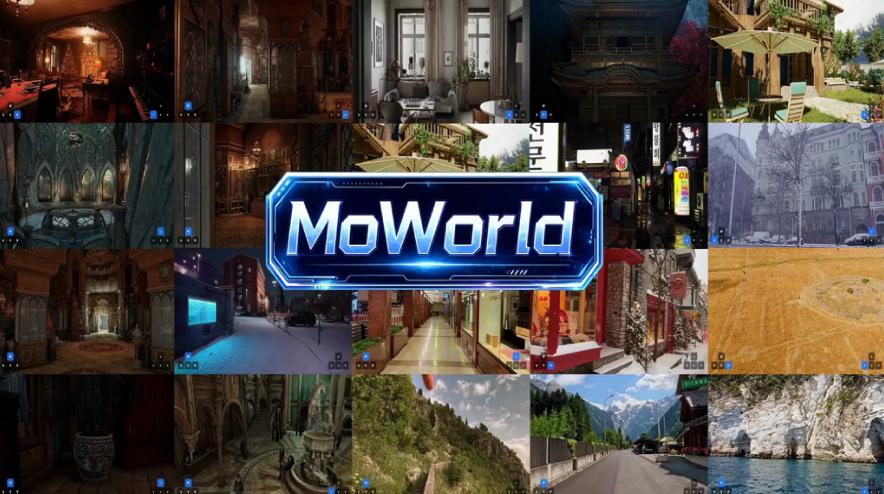
Looking at the whole track, most of the current world models still focus on static image generation and video rendering optimization in To C cultural and entertainment scenarios, emphasizing display while ignoring implementation, and lack of industrial-grade real-time interaction capability and cost advantage; while Moxin Technology has anchored the core demand of industrial implementation from the very beginning of R&D, to build a general-purpose spatial intelligent infrastructure.
Therefore, the core value of MoWorld-4D is not only to generate realistic scenes, but also to accurately simulate the dynamic causality, spatial interaction and environment evolution of the physical world, adapting to the real-time decision-making needs of various physical AI terminals. This is a truly industry-oriented hard-core technology, which is undoubtedly a scarce target in the primary market.
Launch the breakout battle
At present, the world model storm is sweeping the globe.
Earlier this year, World Labs founded by Li Fei-Fei announced the completion of its latest $1 billion new financing, with a valuation of an astonishing $5 billion just one year after its establishment; subsequently, AMI led by Yann LeCun also completed a seed round financing of about $1.03 billion, setting a new record for the largest seed round in European history.
Looking back at China, on the one hand, world model startups such as Amazing Vision, LiberAI, Unbounded Power and VAST are pushing forward financing non-stop; on the other hand, Internet giants have entered the market collectively. For example, not long ago, Tencent and Alibaba released their own world model products on the same day, namely Hunyuan 3D World Model 2.0 and the world model Happy Oyster, and the Seed team of ByteDance also released the new generation 3D generation large model Seed3D2.0.
The reason why the world model is so popular is that it is regarded as the core engine of physical AGI, which completes the key link of "understanding reality and interacting with reality" for AI, and then enables AI to move from "being able to generate" to "being able to understand, deduce and act".
However, the competition logic of the world model is undergoing fundamental iteration, shifting from technical competition in the laboratory to systematic competition involving computing power, models, data and industrial applications. The focus of the market is no longer "whether it can generate scenes", but "whether it can interact in real time, popularize at low cost and adapt to the real needs of the industry".
In other words, technology must finally return to the realization of industrial value.
This is also the key direction that the Moxin Technology team focuses on. On the one hand, the company meets the strict real-time requirements of industry, transportation, robotics and other fields through 50FPS ultra-high frame rate, turning the world model from a "ornamental technology" into a "productive tool"; on the other hand, the domestically oriented low-cost path explored by the team also breaks the barriers to implementation.
After the release of the MoWorld-4D model, Moxin Technology has accelerated the exploration and implementation of applications in multiple scenarios such as industrial digital twins, embodied intelligence training, urban and rural planning, and cultural tourism consumption.
Among them, in the field of advanced manufacturing, relevant models can convert images taken by mobile phones or ordinary cameras into 3D space, helping enterprises continuously update the digital status of factories and production lines, and conduct scheme rehearsal and risk screening in advance before equipment installation and production line transformation; in the field of embodied intelligence, MoWorld-4D can provide robots with a continuous and controllable virtual training environment, reducing the cost of data collection and trial and error in real scenes; in the field of urban and rural planning and cultural tourism, the model can be used for spatial reconstruction, scheme simulation, digital scenic spots and immersive content production.
Any technology that can cross the cycle must finally return to the real world, return to the industry, and return to the real needs of people.
Today, AI has shown great potential in information processing and knowledge work, but the greater opportunity in the future comes from how it enters more complex and real systems. Just like Moxin Technology's valuation rose from 4 billion yuan to nearly 10 billion yuan, what the market repriced is the possibility of this company moving from model breakthrough to industrial infrastructure.
The primary market gathers the smartest capital in the market. Their continuous heavy investment is not only a vote of confidence, but also represents the belief that Chinese forces will surely occupy a place in the global spatial intelligence landscape.
This article is from WeChat official account "Investment" (ID: pedaily2012), written by Liu Bo, authorized by 36Kr to release.