Spending 12.3 billion yuan on a "non-controlling" admission ticket: The three ledgers of Anta taking the reins of Puma
Recently, the State Administration for Market Regulation released the list of unconditionally approved operator concentration cases from August 31 to September 6, 2026, in which the case of "Anta Sports Products Limited acquiring the equity stake of PUMA SE" is included, with the review completion date set as August 31.
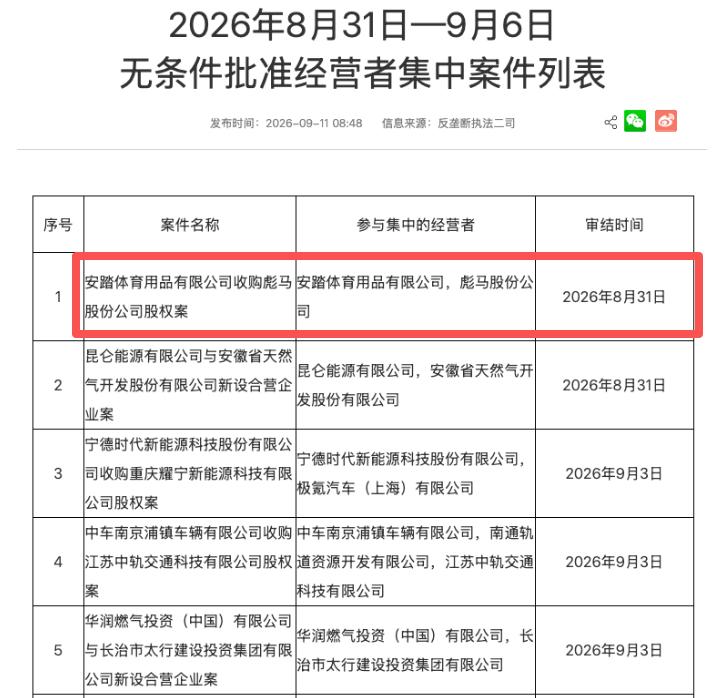
From the official announcement on January 27 to the domestic regulatory approval, this cross-border equity transaction of 15.06 billion euros (approximately 122.78 billion RMB) has passed the most critical administrative checkpoint after more than seven months.
But the phrase "buy out" is not accurate.
After the transaction is completed, Anta will hold 29.06% of PUMA SE's equity and become its single largest shareholder — it will not obtain control, nor launch a full tender offer, while PUMA will retain the independent governance structure and original management team as a publicly listed company in Germany.
This determines the analytical tone of this article: it is not a narrative of "Chinese capital swallowing a long-established German brand", but a precisely calculated transaction combining minority equity investment and strategic synergy options.
The market's divergent pricing on this matter constitutes exactly the most noteworthy part of the event that deserves in-depth breakdown.
The Price Calculation: 62% Premium — Paying for Control, or an Admission Ticket at the Brand's Low Point?
First, let's look at the hard parameters of the transaction itself.
On January 26, 2026 (Hong Kong time), Anta entered into a share purchase agreement with Groupe Artémis, the investment company of the French Pinault family, to acquire a total of 43,014,760 ordinary shares of PUMA SE at a consideration of 35 euros per share, totaling 1.5055 billion euros (tax excluded), fully paid with Anta's own cash.
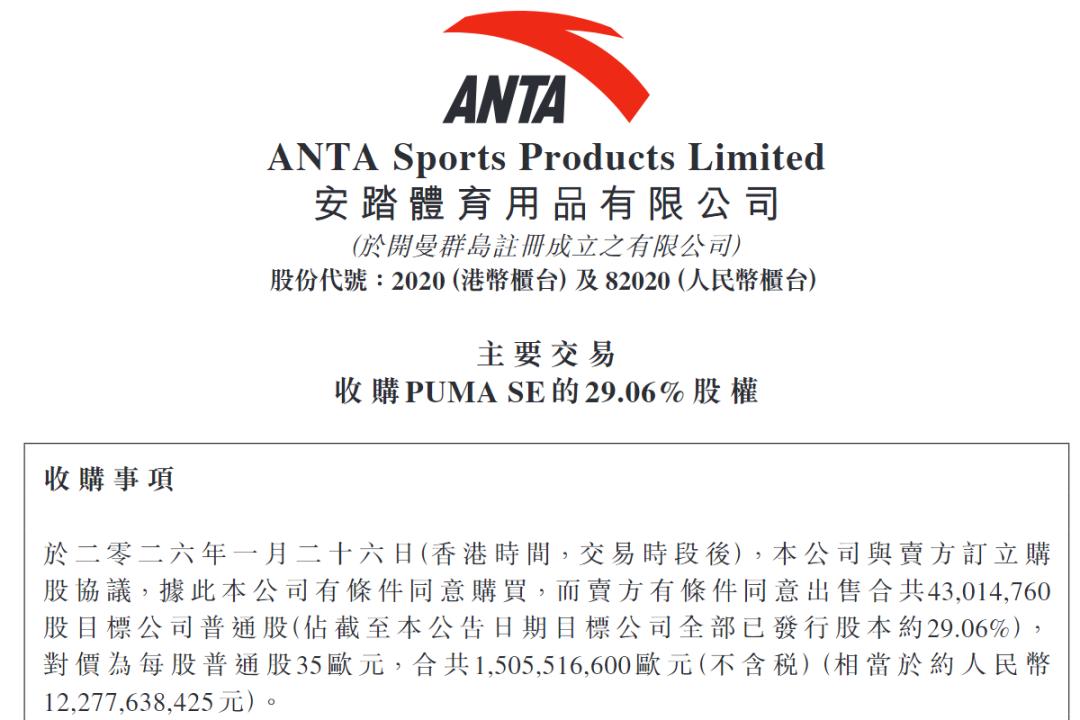
The premium is the most questioned part of this transaction.
The agreed price of 35 euros is about 62% higher than the closing price of 21.63 euros on the day before the announcement. PUMA's share price once rose by more than 17% on the day the news was released, but fell back afterwards, leaving a clear gap between the transaction price and the market price. The buyer took the shares at a high premium while the seller successfully reduced its position — which explains why PUMA's share price in Frankfurt reacted positively after the "approval" news came out.
The discount given by the market is essentially a cautious pricing for the logic of "buying the dip when the brand is at its trough".
PUMA's financial performance is indeed unsatisfactory: in 2025, its sales decreased by 8.1% to 7.2962 billion euros after exchange rate adjustment (-13.1% on a reported basis), gross margin fell by 260 basis points to 45%, EBIT was -357.2 million euros, consolidated net profit was -645.5 million euros, and free cash flow was -530.3 million euros; its share price dropped from 44.36 euros to 22.30 euros throughout the year.
In the first half of 2026, PUMA's revenue fell 7.9% year-on-year to 3.5544 billion euros, or 5.2% down at constant exchange rates. The problem mainly emerged in the second quarter: revenue reached 1.6906 billion euros, down 9.4% year-on-year after currency adjustment. The profitability performance was also under pressure: EBIT turned to a loss of 53.1 million euros from a profit of 5.6 million euros in the same period last year; after excluding one-off items, the adjusted EBIT recorded a loss of 41.9 million euros, expanding by 17.4 million euros compared with the same period of the previous year. This is a company that is still destocking and still in its "transition year".
Therefore, the pricing of 35 euros cannot be simply classified as "cheap" or "expensive". It is more like the scarcity consideration Anta paid for the single largest shareholder seat: this is the only core stock asset on the market that can be transferred as a whole without equity disputes, and the seller once expected the offer to exceed 40 euros.
It is worth noting that in addition to the transaction consideration, relevant taxes and fees will be borne by Anta separately, which means the actual cash outflow is slightly higher than the nominal consideration of 1.506 billion euros.
The Structure Calculation: 29.06% — a Red Line, and a Governance Concession
The most thought-provoking number in the entire transaction is not 1.5 billion, but 29.06%.
It is only 0.94 percentage points away from 30% — this is no coincidence, but a precise response to Germany's Securities Acquisition and Takeover Act (WpÜG): an investor holding 30% of the voting rights of a German listed company is deemed to have obtained control, and must issue a mandatory full takeover offer to all shareholders. Once triggered, Anta will have to acquire the remaining approximately 71% of shares at the statutory price, expanding the transaction scale from 1.5 billion euros to tens of billions of euros, and the transaction will be subject to review by Germany's Federal Financial Supervisory Authority (BaFin).
So what Anta actually bought is not "operating right", but "supervisory board seat + strategic synergy right". The announcement clearly states: Anta plans to appoint representatives to PUMA's supervisory board to cooperate with other supervisory board members and employee representatives; fully respect PUMA's management culture and independent governance structure; "there is no plan to launch a tender offer for PUMA". After the transaction is completed, PUMA SE will be treated as an associate of Anta and accounted for in the consolidated financial statements using the equity method.
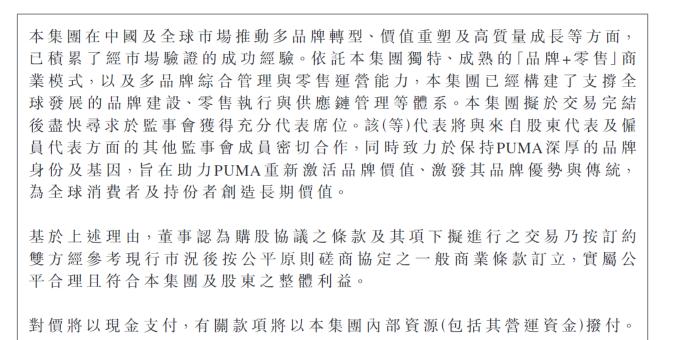
This is a structural design that allows both offensive and defensive moves, but it also has clear costs.
The equity method means PUMA's future losses will affect Anta's investment income proportionally according to its shareholding ratio, while Anta cannot directly adjust the channels, pricing and organizational structure the way it operated FILA in the past. The co-determination system for labor and capital in German enterprises further raises the cost of external intervention.
In other words, Anta exchanged "non-consolidation and non-takeover" for minimized governance friction, but at the same time gave up the direct implementation space for its well-honed "brand + retail" direct operation model that it excels at.
Financial affordability is another matter.
Anta's revenue reached 80.219 billion yuan in 2025, up 13.3% year-on-year, ranking first in the Chinese market industry for four consecutive years, with a market share of about 21.8%; its operating profit was 19.091 billion yuan; by the end of 2025, its net cash was about 31.719 billion yuan, and free cash inflow reached 16.106 billion yuan.
In the first half of 2026, its revenue hit 43.507 billion yuan, up 12.9% year-on-year, crossing the 40 billion yuan threshold for the first time in a half-year period, operating profit reached 11.76 billion yuan (+16.1%), operating margin stood at 27%, free cash inflow was 11.63 billion yuan (+54.2%), and net cash was about 39.11 billion yuan.
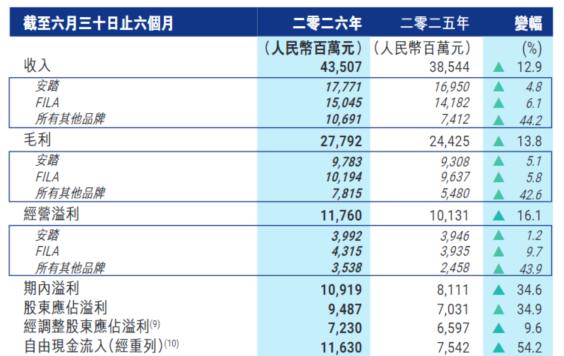
The use of 12.3 billion yuan of fully self-owned cash with zero external borrowing is the foundation of Anta's transaction confidence — but it should be noted that the cash and loan scales coexist under the statement caliber, and the net cash conclusion depends on the calculation of "cash and short-term investments minus loans", which does not mean the book cash can be used arbitrarily.
The Strategic Calculation: Making up for Shortcomings and the Integration Ceiling of the "Multi-brand Empire"
If price and structure are the items that can be clearly calculated on the books, strategic value is the part with the most divergent opinions.
Anta's multi-brand territory already covers the main Anta brand, FILA, Descente, Kolon Sport, MAIA ACTIVE, Jack Wolfskin, and as the largest shareholder of Amer Sports, it holds brands including Arc'teryx, Salomon and Wilson.
The success of this system is proven by facts: FILA was losing more than 39 million Hong Kong dollars annually with only 50 stores nationwide when Anta took over in 2009, and its revenue reached 28.4 billion yuan in 2025; Amer Sports turned from losses to listing on the New York Stock Exchange in 2024; Descente's revenue exceeded 10 billion yuan for the first time in 2025, becoming the group's third 10-billion-yuan brand.
What exactly does PUMA make up for?
The first point is the "blank category" in professional sports.
Founded in 1948, PUMA is a sibling brand with the same origin as Adidas, with deep accumulation in the fields of football, running, training, basketball and motorsports, and it is one of the few comprehensive sports brands in the world that still has first-tier recognition.
The core battlefield of Anta's main brand and FILA is in China, while Descente and Arc'teryx are positioned at high-end professional and outdoor segments, leaving Anta with no carrier that can fight globally in the mass sports footwear and apparel market. After combining Amer Sports and PUMA, the statement that the overall revenue scale of the Anta ecosystem is close to the magnitude of Adidas has been circulating in the industry, but this caliber includes the revenue of associate companies, which is not the same concept as Anta's consolidated statements, so it needs to be treated with caution.
The second point is the "low penetration dividend" in the Chinese market.
In 2025, PUMA's revenue in Greater China only accounted for about 7% of the group's sales (about 15% in 2020), and its market share in China was about 1.3%; Citi and HSBC expect the proportion of revenue from China to rebound in 2028. What Anta is best at is exactly expanding international brands in the Chinese market — which forms the most self-consistent business logic of this transaction.
However, three risk variables must be faced squarely.
First, the execution radius of synergy is limited.
The cost of "empowering without taking over" is that although Anta can appoint representatives to the supervisory board, it is difficult to directly transform PUMA's low-quality wholesale channels in North America and EMEA — and North America is exactly the market where PUMA recorded the deepest decline in 2025. PUMA CEO Arthur Hoeld has clearly stated that since Anta tends to adopt the DTC strategy while PUMA is currently dominated by wholesale, PUMA's sales in China may be affected in the short term.
Second, the competitive intensity is completely different.
PUMA is a brand that fights head-on with Nike and adidas in the mass market below 1,000 yuan, which is a completely different level of difficulty from the "blank position in sports fashion" when FILA was taken over and the high-end light luxury positioning of Arc'teryx. At the same time, emerging brands such as On and Hoka are continuing to erode the share of professional running and lifestyle segments.
Third, Anta's own growth structure is shifting gears.
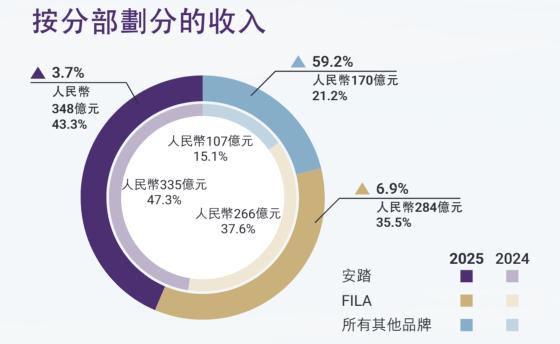
In 2025, the revenue of Anta's main brand reached 34.8 billion yuan, up 3.7% year-on-year, and the growth rate was significantly lower than the overall level of the group; the group's growth is increasingly driven by "all other brands" and Amer Sports.
When the growth engine itself is decelerating, it is reasonable for the market to give a discount when placing a minority equity bet on an overseas brand that is still losing money.
Conclusion
Putting the three calculations together, the full picture of this transaction is: Anta, with a 62% premium and zero debt, purchased a control entry for a professional sports platform that is at the trough of performance but still has scarce brand assets and global channels — while deliberately giving up the obligation of full control and integration costs.
To be fair, the success or failure of Anta's investment should be judged three years later, not three months later.
Its historical track record (all three investments in FILA, Descente and Amer Sports are successful) gives it a higher prior probability of success in overseas expansion than ordinary Chinese enterprises, but PUMA's scale, competitive environment and governance constraints far exceed any of its previous transactions.
The premise of buying the dip is a reversal, and the premise of reversal is that synergy can penetrate the glass ceiling of "minority equity".
This is the next step Anta must prove to the market, and also the variable of this case that is most worthy of continuous tracking.
This article is from the WeChat official account "Bowang Finance", written by Hengxin, and published by 36Kr with authorization.