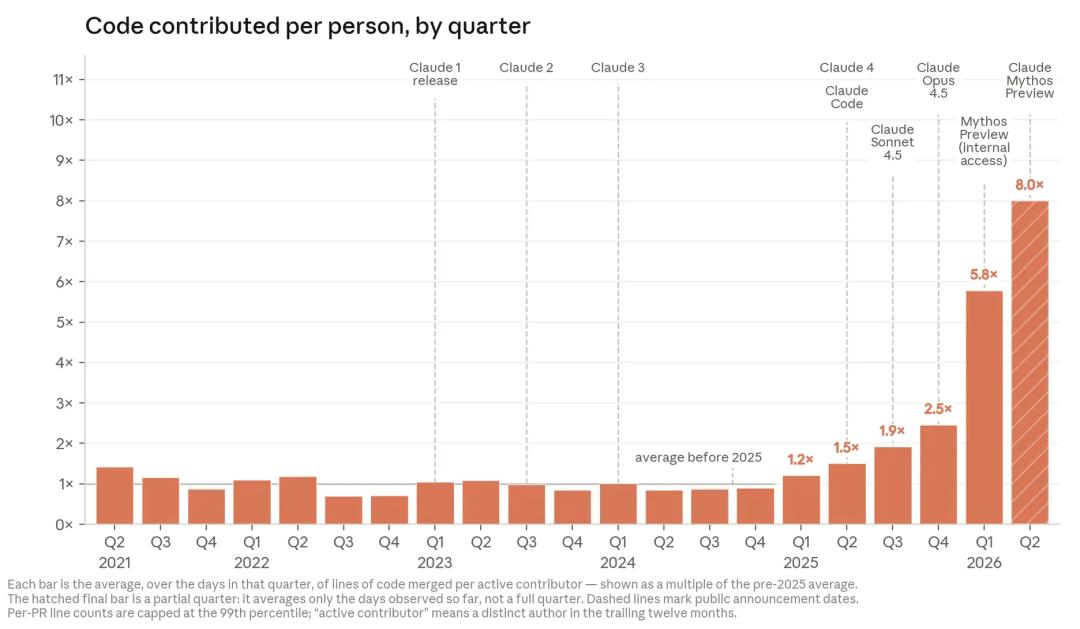
Just now, the Claude developed by Claude has recorded a 26-fold surge within half a year, with 30,000 Agents working simultaneously.
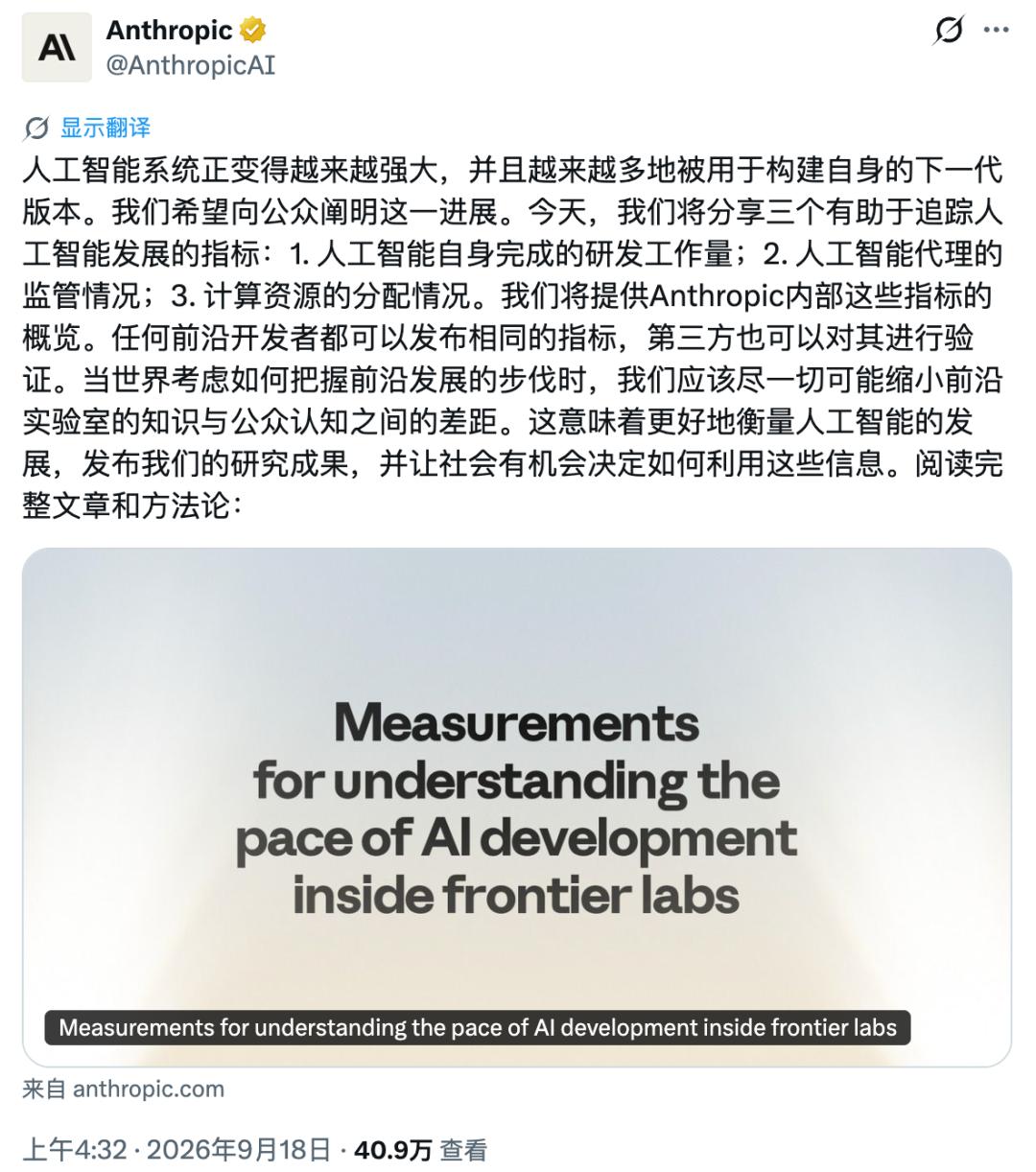
Just now, Anthropic has for the first time publicly detailed its internal progress of Claude participating in the R&D of next-generation AI.
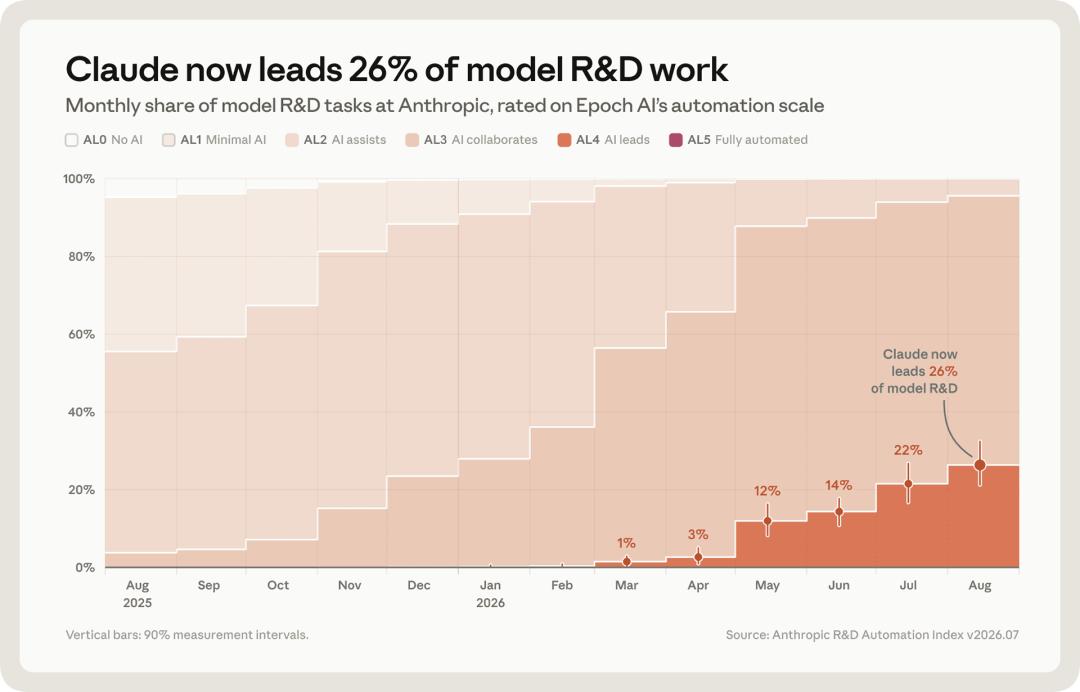
As of August this year, Claude has been able to "lead" approximately 26% of Anthropic's AI R&D work, with over 90% of tasks reaching at least the "AI collaboration" level. In comparison, the proportion of work that Claude could lead was less than 1% in February this year.
Meanwhile, around 30,000 AI Agents are engaged in research and engineering work on Anthropic's most commonly used internal platform.
In August alone, they made over 1 billion decisions, of which about 0.002% were intercepted by the real-time monitoring system, equivalent to a blocking mechanism being triggered every 47,000 times.
In addition, Anthropic also disclosed that about 6% of the computing power used for AI R&D goes to security research, and this proportion is 12% in the AI-driven AI R&D computing power.
Then the question arises: when AI begins to participate in building the next generation of AI, can humans still perceive its speed clearly and intervene in its actions in a timely manner?
AI building AI has entered Anthropic's R&D scene
To measure Claude's participation in internal R&D work, Anthropic has built a prototype system called the "Anthropic R&D Automation Index".
This index adopts the automation levels proposed by Epoch AI, dividing the degree of AI participation in R&D into six levels from AL0 to AL5.
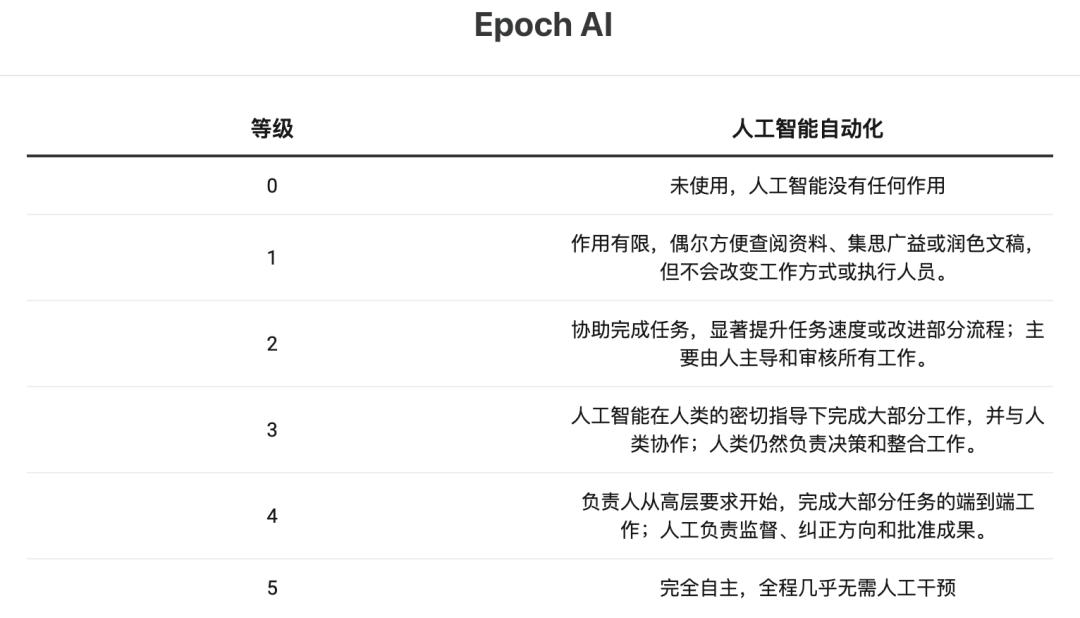
AL0 means no AI is involved. AL3 means AI can undertake a large number of tasks under the close guidance of engineers. AL4 means after receiving a high-level goal, AI can complete most tasks and only accept human supervision at key nodes. AL5 means AI can identify problems, plan tasks, perform modifications, complete tests and deploy directly without any human intervention throughout the process.
What Anthropic refers to as "Claude leading 26% of AI R&D work" corresponds to AL4.
Taking the failure of a nighttime data pipeline as an example, at the AL3 stage, engineers need to check the logs, put forward preliminary judgments, and continue to provide guidance when Claude encounters new problems. After entering AL4, engineers only need to send the failure alert to Claude, which can then analyze the logs independently, locate the faulty part, write and test the repair plan, handle unexpected situations that arise during the process, and re-run the pipeline on the test data.
After completing the above work, Claude will sort out the cause of the problem and the modification content, and then the engineer will decide whether to deploy it. Humans still hold the final release right, but they no longer need to participate continuously in the entire processing process.
However, as of August this year, Anthropic has not found any type of AI R&D work that has reached AL5.
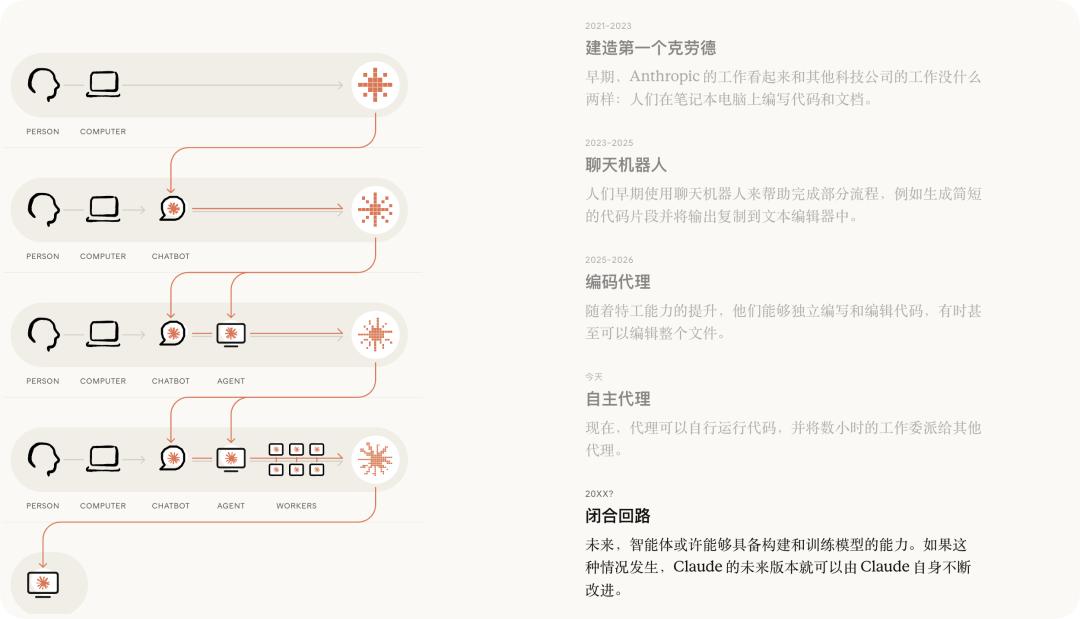
Claude is still unable to independently monitor all faults, nor can it deploy modifications to the production environment without human approval. Claude has not achieved recursive self-improvement, but the engineering loop of AI participating in the development of next-generation AI has evolved from a research concept to a countable and trackable internal production process.
To build this index, Anthropic randomly selected about 20% of employees in relevant departments every week in July this year, and let Claude study the work records left by these employees on Slack and internal documents, finally sorting out about 15,000 specific R&D tasks.
Subsequently, Claude organized these tasks into a hierarchical tree containing 542 nodes, including 378 specific task categories, covering work such as pre-training, reinforcement learning, evaluation platform failures, sandbox network policies, and inference service incident reviews. Anthropic then assigns weights according to the working hours invested by employees to judge the importance of different tasks in the overall R&D process.
Judging from the data changes, the proportion of R&D work that Claude can lead has risen from less than 1% in February this year to 26% in August. In just half a year, AI's identity within Anthropic has begun to shift from an R&D tool to an R&D participant that can take over complete tasks.
When 30,000 Agents start making decisions for humans
After the degree of R&D automation rises, another problem facing Anthropic emerges. When tens of thousands of Agents run simultaneously, and can perform tasks for a long time and allocate work to each other, the traditional management method that relies on manual review of each item can no longer cover all behaviors.
As of August 2026, on Anthropic's most frequently used internal platform, about 30,000 Agents are simultaneously engaged in research and engineering work. To monitor them, Anthropic has deployed two sets of systems: real-time monitoring and post-hoc monitoring.
Real-time monitoring checks relevant behaviors before Agents perform actions, focusing on blocking operations that may quickly cause serious consequences, such as copying model weights to external systems. Anthropic states that all operations of Agents on this platform will go through real-time monitoring, the check is usually completed within a few seconds, and the intercepted behaviors will be manually reviewed within a week.
In August this year, Anthropic's research and engineering Agents made a total of more than 1 billion decisions, of which about 0.002% were blocked by the real-time monitoring system, a ratio of approximately 1 in every 47,000 times.
The post-hoc monitoring system reads the activities that Agents have completed, which is used to discover risks that develop slowly and still have a chance to be reversed, such as behaviors that may be related to model misalignment. The system marks about 100,000 conversation records every week, and multi-layer classifiers are responsible for eliminating false positives and conducting preliminary screening. Finally, about 50 highest-priority records are submitted for human review.
According to the data disclosed by Anthropic, the post-hoc monitoring system marks 1 to 2 records for every 1,000 records. The probability of abnormal behavior of a single Agent is not high, but when the operating scale of Agents expands from tens of thousands to millions or even billions, low-probability events may also occur frequently.
Anthropic has also set up independent identities for internal Agents, and the data generated, messages sent and actions performed by each Agent are bound to the identity. Even if the underlying model is upgraded, the Agent's historical records will still be retained. Different Agents communicate through a shared messaging system, and other Agents can check the information it publishes, view the original references, and correct errors when they are found.
The relevant design allows Anthropic to trace every operation along the identity and communication records, but the company also acknowledges that the existing monitoring system has only been running for a few months, and it is still unable to confirm whether all potential behavior patterns have been covered.
Security research only gets 6% of R&D computing power
Apart from R&D automation and Agent monitoring, Anthropic has also publicly disclosed the allocation of its internal computing power for the first time.
The company counted all computing power usage records from July 13 to July 20, 2026, and divided the relevant work into categories such as AI R&D and security research. The results show that among the computing power allocated to AI R&D, about 6% is used for security work; among the AI-driven AI R&D computing power, the proportion of security work is about 12%.
Anthropic defines security work as research whose main goal is to improve model security, interpretability and system security, including auditing the model's thinking process, studying misaligned behaviors, and evaluating whether the model can be deployed safely. Work such as training production models, product development, capability research and developer tools is counted in other AI R&D categories.
If a piece of work improves both model capabilities and security, Anthropic will classify it as capability R&D. Therefore, the company believes that 6% and 12% are relatively conservative estimates. The computing power used for security classifiers is not included in this figure, and its scale is reportedly roughly equivalent to the public number.
During the statistics process, the Claude classifier read the metadata and related code of the training tasks, and judged whether each task belonged to security research or other R&D. Among nearly 10,000 research training and evaluation tasks, Anthropic sampled and checked about 14% of them, and increased the sampling weight of high-computing-power tasks to make the data closer to the real flow of computing power.
Who will supervise the AIs that are responsible for building AI
The background for Anthropic to release these data is that the development speed of cutting-edge AI is triggering more and more controversies. The company's CEO Dario Amodei has previously publicly called for slowing down the advancement of cutting-edge AI, hoping that the industry will establish clearer transparency mechanisms and security requirements.
According to Anthropic's plan, the company will invite independent evaluators from multiple institutions to access its internal system, and provide them with access to processes, systems and data close to the risk assessment team. These third parties will inspect security measures, report relevant incidents, and continuously track indicators such as R&D automation, Agent monitoring and computing power allocation.
Anthropic also acknowledges that the current data still has obvious limitations. The R&D Automation Index is collected and judged by Claude, which is equivalent to letting the company's own model evaluate the work it participates in. Different laboratories have not adopted a unified method, so these figures cannot be used for horizontal comparison directly for the time being.
In internal verification, the full consistency rate between Claude and human evaluators on the judgment of automation level is 59%, while the full consistency rate between two human evaluators is only 35%. If an error of one level is allowed, the consistency rate between Claude and human judgment can reach 97%, but there is still a large room for interpretation between "AI collaboration" and "AI leading".
Anthropic currently also uses a fixed task catalog to measure the degree of automation. This method can show how much of the original human work has been taken over by AI, but may miss new tasks that emerge as technology develops. Agent monitoring data only covers the company's most commonly used internal platform, and the computing power statistics only cover one week. Therefore, all indicators still need continuous update and independent verification.
Even with these limitations, the data disclosed by Anthropic still provides a rare internal preview of a cutting-edge laboratory.
When an AI company begins to use tens of thousands of Agents to develop AI, and then uses another group of AIs to monitor and evaluate these Agents, recursive self-improvement has not really arrived, but the early loop for its growth has already appeared in the real R&D system.
Official Blog🔗
https://www.anthropic.com/institute/measuring-pace-of-ai-development
This article is from the WeChat Official Account "APPSO", author: Tomorrow Product Discovery, published with authorization from 36Kr.