On the 17th day of Manus's rebirth, its valuation has actually doubled.
It's only been over half a month since Manus regained its independence, and its value has suddenly skyrocketed?!
According to the latest news, Manus is pushing forward a new round of financing of about 500 million US dollars, with a target valuation of about 4 billion US dollars.
This is its first round of financing after completing the spin-off from Meta and resuming independent operation.
Citing people familiar with the matter, Bloomberg reported that this round of financing is nearing completion, but negotiations are still ongoing, and the final amount and terms may still change.
At present, the identity of the latest new investor has not been disclosed, and existing shareholders such as Tencent, HSG and ZhenFund have not publicly confirmed whether they will continue to increase their investment.

Back on September 1, Manus just officially announced the resumption of independent operation.
Less than a month earlier, Manus' old shareholders including Tencent, ZhenFund and HSG just bought back the company at a price of about 2 billion US dollars — which was also the price when it was sold to Meta.
If the latest round of financing is finally completed at a valuation of 4 billion US dollars, only 17 days after Manus resumed independent operation, the valuation of the new round of financing may double compared with the previous repurchase.
In the past year and a half, Manus' valuation has risen from 500 million US dollars to 2 billion US dollars, and now it is targeting 4 billion US dollars.
In the middle, it also experienced an acquisition, regulatory suspension, business spin-off and repurchase by original shareholders.
Well, leaving other things aside, I'll call it "the most dramatic Agent company in the world" first.

From 500 Million USD to 4 Billion USD in a Year and a Half
The news was first exposed by Bloomberg, saying that Manus plans to raise about 500 million US dollars, seeking a valuation of about 4 billion US dollars.
It is worth noting that Manus only took a year and a half from the first product launch to a valuation of 4 billion US dollars — and there were countless dramatic moments in between.
Let's take a quick brief look back.
In March 2025, Manus released the general-purpose Agent, which became a hit overnight and was extremely popular.
In April, Benchmark led a $75 million financing round, and Manus' post-money valuation was about $500 million.
At the end of December, Meta announced the acquisition of Manus for 2 billion US dollars. Before the acquisition, Manus had just announced that its ARR exceeded 100 million US dollars and had millions of users.
However, at the beginning of this year, this cross-border transaction was terminated. Meta then began to split business and data with Manus.
By May, Bloomberg reported that one of the options Manus considered was that three founders Xiao Hong, Ji Yichao and Zhang Tao had discussed raising about 1 billion US dollars to buy Manus back from Meta, and the financing valuation must at least reach the level of about 2 billion US dollars when Meta acquired it.
And consider operating through a joint venture structure in the follow-up, and finally go for an IPO in Hong Kong.
However, the final plan is not like this — in August, Manus' original investors including Tencent, ZhenFund and HSG bought back Manus' shares from Meta at a price of about 2 billion US dollars.
According to the information disclosed by Caixin, Tencent took over the shares originally held by Benchmark and became the largest shareholder of Manus.
(BTW, Manus founder Xiao Hong has a long history with Tencent. The WeChat official account management tool "Yiban Assistant" he developed in his early years once received investment from Tencent)

On September 1, Manus officially announced the resumption of independent operation to the public.
The founding team re-leads the company, and Manus redefines itself as an "independent Agent laboratory".
Then 17 days later, the new quotation of 4 billion US dollars came.
In a year and a half, it went from 500 million US dollars to 2 billion US dollars, and now it is targeting 4 billion US dollars.
Manus is not the only company that "was bought by a giant, the transaction was revoked, and the old shareholders bought it back", but in most cases, the valuation fell or remained flat after being bought back (many times the repurchase is to stop losses, not revalue the value), only a very small number of businesses have experienced explosive growth to achieve valuation increase.
Figma, which failed to be successfully acquired by Adobe, had a higher listing valuation than the proposed acquisition price, and its valuation rose sharply.
It belongs to the latter few cases.
Manus, obviously, is also the latter.
The Past Six Months When Manus Never Stopped
Why can Manus quickly seek a higher valuation after such a big turmoil?
We might as well take a look at Manus' business data during the acquisition turmoil.
On the eve of Meta's acquisition of Manus last December, Manus publicly announced that its ARR had exceeded 100 million US dollars, and its annualized revenue run rate reached 125 million US dollars.
According to Caixin's report, as of the end of June this year, Manus' ARR has reached about 400 million US dollars.
That is to say, from last December to the end of June this year, in about half a year, Manus' ARR has grown to about 4 times of the previous figure.

The caliber disclosed by The Information is even higher. Citing people familiar with the matter, it said that in June this year, Manus' annualized revenue run rate had reached 400 million to 500 million US dollars.
If we only use the public ARR for rough calculation, at the end of last year, Meta acquired Manus for about 2 billion US dollars, corresponding to more than 100 million US dollars of ARR at that time, which is about 20 times ARR.
Calculated based on the ARR of about 400 million US dollars at the end of June this year disclosed by Caixin, the current target valuation of 4 billion US dollars corresponds to about 10 times ARR.
That is to say, although Manus' overall valuation has doubled from 2 billion US dollars to 4 billion US dollars in absolute terms; the valuation corresponding to every 1 US dollar of ARR has almost halved.
When it was bought back in August, Manus' revenue was already significantly higher than the level at the time of Meta's acquisition. So, in fact, the original shareholders got back a larger company with better revenue at the old valuation.
To be reasonable, the currently exposed 4 billion US dollars financing valuation should be the capital market pricing this part of the growth.
Moreover, in the past six months, Manus has not only experienced revenue growth.
While busy splitting with Meta, it did not stop the pace of intensive product updates.
Connecting office software, retaining project context, calling external tools, making a task go from a few minutes to a few hours, a few days, or even running continuously...
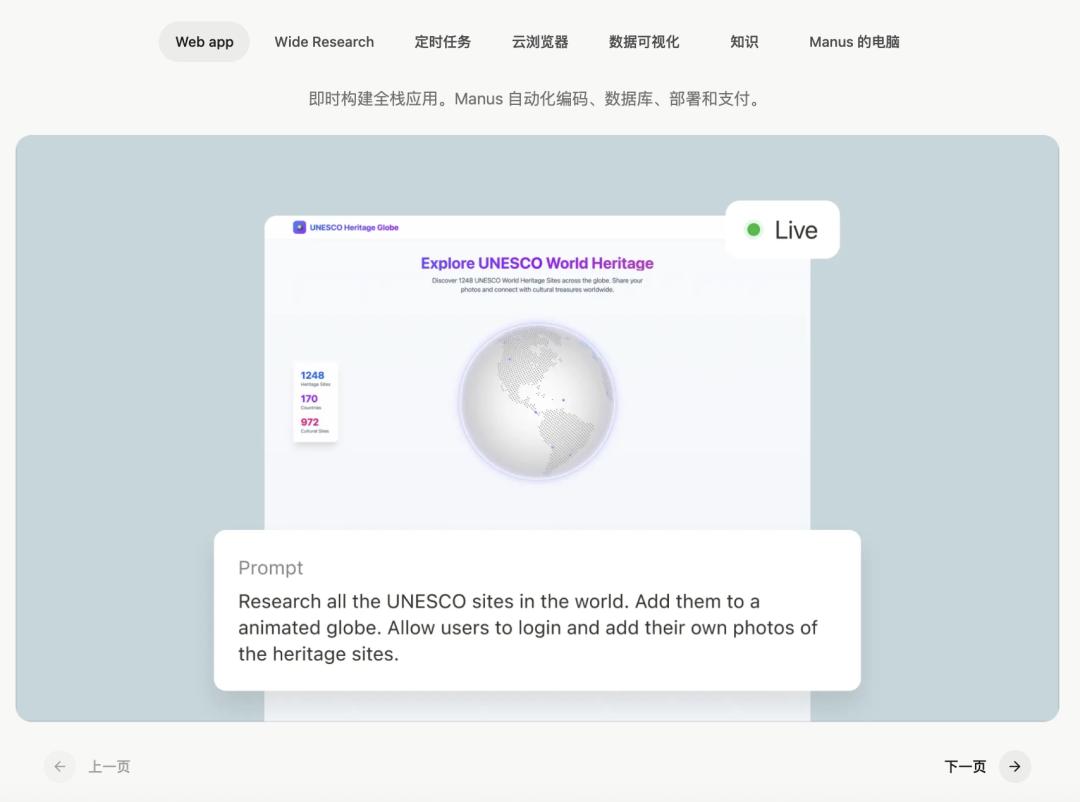
According to the product update records publicly available on Manus' official website, only in the spring and summer of this year, its product capabilities have been advancing along the path of "connecting more tools, retaining more context, and processing longer tasks".
At the same time, even when the acquisition relationship was in the split stage, Manus continued to promote cooperation with companies such as Canva, Zoom, Similarweb, Notion and Shopify.
In addition, Manus also gave the next step plan in the announcement of resuming independent operation.
In the future, Manus will go deeper into daily workflows, interact more directly with the outside world, and take actions on behalf of users more actively.
Now everyone should be very clear about where the latest 4 billion US dollars valuation comes from.
Subscription revenue, workflow entry, user accumulation, and whether it can occupy a layer of long-term existing product value on top of the basic model, are all included in this 4 billion US dollars quotation sheet.
What Capital Pays For Is Not Just "Manus"
Don't forget that in addition to all the above, a more important thing is Manus' positioning.
It is a leading player in the most popular Agent track this year.

Before this year, Manus was one of the few general-purpose Agents on the global market, and it was also in the top tier with very good user experience.
Since the beginning of this year, OpenClaw has become a hit, Claude Code and Codex have continuously expanded Agent capabilities, and various domestic Agents are also advancing rapidly in long tasks, tool use and autonomous execution.
Also starting from this year, in addition to native Agent players, underlying model manufacturers themselves are getting better and better at making Agents.
Every time the basic model is updated, part of the capabilities of the upper-layer Agent product may be absorbed immediately.
But Manus itself does not train cutting-edge basic models —
With tigers in front and wolves behind, Manus is facing quite fierce competition.

But Manus has at least proved with its current revenue curve that as of today, even if it does not train basic models, there is a possibility that a startup can build a layer of Agent products that users are willing to pay for and grow rapidly on top of other models.
But will anyone buy this 4 billion US dollars valuation? The final result is not yet settled.
There are at least three questions hanging over Manus —
First, can the current ARR of about 400 million US dollars continue to grow?
Although Manus only took half a year to go from 100 million US dollars to 400 million US dollars, it will be more and more difficult to maintain such a high growth rate as it goes further.
Especially after the world's top model manufacturers continue to package Agent capabilities into their own products, Manus still needs to prove that the value of its subscriptions can continue to exist.
Second, who will contribute the 500 million US dollars in this round?
Will old shareholders continue to increase their investment? Will there be new large US dollar funds, industrial capital or sovereign funds joining in?
There are no answers at present.
Of course, once the investor list is exposed, the capital logic behind this 4 billion US dollars valuation will be much clearer.
Third, what kind of company will Manus develop into after resuming independent operation, and how will it plan the product development direction?
Is it a super Agent covering more scenarios? An Agent work platform for teams and light-weight enterprises?
We don't know the answers to these questions yet.
But it is certain that after experiencing twists and turns, Manus still holds a good hand of cards, and in the era of more explosive growth of Agents, Manus has taken the first wave of mindshare advantage.
Reference Links:
[1]https://www.bloomberg.com/news/articles/2026-09-17/manus-eyes-4-billion-value-in-first-round-since-meta-breakup
[2]https://www.businesstimes.com.sg/companies-markets/telcos-media-tech/manus-eyes-us4-billion-value-first-round-meta-breakup
[3]https://techcrunch.com/2026/06/13/meta-reportedly-moves-to-unwind-2b-manus-deal-after-beijings-demand/?utm_source=chatgpt.com
[4]https://www.reuters.com/world/asia-pacific/manus-original-investors-plan-buy-back-ai-firm-meta-2-billion-information-2026-06-18/?utm_source=chatgpt.com
This article is from the WeChat official account "QbitAI", author: Heng Yu, published with authorization from 36Kr.