A Tour of Tesla's First Cybercab Exhibition in China: the Car Without a Steering Wheel, and the Questions It Has Yet to Answer
On September 17, Tesla's Cybercab driverless taxi made its debut stop of the national tour exhibition at HKRI Taikoo Hui Shanghai. This marks the first public appearance of Cybercab in the Chinese market since its official launch in the United States in early September. On the same day, the Cybercab tour exhibition also simultaneously kicked off at the Tesla Experience Store at Beijing China Central Place.
A reporter from Science and Technology Innovation Board Daily witnessed a constant stream of visitors at the booth, with many foreign visitors excitedly taking photos with the light gold exhibition vehicle. One visitor leaned in for a close look and raised a series of questions to the reporter: "There are no operation buttons on the door handle or the inner side of the door, how do passengers identify their booked vehicle and open the door? Are window adjustment and air conditioning adjustment all only operable through the central control screen?" Another visitor was more concerned about the implementation timeline: "FSD adopts a different technical route from domestic intelligent driving solutions, so it may take some time for it to be put into actual use." These questions point exactly to the core part of Cybercab's product logic: how will it actually be used in the future?
A Vehicle That Requires No "Driver"
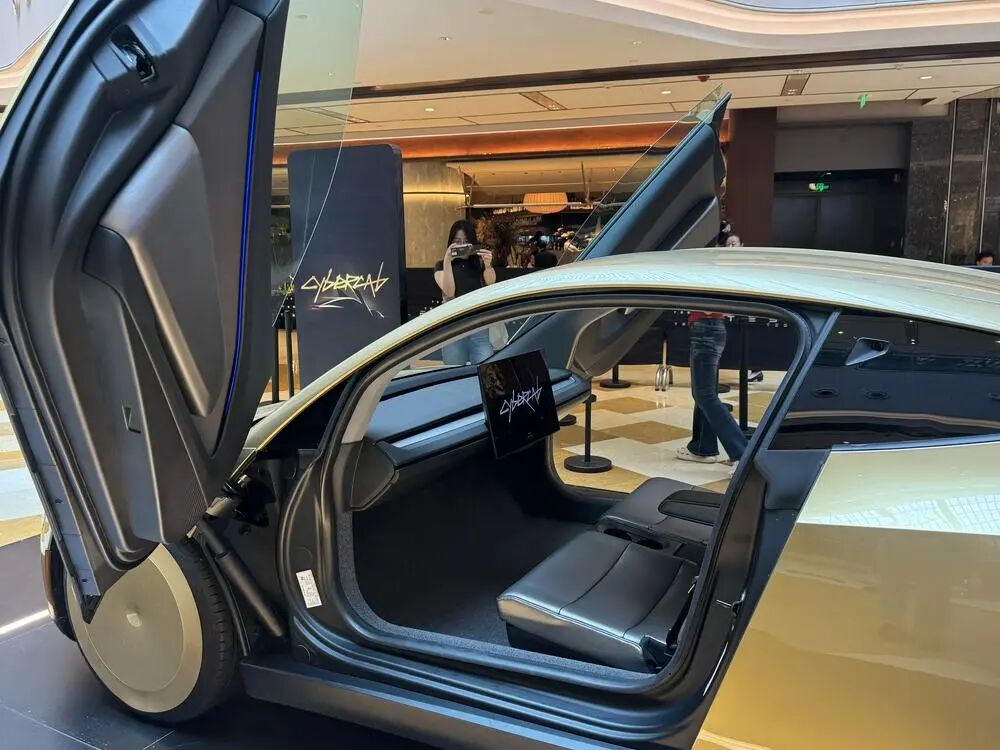
At the scene, the reporter from Science and Technology Innovation Board Daily found that there is no steering wheel, no accelerator or brake pedals, and no traditional rearview mirrors inside the Cybercab cabin. Two bench-style seats and a 22-inch central control screen constitute all the human-vehicle interaction interfaces inside the vehicle. The upward-opening butterfly doors are the most recognizable design in appearance, and the hatchback trunk is clearly tailored for shared mobility scenarios.
According to the staff at the Tesla store, Cybercab is redesigned around driverless shared mobility, with the product focus shifting from driving operations to riding experience. The accessibility concept is deeply embedded in product details: the height of the bench seats is level with that of standard wheelchairs, making it convenient for passengers to get on and off from one side and adjust their seating position; braille signs are set in the door and ceiling light areas, and tactile guide rails are equipped on operation buttons.
The aforementioned Tesla store staff stated that the Cybercab is equipped with 8 cameras in total, adopts a pure vision plus end-to-end neural network solution, and shares the same technical origin as the assisted driving system of the Model 3/Y currently sold in China. The AI 4 hardware equipped on the latter is exactly the hardware used by Cybercab.
Ashok Elluswamy, Vice President of AI Software at Tesla, previously disclosed that Tesla has completed 1 million miles (approximately 1.6 million kilometers) of unsupervised Robotaxi operations, with no human intervention in the vehicle or on the backend throughout the whole process. The changes of Cybercab at the manufacturing end may be even more disruptive than its appearance.
The on-site staff member mentioned when introducing the vehicle body process to the reporter from Science and Technology Innovation Board Daily that Cybercab adopts a split-box parallel assembly process. "At present, the production takt time of a single Model 3 or Model Y is about 30 seconds, while the target takt time of this vehicle (Cybercab) is 5 to 10 seconds. Just like building blocks, the whole vehicle is divided into six modules, each of which is fully manufactured in advance, and then directly assembled on the production line."
It is worth noting that the outer panel of the vehicle adopts the integral injection molding process, and the gold color is directly injected into the material without the need for painting. The aforementioned Tesla on-site staff explained that this not only eliminates a highly polluting process, but also avoids the common color difference problem in painting. "The gold color is injected into the material during the molding process. Therefore, the process is simpler, and no painting is required." The coating thickness can reach 5 to 10 times that of traditional paint, and the underlying base metal will not be exposed after scratches. Data released by Tesla shows that this process can reduce greenhouse gas emissions of related parts in the manufacturing link by 35%, and reduce VOC emissions in the coating link to zero.
Cost and Safety: Two Propositions Yet to Be Verified
Cybercab currently only serves Tesla's Robotaxi fleet and is not sold to individual consumers. As of early September this year, there are a total of 420 autonomous driving vehicles registered by Tesla in Texas, among which only 45 are Cybercab units, and the remaining 375 are Model Y units.
Tesla China explicitly stated on September 16 this year that this China tour exhibition is only for static display, does not involve the listing and sales arrangement of Cybercab in the Chinese market, and Tesla has no plan to carry out driverless ride-hailing related businesses in Chinese Mainland for the time being.
The aforementioned Tesla on-site staff said, "The existing operation mode of Cybercab abroad is to receive orders 24 hours a day. When the vehicle runs out of power, it will drive to the nearby supercharger to charge itself, and then continue to be put into operation after charging is completed."
The reporter from Science and Technology Innovation Board Daily noticed that the commercial implementation of FSD in China is one of the most frequently mentioned topics by on-site visitors and even staff members.
A visitor who has been following Tesla for a long time told the reporter from Science and Technology Innovation Board Daily that he judges that the actual implementation of Cybercab in Shanghai "will still take some time", mainly because the technical route of FSD is different from the existing domestic intelligent driving solutions.
In terms of economy, according to Tesla's calculation, the mobility cost of this model can be reduced to $0.2 per mile, equivalent to about RMB 0.84 per kilometer, which is only one tenth of the industry average level. In terms of energy efficiency data, Cybercab has a curb weight of 1412 kg, is equipped with a 47.6kWh battery pack, has a laboratory-condition range of 673 km, a drag coefficient lower than 0.2, and can travel about 9.8 km per kWh of electricity.
But safety is a more difficult question to answer than cost.
The U.S. National Highway Traffic Safety Administration (NHTSA) has stated that it is assessing whether Cybercab's steering-wheel-free and pedal-free design complies with federal safety regulations. U.S. federal regulations usually require vehicles to be equipped with manual driving control devices, and restrict the sales volume of vehicles without steering wheels.
This article is from the WeChat official account "Kechuang Daily", authors: WANG Chufan, HU Yuqian, published with authorization from 36Kr.