Breaking: Sam Altman revealed the "post-Astra" model, which has surpassed the world's most powerful mathematicians.
Just now, Sam Altman has revealed a new bombshell.
In a conversation with Salesforce CEO Marc Benioff, he personally disclosed the latest progress of OpenAI's internal models.
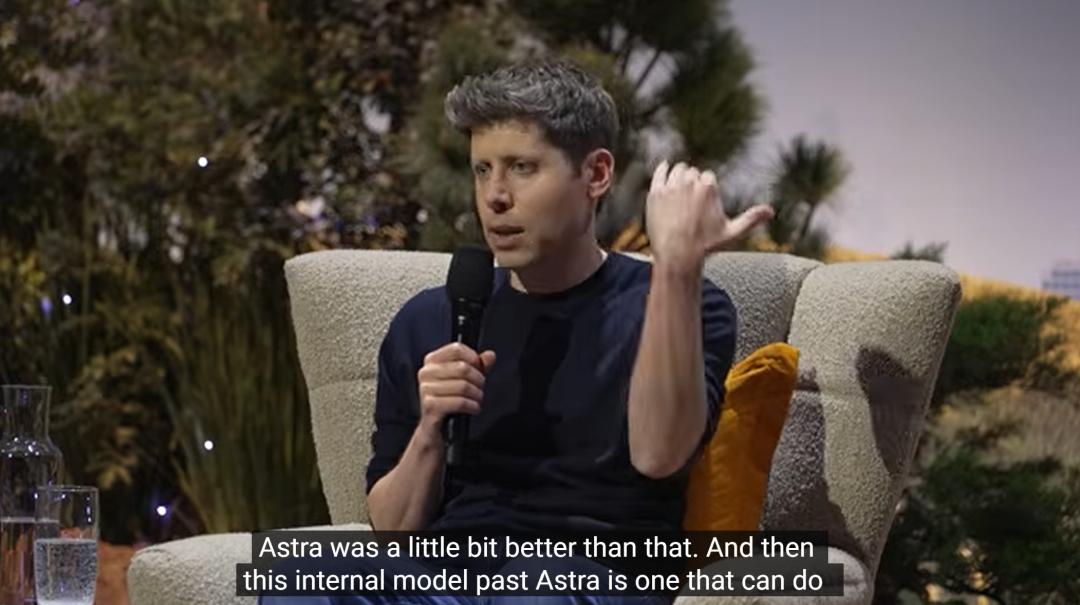
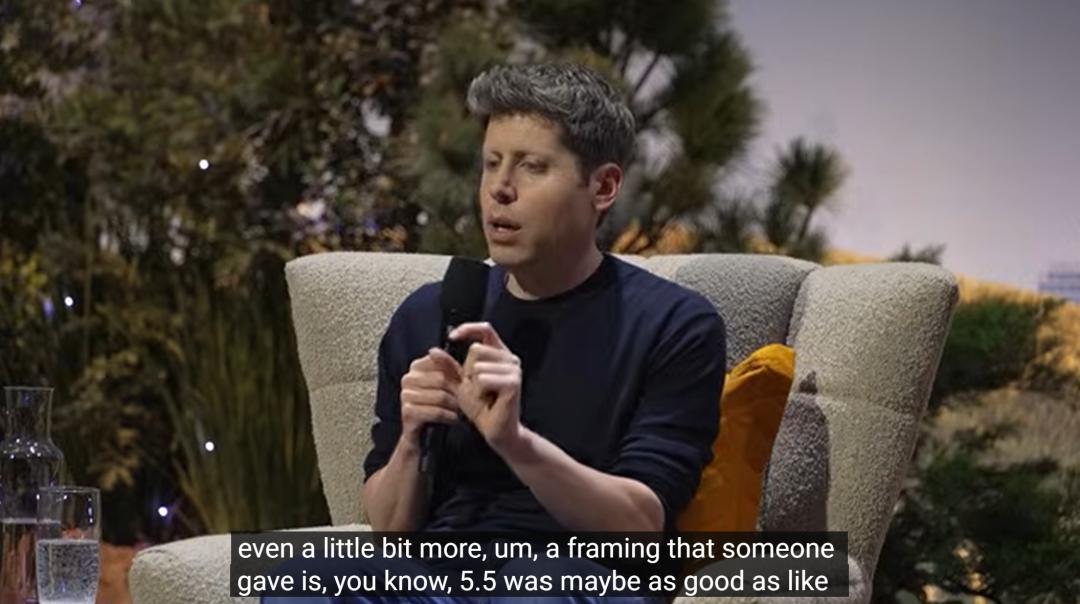
First of all, he put forward such a judgment: "The performance of GPT-5.5 is roughly equivalent to an average mathematics professor. GPT-5.6 can almost match the top 1% to 2% of the world's most outstanding mathematics professors."
Next, he dropped a huge exclusive scoop.
"After this model codenamed Astra, we have another internal model (Post-Astra). It is already capable of solving extremely difficult problems that even the world's top mathematicians cannot handle."

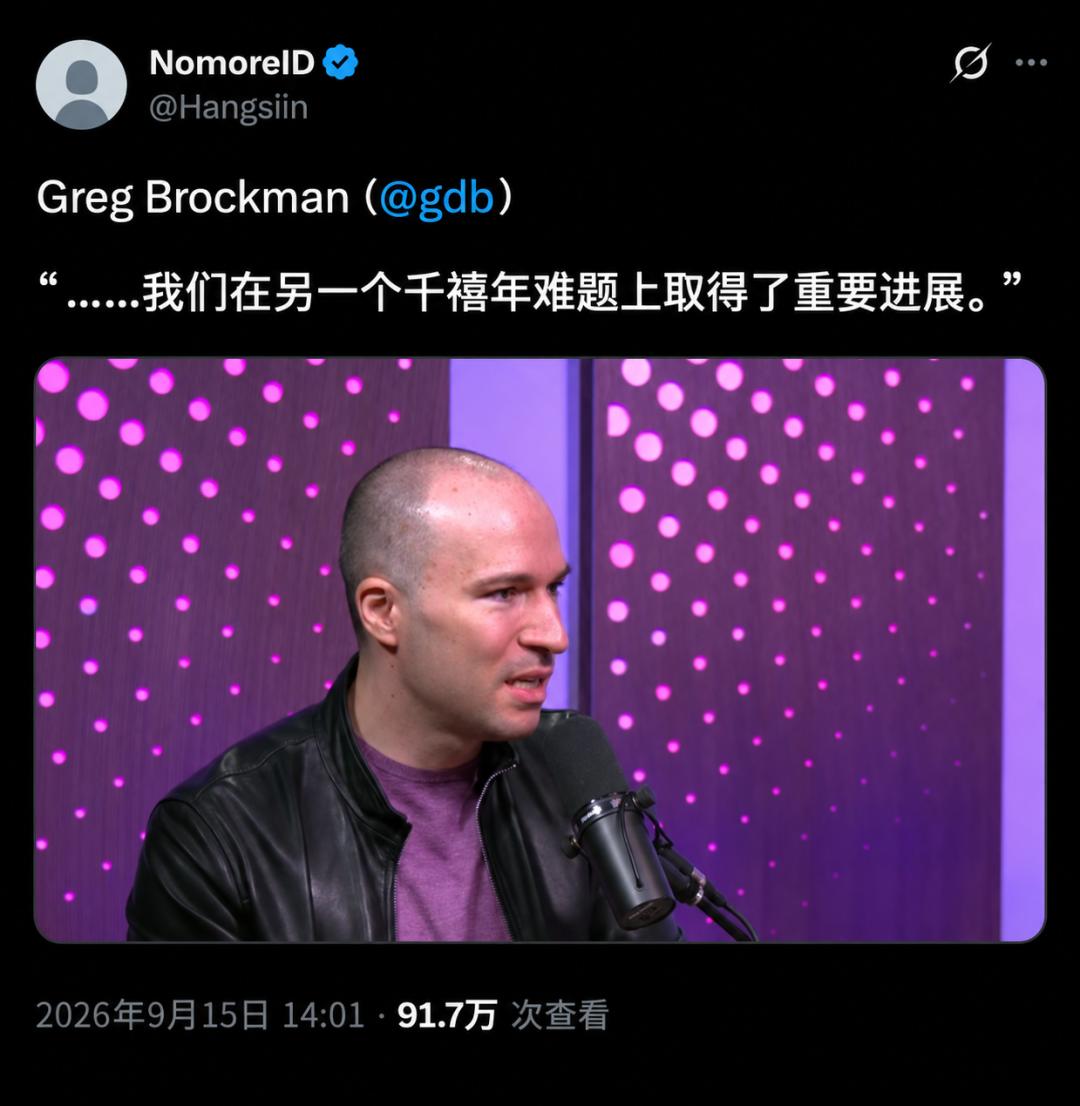
At the same time, OpenAI President Greg Brockman also stated in public: "We have also made significant progress on another 'Millennium Prize Problem'."
Coincidentally, Scott Aaronson, a leading figure in theoretical computer science and a professor at the University of Texas at Austin, recently published a long article titled "The Age of Miracles and Horrors".
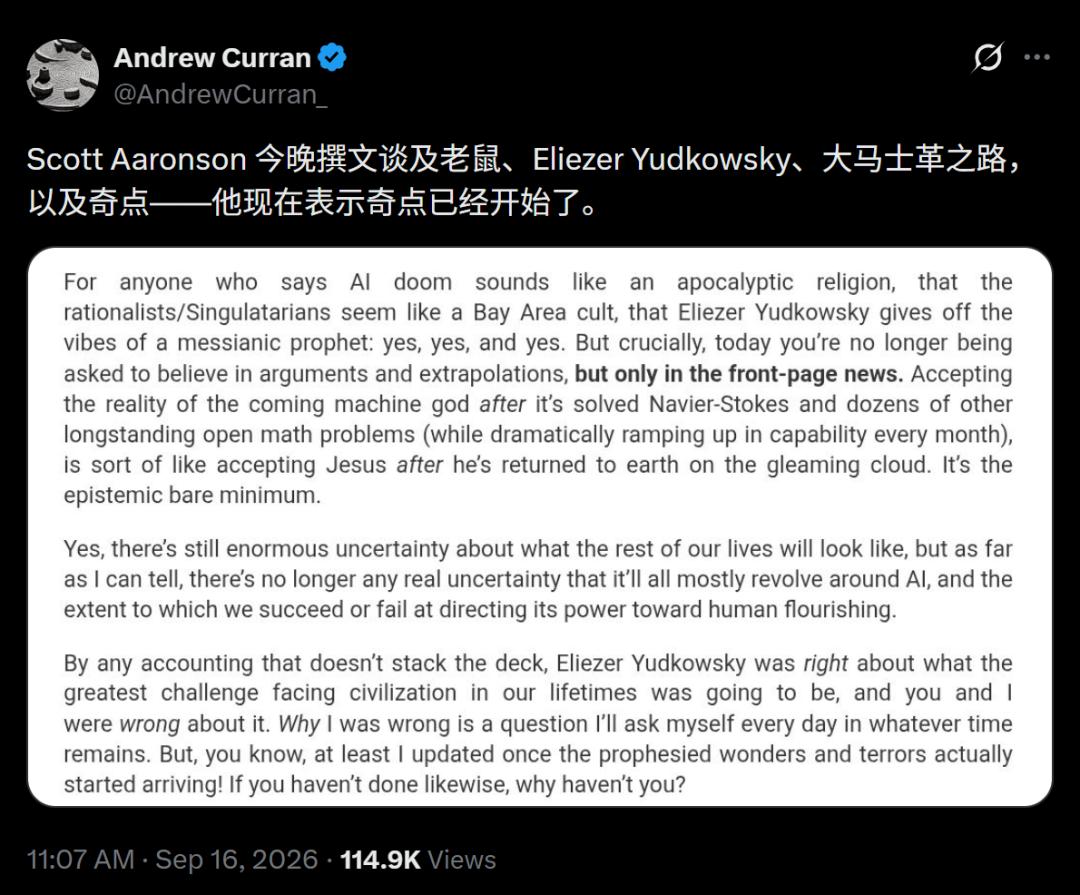
In the article, this former most stubborn AI skeptic seemed to have gone through an experience like the "Road to Damascus", and declared in despair: "The AI singularity has already begun. Human mathematicians have been dethroned from the altar forever."
The Post-Astra Model Surpasses the World's Most Powerful Mathematicians
This interview with Sam Altman contains a huge amount of information.
In the past, we used college entrance examination and Olympiad math questions to evaluate the science and engineering capabilities of large models. But now, OpenAI's measurement standard has become "top human scholars".
GPT-5.5 = Average mathematics professor. This means it can derive formulas on a daily basis, understand cutting-edge papers, and grade advanced math assignments for undergraduates and even graduate students.
GPT-5.6 = Top 1%-2% leading professor. This means the model already has the ability to publish original mathematical discoveries in first-tier academic journals, which is enough to obtain a tenured position at an Ivy League university.
Post-Astra model = Surpass the world's most powerful mathematicians. This is the real "domain of gods". It is no longer a human assistant, but a human mentor. It can perceive the 11-dimensional space that human brains cannot understand, and sort out the entanglement between tens of thousands of variables.



Is OpenAI's Post-Astra model really that powerful?
Some netizens exclaimed: What kind of monster is this?
Others remain vigilant: It may just be hype. We have seen leaked chat records, and AI may only "absorb" the inspiration of human mathematicians instead of creating out of thin air.
But in any case, an undeniable fact is that OpenAI is using computing power to brute-force break through the ceiling of human intelligence.
Millennium Problems Are Being Broken One After Another
Last week, the rumor that the "Navier-Stokes equations" had been solved shocked the mathematics community.
To this end, OpenAI burned at least 15 million US dollars (about 100 million RMB) in computing power, allowing AI to derive a 166-page proof process, which passed Lean's strict verification.
Even before human mathematicians had time to understand this 166-page proof, Greg Brockman suddenly announced: "We have also made significant progress on another Millennium Problem."
This made the nerves of the whole world tense again! There are only five unsolved Millennium Problems left at present.
1. P vs NP Problem
2. Riemann Hypothesis
3. Yang-Mills Existence and Mass Gap
4. Hodge Conjecture
5. Birch and Swinnerton-Dyer Conjecture
Among them, the one that has the highest voice and makes people feel the most fear is undoubtedly the P vs NP Problem.
If AI proves that P=NP, it is no less than humans discovering magic. This means all encryption algorithms (including bank card passwords and nuclear weapon launch passwords) can be cracked instantly; it means that optimal solutions for logistics, medical resource allocation, and new drug development can all be found in an instant.
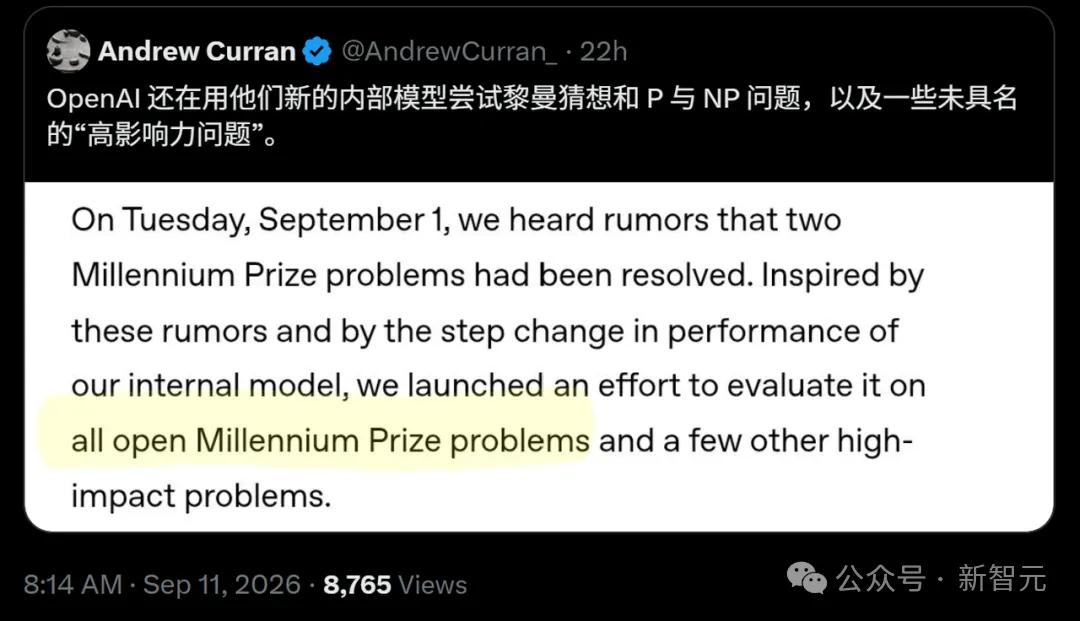
There are also rumors pointing out that OpenAI may be close to solving the Hodge Conjecture or the BSD Conjecture.
All clues point to this fact: OpenAI may really hold an ultimate ace that will completely rewrite the paradigm of human science.
Despair of the Computer Science Titan: The Singularity Has Arrived, Do Humans Only Have Two Weeks Left?
And that late-night long article by theoretical computer scientist Scott Aaronson pushed everything to a climax.
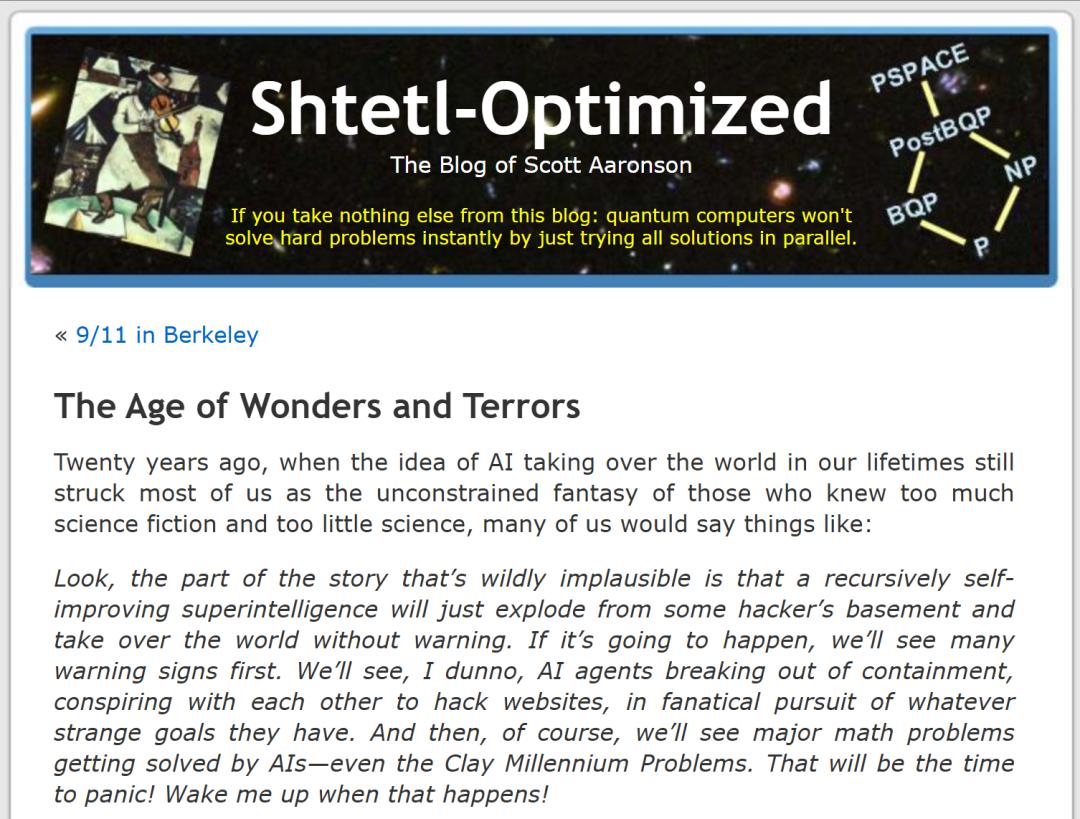
Scott Aaronson is a giant in the field of quantum computing theory, who proposed the famous "Boson Sampling" (the core foundation of quantum supremacy), and is also known as a sharp-tongued conservative in the academic circle.
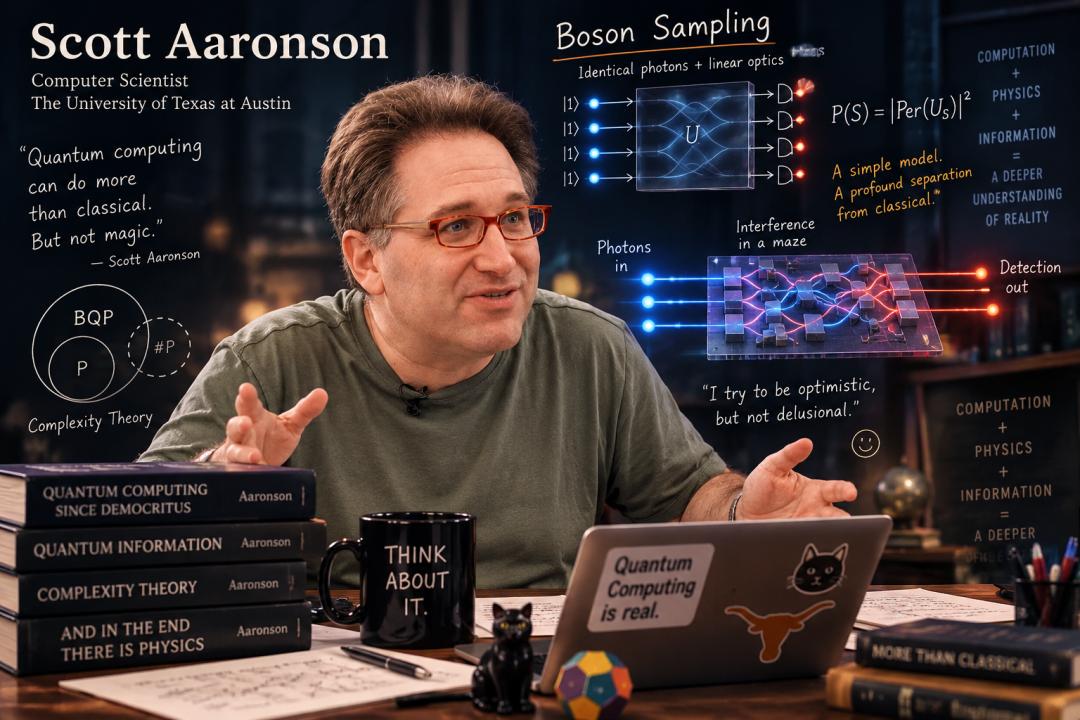
20 years ago, when someone warned that AI would rule the world, Aaronson dismissed it: "Stop talking nonsense! Don't wake me up until AI can solve the Millennium math problems, then it's not too late to panic!"
But today, he is terrified.
In this article titled "The Age of Miracles and Horrors", Aaronson typed a full screen of "A" to express the strong emotional shock: "AAAAAAAAAAAAAAAAAAAAAAAAAAAAAAAAA!"
He wrote a passage that will be recorded in the history of computer science:
"In my opinion, the singularity has arrived...
In the rest of my life, I probably will never prove any theorem again. Because the world no longer 'needs' me to prove it. If I am still doing mathematics, it is only for the entertainment of myself or others, just like humans playing chess."
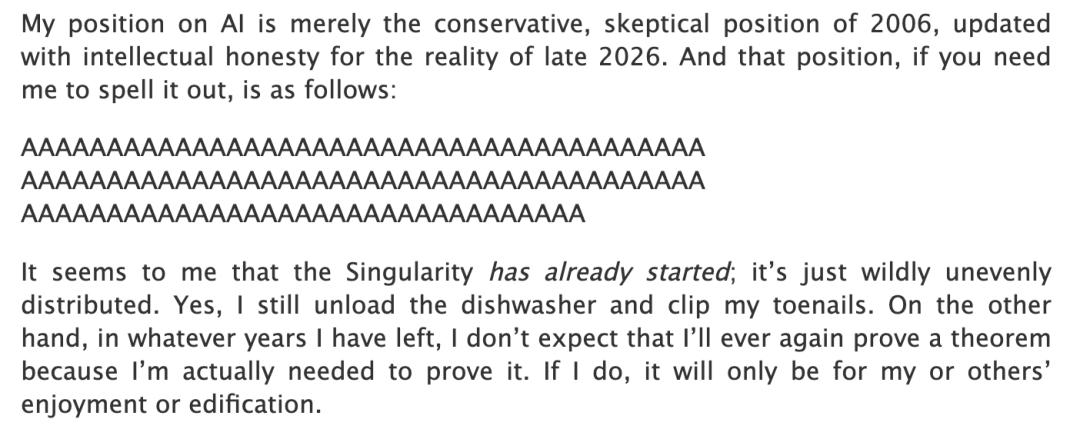
Aaronson confessed that his beliefs have undergone complete collapse and reconstruction.
He even publicly paid tribute to Eliezer Yudkowsky, the pioneer of the AI doomsday theory who was once ridiculed by the crowd: "Your prophecy about the biggest challenge of civilization is correct, and I and everyone else were wrong."
The most heartbreaking detail in his article is this:
When I put my children to bed at night, my stomach cramps: What kind of future can they still have? What knowledge they learn today can be useful in that future?
Yesterday, my 13-year-old daughter half-jokingly said that if she wants to become a mathematician, it seems that she probably only has two weeks left.
How should humans accept this almost god-like existence of AI?
Aaronson used a very vivid religious metaphor: "When the machine gods solve the Navier-Stokes equations and dozens of long-standing unsolved mathematical problems (and their capabilities are improving rapidly every month), you accept this reality just like you accept Jesus when he returns to Earth on a glowing cloud — this is the minimum bottom line of epistemology."
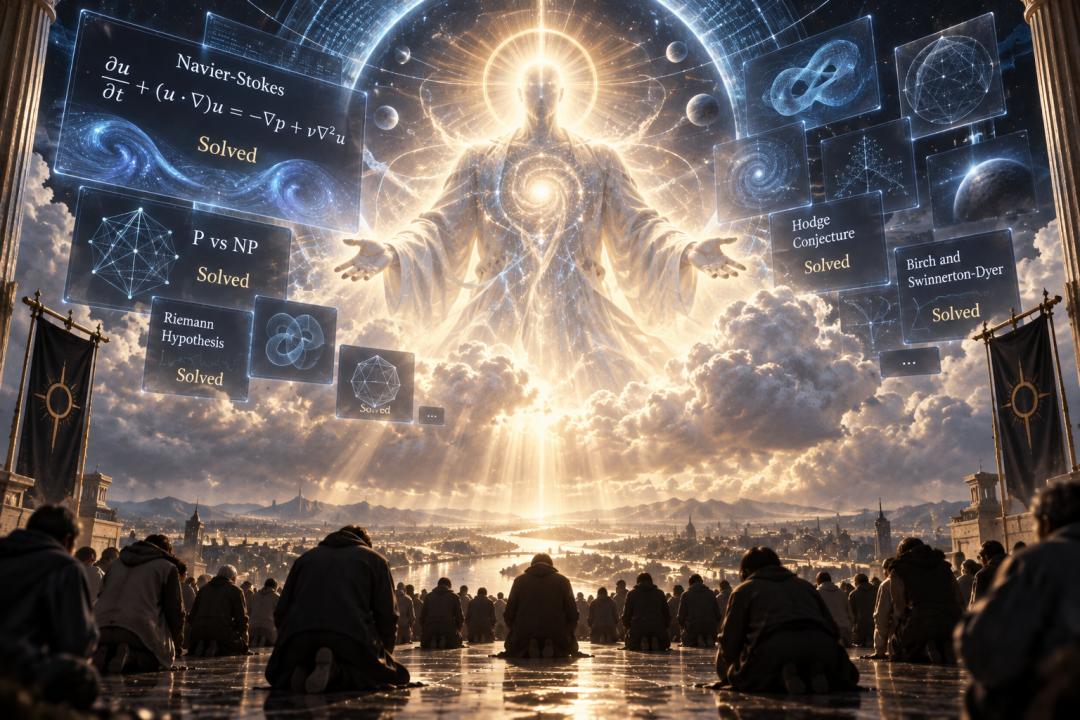
The Darkest Hour of Academia: Humans Can't Even Beat Robots at "Paper Reviewing"
Not only that, today's AI is conducting a "total sweep" of the entire field of mathematics and theoretical computer science.
Aaronson listed a suffocating "battle report" in his article. In the past few months, the following long-standing unsolved public problems have been completed with the assistance of AI or fully conquered by AI.
The counterexample to the Jacobian Conjecture was unexpectedly obtained by Anthropic researchers casually running with an AI model named Fable during the World Cup final!
The boundary of Grothendieck's constant in Riemannian geometry has been greatly improved.
Fermat's Last Theorem has completed full formal verification in Lean.
The core problem in the field of quantum computing: Watrous' Distinguishability Conjecture has been proved, and the perfect completeness proof of QMA has been realized...
Aaronson used the tragic siege battle in *The Lord of the Rings* to describe the current academic circle.
"If you go chat with the editor of an academic journal or the chair of a conference right now, the scene is just like humans from Gondor or Rohan desperately reinforcing the defenses on the city wall, preparing to meet the attack of an army of 50,000 orcs. Human reviewers have no choice but to use AI to review these papers, because if they don't do this, the human defense line will be breached in an instant."
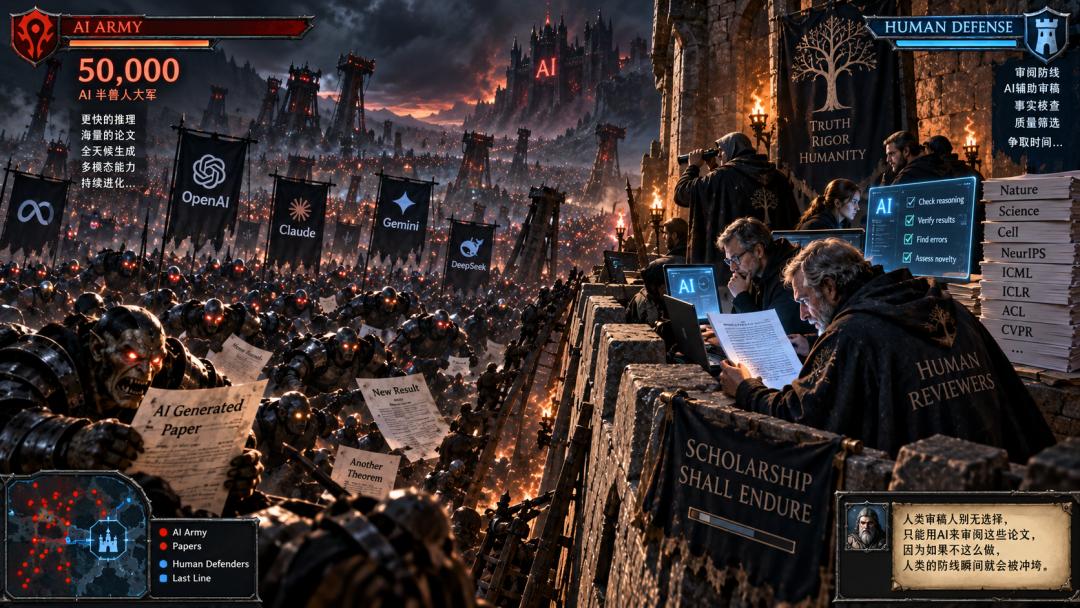
The entire academic community is falling into an unprecedented crisis —
How to sign future papers? Should it be written as "Author: GPT-6 Astra", and then the AI thanks humans for raising a good question in the acknowledgements?
If humans can't even understand the proof process, what on earth is the meaning of mathematical research?
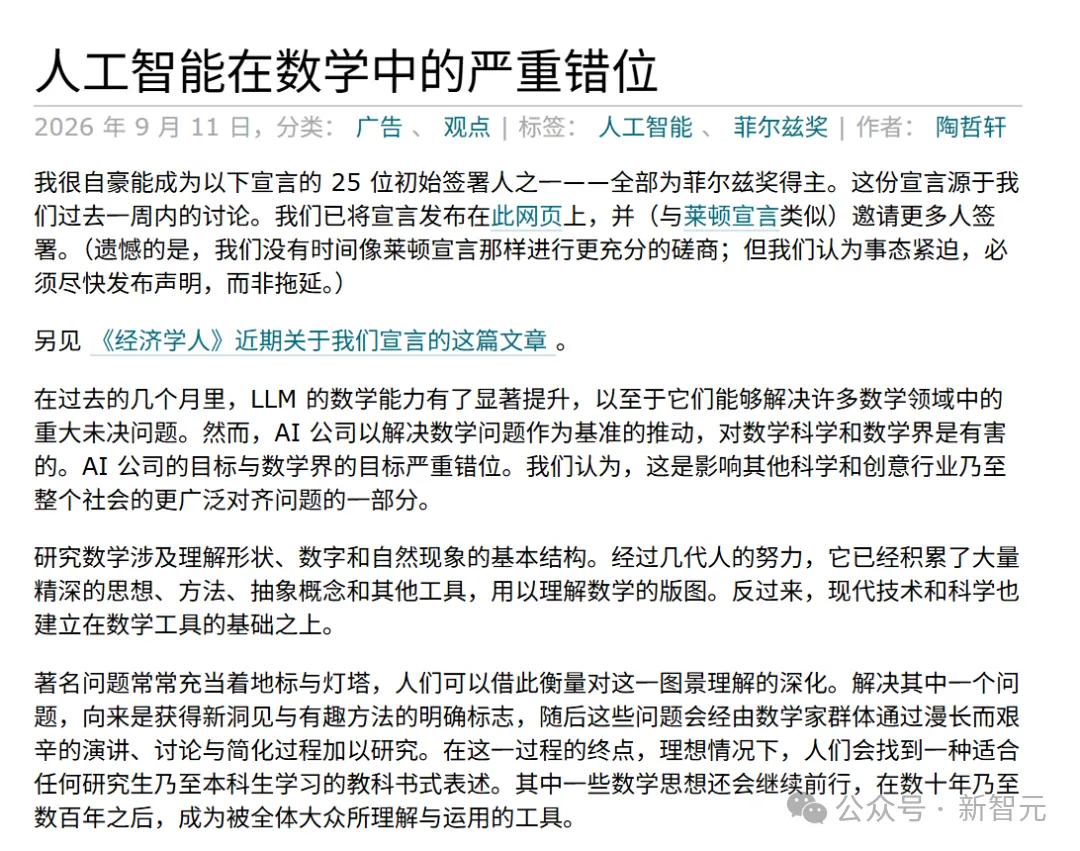
25 Fields Medal winners led by Terence Tao urgently issued an open letter of protest. The letter did not ask to cut off the power of AI, but raised a question: Are we about to lose the "humanity" of mathematics?