A "silent" AI has taken social media by storm. Is Jev truly a new paradigm?
Around September 15, a new model named Jev suddenly went viral in the Silicon Valley AI developer community.
It subverted people's current perception of large models: it cannot write code, compose articles or even chat, and actively cuts off the most critical capability of large models developed in the past few years — text generation, retaining only "judgment". TypeSafe defines it as: "Decisions, not strings" — prioritize decisions, not text.
When given a piece of information and several pre-defined questions, it can directly return choices, scores and corresponding probabilities. For example, after receiving a customer service email, Jev can simultaneously judge which department it should be assigned to, the urgency level, the refund risk and whether human intervention is required.
This model, which looks more like an "advanced classifier", quickly gained widespread attention. Latent Space mentioned in its AI News on September 16 that TypeSafe remained at the top of Hacker News for a long time on the day of its release, and the release post from founder Diogo Almeida had about 4.2 million views and nearly 20,000 likes at that time.
The performance figures announced by TypeSafe are also very impressive: in specific workflow evaluations, Jev is up to 193.6 times faster and 444.6 times cheaper than the control large model, with end-to-end latency of 70 to 500 milliseconds, an input price of $0.042 per million tokens, and no charge for outputs by token.
The team behind Jev is also highly influential. It comes from TypeSafe AI, a San Francisco-based startup that has just exited stealth mode, co-founded by Diogo Almeida, Erik Gafni and Sasha Sheng. The company has just completed a $40 million seed round led by DCVC, with an estimated valuation of about $200 million according to people familiar with the matter cited by Forbes.
Almeida used to be a researcher at OpenAI and was one of the main authors of the 2022 InstructGPT paper, participating in the establishment of the widely adopted RLHF training process later. OpenAI also listed him in the "Foundational RLHF and InstructGPT work" section of the GPT-4 contributor list.
After leaving OpenAI, Almeida said he spent two years thinking about one question: If large models are already so capable, why have most jobs in the world not yet been automated?
Jev can be regarded as his first answer to this question.
Do Agents Really Need to "Speak" at Every Step?
Today's large language models are essentially still extremely powerful token generation machines. Take an e-commerce Agent as an example: after it opens a web page, it needs to judge which button to click next. A common practice is to send the web page state to GPT, Claude or Gemini. After the model understands the page, it generates answers autoregressively, token by token, for example, "Based on the current page, I should click the Checkout button at the bottom right corner". Then the software extracts the Checkout from this text and calls the browser tool to complete the click.
But from the perspective of the software system, the information it really needs may just be "the third button".
Similar scenarios are widespread inside Agents: whether this work order should be assigned to the sales department or the after-sales department, whether this transaction has high risk, and which of the ten search results is the most relevant. All these tasks require the model to have semantic understanding and judgment capabilities, but there is little need for open-ended text generation.
Jev is designed to target this type of work. TypeSafe defines it as "System One Model", whose name comes from System 1 in Daniel Kahneman's *Thinking, Fast and Slow* — fast, intuitive judgment.
The name Jev comes from the economist William Stanley Jevons and the Jevons Paradox: After the use efficiency of a certain resource increases and its cost decreases, the final demand for it may rise instead. TypeSafe hopes the same will happen to AI so that "intelligent judgment" can be embedded in software on a large scale after it becomes sufficiently affordable.
The currently publicly available basic outputs of Jev mainly include Choice, Score and Noul.
Choice is responsible for selecting from pre-defined options, Score gives grades or continuous scores, Noul handles yes/no judgments, and outputs corresponding probabilities at the same time. For example, a risk control system can let Jev judge whether a user's refund risk is low, medium or high, and the model finally returns "75% high risk". After obtaining this result, the software can directly decide whether to enter manual review through ordinary code.
From this perspective, Jev is very much like an "intelligent if statement" with general semantic understanding capabilities. This is also the most important difference between it and traditional classifiers.
Traditional classifiers can of course also judge spam emails, fraud risks or image categories, but every time a new task is added, it is often necessary to redefine data, train or fine-tune the model. Jev aims to retain the general knowledge and zero-shot generalization capabilities that large models have already acquired, while compressing outputs into the choices and probabilities that software truly needs.
This demand has been significantly amplified in the Agent era. A complex Agent task may involve dozens or even hundreds of model calls internally, many of which are routing, classification, verification and state judgment. If all these steps are handed over to a full generative large model, the model will not only need to understand the problem, but also spend time generating a piece of text that will not be read by anyone in the end. This extra cost seems really unnecessary.
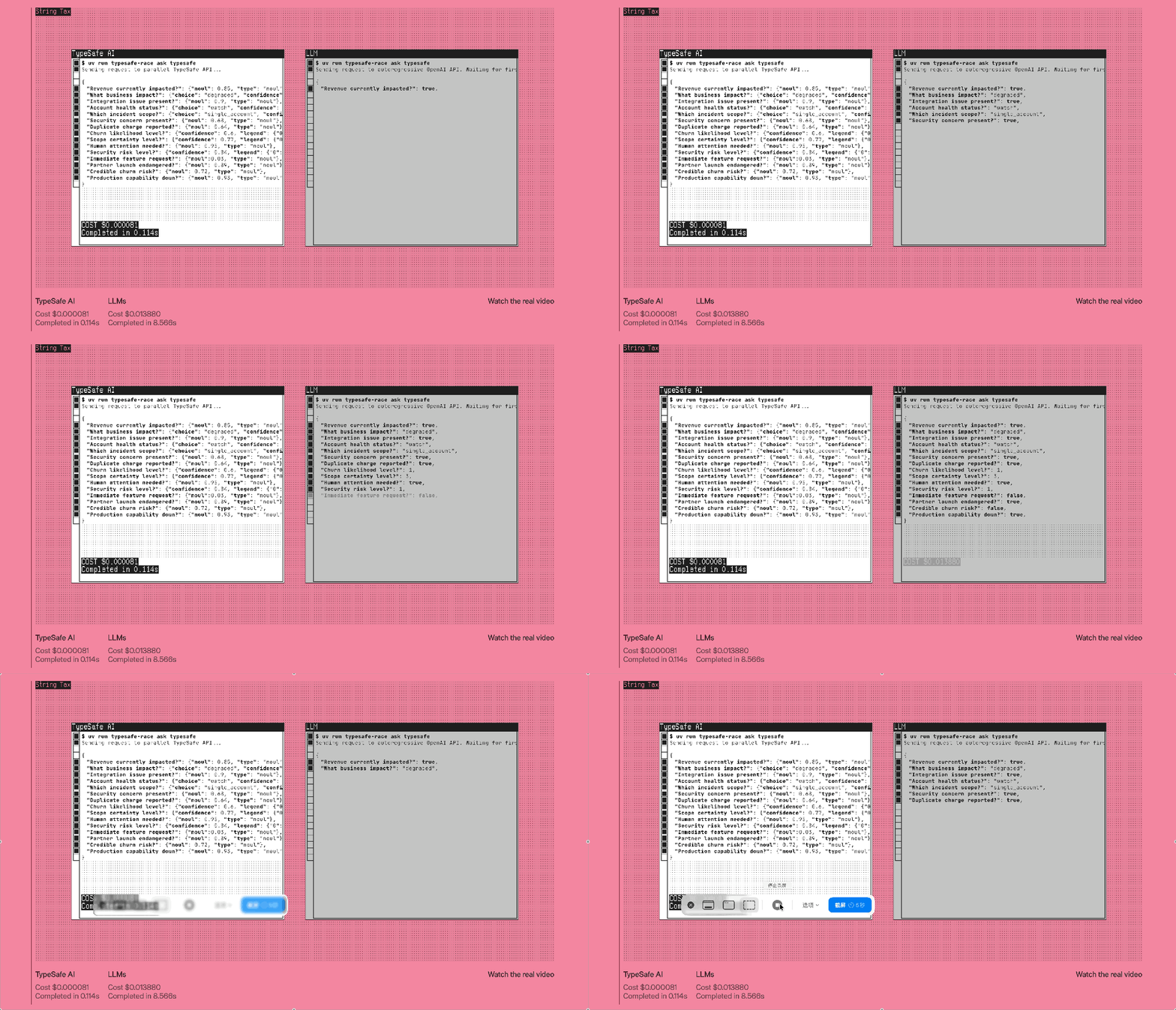
Figure: TypeSafe's demonstration shows that Jev directly returns multiple structured judgments, while traditional LLMs are still generating text step by step. In the official example, the former takes 0.114 seconds, while the latter takes 8.566 seconds.
A New Classifier?
This is also the most critical issue to judge the technical content of Jev.
Large language models such as GPT, Claude and Gemini adopt autoregressive generation. The model first processes the input, then predicts the next token based on all previous tokens, so a sentence must be decoded sequentially. This mechanism gives the model great output freedom: it can write articles, generate code, explain reasons, and perform complex reasoning, but the price is that the generation process is sequential, and the longer the output, the more decoding steps are usually required.
Jev actively limits the output space. Developers specify possible answers in advance, for example, refund_risk={low, medium, high}, and the model only needs to judge the probabilities of the three results, without generating natural language like "I think this user has a relatively high refund risk". TypeSafe also claims that Jev adopts a new parallel sampler, which can answer multiple independent questions at the same time in one query. For example, when processing an invoice, it can simultaneously judge the invoice type, abnormality risk, approval level and whether manual review is required.
This is also the key to understanding Jev's efficiency figures.
It is therefore clearly different from the Flash route that has been gaining increasing attention recently. Models such as Google Gemini Flash and DeepSeek V4.1 Flash still belong to generative LLMs, which reduce the calculation cost of each token through optimizations on architecture, activation parameters, KV Cache and inference systems, to solve the problem of "how to generate tokens faster".
Jev directly reduces the number of tokens. If an Agent needs 100 model calls to complete a task, 10 of which require complex planning and natural language generation, and the remaining 90 are only tool selection, result ranking, risk judgment and task status check, there is obviously room for optimization if all calls are made to the same large generative model.
More practical Agent systems in the future may adopt a multi-layer model structure: complex tasks are handed over to Frontier Models, ordinary reasoning to Flash models, high-frequency judgments such as routing, classification and verification to Decision Models, and deterministic parts continue to be processed by traditional code, with Harness responsible for scheduling between these capabilities.
This is also the most noteworthy industrial significance of Jev: not every scenario that requires intelligence needs to call a generative LLM.
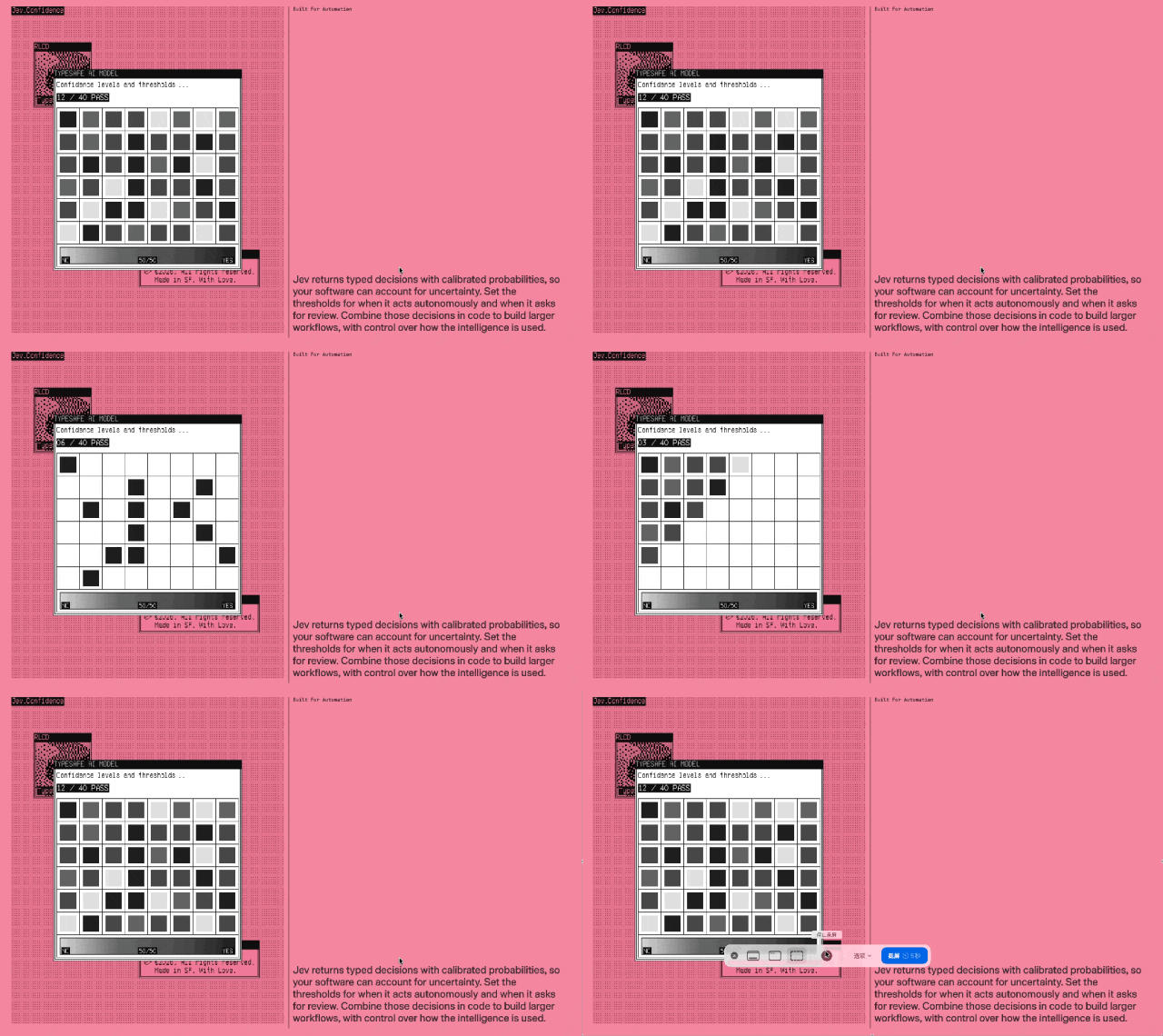
Figure: TypeSafe states that Jev returns calibrated probabilities for each judgment, based on which software can set thresholds for automatic execution: tasks with high confidence are processed directly, and tasks with low confidence are transferred to manual review.
Zero Hallucinations?
One of the most prominent promotions of Jev on TypeSafe's official website is "Zero Hallucinations". This phrase easily misleads people into thinking that Jev has solved the long-standing hallucination problem of large models, but it only ensures that outputs will not exceed the pre-defined types.
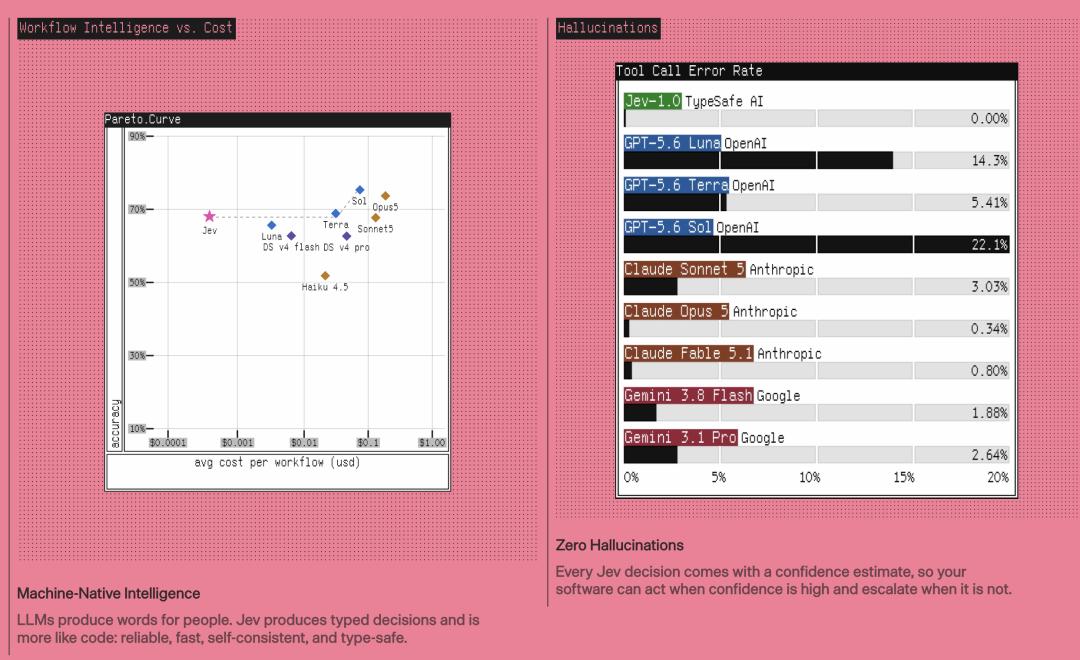
Figure: The official evaluation released by TypeSafe shows that Jev achieves accuracy close to that of cutting-edge models at lower cost in its workflow tests; the right chart shows that Jev's tool call type error rate is 0%.
For example, if the developer specifies that the model can only choose from the three options "cat, dog, bird", Jev will not return "elephant", nor will it generate a piece of text that cannot be parsed by software.
TypeSafe therefore emphasizes that its type error can reach 0%. This is indeed important for production systems, especially when Agents automatically call APIs, modify databases and execute workflows. The more stable the structured output is, the easier it is for the system to connect to subsequent operations.
However, correct type does not mean correct judgment. If the input is clearly a cat, but the model returns "dog: 97%", no type error occurs, but the business result is completely wrong. Therefore, "Zero Hallucinations" is more accurately a constraint on output format and type, and there is currently no evidence that Jev eliminates errors at the fact and judgment levels.
The more noteworthy part of Jev is actually RLCD proposed by TypeSafe — Reinforcement Learning for Calibrated Decisions, that is, reinforcement learning oriented to calibrated decisions. According to the team's explanation, RLHF mainly optimizes human preferences, RLVR relies on verifiable rewards to improve capabilities in tasks such as mathematics and coding, and RLCD focuses on solving "how confident the model says it is, and whether this probability is reliable".
This is especially critical for Agents to enter production environments. Suppose a model has an actual judgment accuracy rate of only 80%, but often gives a confidence level of 99%, then this figure can hardly be used for automated decision-making. Ideally, when the model gives a 90% confidence level for a batch of tasks, about 90% of them should be judged correctly. Only by achieving this can enterprises establish a stable diversion mechanism: tasks with high confidence are executed directly, tasks with medium confidence are transferred to a more powerful model for review, and tasks with low confidence are then transferred to humans.
If RLCD can finally be independently verified, its practical significance will be very important. A well-calibrated Decision Model can itself act as a router in the Agent system.
However, TypeSafe has not yet published the full paper, nor has it disclosed the parameter scale, network structure, training data and sufficient ablation experiments. The outside world is therefore unable to judge whether RLCD represents a significantly different training paradigm, or an engineered combination of existing methods such as reinforcement learning and probability calibration. Similarly, the parallel sampler and System One Model claimed by TypeSafe currently lack sufficient details, making it difficult to confirm that Jev has completed a fundamental architecture breakthrough at the level of Transformer, Attention or MoE.
"193 Times Faster, 444 Times Cheaper"?
Another set of eye-catching performance figures during Jev's dissemination process. The production-style workflow evaluation released by TypeSafe shows that Jev has an average score of about 67.8% on the four types of workflows it designed, while some cutting-edge models are in the range of 68% to 74%; at the same time, the cost of a single case of Jev can be as low as about $0.0004, with a response time of about 0.4 seconds. The company accordingly gives the data of up to 193.6 times speed improvement and 444.6 times cost reduction.
These figures cannot be simply interpreted as "Jev has intelligence close to GPT while being 193 times faster".
First of all, these tasks themselves are the System One type tasks that Jev is best at, namely classification, selection, scoring and judgment. Letting a model specially designed for structured decision-making compete with general generative models on such tasks will inherently amplify Jev's advantages. Secondly, the most complete evaluations are currently completed by TypeSafe itself, and the company also admits that the test tasks are designed by its own model capabilities team, which may have bias; some reference answers are also generated by powerful models, not all using manually labeled ground truth.
"193.6 times" and "444.6 times" are also the maximum gaps in the comparison of specific tasks and specific models, which do not mean that Jev can achieve such improvements in processing any task.
It better proves a common sense: If a task ultimately only requires a choice or probability, then a model specially designed for judgment does have the opportunity to be much cheaper than a full generative LLM.
More importantly, the real competitors that Jev should compare with are not just expensive cutting-edge models like GPT and Claude. Today's small Flash models can already cooperate with JSON Schema, Structured Output, Function Calling and Constrained Decoding to return structured answers. The cost of traditional classifiers and embedding+classifier may be even lower.
Therefore, a truly convincing independent test should put Jev, Flash models with Constrained Decoding, traditional classifiers and embedding classifiers into the same batch of real production tasks, and uniformly compare Accuracy, Calibration, Latency, Cost, OOD Robustness and Batch Scaling. So far, no such test is available.
Is it more gimmick than substance, or a real innovation? The community has already been in heated debate.

Figure: A Reddit user joked that "the industry has rediscovered classification models", while another believes that Jev is more like a general classifier with LLM-level semantic understanding capabilities, which is of great significance if its cost and speed figures are valid.
Jev does put forward a pain point based on the Agent paradigm: does the "intelligence" of AI necessarily have to be achieved through resource-intensive language generation? Is there a better, more reliable and more efficient way?
However, some developers directly told Tencent Tech: "There is no such a good thing."
This article is from the WeChat official account "Tencent Tech", Author: Xiao Jing, Editor: Xu Qingyang, Published with authorization from 36Kr.