The scenario for solid-state batteries over the next three years is roughly as follows.
In June 2026, at the Dalian Davos Forum, someone asked Zeng Yuqun about solid-state batteries. This figure, the richest and most aggressive investor in the entire industry, gave a rare straightforward answer: according to the 1-9 level technology readiness rating system, solid-state batteries are currently only at Level 4 — they have just completed the principle verification of small laboratory samples.
What does Level 4 mean? From this stage to Level 9 of mass production, there is usually a gap of 5 to 8 years according to the historical experience of the manufacturing industry.
On the other side of the same year: in Bishan, Chongqing, the construction of BYD's 20GWh sulfide all-solid-state mass production line started; starting from September 1, solid-state batteries are exempt from consumption tax; in the first quarter, 25 solid-state battery projects across the country were intensively signed and started, with a total investment of over 35 billion yuan. In the A-share market, a company producing indium phosphide, with a price-earnings ratio as high as 839 times, is classified under the "solid-state battery" concept sector.
While some say "it's still too early", others are breaking ground, increasing investment, and raising prices. These two phenomena are not contradictory — they just stand at different scales on the industrialization clock.
To read this clock clearly, you only need three things: a mid-year report, a cost sheet, and 830 tons of lithium sulfide. 830 tons, that is the total effective global capacity of lithium sulfide in 2026. This number determined by material science sets the boundary for this market boom earlier than any industry research report.
What Does Level 4 Mean
The Technology Readiness Level (TRL) is a metric developed by NASA and adopted by military sectors of various countries to measure technology industrialization: Level 4 refers to laboratory principle verification, Level 6 refers to prototype demonstration in a relevant environment, and Level 9 refers to passing the test of actual application.
Between Level 4 and Level 9, what separates them is not just engineering workload, but yield rate, cost, and the complete industrial chain. All three terms have specific figures for solid-state batteries in 2026.
In terms of cost, the price of all-solid-state cells is 1.6 to 2.2 yuan/Wh, while that of lithium iron phosphate cells is 0.39 to 0.5 yuan/Wh — 3 to 5 times the gap. Applied to a 100kWh vehicle, the battery alone costs more than 150,000 yuan extra, which is equivalent to the price of a BYD Seagull.
In terms of yield rate, the comprehensive yield rate of all-solid-state pilot lines is only 60–70%, while that of liquid batteries has exceeded 94%; the 92% yield rate of Toyota's trial production line is already one of the best performances in the industry.
In terms of production lines, sulfide electrolytes will generate toxic hydrogen sulfide when encountering water, so the entire production process must be carried out in a dry environment with a dew point of minus 60 degrees Celsius. 90% of the existing liquid battery production lines cannot be reused, and the equipment investment per GWh is 1.5 to 1.8 billion yuan, 8 to 12 times that of liquid battery production lines.
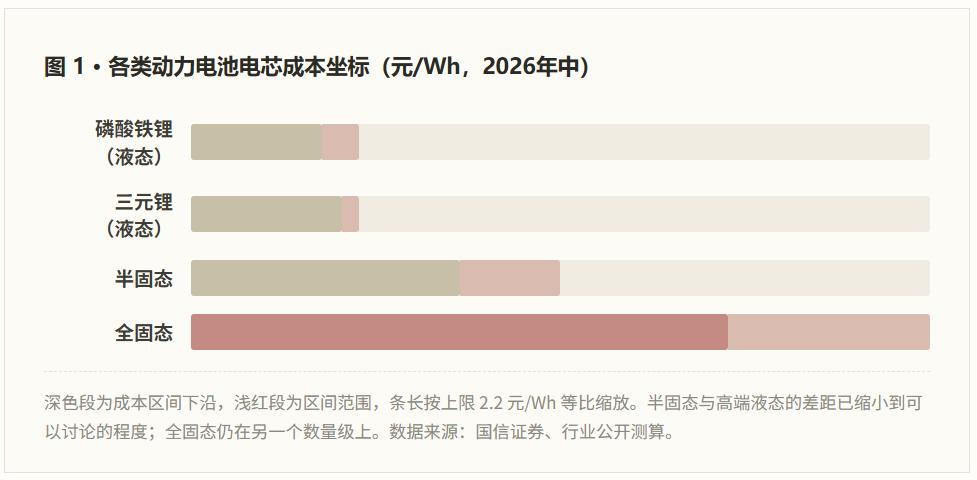
However, there is an easily overlooked detail in the cost sheet: semi-solid-state batteries are already close to liquid batteries in cost. At 0.8–1.1 yuan/Wh, they are only 20 to 30% more expensive than high-end liquid batteries, because 90% of the process links can reuse existing production lines. That is why almost all "solid-state battery vehicles" you can buy in 2026 are semi-solid-state; that is also why the national standard GB/T 43568-2026 uses the threshold of "0.5% weight loss rate" to make it clear: no mass-produced vehicle currently meets the all-solid-state standard.
Level 4 refers to all-solid-state technology, and it is also the main pricing target of the A-share solid-state battery sector.
Then the question arises: what should the financial statements of a company at Level 4 of technological maturity look like? The answer is simple: unpromising. No revenue has come in yet, while capital is flowing out: revenue comes from old businesses, costs come from new businesses. The higher the proportion of solid-state business, the worse the current financial statements will look.
Therefore, in this sector, the P/E ratio is completely meaningless. There is only one correct question to ask: whose account is the money in right now.
At What Level Do the Financial Statements Stand
If you lay out the mid-year reports of 27 core sample companies and penetrate their main business composition one by one, you will find an awkward fact more notable than "mismatch": the profit growth of this sector in the first half of 2026 almost entirely comes from a super boom of liquid lithium batteries.
Only 5 companies have positive price increases since the beginning of the year. After checking their main businesses one by one, the driving factors are as follows:
● Yunnan Germanium Industry: indium phosphide and gallium arsenide for AI optical communications, compound semiconductors contributed 32.84% of gross profit, while the gross margin of germanium decreased in the same period;
● Chihong Zinc & Germanium: silver production rose from 87 tons to 212 tons, gold production nearly tripled, a typical precious metal company;
● Sanxiang New Materials: zirconium business, revenue only increased by 0.23%, net profit growth entirely came from the rise of gross margin;
● Jiao Cheng Ultrasonic: energy storage and semiconductor business, the 1.344 billion yuan private placement is mainly invested in semiconductor packaging;
Zhongyi Technology: lithium battery copper foil business, global shipments rose by 60.1%, net profit nearly tenfold.
In other words, among the 5 companies, the rise of 4 has nothing to do with solid-state batteries. The driving factor of the fifth is the boom of liquid lithium batteries — which is exactly what solid-state batteries are supposed to replace.
The ranking of gross margins confirms this rule further. The four companies with the most significant gross margin increase are: Ganfeng Lithium (+20.4 percentage points), Tianci Materials (+14.9 percentage points), Do-Fluoride New Materials (+9.6 percentage points), Xiangfenghua (+6.3 percentage points). Their main businesses are lithium salt, electrolyte, lithium hexafluorophosphate, and graphite anode respectively. All four are the targets to be replaced by solid-state batteries. 99.44% of Xiangfenghua's revenue comes from graphite anode, while the protagonists of the solid-state era will be silicon carbon and lithium metal.
Behind this lies a widely ignored negative feedback. The common sense of industrialization is "technology matures, costs fall, large-scale substitution takes place", but there is another rule in the real industrial history: The better the cash flow of incumbents, the lower their willingness to switch tracks.
Think about the situation of battery manufacturers in the first half of 2026: demand for energy storage exploded, production lines operated at full capacity, and every link of the liquid battery industry was making profits. At this moment, asking the management to invest in an all-solid-state pilot line with 3 to 5 times the cost, 60-70% yield rate, and 90% of production lines unavailable for reuse? The rational answer is written in the financial statements: CATL's construction in progress totals 33 billion yuan, the largest in the industry, but the year-on-year growth rate is -5.9%. The capital expenditure of the leading enterprise in the liquid battery sector has entered the harvest period, instead of making large-scale investment in new technology routes.
There is a ready-made mirror in industrial history. In the 2000s, polysilicon price rose to 400 US dollars per kilogram, and thin-film batteries were highly expected; after 2008, polysilicon price dropped by 90% in two years, and all the cost advantages of thin-film batteries vanished instantly. The reverse is also true: when every link of the liquid lithium battery industry is making profits, the window for solid-state batteries will be delayed.
Buying the most profitable companies in this sector is essentially betting against solid-state batteries. This is not a mispricing by the market — the market is pricing for "the last boom of liquid lithium batteries", and the pricing is very accurate.
75% of BOM Cost Is Lithium Sulfide
The cost sheet in the following part is the most factual part of this article, as it does not depend on the statement of any single company.
Why is the cost of all-solid-state batteries 1.6–2.2 yuan/Wh? Break down the BOM: cathode materials account for 30%, solid electrolyte accounts for 25%, anode (lithium metal/silicon) accounts for 15%, manufacturing and other links account for 30%. The proportion of the manufacturing link is nearly twice that of liquid batteries, with dry process, isostatic pressing all being new additional processes, while the yield rate is still low.
But this is not the core point. The core point lies inside the electrolyte. Gotion High-Tech gave a statement at the 2026 Global Technology Conference: 70–80% of the cost of sulfide solid-state batteries comes from the electrolyte, and 70–80% of the electrolyte cost comes from lithium sulfide — multiply the two figures, the single material lithium sulfide accounts for 50% to 2/3 of the total cost of all-solid-state batteries. The BOM decomposition result from Changjiang Securities is more extreme: in the current 1.66 yuan BOM cost per Wh of all-solid-state batteries, lithium sulfide accounts for 75%.
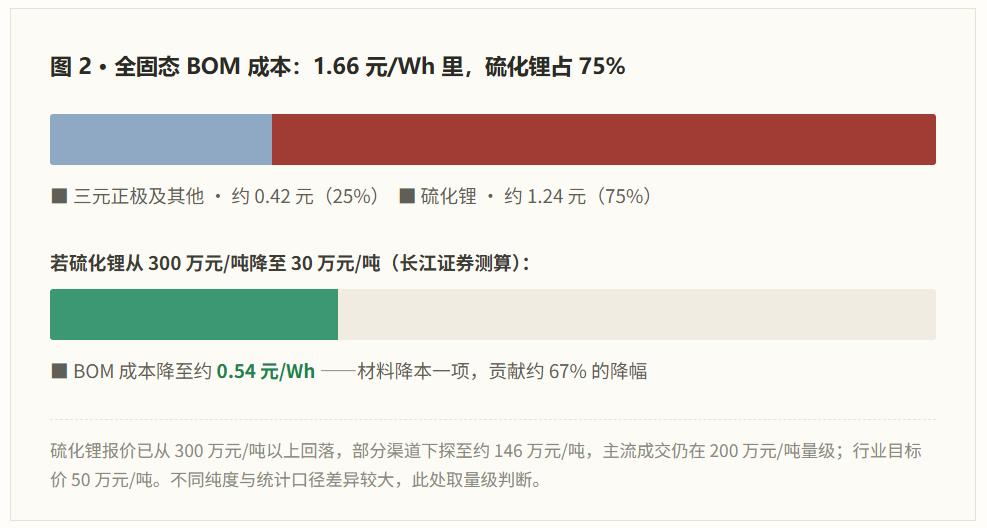
This leads to an unpleasant but unavoidable conclusion: the cost reduction of all-solid-state batteries is essentially the cost reduction of lithium sulfide. This is not just an important path, but the only path.
The other three paths do exist, but their impact is far smaller. In terms of process, dry electrode simplifies 7 processes into 5, without the need for expensive NMP solvent. GAC's cathode film-forming speed reaches 50 meters per minute, 3 times that of the wet process, bringing a total cost reduction of about 15%; in terms of yield rate, BYD's 2GWh all-solid-state pilot line in Pingshan, Shenzhen, claims to have raised the yield rate to 95%, cutting the unit manufacturing cost by 20%; in terms of system design, solid electrolyte can also act as a separator, thermal management can be simplified, and lithium metal anode can be compatible. The sum of the cost reduction from the three paths cannot match the impact of lithium sulfide cost reduction.
However, the cost reduction of lithium sulfide hits a wall: 830 tons.
Calculated according to the mainstream formula: 1GWh of batteries require about 700 tons of electrolyte, and 1 ton of electrolyte requires about 400kg of lithium sulfide. Multiply the two figures, the demand per GWh is about 280 tons. The effective global capacity of lithium sulfide in 2026 is 830 tons, with monthly output less than 10 tons. Physically, this capacity can only support the production of about 3GWh of batteries. However, the expected capacity calculated from the existing equipment orders is more than 5 times this figure.
Thus a three-ring deadlock emerges: material manufacturers dare not expand production, as a 100-ton-level production line requires an investment of over 100 million yuan, no one will build it without bulk orders; battery manufacturers dare not carry out mass production, as raw materials are expensive and unstable, with the cost 3 to 4 times that of liquid batteries; without mass production, there will be no large-scale demand, and the loading volume of solid-state batteries stays at the demonstration level. The three links are waiting for each other, and the first mover will take all the risks.
The core of this deadlock is no longer the technology itself, but risk allocation.
There is a ready-made thermometer on this wall: Shanghai XiBa. According to its mid-year report, its new energy advanced materials revenue accounts for 5.72% of total revenue, making it the company with the highest solid-state business proportion in the entire A-share market — the total revenue from this business is only 13.37 million yuan in half a year. In the fourth quarter of 2025, it transferred 186 million yuan of construction in progress to fixed assets, making its fixed assets surge from 60 million yuan to 261 million yuan, and the 100-ton-level lithium sulfide production line was truly completed. But then what? In the first half of 2026, its construction in progress is only 4 million yuan, down 99.8% year-on-year.
The production line is completed, but the demand does not follow, so it dare not expand further. The market interprets its lithium sulfide shipments as "accounting for 30% of the national total", but the company's own capital expenditure casts a negative vote on this statement.
Tax Exemption, National Standard and 35 Billion Yuan
Policymakers are well aware of this wall, and unprecedented supportive policies have been introduced in 2026.
The national standard GB/T 43568-2026 was implemented on July 1, using the 0.5% weight loss rate to clearly distinguish liquid, solid-liquid hybrid, and solid-state batteries. According to industry estimates, cleaning up "pseudo-solid-state" products alone can help the entire industry save about 30% of invalid R&D and trial error costs. Starting from September 1, solid-state batteries are exempt from consumption tax for two and a half years. The Ministry of Industry and Information Technology has listed all-solid-state batteries and solid-state electrolytes as key research and development directions in the "15th Five-Year Plan"; Shenzhen issued a special subsidy of 30 million yuan for equipment investment. The capital market is even hotter: 25 projects in the first quarter, 35 billion yuan of investment, and a planned capacity of 110GWh.
But all these measures only change one thing: the cost side of the financial statements. Tax exemption improves the profit statement, the national standard clears the industry track, and subsidies reduce the equipment cost. They cannot break the three-ring deadlock: material manufacturers will not expand production without orders, battery manufacturers will not carry out mass production without cheap and stable raw materials, while cheap and stable raw materials can only be achieved after large-scale production.
Tax exemption can change the financial statements, but cannot break the deadlock. There is only one key to break the deadlock: when the monthly output of lithium sulfide rises from 10 tons to 100 tons.
There is also a divergence easily covered by the policy boom, which is more fundamental than most people think. Yang Hongxin, chairman of Honeycomb Energy, judges that even by 2035, all-solid-state batteries will not have cost advantages over liquid batteries, and solid-liquid hybrid batteries will remain the mainstream for a long time. Academician Ouyang Minggao holds a corresponding view: solid-liquid hybrid batteries will be the real growth driver in the next 5 to 10 years. In contrast, BYD's goal is to achieve "equal cost for solid and liquid batteries" by 2030, bringing the cost of all-solid-state cells down to 0.5–0.7 yuan/Wh.
One side says "it will never catch up", the other side says "it will catch up by 2030". This divergence cannot be resolved in 2026, but it sets an investment discipline: it is dangerous to take "all-solid-state batteries will inevitably be widely adopted" as the reason for buying. A more prudent approach is to find links that can generate revenue no matter which technology route wins.
The Money of Pilot Lines
There is only one such link: equipment.
The total contract liabilities of 9 equipment companies in their 2026 mid-year reports add up to