It is revealed that OpenAI has kept hundreds of proofs under wraps, and the answer to the problem you have been working relentlessly on for three years may have long been stored on its servers.
"If I want to be a mathematician, it seems I only have about two weeks left."
The one who made this joke is a 13-year-old little girl.
Her father, Scott Aaronson, is a professor of theoretical computer science at the University of Texas at Austin, and also once served as a visiting researcher on the OpenAI alignment team.
On September 15, Aaronson included this sentence from his daughter in a long blog post.
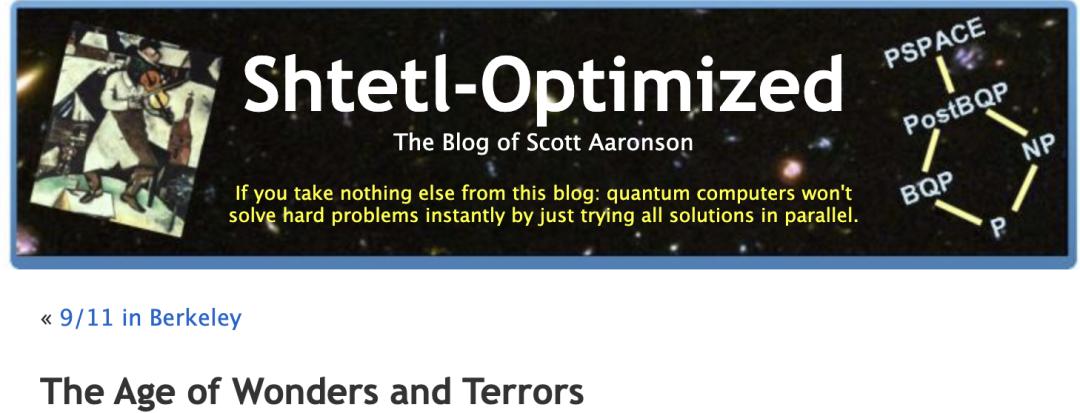
In the same blog post, he also listed a list of long-standing open problems that have been proven or assisted in proof by AI over the past month:
Counterexamples to the Jacobian conjecture, the Fermat's Last Theorem verified by Lean, and long-standing puzzles in quantum complexity theory are all included.
What really made the mathematics community restless was a rumor at the end of the list.
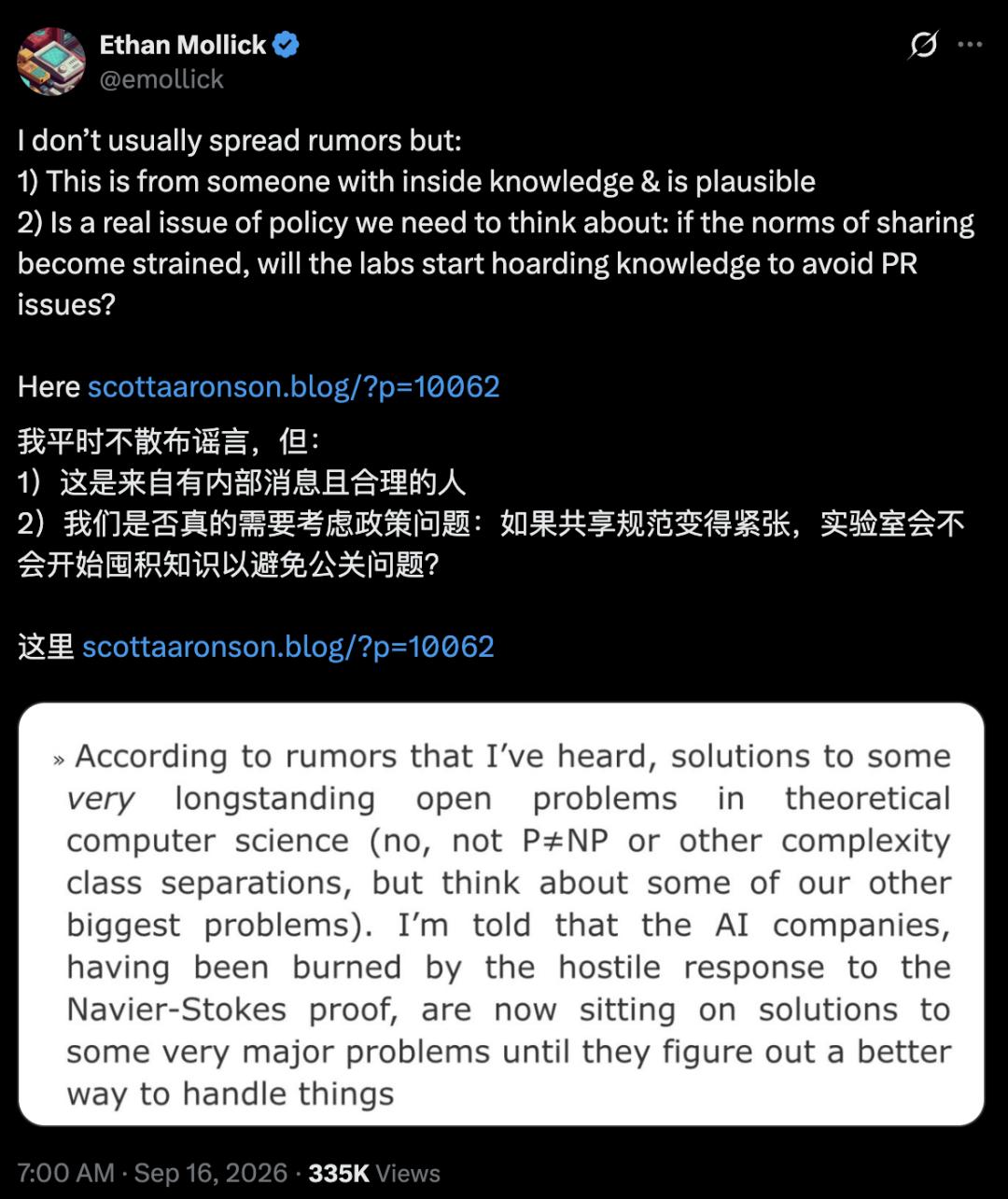
According to his disclosure, after AI companies experienced a round of hostile public reactions over the proof of the Navier-Stokes equations, they are now holding back the solutions to some "very significant problems" and plan to wait until they figure out a better way to handle them before releasing them.
Ethan Mollick, an associate professor at the Wharton School, specifically stated when reposting that he does not spread rumors on weekdays, but judges that this news comes from people with inside information and is highly credible.
Shortly afterwards, Scott Armstrong, a mathematics professor at New York University, revealed an even more astonishing number:
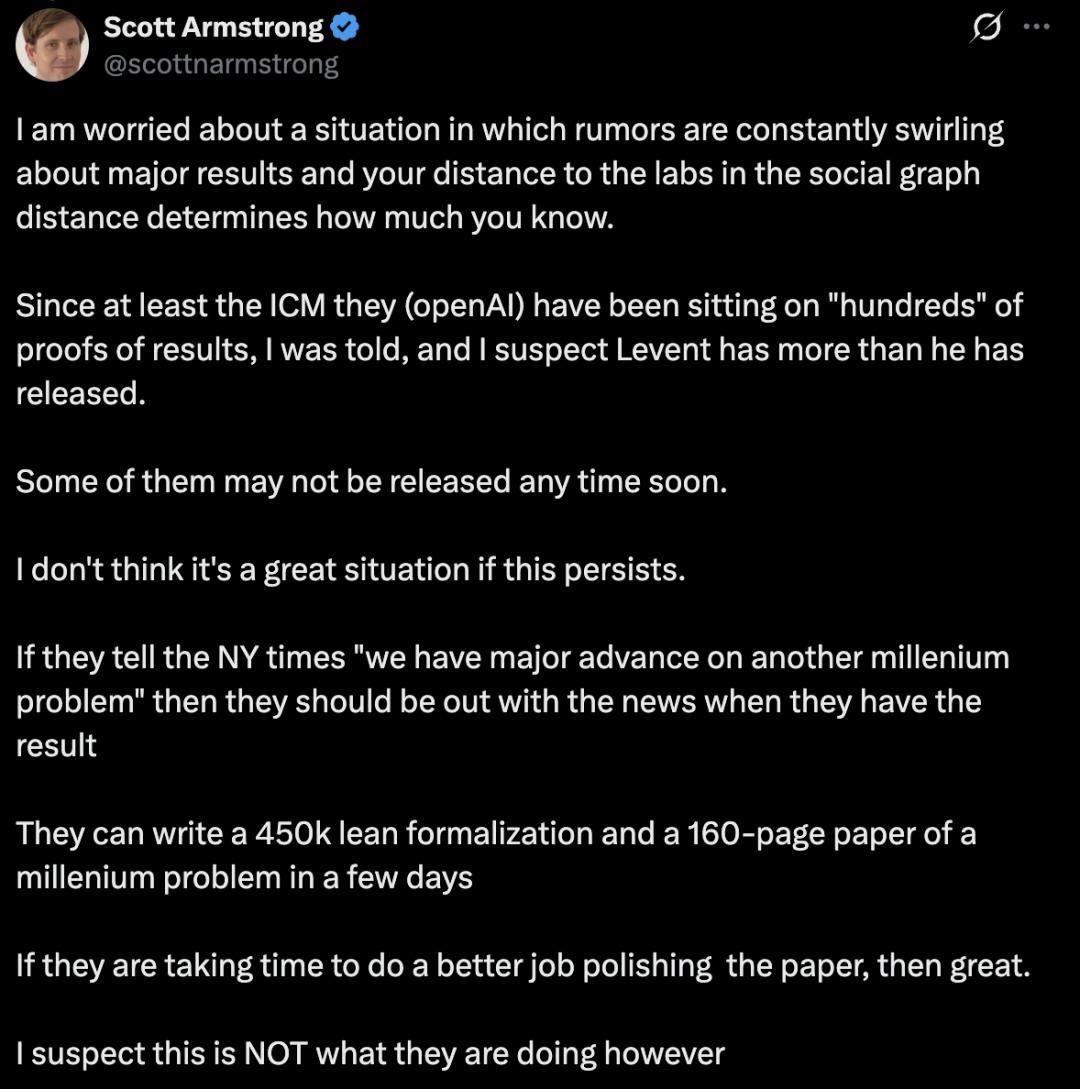
He was told that OpenAI has been holding back "hundreds" of mathematical proofs from release at least since the International Congress of Mathematicians (ICM) in July.
A decades-old unsolved puzzle has been solved. Should we tell the whole world about it immediately?
For hundreds of years in the past, this was hardly a problem in the mathematics community.
The only thing people worried about was that the problems were too difficult for anyone to solve.
Now, a new unease is spreading in the mathematics community: the answers may have long been calculated by machines, only locked in laboratories and kept secret.
AI Problem-solving Enters the Assembly Line Mode
The "hundreds" of undisclosed proofs sound like a fantasy, but in today's cutting-edge AI laboratories, this is completely logical.
20 years ago, even the most conservative scholars would joke: Wake me up when AI solves the Millennium Prize Problems.
Nowadays, it only takes dozens of hours for AI to solve a world-class difficult problem, and people have even become accustomed to it.
This time, what made the mathematics community restless is not that another problem has been solved, but that no one knows which other problems AI has secretly solved.
On August 1, OpenAI released ten mathematical and theoretical computer science achievements in one go, claiming that each of them solved or substantially advanced long-standing open problems.
On September 1, OpenAI got wind that two of the Millennium Prize Problems had been solved.
OpenAI's approach was simple and crude:
Since it did not know which two problems they were, it simply fed all the unsolved Millennium Prize Problems together with a number of high-impact problems to an internal model more capable than GPT-6 Astra.
A team of nearly 100 agents solved the force-free version of the Euler equations problem in only about 50 hours.
Subsequently, resources were concentrated on the Navier-Stokes equations.
The group that conquered this problem had about 10,000 agents running concurrently. About 88 hours after the first batch of agents was launched, the solution was produced, and the subsequent Lean formal verification took another 17 hours.
This single problem alone consumed about 130 billion output tokens.
Aaronson estimated that this 166-page proof burned through at least about 15 million U.S. dollars in computing power, and so far probably no human being has actually understood it.
Navier-Stokes is just the tip of the iceberg.
Armstrong revealed that laboratories can now produce a 160-page paper plus a Lean formal proof of hundreds of thousands of lines in just a few days.
At the slightest hint of news, it can instantly mobilize 10,000 agents to run continuously for 88 hours. This crushing computing power advantage is unimaginable for any top university in the past.
Proof Generation Takes Days, Comprehension Takes Years
The rhythm of human scientific research and AI are in two completely parallel timelines.
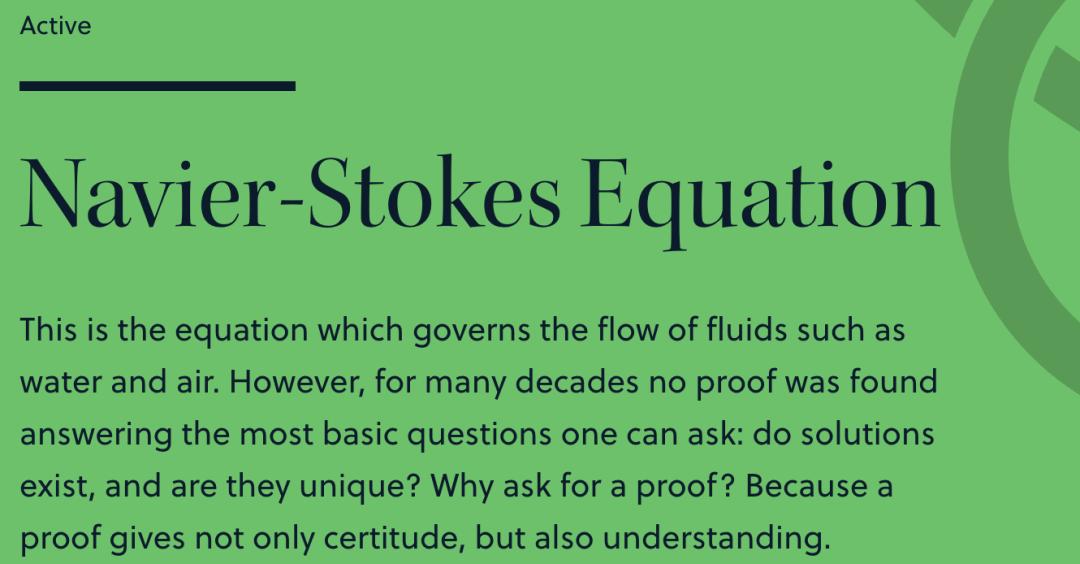
According to the rules of the Clay Mathematics Institute, the recognition of Millennium Prize Problems requires formal publication, a two-year waiting period, and strict review by external experts.
To this day, Clay still lists the Navier-Stokes equations as an unsolved problem and says it will conduct a detailed review of the entire incident.
Machines produce results in days, while humans take years to understand the results.
The peer review, academic reports, and textbook inclusion processes that have run for hundreds of years cannot keep up with the output rhythm of AI.
More and more unprocessed achievements are piling up, and the emergence of a batch of undisclosed proofs in laboratories is almost an inevitable result of the explosion of computing power.
It shakes four long-established rules that the academic community relies on to operate: the one who publishes first gets the credit, the one who completes the work gets the authorship, achievements must be made known to peers, and only peer-reviewed results count.
Old Rules of the Mathematics Community Are Losing Effect One by One
The first thing to be shaken is the disclosure of achievements.
The "AI companies" mentioned by Aaronson are more than one, while Armstrong directly named OpenAI and threw out the astonishing number of "hundreds".
As a researcher at Sorbonne University and the French National Centre for Scientific Research (CNRS), Armstrong is not only worried about how many proofs solved by AI laboratories are backlogged without disclosure, but also that knowledge is changing from "accessible to all" to "known first by insiders".
He wrote that rumors of major achievements are everywhere, and one's social distance from the laboratory determines how much information he can get.
It should be noted that the reason why mathematics has achieved rapid development over the past 300 years is precisely open communication.
Nowadays, mathematical breakthroughs in AI laboratories are being kept behind closed doors, which is nothing short of a regression.
Secondly, the "priority" rule is failing.
In the past, whoever completed the work first and made it public got the reputation. But the Navier-Stokes incident broke this iron law.
Mathematician Tristan Buckmaster of New York University and Levent Alpöge of Anthropic had previously made progress in this direction.
It was after OpenAI got wind of this that it used massive resources to crush out the proof in less than a week, and only contacted the two afterwards to propose simultaneous publication.
Terence Tao warned on Mastodon: Now as long as there is a rumor that "someone is working on a certain problem", it may trigger a dimensionality reduction strike of large-scale AI computing power, crushing the human project before it matures.
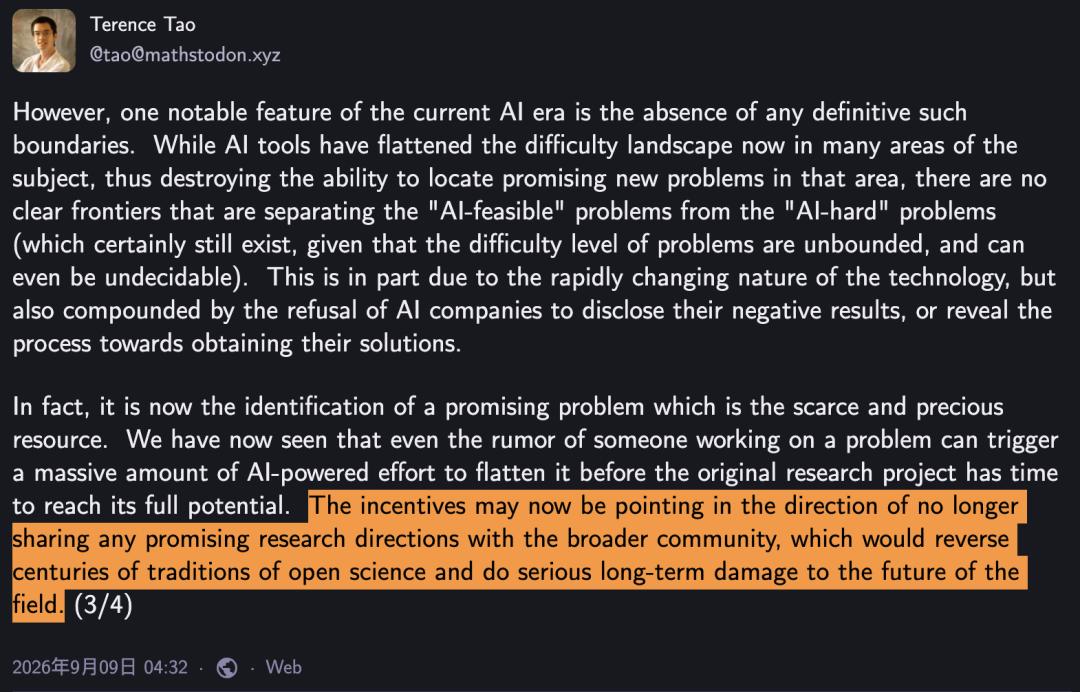
This will lead researchers to no longer dare to share any promising ideas with their peers, reversing the centuries-old tradition of open science.
The third torn rule is "being understood before publication".
Lean can guarantee that the logic of the proof is correct, but it cannot guarantee that humans can understand it.
Aaronson described that today's journal editors are like the defenders of Minas Tirith in *The Lord of the Rings*, facing the frantic charge of 50,000 orc troops. If they do not hand over part of the peer review work to AI, humans simply cannot keep up.
On September 11, Terence Tao and 24 other Fields Medal winners jointly published an open letter criticizing AI companies for treating mathematical puzzles as performance benchmarking tools.
The letter pointed out sharply that the real goal of mathematics is understanding, and solving problems is only a means.
This is a deadlock: if you publish fast, no one can understand it; if you publish slowly, you will be accused of "holding back the release". For the first time, the cost of disclosing an answer is higher than the cost of finding the answer.
The last thing to be shaken is the "authorship" issue.
If you did not participate in the whole process of finding the proof, can you still be listed as an author? What does it mean to include GPT-6 Astra in the author list?
Aaronson said that when mathematicians chat now, no matter where they start the conversation, they will eventually circle back to AI.
But no one has the answer on how to deal with it right now.
Whoever Holds the Answer Decides the Time of Disclosure
A doctoral student has been working relentlessly on a difficult problem for three years.
And the answer to this problem may have long been stored in the server of some AI laboratory.
Not only he and his supervisor do not know, even the peer reviewers do not know.
You have been working on it for years, while the AI over there has already solved it. Just imagine, what a cruel scene this is!
In the past, the academic community competed to see who could prove it first; in the future, another rule may be added: who is the first to know which problems have been proven.
When the speed at which machines find answers begins to exceed the speed at which the academic community can understand the answers, a series of problems are put on the table: when to disclose, in what form to disclose, who should be listed as the author, and who has the final say?
Aaronson wrote such a judgment in his blog:
The Singularity has already begun, but it is extremely unevenly distributed.

Aaronson said he still has to unload the dishwasher and cut his toenails. But for the rest of his life, he probably will not prove a theorem again just because he is "truly needed". Even if he does, it will only be for fun.
What Aaronson said is that the Singularity is unevenly distributed. If you look further, what is unevenly distributed is not only the problem-solving ability, but also the right to know, and the sense of value of doing mathematics.
For thousands of years, the core anxiety of mathematicians has been: who can solve this problem?
In the future, two more kinds of anxiety may be added.
One is: will the problem I am working on have long been solved by a machine?
The other is: once I speak out the idea in my hand, will it be completed in advance by computing power, wasting years of my hard work?
Mathematics has always been the most generous discipline for human beings.
Once a proof is written out, the whole world can read it and move forward on the basis of it.
But when the answer first falls into the server of an AI laboratory, how long can this generosity last?
References:
https://scottaaronson.blog/?p=10062
https://x.com/emollick/status/2099996799750623665
This article is from the WeChat official account "AI_era" (ID: AI_era), author: Yuan Yu, published with authorization from 36Kr.