On the day Alibaba Health was removed from the "Tech Index", the company entered the Yu Yong era.
Recently, Alibaba Health has witnessed one of its most significant personnel adjustments. Shen Difan has stepped down from positions including chairman of the board and CEO, and Yu Yong has taken over all relevant duties.
From then on, Alibaba Health has officially entered the Yu Yong era.
The senior executive change information displayed on the Tianyancha App shows that in July 2024, Shen Difan assumed the position of legal representative of Alibaba Health Technology. After stepping down from the top posts, Shen Difan did not leave Alibaba Health. Instead, he serves as an executive director and focuses on promoting the implementation of Alibaba Group's artificial intelligence business in the healthcare sector.
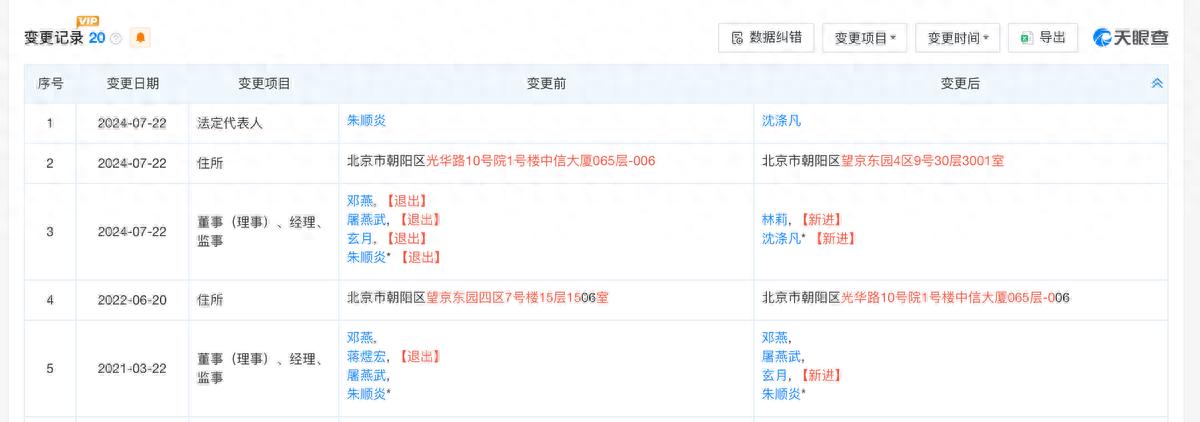
At the time when Alibaba Health changed its top leader, another important change also occurred: Alibaba Health was removed from the list of constituent stocks of the Hang Seng Tech 100 Index.
From the perspective of the public, this may mean that the "technology valuation" part of Alibaba Health has been further reduced. At the moment when Alibaba Group takes AI as its strategic priority, this is not the result that the group expects to see.
In terms of financial performance, in the last fiscal year, Alibaba Health's self-operated pharmaceutical revenue reached 29.665 billion yuan, accounting for 86.6% of the total revenue, with a year-on-year growth of 13.6%; the revenue from the pharmaceutical e-commerce platform business was 3.638 billion yuan, accounting for 10.6%, while the revenue from healthcare and digital services only accounted for 2.8%.
Judging from the current proportion of AI technology-related revenue of Alibaba Health, it is really difficult to continue to convince the market of its "AI technology" valuation story. Next, how to guide Alibaba Health back to the "main line of technology"? How to increase the AI technology content in Alibaba Health's revenue?
These are the issues that the veteran Yu Yong needs to consider.
The Veteran in Supply Chain Takes Over the AI Banner of Alibaba Health
Yu Yong is a long-serving veteran of Alibaba.
Yu Yong joined Alibaba in 2005, and has successively served in leading positions of various new B2B businesses of Alibaba, leading the strategic transformation of projects including "1688 Select" and "AI to B Supply Chain".
This Alibaba veteran, who has a background in logistics, made his name in B2B business and made outstanding achievements in supply chain sector, takes over the position from Shen Difan to reorganize the core business of Alibaba Health, and then create more value for the whole Alibaba Group's AI medical strategy.
But can changing the top leader completely solve the problem? Does Alibaba Health currently need to refocus on the supply chain?
To answer these questions, I think we can analyze them from three aspects.
The first point: Alibaba Health in the future cannot rely solely on drug sales to support its business.
AI healthcare is one of the key points of the group's strategy. Under the general trend that the whole Alibaba is shifting to AI, Alibaba Health in the future cannot only rely on drug sales to maintain its operation.
In the past, the low-tech attribute of the group's business was a reality, but now it is the AI era, and half of the focus of the whole Alibaba Group is on AI. Next, it is very important to see whether Alibaba Health has the ability to take on this responsibility.
After all, Alibaba Health is at the front line of the medical industry, and it is also one of the most important implementation positions for the group's AI strategy.
At present, all business lines under Alibaba are actively embracing AI implementation.
For example, the on-demand retail business regards the 2026 fiscal year as the AI strategy window period, and launched the "AI Operation Assistant" to further promote the AI strategy; in terms of Fliggy, it launched the new generation of travel AI product "Fliggy Helper" in August, which is built based on Alibaba's Qwen model; AutoNavi 2026, with spatial intelligence as the core, launched the navigation Live function, transforming AI from a "conversation tool" to a travel "action partner" for users...
Judging from the current pace of the whole Alibaba, AI is no longer the KPI of a single department, but the core strategy that the entire group is working together to implement.
Alibaba Health has also taken some actions in the AI direction. For example, it established the "full-stack pharmaceutical + medical AI" two-wheel drive strategy in the 2026 fiscal year financial report, and clearly extended its strategic focus to the construction of medical intelligent infrastructure.
Although the strategy has been established, there is no major change in resource allocation. Reflected in R&D investment, in the 2026 fiscal year, with Alibaba Health's total revenue reaching 34.2 billion yuan, R&D investment only accounts for 2.3%. This R&D intensity does not match the standard of a technology company, but that of a retail company.
How Yu Yong will promote the reform after taking over is worth looking forward to.
The second point: Whether the personnel change can solve the fundamental problem depends on whether the new leader's ability matches the development direction required by the group.
Although Shen Difan resigned from the positions of chairman and CEO, he did not leave the company. He continues to serve as an executive director and devotes more time to promoting the application of Alibaba Group's artificial intelligence business in the healthcare sector.
After Yu Yong takes over, how much influence will he have on the two businesses of Alibaba Health that are most closely related to technology assets?
This needs to be continuously observed.
In fact, after Yu Yong took over, the management structure of Alibaba Health has divided AI and commercialization into two separate lines: Yu Yong is responsible for the core of business decision-making but not in charge of AI related work, while Shen Difan continues to be responsible for Hydrogen, traceability code and the group's AI implementation, but has handed over the business decision-making power.

This kind of division of labor seems reasonable in management, but it may also bring new problems. For example, under the new personnel structure, can AI technology still successfully complete the business closed loop? Can the decision-making efficiency keep up with the speed of technological change and commercial implementation? All these issues need to be carefully considered.
What is Yu Yong best at?
Judging from his past resume, his strength is not algorithm development or technology research, but building the basic capabilities of performance fulfillment, merchant operation and supply chain. Although these are the most valuable businesses of Alibaba Health, these business capabilities have already passed the basic construction stage.
In other words, Yu Yong may be better at making the existing drug sales business more efficient. But from the perspective of Alibaba Health, in addition to the basic retail capabilities, it needs to devote more energy to the AI healthcare track in the future, and become a new core leader who can rally support in AI technology innovation and open up a new situation, so as to truly realize the unfinished work that Shen Difan did not complete in the past.
Just like Ant Group, which is adjacent to Alibaba Health.
Ant Group has always performed well in the implementation of AI strategy.
Why?
One important reason is that the core personnel structure of Chairman Jing XianDong and CEO Han Xinyi is very stable, and their abilities have always matched the development needs of the group.
Now, the number of users of Ant Aifu has reached 150 million, and the number of daily health consultations is nearly 20 million. This scale is absolutely overwhelming for any internet medical company.
The result is that Alibaba Group's construction of AI ToC medical entrance has been initially completed. More importantly, in this process, the core business of Ant Insurance has also achieved new growth. The health insurance business reached a premium scale of about 30 billion yuan last year, with a profit of 6 billion yuan. Both new and old businesses have made good achievements.
Then look at Alibaba Health.
Yu Yong is good at making the existing drug sales business more efficient, but what the group needs is a game-changer who can open up a new situation in the AI healthcare track. The gap between these two things is probably difficult to fill in the short term.
Next, whether Yu Yong can take over the AI banner and how he will do it? These questions need time to give the answer.
The third point: The commercial implementation of Hydrogen is not a simple technical problem, but a systematic implementation problem.
In the current medical industry, due to regulatory restrictions, core medical behaviors such as disease diagnosis, prescription issuing and professional treatment plan formulation can only be completed by medical personnel with professional practice qualifications, and AI cannot replace the work of prescription review.
In this case, no matter how powerful your product is, it can only be used as an auxiliary tool.
In other words, for medical institutions that are willing to pay real money for B-end products, this product is not just in demand at present.
An AI large model product that is not just in demand may be difficult to achieve large-scale commercialization. This may also be one of the reasons why the proportion of Alibaba Health's medical service and digital revenue is difficult to further increase in the short term.
From the perspective of the internet industry, what Alibaba Health needs today is not a CEO who can only optimize supply chain efficiency, nor a mature and independent AI product. What it needs is an industry environment that can make technology, scenarios and business operate smoothly in the same closed loop.
Objectively, on the way to AI transformation, Alibaba Health needs more time, but from the perspective of Alibaba Group, this time window is narrowing.
Alibaba Health Cannot Afford to Lose the Battle of AI Healthcare
Today's Alibaba Health needs a breakout battle in the AI era.
In Alibaba's AI strategy map, Alibaba Health connects pharmaceutical companies, hospitals, doctors and consumers, Ant Aifu connects C-end traffic and insurance payment networks, and Alibaba Cloud connects hospital IT infrastructure and MaaS platforms. So far, a complete AI healthcare service ecosystem has been built.
After understanding the group's AI medical strategy, the AI implementation of Alibaba Health actually has another layer of meaning:
For Alibaba Health, AI healthcare is far more than just an AI technology implementation scenario.
Alibaba Health needs to transform from a "drug selling company" to a "company that provides medical value with AI". This cannot be solved simply by changing a CEO, and what is required may be a systematic reconstruction covering strategy, organization and products.
You see, the on-demand retail business of Alibaba has been developed through fierce competition in the local life battlefield, Fliggy has been built from scratch in the OTA track, and AutoNavi has established technical and data barriers in the travel field for ten years. Therefore, in the process of integrating into Alibaba's AI strategy, they only need to multiply their existing core capabilities.
Alibaba Health is different. For a long time, Alibaba Health has been adopting a growth model that relies on the group to inject resources.
In the pharmaceutical industry, with the category entry of Tmall, the traffic provided by Alibaba and the resources given by the group, Alibaba Health is essentially a "resource integration" platform, rather than a real business incubation platform.
Even so, Alibaba Health has still developed the Hydrogen business and AI related business, which proves that its innovation capability is commendable.
But this objectively leads to a problem that the AI business is not strong enough from the very beginning.
At present, in terms of JD Health, the AI + medical device strategy can directly drive hardware sales and platform GMV growth. In terms of Meituan, it embeds high-frequency scenarios of instant retail to drive the repurchase of drugs and health products.
However, for Alibaba Health, the AI business sector that is not strong enough has reached the stage of competing for market position with peers.
At present, more and more AI medical pilot projects are becoming the track of "conventional configuration".
An important change in the industry is that in the future, the medical insurance payment policy will tilt towards AI-assisted diagnosis. Whoever can build AI capabilities in the diagnosis and treatment decision-making link will occupy the commanding height in the next round of competition. In this process, whether Alibaba Health can take over this task is quite critical.
At this moment, when results are most needed, Alibaba Health's AI-related business needs to open up the situation as soon as possible.
From its own point of view, Alibaba Health does need the second growth curve brought by AI commercialization.
On the one hand, the ceiling of pharmaceutical e-commerce has gradually appeared. AI healthcare is a key link for Alibaba's big health ecosystem to upgrade from "selling drugs" to "selling services"; on the other hand, from the perspective of valuation, Alibaba Health with higher AI content can also provide more pricing space for the capital market.
At present, the entire internet medical track is being re-priced by AI and the capital market.
For any player in the track, no matter how good your profit is, as long as your core story is still "selling drugs", the valuation logic cannot jump out of the framework of the retail industry.
For Alibaba Health, it is already at the stage of completely changing its development anchor.
Being removed from the technology index is just a signal from the capital market. When the whole Alibaba is shifting to AI, can Alibaba Health replace its anchor with a real "technology anchor"?
This may be the problem that Alibaba Health needs to answer after entering the Yu Yong era.
After all, what Shen Difan handed over to Yu Yong is an Alibaba Health that has not completed its AI transformation.
From another perspective, for Alibaba Health, changing the top leader is also a good thing. A new management style, breaking the old to establish the new, taking this opportunity to readjust Alibaba Health is itself a good starting point.
We expect that Alibaba Health in the Yu Yong era can take advantage of the AI trend as soon as possible and set a good example for the whole industry.
Disclaimer: All the information cited in this article comes from the statutory disclosure documents of the company and public materials. The author does not make any guarantee for its completeness and timeliness. Stock market investment is risky, please be cautious. The content of this article is only a comment, and does not constitute any investment advice. If you decide to participate in the investment, please make your own judgment and bear the risk independently.