From the era of technical showboating to the era where delivery is king, four leading players stand abreast in the AI office sector.
In just over a year, the AI office track has gone through a raucous round of industry scrimmages. Dozens of manufacturers rushed into the market, products were released intensively, and the demonstration effects were more stunning than the last. However, after the fanfare faded, most products still remain at the stage of dialogue Q&A and content generation, can only deliver suggestions and drafts, and are very difficult to produce a complete set of directly deliverable work results.
As the tide recedes, the market is clearing out rapidly. Recently, Omdia, the global authoritative analysis institution, released the report *Global Enterprise-Grade Agentic Worker – China Market 2026*, which systematically sorted out China's enterprise-grade office agent market and more than 30 manufacturers, and finally emphatically highlighted four representative products: Alibaba Qwen, Baidu DuMate, Tencent WorkBuddy, and SenseTime Raccoon. The industry landscape has officially moved from a hundred flowers blooming era to a new era where four strong players stand side by side in the AI office sector.
In the second half of the AI office competition, the contest is no longer focused on model dialogue capabilities, and the core has shifted to long-chain task reliability, native desktop execution, enterprise-level delivery governance, and the ability to output reusable and implementable work results. None of these four points can be achieved by model capabilities alone, all of them require long-term engineering accumulation and real delivery practices. The shift from scrimmages to the coexistence of four strong players is not just a ranking change, but an overall rise in the competitive threshold.
The scrimmages are gradually drawing to an end, the AI office sector has entered the era of "delivery first"
This round of scrimmages in the AI office sector has clear time markers. Omdia defines 2025 as the year of capability verification: open-source reasoning models have greatly lowered the access threshold for high-level reasoning, and general agent products have also proved that it is feasible to generate complete deliverables with only one instruction through task decomposition, browser automation and cross-application execution. The demand side is also booming, and enterprise knowledge workers generally expect a unified AI entry to directly complete those open office tasks that are not covered by traditional software.
However, there is a gap between supply and demand. By 2026, the leading model's score on OSWorld-Verified has reached about 85%, while the human baseline is about 72%, so operating computers and completing daily office tasks across applications is no longer a bottleneck. But once switched to the new generation of long-horizon evaluation, the situation changes immediately: OSWorld 2.0 upgrades the test to 108 long-horizon professional workflows, raises the upper limit of interactions to 500 steps, and adopts a strict binary completion judgment. The best-performing model only has a full completion rate of 20.6%, and the partial completion score is only 54.8%.
Being able to demonstrate a function does not mean being able to complete the whole task, and running smoothly in the demonstration environment does not mean stable reproduction in the production environment. From 2025 to the first half of 2026, the end-to-end completion rate of complex long-process tasks is generally low, many AI assistants can only complete fragmented Q&A, and cannot go through the complete link from data collection, analysis and reasoning to producing available results.
After more than a year of iteration, basic model capabilities are no longer scarce, and reliability is the core constraint. The measurement standards of enterprise customers have undergone fundamental changes: they no longer only focus on whether the answer is correct, but pay more attention to whether the task can be completed correctly, and whether the results are manageable and traceable.
Once the measurement standards change, industry reshuffling becomes inevitable. A large number of small and medium-sized players have gradually withdrawn due to limited delivery capabilities, industry resources are concentrated in the four players, and the "four strong" pattern has gradually taken shape. However, the overall market of the track has not shrunk accordingly, but has been redefined: calculated by the caliber of software subscription, enterprise AI procurement and business process transformation, China's market has a hundred-billion-level commercial space; if the time cost of knowledge work, professional services and outsourcing, as well as the new supply created by AI are included, the long-term space will be even larger.
With the coexistence of four strong players, Omdia reviews the differentiated competition of the four participants
There is no absolute hierarchy between the four players commented by Omdia, this is a competition of four different genes: collaboration base, search content assets, social organization ecology, and capabilities of desktop execution plus industrial data analysis, jointly support the coexistence pattern of the four strong players.
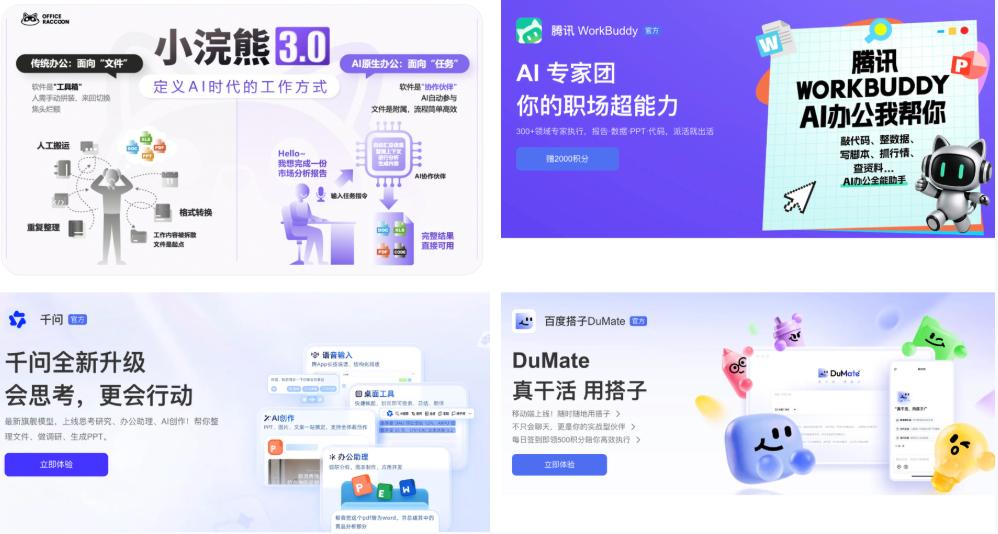
Alibaba Qwen Work relies on the DingTalk collaboration base and Alibaba Cloud system. Omdia integrates its capabilities to combine collaboration, execution and delivery into an integrated office agent system, whose core advantage lies in deep embedding into enterprise organizational processes. Group chats, schedules, approvals, to-dos, and knowledge bases are all within the task scope of the Agent, documents and spreadsheets can be created directly, and messages and emails can be sent on behalf of users.
In addition to generation capabilities, it has built the web application generation into a complete delivery chain, from page generation all the way to domain name, database and online release, instead of stopping at HTML code like the average level in the market.
Baidu DuMate is backed by search and content assets, Omdia positions it as an agent product anchored by search and content assets. Its strengths lie in information research and data retrieval, with outstanding capabilities in ontology modeling and plug-in free Office file reading and writing. It precipitates industry suite templates for information-intensive positions such as finance, self-media, law, and education, and then embeds them back into the existing IM, knowledge base and portal of enterprises through APIs.
Baidu DuMate is an office agent closer to AI native, which is positioned as a "general Agent + data base" from the very beginning. Baidu DuMate's product strategy has four pillars: mastering delivery standards, internalizing ecological assets, developing in depth by position, and sovereign delivery and governance. The last one is particularly critical, which uses finer security granularity and deployment freedom to obtain access to regulated industries.
Tencent WorkBuddy is based on the WeCom and Tencent Document ecosystem, Omdia's evaluation of it is that its leading advantage belongs to the production system level, rather than a single-point content advantage. This set of capabilities can be broken down into three modules: the production-level execution system transforms the probabilistic model into a planable, traceable, recoverable and verifiable task flow, covering the complete link of clarification, planning, execution, review and acceptance; the expert capability supply system encapsulates models, tools and methods into experts and skills, allowing ordinary employees to obtain role-level capabilities without understanding the underlying technology; the enterprise management and delivery system uniformly manages members, departments, roles, models, knowledge and credentials.
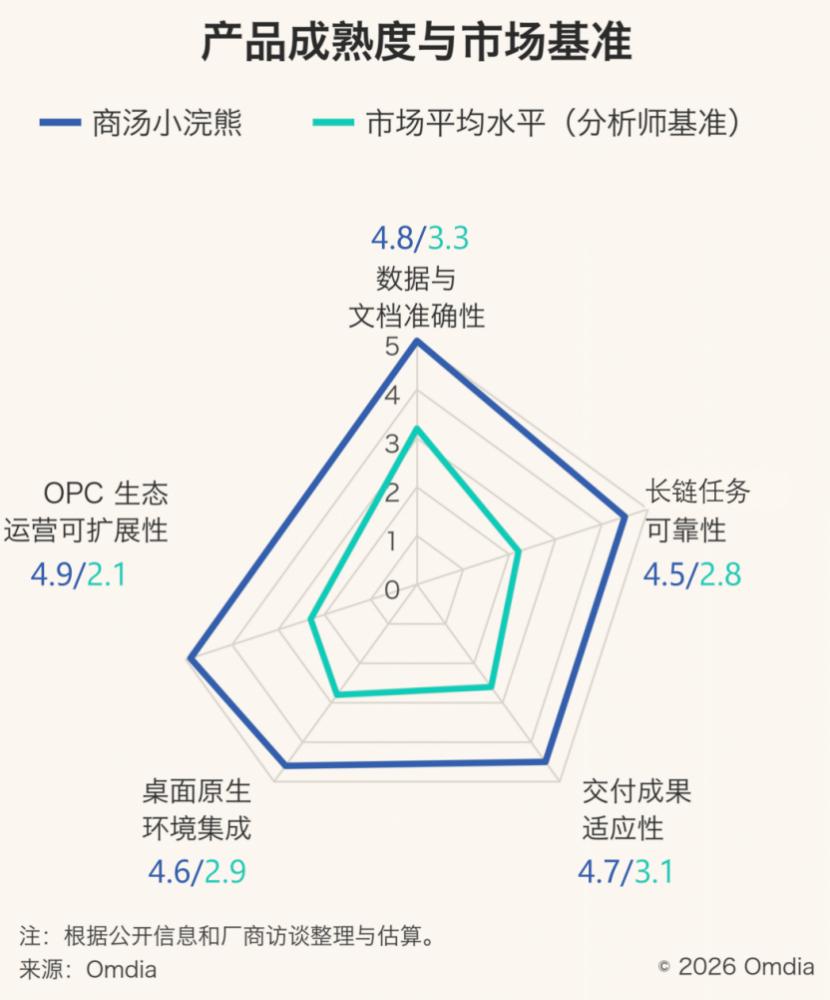
Compared with the three Internet giants that hold IM, collaboration suites and traffic entrances, SenseTime Raccoon can be among the "four strong" by relying on the combination of native data analysis background, desktop execution, industrial-level delivery and OPC ecology. Omdia's scores on five dimensions are all higher than the market average, and it is the only sample in the report that scores above average in all five items. It is worth studying how this combination is formed.
SenseTime Raccoon was not developed in a hurry after Agent became a market hotspot. Office Raccoon was launched in early 2024. At that time, the Raccoon team repeatedly asked: when the large model enters the productivity field, should it help people generate more content, or help people complete more work. The answer was the latter from the very beginning.
Therefore, SenseTime Raccoon established very early that data cleaning, multi-table calculation, anomaly detection, visualization and report delivery should be taken as its core capabilities. This set of links has been tested in enterprise scenarios, with data analysis accuracy exceeding 95%, and the accuracy of professional tasks such as time series calculation, data matching and anomaly detection can reach 100%. In the current AI office war, the path of SenseTime Raccoon is also very clear, it avoids the competition for entry, instead cuts into the workflow with desktop execution, opens up the last mile with industrial-level delivery, and then precipitates one-time projects into replicable Skills and industry versions through the OPC ecology.
Omdia's scores corroborate this path. It gets 4.9 points for OPC ecological operation scalability, while the market average is only 2.1 points; 4.8 points for data and document accuracy, while the market average is 3.3 points; 4.7 points for delivery result adaptability, while the market average is 3.1 points; 4.6 points for native desktop environment integration, while the market average is 2.9 points; 4.5 points for long-chain task reliability, while the market average is 2.8 points.
Of course, what really secures Raccoon's position is the internal strength of SenseTime. The three-layer flywheel of "C-B-Industry" has been put into operation, and more than ten years of SenseTime's ToB industrial delivery capabilities have been migrated. The combination of these capabilities enables Raccoon to translate customers' vague business problems into clear tasks, workflows and measurable results in the process of pre-sales, delivery, after-sales and FDE, and precipitate one-time delivery into standardized Skills and industry versions.
After the general capabilities are verified by users, SenseTime Raccoon has further launched three vertical industry versions for the finance, government data and education sectors. As of August 2026, SenseTime Raccoon has served more than 20 million accumulated users, with more than 3 million weekly active users, and more than 8000 enterprises are using it.
When the "four strong" are placed together, the situation becomes really clear: they are not competing to fill the same blueprint more completely, but each occupies a part of the complete workflow. Qwen cuts in from group chats and approvals, and transforms collaborative relationships into execution permissions that Agent can call; DuMate cuts in from search and content assets, and transforms data retrieval into directly deliverable industry suites; WorkBuddy cuts in from organization and permissions, and transforms the probabilistic model output into planable and verifiable task flows; SenseTime Raccoon cuts in from files and spreadsheets, and turns the most trivial and fragmented work on the desktop into precipitable and reusable skills.
The "four strong" era has begun, the AI office track table is fully occupied
In the view of Deep Dive Atom, the judgment of the mid-term pattern of AI office is not complicated: "The four strong" era has begun and will not end soon. There are three points supporting this judgment.
First, the four players do not sell the same service. The advantages of the four strong are connected end to end, which exactly forms a complete workflow from alignment, material collection, circulation to implementation. Each of them can extend their business to adjacent links, but no one can take over the whole chain, because that means they have to recreate the organizational relationships, data assets and customer habits accumulated by other players over years.
The second point is related to the procurement psychology of enterprises. Core processes will not be handed over to a single supplier, and the coexistence of multiple suppliers is a rational choice to lock in risks, so the four players will coexist for a long time instead of the market converging rapidly. Of course, coexistence does not mean equal balance, the four players have different positions and can leverage different industries.
The third point is that this round of leading position is self-reinforcing, and the competition dimension has also changed. The competition is no longer simply about traffic investment, but a comprehensive contest of real workflow implementation quality, delivery reliability, cost control and ecological standardization. Giants have the advantage of traffic entrances, but traffic can only make them seen, product quality determines whether users are willing to stay, and delivery capabilities determine whether enterprises dare to hand over their core work to AI.
Omdia's judgment on this point is very straightforward, the moat is the production feedback closed loop, desktop traffic has lost its explanatory power, and the manufacturers that hold more real production work are the ones that can truly form compound interest. The more real processes the four strong hold, the denser the returned data and scenarios, the richer the Skills and industry templates, the higher the replacement cost; on the contrary, even if new players obtain models of the same level, they do not have real workflows for data return, nor can they make up for the hard procurement thresholds such as auditability, privatization deployment and domestic adaptation in a short time. The industry has changed from a stage where everyone can enter to a stage where the track table is almost fully occupied.
The pattern is clear, and the track itself is still evolving. Three major trends in the current AI office sector are taking place at the same time and interlocking with each other. The first is paradigm shift: AI office has transformed from a dialogue Q&A assistant to a delivery-oriented Agent, and the unit of competition has changed from answer quality to task completion rate; the second is procurement change: the procurement object has shifted from software seats to manageable digital capabilities, the business model has expanded from seat subscription to task packages, Skill workflows and result-based delivery, and features such as manageability, auditability, privatization and domestic adaptation have changed from bonus points to access thresholds; the last is value upgrading: AI office not only improves personal efficiency, but also precipitates personal experience into organizationally reusable assets, an entrepreneur can use AI to complete product design, research and operation that used to require a whole team to achieve, realizing "one person owns team-level productivity".
These three trends converge to point to the same thing: the coordinate system for ranking has been completely replaced. In the past, people focused on traffic, seats and parameters, but now people focus on task completion rate, delivery reliability and process embedding depth, none of which can be achieved overnight at a press conference. Therefore, after the scrimmages end and the "four strong" appear, only the peripheral players of the track are eliminated, the ranking among the four players is far from settled: currently the competition is still about capability combination and ecological niche, what really determines the final ranking is the depth of capabilities embedded in the production process, the deeper the embedding, the higher the replacement cost, the faster the feedback flywheel rotates, the player who first pushes the flywheel into more real workflows will be the first to stand out from the coexistence pattern.
After the audience leaves, what remains are the four players and a new standard. The first half of the competition is about who is better at demonstration, and the second half is about who dares to take on more practical tasks: what is examined is no longer whether a demonstration video can run smoothly, but whether the same task can produce the same verifiable results after being repeated a hundred times by different departments, different months and different people. This is exactly the meaning of shifting from technical showmanship to delivery first. The only thing that can be confirmed is that the future leader will emerge from these four players, and no new seats will be added in the short term.