Insights into the Divorce Landscape of Actual Controllers of Listed Companies from the Equity Split of Dianhun Networks
On the evening of September 16, Dianhun Network released a suggestive announcement on changes in the equity of the actual controller and the signing of the *Concert Party Agreement*. The couple Hu Jianping and Chen Fang, the actual controllers of the company, have officially completed divorce procedures and finished the property division of the shares of the listed company. This division involves shares with a market value of about 95 million yuan. As the two parties signed a 36-month concert party agreement at the same time, the control right of the company has not changed.
The announcement of the actual controller of Dianhun Network splitting property after divorce is not an isolated case. Recently, cases of equity division involving marital changes of actual controllers or important shareholders of A-share listed companies have been frequently reported by the media.
Yinxing Finance has sorted out and found that most of the property divisions caused by these marital changes are similar to the peaceful breakup of Dianhun Network, and there are also many cases of fierce disputes and court proceedings. The market's attention to the divorce of the actual controller of a listed company never stays at the marriage itself, but extends to equity stability, subsequent share reduction expectations and potential impacts on the company's operation.
Concert Party Arrangement Stabilizes Control Right
The announcement shows that for the property division after the dissolution of the marriage relationship, Hu Jianping, the actual controller of Dianhun Network, split 7.2829 million shares of the company he held (accounting for 3.00% of the total share capital) to his ex-wife Chen Fang through non-trading transfer. After the share transfer is completed, the total number and proportion of shares held by the two parties remain unchanged. By signing the concert party agreement to maintain the joint control status, the actual controller of the company has not changed.
According to the equity details disclosed in the announcement, before this share division, Hu Jianping directly held 14.0405 million shares of Dianhun Network, accounting for 5.78% of the total share capital of the company; Chen Fang directly held 26.1785 million shares, accounting for 10.78% of the total share capital. The two jointly held 40.219 million shares, accounting for 16.56% of the total share capital, and are the joint actual controllers of the company.
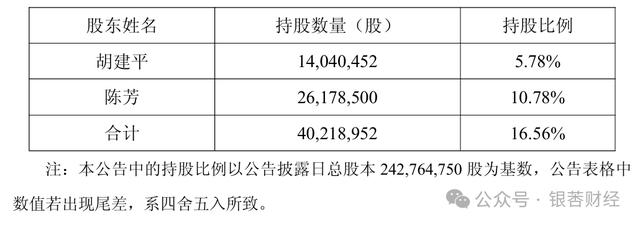
In accordance with the divorce agreement, Hu Jianping transferred 7.2829 million shares to Chen Fang, accounting for 3% of the total share capital. Calculated based on the closing price of 13.07 yuan per share on the day of the announcement, the market value of this part of the shares is about 95.1881 million yuan. After the division is completed, Hu Jianping's shareholding drops to 6.7575 million shares, with a shareholding ratio of 2.78%, corresponding to a market value of about 88.32 million yuan; Chen Fang's shareholding rises to 33.4614 million shares, with a shareholding ratio of 13.78%, corresponding to a market value of about 437 million yuan.
From the perspective of shareholding nature, all the shares divided this time are unrestricted tradable shares, but both parties promised in the announcement that they will continue to strictly abide by the laws, regulations, normative documents related to the reduction of holdings by shareholders of listed companies and various previous share lock-up and share reduction commitments, and implement share management in accordance with laws and regulations. This also means that the divided shares will not immediately enter the circulation and reduction stage, and are still restricted by previous commitments and share reduction rules.
In response to the control right issue that the market is most concerned about, the announcement clearly gives the answer: Hu Jianping and Chen Fang have signed a 36-month *Concert Party Agreement* while going through the divorce procedures. The agreement stipulates that when exercising the rights of shareholders and directors of the company, the two parties shall maintain consistent expressions of will, and jointly exercise shareholder rights such as proposal right, voting right and director nomination right.
In terms of positions, Hu Jianping will continue to serve as the chairman of the 5th board of directors of the company, and Chen Fang will continue to serve as a director of the 5th board of directors and general manager of the company. The core operation and management team remains stable.
Among the divorce cases of actual controllers in the A-share market, signing a concert party agreement is the most common means to stabilize control right, which is especially suitable for situations where both parties participate in the company's operation and start a business together. As a typical husband-and-wife founded company, Dianhun Network has been jointly operated by Hu Jianping and Chen Fang since the establishment of the company. Maintaining a cooperative relationship in career after divorce is in line with the general market expectation.
As a veteran domestic client game manufacturer, Dianhun Network focuses on the *Meng San Guo* series of competitive games, and also lays out the mobile game and casual game tracks. In recent years, affected by the fading of traffic dividends in the game industry and the shift of user preferences, the company's performance has declined sharply. In 2025, the company achieved operating revenue of 385 million yuan, a year-on-year decrease of 30.08%; the net profit attributable to shareholders was -214 million yuan, a year-on-year decrease of 800.23%. Entering 2026, the performance continued to decline. In the first half of the year, the operating revenue reached 183 million yuan, a year-on-year decrease of 5.67%; the net profit attributable to shareholders was -59 million yuan, a year-on-year decrease of 529.4%.
It is worth noting that while the company is suffering losses, its stock price has continued to decline, and has further fallen on the basis of the low level this year. As of the close on September 16, the stock price has dropped by about 34.63% cumulatively compared with the highest point of 21 yuan per share at the beginning of the year.
On the whole, the divorce of the actual controller of Dianhun Network this time is a typical model of "peaceful breakup, internal equity adjustment, and stable control right". The share division is only a redistribution of marital property between the couple, does not involve transfer by third parties, and is not accompanied by changes in business strategy and management team, so it has no substantial impact on the daily operation of the company.
Listed Companies' Actual Controllers Announced Marital Change Events Intensively
The equity division brought by the marital change of the actual controller of Dianhun Network is not uncommon.
In recent years, with the increase in the number of listed companies and the securitization of family wealth of private entrepreneurs, the number of divorce cases of actual controllers and core executives has increased significantly. From the perspective of property division modes, there are both conventional operations of peaceful negotiation and signing concert party agreements, as well as special situations that lead to changes of actual controllers and trigger judicial litigation.
Similar to Dianhun Network, peacefully negotiating equity division and simultaneously signing a concert party agreement to maintain control right is the most mainstream mode for actual controllers of A-share listed companies to divorce, which is especially common in cases where the couple started a business together and both parties are deeply involved in the company's operation. The core features of such cases are: the marriage relationship is dissolved, but the career cooperation relationship continues, the equity is only transferred within the couple, no external shareholders are introduced, and the company's control right and operation team remain stable.
Typical cases of the same type also include Weiston (301315.SZ) and Time Creation Energy (688429.SH). In April 2025, Weiston issued an announcement that the actual controller of the company Mao Yuzhong and his foreign spouse XU XIANGFENG went through divorce procedures, and Mao Yuzhong split 20 million shares of the company he directly held (accounting for 22.73% of the total share capital) to the other party. After the division was completed, the two parties signed a concert party agreement at the same time. Mao Yuzhong was still the actual controller of the company, and the core management team remained unchanged. Calculated based on the stock price at that time, the market value of the divided shares reached 928 million yuan.
In December 2025, Time Creation Energy also announced that its actual controllers Fu Liming and Wang Yanxiao dissolved their marriage relationship, and divided the property of the company's equity held indirectly. Fu Liming split the property share corresponding to 8.54% of the total share capital of the company indirectly held through the shareholding platform to his ex-wife. This division was also completed through internal adjustment of the shareholding platform, and did not involve direct transfer of shares of the listed company. After the division, Fu Liming still controlled about 70.04% of the voting rights of the company in total, and neither the controlling shareholder nor the actual controller changed.
Since the beginning of this year, the marital changes of the actual controllers of Maxscend (300782.SZ), Qiangyi Co., Ltd. (688809.SH) and Langzi Co., Ltd. (002612.SZ) all belong to this mode.
Of course, there are many cases where the marital change and property division lead to changes in the equity structure of listed companies, such cases are often superimposed on the background of personal risk events of actual controllers, position changes and other situations, and have a deeper impact on the company.
For example, Anzheng Fashion (603839.SH) announced on July 1, 2026 that the divorce property division matter between Chen Kechuan, the former second largest shareholder and co-founder of the company, and his spouse Zheng Xiuping has been officially implemented. According to the divorce agreement signed by the two parties, Chen Kechuan transferred all the Anzheng Fashion shares he held, that is, 41.4063 million unrestricted tradable shares (accounting for 10.70% of the total share capital of the company) to Zheng Xiuping through non-trading transfer. Calculated based on the closing price of 5.95 yuan per share on the day the transfer was completed (July 1), the market value of this part of the equity is about 246 million yuan. After the transfer is completed, Chen Kechuan no longer holds any shares of Anzheng Fashion and completely withdraws from the list of shareholders; Zheng Xiuping has newly become an important shareholder holding 10.70% of the company's shares, and the total shareholding scale of the two parties remains unchanged before and after the change.
In a more extreme case, in March 2025, Jinyuan Co., Ltd. (000546.SZ) issued an announcement that Zhao Hui, one of the actual controllers of the company, and Pan Ying went through divorce procedures. Zhao Hui split all 66.1376 million shares of Jinyuan Co., Ltd. (accounting for 8.505% of the total share capital) he directly held to Pan Ying, and at the same time transferred 7.67% of the equity of Jinyuan Holding he held. The market value of the shares obtained by Pan Ying is about 415 million yuan. Due to the transfer of all shareholdings, Zhao Hui's equity in the company is cleared, which is described by the market as "leaving the house with nothing".
It is worth noting that Zhao Hui had previously resigned from the positions of chairman and general manager of the company for personal reasons, and was later filed for investigation by the China Securities Regulatory Commission on suspicion of illegal information disclosure, and was taken a bail pending trial compulsory measure by Jinhua Public Security Bureau. Under the background of personal risk exposure, the divorce equity division completed the replacement of shareholding subjects and the adjustment of actual control right at the same time. The market believes that this move may be intended to avoid regulatory risks, and weaken his identity as "actual controller" by splitting equity, so as to try to reduce potential joint and several liabilities.
What has a greater impact on listed companies is the marital change superimposed with litigation. Different from the clear arrangement of divorce by agreement, the equity division under the litigation divorce mode often has a longer cycle and greater uncertainty, which easily arouses the market's concern about the turmoil of equity structure. Such cases mostly occur in situations where the couple have major disputes over property division and fail to reach a consensus agreement, and the court finally decides the equity division plan.
In January 2025, Zhihang Co., Ltd. (688070.SH) disclosed an announcement that the first instance judgment of the divorce case of Ren Bin, the actual controller of the company, was released. The People's Court of Tianfu New Area, Sichuan Province ruled that the two parties were allowed to divorce. Among the 20.502 million shares of the company directly held by Ren Bin (accounting for 23.41% of the total share capital), 12.3012 million shares (accounting for 60% of his direct shareholding, corresponding to 14% of the total share capital) were awarded to Kuang Mingfang; 23% of the property share Ren Bin held in Hainan Yongxin Dapeng Enterprise Management Center (Limited Partnership, the company's shareholding platform) still belongs to Ren Bin. Calculated based on the stock price at that time, the market value of the divided shares is about 430 million yuan, and Kuang Mingfang will become the second largest shareholder of the company. Ren Bin refused to accept the first instance judgment and then appealed to the Chengdu Intermediate People's Court.
In July 2025, the Chengdu Intermediate People's Court made a final judgment, changing the equity division ratio: the number of divided shares was reduced from 12.3012 million shares in the first instance to 9.996 million shares, corresponding to 11.41% of the total share capital of the company, and the proportion of Ren Bin's direct shareholding was reduced from 60% to about 49%. Although the number of divided shares decreased, due to the cumulative increase of about 52% in the stock price of Zhihang Co., Ltd. during the appeal period, the market value of the shares obtained by Kuang Mingfang instead increased from about 430 million yuan in the first instance to 537 million yuan in the final instance.
It is worth mentioning that in August 2026, Joe Tsai, chairman of the board of directors of Alibaba, and his wife Clara Wu Tsai announced the end of their nearly 30-year marriage, but this divorce involving tens of billions of assets did not have any equity division or share reduction arrangements.
According to the public statement, the two parties do not plan to sell Alibaba shares. Joe Tsai will continue to serve as the chairman of the board of directors of Alibaba, and the two parties will continue to jointly hold and operate sports assets such as the Brooklyn Nets, New York Liberty and BSE Global. According to Alibaba's 2026 fiscal year annual report, Joe Tsai beneficially owns about 272 million ordinary shares of Alibaba, accounting for about 1.5% of the issued shares.
From the perspective of equity structure, the Alibaba-related equity of Joe Tsai and his wife is scattered in multiple offshore holding entities and family trusts, not directly held by natural persons. Changes in marriage will not directly lead to the transfer and change of the shares of the listed company.
There Is No Fixed Rule for "Divorce Means Cashing Out"
In fact, the market's biggest concern about the divorce of actual controllers often focuses on "cashing out by reducing holdings after divorce". However, Yinxing Finance has sorted out more than ten divorce events of actual controllers of A-share listed companies in recent years and found that there is no fixed rule that "divorce is inevitably accompanied by share reduction", and subsequent equity changes have a case-by-case tendency.
From the existing tracking data, in most of the cases of divorce by agreement and signing concert party agreements, large-scale share reduction did not occur within 6-12 months after divorce. Most of the divided shares are in the commitment lock-up period or restricted by share reduction rules, only a small amount of small-scale share reduction for personal capital needs occurred, and no liquidation-style exit appeared.
But there are also individual exceptions. Jiang Ming, one of the actual controllers of Daimay Co., Ltd. (603730.SH), in accordance with the property division agreement in the divorce agreement, transferred 32.2287 million shares (accounting for 1.5% of the total share capital) to the CCB Trust Family Trust with Ju Wenjing as the first beneficiary through block trading from July 3 to 7, 2025. The transfer price range was 5.09 yuan per share to 5.15 yuan per share, and the cash out was about 165 million yuan. Jiang Ming originally planned to complete the transfer within two years after the signing of the divorce agreement, but the actual implementation only took 5 days.
Yang Yaohua, the second largest shareholder and former vice chairman of Space-Time Technology (605178.SH), and his spouse Zhou Lei dissolved their marriage through agreement. Yang Yaohua split 4.8% of the