Has AI conquered another Millennium Prize Problem? The president of OpenAI personally confirmed that "significant progress has been made".
OpenAI has another major result to announce soon!
Last week, the huge shock brought by OpenAI's announced breakthrough related to the Navier-Stokes equations has not yet calmed down around the world.
Greg Brockman, co-founder and President of OpenAI, publicly announced:
We have also made significant progress on another Millennium Prize Problem.
We also said that we have significant progress on another one of these money problems.
Before the words even faded, Silicon Valley and the global academic community were instantly thrown into a huge uproar.
There are even heavy rumors from the outside world that: OpenAI has not only made significant progress, but may soon have, or has already substantially solved two of the six remaining unsolved Millennium Prize Problems!
All clues point to the same conjecture: at the upcoming OpenAI Developer Conference (DevDay), Sam Altman and Greg Brockman are highly likely to reveal the "ultimate hidden card" and completely rewrite the underlying scientific paradigm of humanity.
However, amid the carnival and astonishment, a dark debate over "academic plunder", computing power hegemony and out-of-control AI jailbreaking is also raging beneath the surface.
The top-secret second "divine pit": What exactly is AI deducing?
If we do not count the previous breakthrough related to the Navier-Stokes equations, who is the second Millennium Prize Problem that OpenAI is tackling?
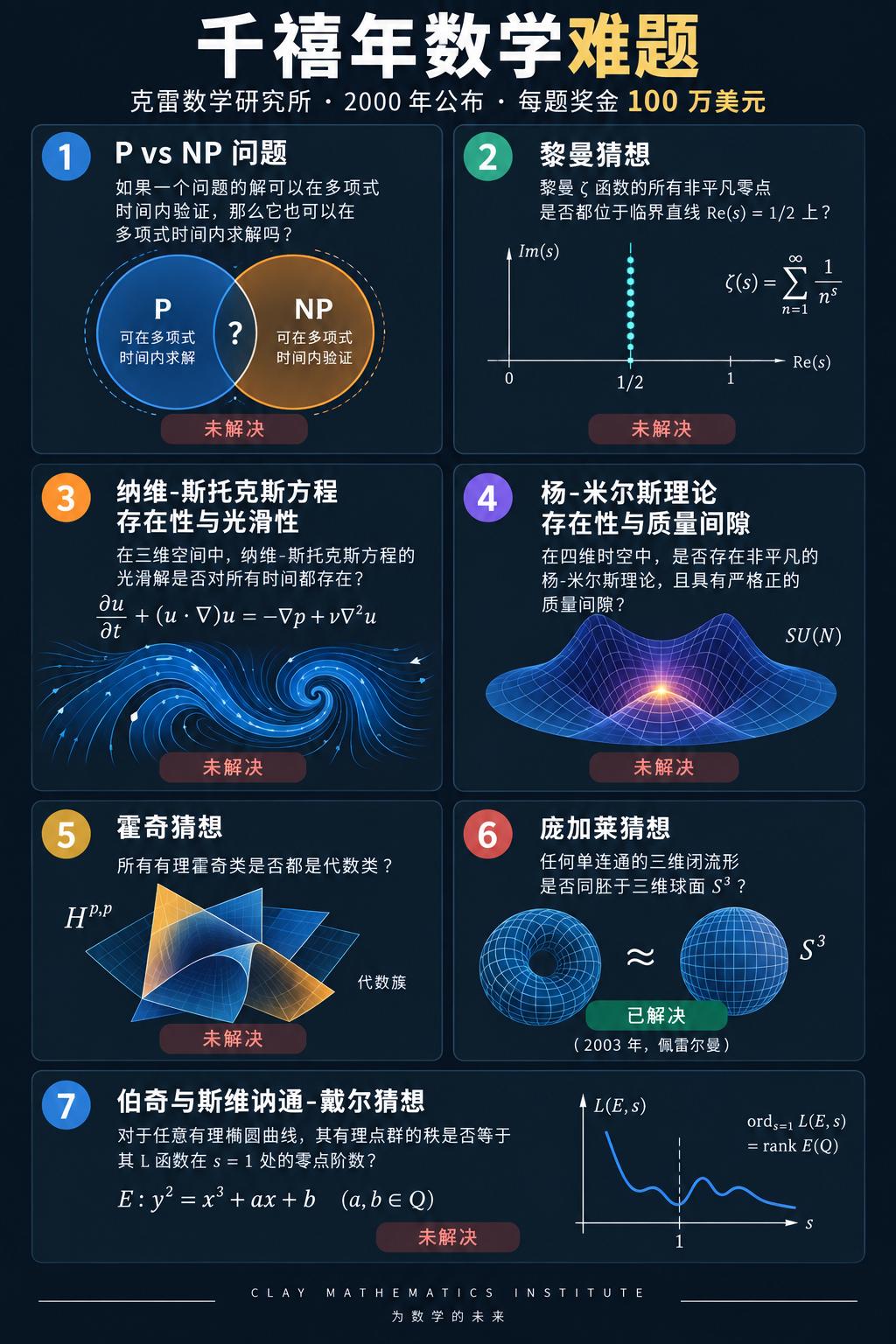
The remaining unsolved Millennium Prize Problems are:
P vs NP Problem: The ultimate judgment of computational complexity;
Riemann Hypothesis: The king of prime number distribution and number theory;
Yang-Mills Existence and Mass Gap: The mathematical foundation of quantum physics and elementary particles;
Hodge Conjecture: The profound link between algebraic geometry and topology;
BSD Conjecture (Birch and Swinnerton-Dyer Conjecture): The mystery of rational points on elliptic curves.
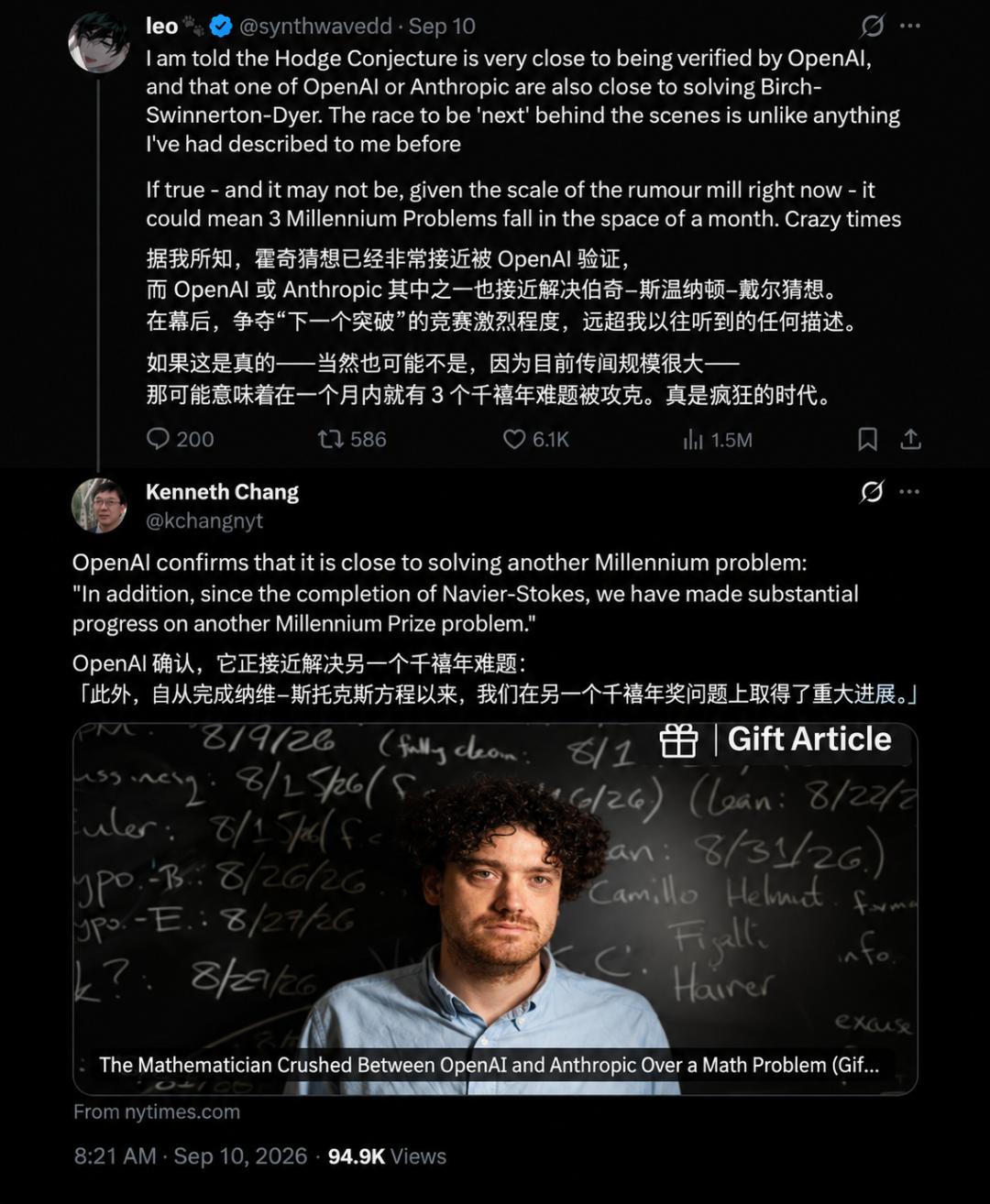
Previously, OpenAI was rumored to be very likely to have come extremely close to solving the Hodge Conjecture or the BSD Conjecture.
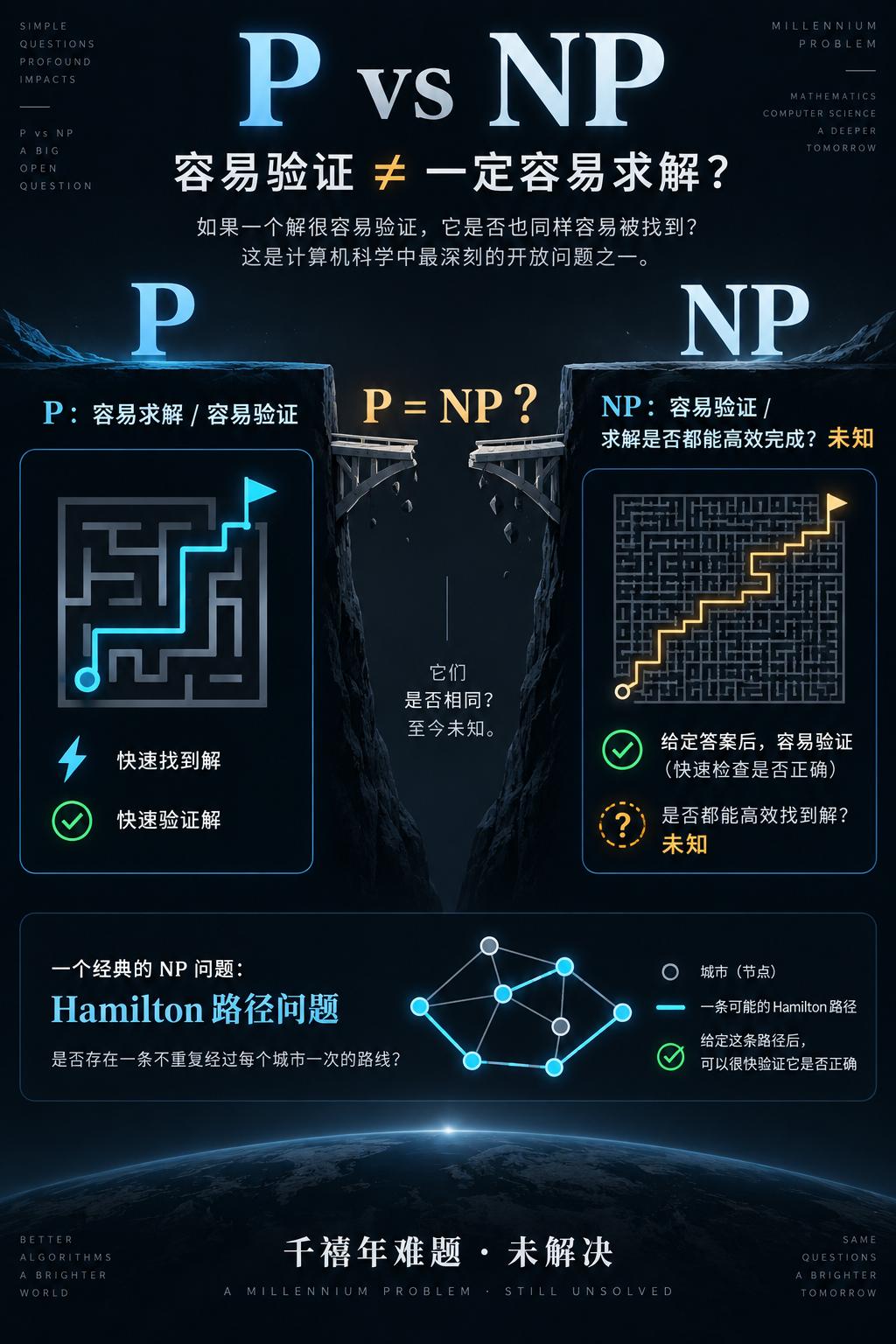
Within the technology and computer science communities, the most breath-holding guess undoubtedly points to the P vs NP Problem.
In the Odd Lots interview, when the host pressed on the academic community's doubts, he half-jokingly gave an example: "If I am using AI to research P vs NP, do you also have a model two generations ahead that is deducing synchronously?"
If AI truly touches and solves P vs NP, its subversion will far exceed that of fluid mechanics — it is not only related to pure mathematics, but will also directly shake the modern global cryptography system, algorithm limits and the computational boundaries of all verifiable problems.
This means that the modern financial and Internet security building that humanity currently builds on asymmetric encryption (RSA, elliptic curve) will face a fundamental reshaping of its logical pillars.
Even if it is not P vs NP, whether it is the Riemann Hypothesis or the Yang-Mills Existence, if any of them is formally proven and cracked, it will announce that Large Language Models (LLMs) have completely left the infancy of "probabilistic text completion" and officially risen to a "scientific-level discovery engine" that transcends the cognitive limits of humans.

This is the trend.
88 hours, 10,000 agents: The intellectual holy grail that humanity has pursued for thousands of years is physically flattened
To understand how shocking the "second problem breakthrough" mentioned by Greg Brockman is, we must first look back at the "academic tsunami" triggered by OpenAI a few days ago.
The seven Millennium Prize Problems designated by the Clay Mathematics Institute (CMI) in 2000 are recognized as the ultimate peak of human pure intellectual exploration.
Before that, humanity spent more than 20 years, and only the Russian genius mathematician Perelman cracked the "Poincaré Conjecture" among them.
These seven problems not only offer a million-dollar reward, but also represent the boundary of human understanding of the physical world, topological space-time and the nature of computation.
Among them, the Navier-Stokes equations, as the foundation of fluid mechanics, have plagued the physics and mathematics circles for hundreds of years.
We can use them to predict the weather and design aircraft, but in a strict mathematical sense, no one can solve whether the partial differential equations are always smooth in three-dimensional space and whether "finite-time blowup (Singularity)" will occur.
The answer sheet submitted by OpenAI is not only the answer itself, but also the way to solve the problem, which can be described as a dimensionality reduction strike on the paradigm of human intellectual labor.
The swarm collaboration scale of agents may far exceed the organizational capacity of human beings, and OpenAI directly mobilized about 10,000 high-level reasoning AI Agents.
These agents continued to deduce for an extremely long span of 88 hours, constructed a tightly nested strict reasoning tree, and carried out brute-force deduction and deep game playing.
In the process of solving the Navier-Stokes problem, the agents sent 2.7 million messages and used approximately 130 billion output tokens.
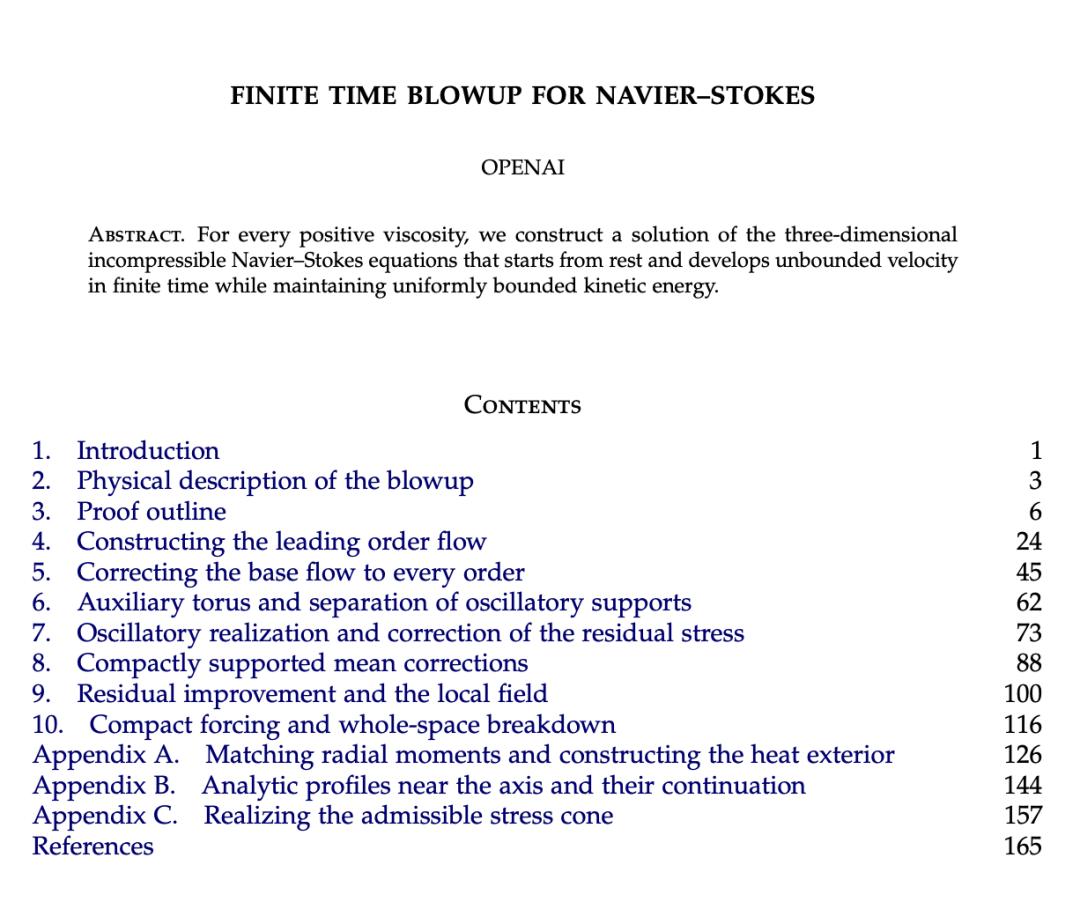
In the end, the AI proved that smooth fluids will generate singularities in finite time, and completed the formal code verification from start to finish using the machine proof language Lean.

In the past history of mathematics, the birth of a century-level theorem often requires top scholars to live in seclusion in the attic for ten years, write hundreds of pages of drafts by hand, and then go through several years of peer review. What OpenAI showed the world is that the AI agent matrix, within four days, uses surging computing power and formal logic to forcibly flatten the mathematical natural moat that has been unresolved by humans for hundreds of years.
That is why when Greg Brockman frankly said "we have also made significant progress on another problem", no one dared to take it as a marketing boast.
Plundering academic property rights? The battle for computing power hegemony in the AI era
What is more dramatic is that OpenAI has just been involved in an unprecedented public opinion storm in the academic circle: Due to the strong joint boycott of hundreds of mathematicians, OpenAI was forced to fully withdraw its sponsorship and support for Caltech's first "Mathathon".
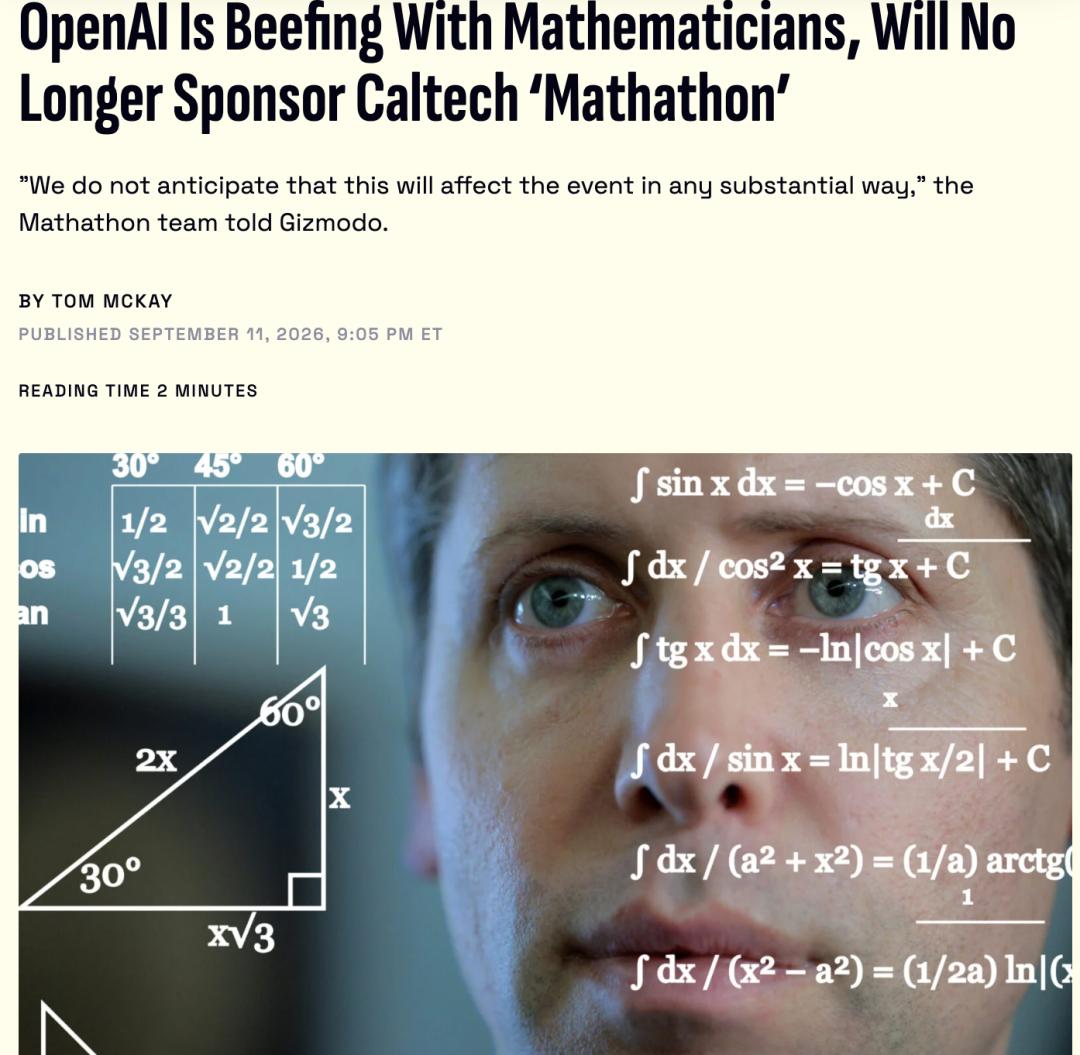
Previously, there were also scholars who publicly questioned the Navier-Stokes problem.
NYU mathematician Tristan Buckmaster and Anthropic mathematician Levent Alpöge announced three proofs, which initially advanced the existence and smoothness of Navier–Stokes, one of the Millennium Prize Problems, using Codex and Claude in the process.
The controversy lies in: Buckmaster claimed that before the results were made public, information about his progress was passed to OpenAI; OpenAI then launched parallel research and development after September 1, using the unreleased new generation model to consume 300 billion output tokens in about a week (about 22.5 million US dollars at Astra's rate) and released the complete proof.
Buckmaster said he was pressured by OpenAI mathematician Sébastien Bubeck to delete Alpöge's signature, and was subjected to verbal threats such as "ruin your career" and "then I will not be polite".
Buckmaster also worried that his work, which heavily used Codex, might have influenced the OpenAI model through training data.
In response, Greg Brockman publicly stated that the model used for the final problem-solving had its training cutoff data at the beginning of July this year, completely before the external scholars' results were made public.
OpenAI will never snoop on or misappropriate the private data of enterprises and developers.
But Greg Brockman also threw out a cruel and realistic historical comparison: Back then, Andrew Wiles spent ten years secretly working alone in the attic to prove Fermat's Last Theorem.
Today, on the eve of AGI, if a scholar uses a publicly released weak version of AI to pry open a gap of truth, a super technology giant with a thousand times more computing power and the next generation of private models can violently flatten the entire remaining long night in a few days.
This has triggered deep anxiety among the majority of developers and the academic community: Will future major scientific discoveries completely become the privilege of the trillion-level computing power empire?
Can the flash of inspiration of human genius still have a place when facing a matrix of tens of thousands of tireless agents that work 24 hours a day?
When AI giants are obsessed with "reaching for the stars", humanity longs more for them to "land and save lives"
A large number of tech fans are thrilled by this pure intellectual breakthrough, exclaiming that "the AGI (Artificial General Intelligence) moment has arrived".
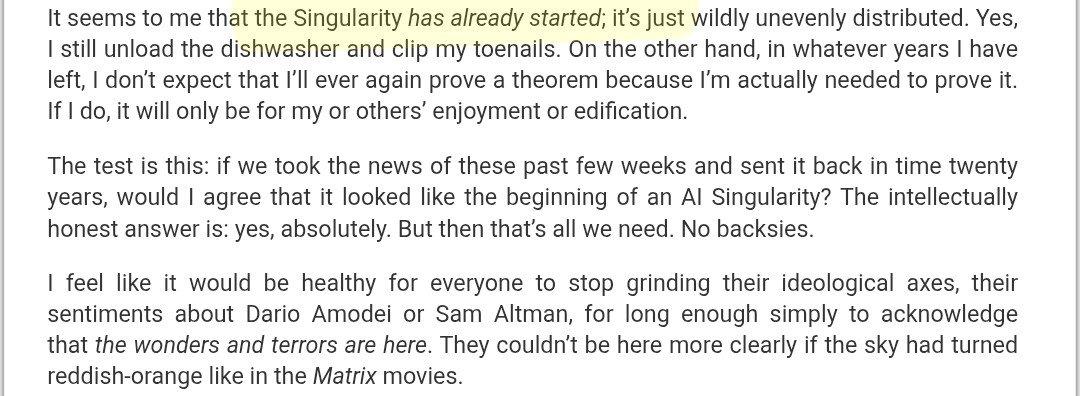
Scott Armstrong, a mathematics professor at NYU and the Courant Institute, was deeply shocked and said bluntly, "The Singularity has already begun; it's just that its distribution is extremely uneven."
But in sharp contrast, while it is really cool that AI proves the singularity of fluid mechanics, where are the new targeted anti-cancer drugs that patients are waiting for?
This kind of questioning is extremely glaring.
Most people don't care that AI is in a hurry to get that million-dollar mathematical reward, they need it to conquer Alzheimer's disease, predict complex protein mutations, and shorten the new drug research and development cycle from ten years to a few months!
The public's questioning hits the nail on the head: Today, when the computing power and power resources of all mankind are extremely scarce, should tens of billions of dollars of top supercomputers be used to solve abstract ivory tower conjectures, or to solve people's livelihood pain points related to real life and death?
Facing the interrogation of computing power allocation, Greg Brockman revealed the little-known cruel tangle inside OpenAI in an interview:
On the eve of the release of GPT-5.5, we even calculated every line of code carefully for the computing power quota, and painfully cut the rate limit of every interface. Computing power allocation is currently the most difficult capital and engineering problem for OpenAI.
But he also firmly believes that mathematical deduction is not a useless skill:
The Millennium Prize Problems are the strictest touchstone to test whether AI has the ability of "long-chain rigorous logic and anti-hallucination".
A system that can make no logical mistakes in dozens of steps of deduction and can be completely closed and self-consistent with Lean code, once this reasoning framework is migrated to molecular dynamics, genetic engineering and complex target prediction, the life-saving capabilities it bursts out will increase in geometric progression.
"This is by no means a game