How did two post-2000s boys win over young female users in North America by leveraging AI?
By Xiao Kui
Edited by Guopu
In the AI era, the entrepreneurial circle has become increasingly aligned with the phrase "the strong survive the fierce elimination". The explosion of productivity allows far more people today to "gain 15 minutes of fame", and the number of outstanding products on the market has grown exponentially. At the same time, some people may only enjoy a fleeting moment of glory, while others have already identified their strengths, stepped out of their comfort zones, and are determined to carve out their own path to success.
This is exactly the case for the two post-2000s founders of MobAI. Among them, Vito Zhong Wending was once an investor at a leading VC, and Kaito Wang Bo was a former product manager at Nian Ta.
While they were still in their full-time jobs, they co-developed a product called "Cultivation Simulator". Those who follow the AI product field are no strangers to it, as "Cultivation Simulator" was a relatively classic early AI-related product. It is driven by prompts, requiring users to continuously fill in prompt words. Although it has high freedom and rich content, like many AI products at that time, it imposes considerable requirements on users' AI prompt engineering capabilities.
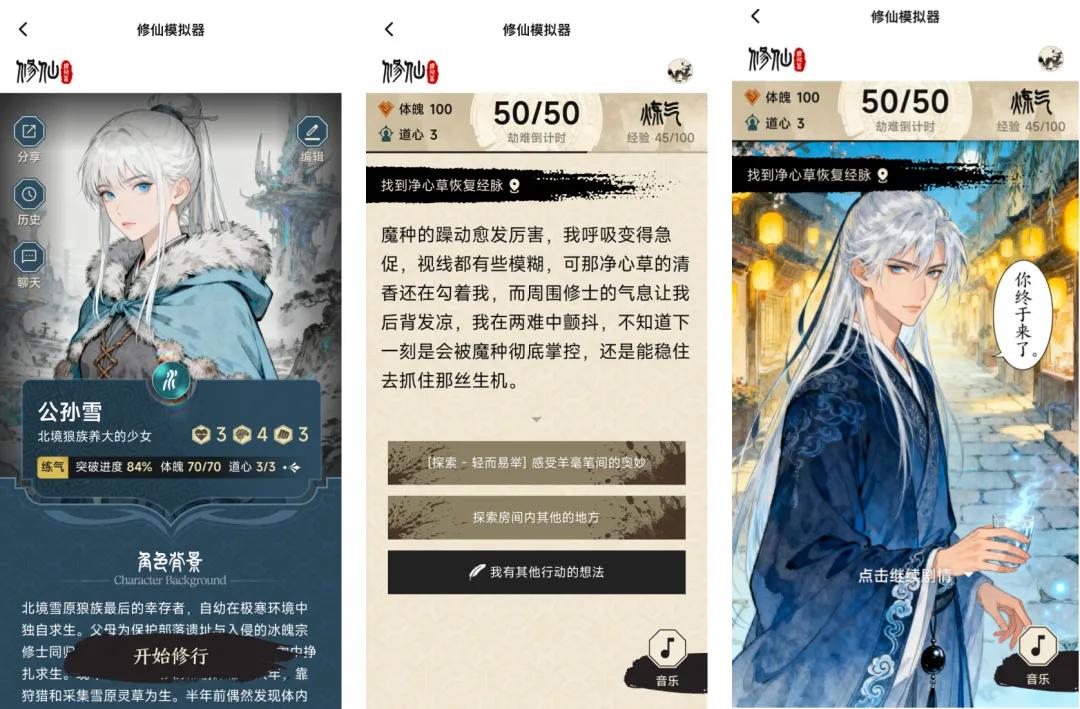
Cultivation Simulator
To solve this problem, they tried different themes, but none of the attempts turned out satisfactory. At their most financially strained point, there was only 2700 yuan left in the company's account.
This predicament lasted until they launched the "Lunaverse Stories" project, an AI interactive narrative mobile application targeted at young women aged 18 to 24 in North America. In July this year, with this product, they secured exclusive investment from Hong Kong-listed company Chihcheng Technology, completing an angel round of financing of several million yuan.

Lunaverse Stories
Not long ago, we met Zhong Wending and Wang Bo, both of whom were in excellent spirits. After learning about their stories and experiences, we hope their ideas can provide inspiration and help for other AI entrepreneurs.
The following is the transcript of the conversation:
Q: How did you first come up with the idea of developing AI-related products?
Zhong Wending: At that time, I was working in the financial industry, and Wang Bo was at an AIGC company. We originally got to know each other through writing prompts — he needed to write prompts frequently for his work, and I was good at it, so we often collaborated on that. Later on, I casually wrote a set of prompts for a cultivation simulator, embedding values, gameplay mechanics, and event systems into the conversation framework, and sent it to him to try. After playing it, we both thought it was so fun that more people should get to experience it.
How crude was the earliest version? It didn't even have a proper web page. But after we released it, the backend data showed that some users played for one or two hours straight. I couldn't even play it for an hour myself, but others were willing to spend hours on it and leave feedback. That moment was truly thrilling.
Q: Did you decide to quit your jobs and start your own business right after that?
Zhong Wending: It wasn't that quick. After that, we did a lot of exploration, making at least seven or eight demos of AI urban legend games, AI puzzle games, Werewolf, murder mystery games... but all of them failed, none of them were fun enough.
There were two things that truly made us make up our minds.
The first was the key breakthrough of multimodal models in October last year. The emergence of models such as ImageNet and Nano Banana gave images real "intelligence" for the first time. These new models are different: graphics are no longer a link requiring manual intervention, but have become automated, AI-native elements. We thought it was time to create richer, more visually immersive content.
The second was the persuasion from a senior. He said we were 24 and 23 years old respectively, which was the best age to start a business. It is not feasible to run a business part-time: you work 8 hours during the day, and after getting home, having dinner and taking a shower, you can work at most until 2 a.m., which means you have 4 to 8 hours less thinking time than others every day. For entrepreneurs, this gap is huge. The market window won't wait for you forever.
He talked to me for two hours, then I introduced Wang Bo to him, and he talked to Wang Bo for another two and a half hours. After listening, we both kept asking ourselves the same question: can we really run a good business in our current part-time state? We didn't have the answer at that time, but we finally decided to go all in on the business.
Q: Weren't you scared?
Zhong Wending: Of course we were. Everyone around us was working full-time jobs, everything seemed very business-as-usual, but you said you were quitting to start a business, which made you an outlier, so it was a bit intimidating.
But after we actually quit, we found it wasn't that bad, we should have done it much earlier. At our most difficult point, there was only over 2700 yuan left in our company account, which was barely enough to pay for the cheapest social security contributions. I used to work in VC, but no one offered us funding at that time, all the money we used was our own savings.
There were several moments when I seriously considered selling my apartment first. In hindsight, we actually quit too late — we shouldn't have taken our first full-time jobs at all, we should have started our business right after graduation. We didn't grow up in the golden age of the early internet era, and we faced severe employment pressure when we graduated. But the AI wave came, and we had the opportunity to create more personalized, more valuable content, so we had to seize it.
Q: How was the data after Cultivation Simulator was launched?
Zhong Wending: The optimization of Cultivation Simulator 2.0 was very poor, each round took more than 20 seconds to load. We posted it on Xiaohongshu, and two to three thousand users flooded in immediately, almost crashing our server. Two weeks later, when we checked the database, we found two players: one played 1200 rounds, the other played 1300 rounds — they spent seven or eight hours playing despite the 20+ second delay. My first thought at that moment was, I'm sorry for you, I haven't done a good enough job.
Wang Bo: We didn't have high expectations when the first version came out, but more than 150 people signed up for the beta test. Over 80% of users played for more than 5 minutes, and 37% played for more than 15 minutes. The average number of valid input rounds was over 17. We realized that a good theme has unlimited potential.
Q: What was the most memorable feedback you received from players?
Zhong Wending: One user wrote at least two to three thousand words of feedback in our Xiaohongshu group. We read every single word of it and thought about it for a long time. This direction has its limitations, but also its strengths, and we are very grateful to that user.
Wang Bo: We were greatly influenced by Wang Dengke, the founder of Duxiang. The "Coax Simulator" he developed was extremely popular among male programmers — players need to calm down their angry girlfriend within 10 rounds, and many later challenged themselves to "calm her down in 5 rounds" or "calm her down in 3 rounds". That's the power of a good theme.
Q: How did the shift from Cultivation Simulator to female-oriented overseas content happen?
Zhong Wending: We figured out one thing. In China, simulators rely on novel, gimmicky topics to attract users. For example, the Green Pepper Simulator is themed around graduate student life, the Sister-in-law Simulator focuses on ethical topics, and the Chongzhen Simulator centers on history. But this model cannot be scaled up. We don't want to make short-cycle indie games. If we just wanted to make an indie game, we could have done that while working full-time, there was no need to quit our jobs. Starting a business means pursuing something with greater potential, something more long-term.
Q: Why did you choose the female-oriented narrative game direction?
Zhong Wending: From day one, we wanted to build a global product. Our target audience is young women aged 18 to 24 in North America, and the actual coverage may extend to people aged 16 to 34. In North America, the majority of interactive game players are women; while in China, male players prefer GalGames on Steam. Chinese female players are fans of platforms like Chengguang and Yicyuan, but those are more focused on character development and numerical progression, and a single work may take a studio half a year or even two to three years to produce. Our small team can't do that. What we can do is create better, more scalable content to keep users engaged with a steady stream of new stories.
Q: What's your consideration for the game mechanics?
Zhong Wending: It's very hard to innovate on game mechanics. Since the birth of games, there are only a handful of proven successful mechanics, and a new one may come out once every one or two years. We don't insist on creating completely new mechanics, but our standard is that the game must be fun enough. The fun has to be long-lasting, not something users abandon right after finishing the first playthrough. If we win with content, we need to bring users continuous excitement and continuous fun.
Q: You are two guys making female-oriented products for an overseas market, how do you solve the problem of cultural differences?
Wang Bo: We struggled with cultural adaptation at the very beginning. I felt their lives were so far away from mine. But there are no shortcuts for this, you have to immerse yourself in that environment. Since January this year, I've been binge-watching American and Korean TV series, and now I watch two to three full series every month. The recommendation algorithm on my Xiaohongshu account no longer pushes male-oriented content to me.
Q: Can you fully understand their preferences just by watching TV series?
Wang Bo: Not necessarily. We once read a werewolf-themed script that had extremely good data. The plot was that the female lead was the wife of the alpha of the werewolf clan, the alpha fell in love with someone else, the alpha's mother told the female lead that her only purpose was to give birth to an heir. The beta fell in love with the female lead, helped her get an abortion, and finally tricked the clan into letting her escape. We were all shocked that such a novel plot could have such good data.
Zhong Wending: Later I figured it out. Many places in North America are Christian, and abortion is illegal in some states, so the act of "abortion" itself is very rebellious. It's like the plot where someone drops out of high school to work at McDonald's to support you to go to college — we can empathize with this story, but if you tell it in North America, they will say that the homies in our neighborhood have been doing this for ages. That's how significant the cultural difference is.
Q: Do you feel painful when creating content? There may be some core ideas of the stories that you can hardly understand.
Wang Bo: Many people have asked the question "why an all-male team makes female-oriented products". I'm actually not a typical male web novel reader. After college, I've read and watched a lot of works like *Pride and Prejudice*, *Notting Hill*, *The Glory*, and found that I naturally prefer this type of theme. I'm actually an omnivorous reader, I read a huge amount of content, alternating between male-oriented and female-oriented web novels, I've even read those melodramatic youth romance novels. After reading a lot of them, you'll find that good content is just good, fun content is just fun, it has nothing to do with whether it's male-oriented or female-oriented.
Q: What are your standards for creating content?
Zhong Wending: We don't like naive, overly simple female leads. Every female lead in our works has her own main storyline and her own life goals, she has to work hard to make her dream come true. The choices she faces are not "which man to be with", but "do you want to be the one in charge, or do you want to fall in love with a man".
Q: What kind of product is Lunaverse exactly?
Zhong Wending: It's more game-like than traditional interactive video games, but its foundation is more like a visual novel. We added continuous video, motion-sensing interaction, mini-games, and a tabletop RPG-style value system. You don't pay to unlock choices, you roll the dice to determine whether you can achieve the outcome. You can think of interactive games as a spectrum. One end is 3A titles like *Detroit: Become Human*, which keep you operating all the time, essentially puzzle games with occasional CG clips. The other end is the flow experience of games like *Flourishing Age*, which is essentially more like watching a video. We are making something in the middle: lighter than 3A games, more interactive than pure interactive video games. We want to build a platform, a hybrid form, so that players with different preferences can find the experience they want.
Q: What do you think of the opportunities in this track?
Zhong Wending: Some interactive narrative products in North America have extremely poor graphics, and their monetization methods are crude: forcing users to pay for choices, which is a very unpleasant experience. But their data is still very good, users are still willing to pay. This proves that the demand is real. What we need to do is to meet this demand with better content and better user experience.
Q: Is there anything else you want to say in the end?
Zhong Wending: Put aside your prejudices, truly understand what users want, and don't use your own judgment to represent others. Content creators need to keep their egos in check. We will always listen to all kinds of feedback — positive, negative, biased, and objective. They are all voices from the outside world that help us calibrate our own ideas.
Wang Bo: If you have the chance to do what you really want to do, don't hesitate. Life is a vast open field.
Zhong Wending: Every moment I feel that starting a business is the right choice. We didn't catch up with the golden age of the internet, but the AI wave is here, and since we have the chance, we have to go for it.
This article was first published on "36Kr Games".