The Four-Step Boomerang Innovation Method: How mature enterprises can successfully spin off innovative businesses and achieve their return.
Key Takeaways at a Glance
- As the market landscape evolves, OPPO's product matrix will continue to iterate in the future, and even new spun-off businesses will emerge. Strategic renewal is a cyclical and ongoing process rather than a final destination.
- The four-step boomerang innovation exploration framework helps large enterprises cross the innovation chasm and solve such intractable management challenges.
- What the mainstream market buys is not technology, but frictionless satisfaction of demands.
The Thorns of Structural Transformation
How can large enterprises maintain innovative vitality and survive business cycles amid drastic structural changes? This is one of the most intractable problems in the field of management, with countless related failure cases. Amid the wave of disruption, incumbent enterprises are clearly able to perceive the earth-shaking changes in the industry, but they are often trapped in a two-way contradiction: existing capability exploitation (deeply tapping existing core capabilities to guarantee current performance), and unknown capability exploration (venturing into uncharted territories to pursue future growth).
Coping with immediate operational pressures naturally takes priority: managers will allocate resources to capability development that appears safer. However, the expectation of strengthening existing advantages to "resist" disruption is almost doomed to failure. As Clayton Christensen revealed in The Innovator's Dilemma: Market leaders almost always lose to disruptive new entrants; continuously optimizing existing capabilities for core customers will make enterprises lose their adaptability to new technologies. Kodak invented the digital camera, but prioritized clinging to the film business and eventually collapsed. From the mobile phone industry to the enterprise computing sector, the same tragedy has repeated itself over and over. As Pony Ma, founder of Tencent, said: "When a giant falls, its body is still warm."
Attempts to carry out exploratory innovation through in-house incubation mostly end in failure. The cultural and institutional constraints of the parent company will stifle the innovation project. Long before the launch of the iPhone, Nokia had already developed a touchscreen smartphone internally, but the company's main feature phone business squeezed resources and attention from this new project. Intel also once formed a mobile processor team internally, but it was marginalized by the PC chip business and completely missed the mobile computing era.
Large organizations come with a built-in "organizational immune system", which is an inherent exclusion mechanism designed to maintain the efficiency and established processes of core businesses. In a stable industry period, this mechanism can protect the organization; but in a period of industrial transformation, it will become a fatal obstacle that stifles innovation.
The Capability Trap
This is the connotation of the capability trap. The concept was first proposed by Barbara Levitt and James G. March in 1988, and later further expanded by Michael Tushman and Charles A. O'Reilly in their research on organizational ambidexterity. Incumbent enterprises will excessively tilt resources to cash cow businesses, neglecting and rejecting radical, unknown cutting-edge explorations.
The mobile phone industry has long suffered from various dilemmas brought by in-house incubation. Many sub-brands, such as Redmi, the sub-brand of Xiaomi, have long struggled to get rid of the "accessory" label in their early stages. Their supply chains and R&D systems are deeply tied to the parent company, leaving very limited room for upward pricing within the group's product matrix. Although some sub-brands have achieved considerable sales, they only act as the group's gross profit firewall and volume-boosting tool, and cannot achieve true high-end brand growth.
To break free from this organizational immune system, some enterprises choose to spin off their innovative businesses. But spin-offs will bring new problems. Even if the independent start-up business survives the early survival stage, when it moves from a niche strong player in the "small but beautiful" segment to the mainstream market, it often hits a growth ceiling - it is difficult to cross the innovation chasm. Constrained by a lack of resources, they have very little room for error in strategy, operation and management, and one mistake may lead to crisis or even collapse.
Motorola's Iridium satellite project was originally a grand internal innovation for global communication. In 1991, it was spun off and made independent to get rid of organizational inertia and explore unproven market potential. Technically, Iridium successfully built a global satellite network, proving its value in niche scenarios such as ocean shipping and polar scientific expeditions. But when it tried to expand to the mass mainstream market, its high pricing directly sealed its fate. Without the Motorola balance sheet to cover losses, the heavily indebted spun-off project had almost no room for trial and error. Just one year after its official launch, Iridium filed for bankruptcy.
Three Major Barriers to Incubating High-end Sub-brands Within Enterprises
Barrier 1: Minimum Order Quantity Bias (MOQ Bias)
The minimum order quantity is a key indicator of the discourse power of internal teams in large enterprises. The management is mostly dominated by managers who have achieved large sales volumes in the past. When an innovative project with small initial shipment size competes for resources with a mature best-selling product line, the parent's "organizational immune system" will naturally favor mature businesses. Mature product lines can bring stable inventory turnover and total gross profit, consolidate market position, ensure the operation of business units, and help managers complete performance appraisals.
Barrier 2: Cognitive Inertia
The parent company has a mature brand and user profile, and when internal teams define new products, they will unconsciously follow the parent's design language and cost structure. When traditional manufacturers want to make mobile phones for young people, product managers find it difficult to break free from the constraints of the existing parts library. Influenced by historical data, the team will prefer thick and durable bodies and mechanical structures for mass users, rather than radical configurations that can truly impress young groups. Even if a more pioneering design is made, the internal review process will distort the original idea. The final finalized plan is only a minor adjustment within the parent company's product matrix, not a real breakthrough innovation.
Barrier 3: Misaligned Talent Incentives
For employees with entrepreneurial spirit, the hierarchical structure of large enterprises often restricts innovation. Managers and employees who incubate businesses within the enterprise are bound by the promotion ladder and KPI system, and it is difficult to obtain entrepreneurial-style returns.
OPPO and OnePlus: A Practical Model for Unknown Capability Exploration
How can incumbent enterprises break through numerous obstacles and complete truly valuable exploration amid the wave of disruption?
Based on years of research, I believe that the more than ten years of innovation journey between Chinese smartphone manufacturer OPPO and its spun-off brand OnePlus provides extremely valuable inspiration for large organizations. The story of OPPO and OnePlus is not absolutely perfect, and the process is not over yet, but it demonstrates how a spun-off business can carry out valuable unknown capability exploration, create value for the parent company, without harming the parent itself.
About 15 years ago, China's smartphone industry was undergoing drastic shocks. Xiaomi soared with its internet model, and the vast majority of traditional mobile phone manufacturers were lost. Unsurprisingly, a large number of incumbent enterprises followed suit to explore the internet business model.
At that time, OPPO had built solid offline channel barriers in China, relying on an exclusive wholesale-retail network. This system covered hundreds of thousands of multi-brand family stores and exclusive offline outlets, spread across China's sinking cities, counties and townships. Different from the Western open distribution system, OPPO's channel barriers are built on three pillars: regional exclusive agents avoid price wars; local dealers hold shares and are deeply bound to the brand for mutual benefit; a high subsidy system provides stores with high gross profit rebates, storefront materials and promoter support. Any attempt at online direct sales will directly collide with this deeply entrenched vested interest.
At the same time, there was a group of technology enthusiasts around the world who were obsessed with pursuing ultimate performance, industrial design and pure Android system experience. This group was a target customer group worth exploring, but the traditional brand narrative of Chinese mobile phone manufacturers could hardly impress them.
OPPO initially took the lead with senior executive Pete Lau to test the internet model internally. But the project soon encountered resistance. OPPO's huge offline sales network had enormous influence and was very resistant to aggressive marketing for big promotions like Double 11. It was clear that promoting the internet model within the parent company faced huge obstacles. So in 2013, the enterprise made a decision: spin off OnePlus to become an independent exploratory startup.
During its eight years of independent operation, OnePlus focused on overseas markets and the niche group of technology enthusiasts; OPPO gave full play to the advantages of its huge user base and scale efficiency. OnePlus grew into a popular brand with global influence, verified the feasibility of the internet marketing model in the high-end track, and accumulated a full set of operational capabilities including global high-end product R&D, operating systems, and high-end displays. These experiences laid a critical knowledge foundation for OPPO's subsequent strategic renewal.
In June 2021, OnePlus returned to the OPPO system. In the following five years, OPPO repositioned OnePlus from "a flagship for global technology enthusiasts" to the group's performance pioneer, moving from a niche segment to the mainstream market. In early 2026, OnePlus's global market share reached 4%, a 426% increase compared to 2021 (data provided by OPPO).
More than ten years after OnePlus was born, the industry landscape has undergone tremendous changes. The vast majority of smartphones are pre-installed with customized smart operating systems, and no brand wins solely by relying on internet marketing. Xiaomi has built a huge offline retail network, and manufacturers that originally focused on offline have also entered online on a large scale. Geopolitics, unpredictable trade tariffs, and supply chain risks are also reshaping the entire industry.
Against this backdrop, in mid-2026 OPPO announced that OnePlus's strategic focus would shift to China and emerging markets, targeting young people and the gaming track, and gradually withdraw from mature European and American markets. In Europe, the OPPO Find series, which has served as the group's high-end flagship since 2018, will take over the group's high-end positioning and inherit the user base and brand awareness accumulated by OnePlus.
From the perspective of OPPO's management, this represents the end of one exploration phase and the official start of a brand new exploration phase. OnePlus has fulfilled its mission of verifying the internet business model and developing overseas high-end niche markets; OPPO has gained battle-tested experience in global brand operation, user operation, and rapid iterative innovation. The group's next task is to integrate and reuse these capabilities within its product matrix, while avoiding the risks of duplicate business construction and brand cannibalization.
The Four-step Boomerang Innovation Framework
How exactly did OPPO and OnePlus cross this intractable management dilemma? Based on my research, I have summarized the four-step boomerang innovation framework, an exploration path that can help large enterprises cross the innovation chasm.
Step 1: Independent Spin-off - Build a Brand Firewall
Through the spin-off, OnePlus established independent brand assets. This is not only legal independence, but also a reshaping of brand mindset: the founding team officially resigned from OPPO and then joined this new startup. This clear gesture reinforces not only strategic independence, but also psychological independence.
With the brand proposition "Never Settle" and a lightweight operating system, OnePlus attracted the world's most discerning early adopters - the Silicon Valley geek community. It would be almost impossible to shape such a geek identity within a parent company that focuses on the mainstream market. In the early days of the startup, I visited OnePlus's office in Tairan Building, Shenzhen. The company even kept a Shiba Inu named One Zai, jokingly called OnePlus employee No. 0000. This Silicon Valley-style corporate culture was unimaginable within OPPO's parent system.
The core feature of brand building is community-driven. OnePlus built extremely strong user loyalty in the technology circle, creating an almost fanatical geek subculture. In the early days, it bypassed traditional marketing and implemented an invitation-only purchase system, where invitation codes became scarce hard currency and were even resold on eBay at prices higher than the hardware cost of the phone. The development path was not all smooth sailing. In 2015, the launch and delivery of the second-generation mobile phone was chaotic, and the OnePlus team publicly apologized. Pete Lau made up his mind to polish the better OnePlus 3, and the brand restored its reputation from there.
Global tech enthusiasts regarded OnePlus launch events as cultural events, not ordinary corporate press conferences. In London, New York, and San Francisco, thousands of users queued up all night in the rain just to experience pop-up stores or buy phones - a sight that previously only appeared at Apple new product launches. When I was based in Silicon Valley in 2019 in charge of North American business, I met an Amazon executive who proudly showed me his OnePlus 7T Pro McLaren custom edition. Employees at Google's headquarters told me that OnePlus was the "darling" of the Android engineer community. This brand firewall unlocked extremely high average selling potential. According to Counterpoint's Q1 2020 report - the last quarter of OnePlus's independent operation, OnePlus ranked among the top five high-end smartphone vendors in all regions except China and Latin America.
Step 2: Symbiotic Coexistence - Provide Support Without Interference
When the parent company carries out exploratory innovation through independent spin-offs, it should provide certain resource support, but maintain non-interference to guarantee operational autonomy of the business. I named this model symbiotic coexistence.
It is widely believed that OPPO's uninterrupted in-depth resource support was the pillar of OnePlus's early success. The support is divided into three aspects:
1. Inherited Accumulation: Pete Lau once served as OPPO's vice president and general manager of the Blu-ray Division, and almost the entire founding team came from the OPPO system. OnePlus inherited OPPO's industry resources, supplier network, and product R&D accumulation, without having to build everything from scratch.
2. Manufacturing Support: In the early days, OnePlus rented OPPO's production sites, no need to build its own production lines, which greatly reduced early capital risks and shortened the product launch cycle.
3. Supply Chain Collaboration: As early as before the official integration in 2021, OnePlus's supply chain benefited from OPPO's industrial ecosystem. It could share the priority OPPO has accumulated in the global supply chain, and compared with ordinary startups, it could obtain more reliable flagship chips and core components.
The most critical point: OPPO did not interfere with OnePlus's decision-making. OnePlus had full control over the product roadmap, brand tone, marketing narrative, regional market implementation strategy, and OxygenOS R&D. This freedom gave birth to industry-leading products like the OnePlus 7 Pro: the world's first 90Hz QHD+ Fluid AMOLED screen, which redefined the smoothness of the industry's screens, paired with an electric pop-up front camera to achieve a full, notch-free full screen.
Backed by heavy-asset resources while ensuring operational autonomy is the core of symbiotic coexistence: the stable scale of large enterprises, superimposed with the agility and creativity of independent startups.
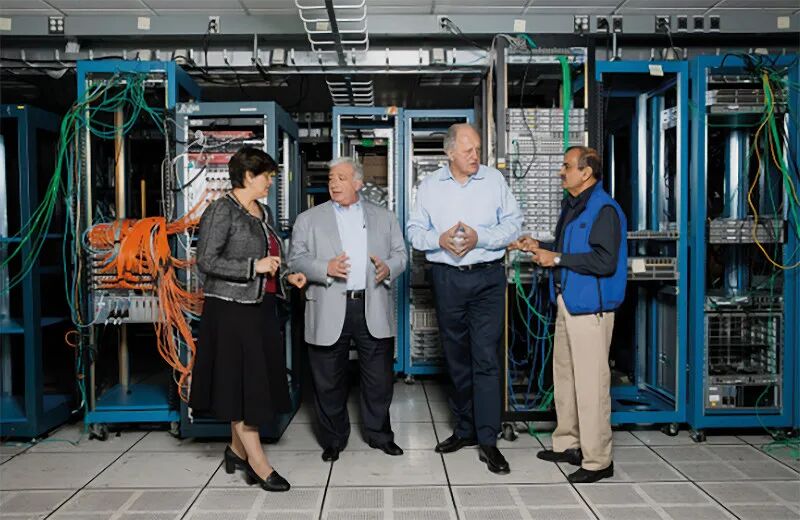
Cisco's "Musketeers": Mario Mazzola, Luca Cafiero and Prem Jain (from left to right), and their colleague Soni Jiandani
Cisco's Three Musketeers: A Practical Case of Symbiotic Coexistence
U.S. tech giant Cisco completed three major breakthroughs relying on the symbiotic coexistence model. The entire spin-off-buyback strategy was led by Mario Mazzola, Luca Cafiero, and Prem Jain, known in the industry as the "Three Musketeers". Each spin-off targeted an emerging track that the group had not yet covered. As the sole investor, Cisco funded the development of disruptive technologies; after the products matured, it completed the acquisition at a premium. After integration, the acquired entity became the pillar of the group's core business, bringing transformative innovation.
Case 1: From Network Devices to Storage Networking (Andiamo), 2002‑2004
In 2002, Storage Area Networks (SAN) became the core track of data centers, Brocade occupied more than 7