Code name J246, Apple is "overhauling" the server market
Apple is considering a return to the server market 15 years after exiting it.
People familiar with the matter revealed to The Information that Apple is developing an AI inference server for enterprise and other customers, which is planned to be equipped with two or four self-developed Ultra chips, and may be launched as early as 2029. Meanwhile, Apple is also in discussions with NVIDIA to use NVLink Fusion to connect multiple Apple chips in the server.
Back in July, veteran analyst Mark Gurman disclosed that Apple was developing a server based on M5 Ultra with the internal codename J246. However, this product is still in the early stage of development, and the final configuration has not been determined yet.
The last enterprise server Apple made was the Xserve. Launched in 2002, the Xserve successively adopted IBM and Intel processors, mainly targeting enterprises and professional users. In 2011, Apple stopped selling Xserve and withdrew from the dedicated server hardware market.
Now that Apple is reconsidering servers, it is facing completely different demands.
Over the past year, a number of AI companies have begun to purchase Mac mini and Mac Studio in batches to run AI inference tasks with Apple Silicon. Apple has also deployed Private Cloud Compute to provide cloud AI computing for iPhone and Mac.
If the current plan moves forward, Apple will continue to extend from Mac and Private Cloud Compute to the data center, and the Ultra chip will be used in server products for external customers for the first time.
Ultra Chips to Be Deployed on Servers First
It is understood that Apple is considering two solutions, one equipped with two Ultra chips, and the other with four.
Ultra corresponds to Apple's high-end M-series chips, which are currently used in products such as Mac Studio. But since there is still a long time before 2029, it is not certain which generation of Ultra chips Apple will finally use.
According to public information, Apple released the M5 Ultra chip with a four-die design, 80-core GPU (each core is equipped with a neural network accelerator) and 32-core NPU in late August this year — two dual-die Ultra chips are spliced together through UltraFusion based on TSMC's InFO-LSI packaging technology.
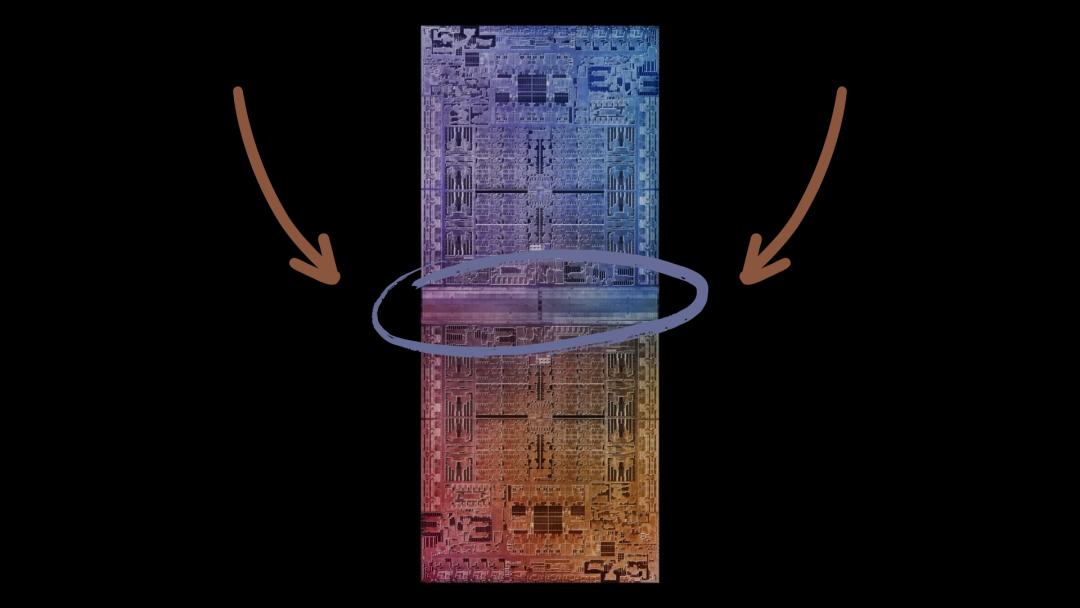
UltraFusion Ultra-High Density Substrate Interconnect Channel
To put it simply, a single die is packaged into a dual-die M5 Max through UltraFusion, and then further packaged into M5 Ultra using UltraFusion technology. Based on this nested packaging, the inter-die bandwidth is increased to more than 4.4TB/s, and the connection density is increased by more than 6 times. Apple stated that the four-die design of the M5 Ultra chip performs as a unified processor in operation.
Although Apple has not disclosed the computing power indicators of M5 Ultra, some third-party estimates show that its FP16 dense computing power can reach 110 TFLOPS. For comparison, the FP16 dense computing power of 2 DGX Spark units is about 200 TFLOPS. That is to say, M5 Ultra can basically compete with DGX Spark.
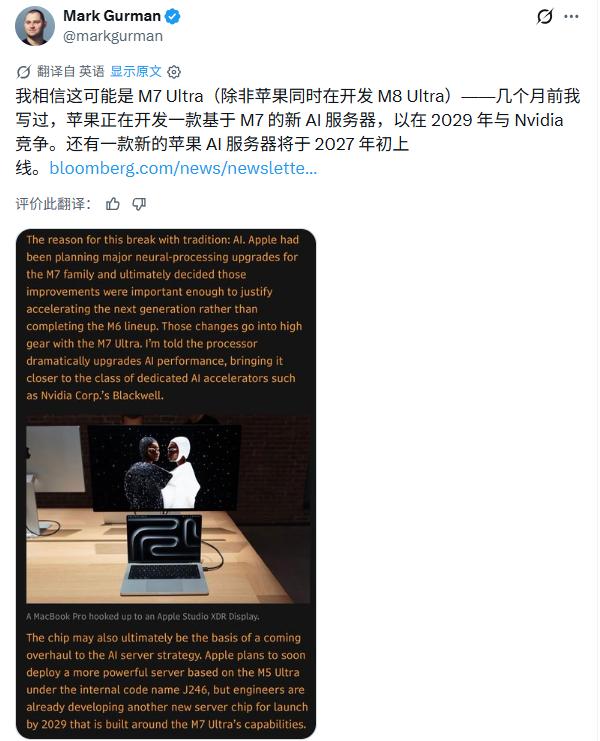
Gurman also revealed that around 2029, Apple may launch another server chip based on M7 Ultra. The memory design of M7 Ultra itself will be further improved. Gurman said that this chip can support up to 1.5TB of memory, which is about twice the planned capacity of M5 Ultra.
At the same time, Apple has already started the development of the M8 series of chips, and one of the chips codenamed "Soko" is expected to be launched in 2028.
In terms of usage, Apple's servers are mainly for AI inference, rather than large-scale computing clusters for large model training.
Different from Mac which targets individual users and developers, servers enter data centers and IT departments, involving not only hardware procurement, but also deployment, management, maintenance and subsequent services. This is a set of commercial systems that Apple rarely directly faced when it made consumer electronics products in the past.
However, this is not the first time Apple has built AI servers on its own. Private Cloud Compute is a set of AI computing infrastructure built by Apple to process tasks that cannot be completed directly locally on devices such as iPhone and Mac. In October 2025, Apple's factory in Houston has started shipping relevant servers, ahead of the previously planned 2026 timeline.
From building infrastructure on its own to selling servers as commodities, there is a whole set of problems that need to be solved in the enterprise-level hardware business in between.
It should be noted that due to the huge difference in cost between single-chip sales and full-chain services, providing servers and deployment for third parties may put pressure on Apple's gross margin.
NVIDIA Technology Serves as the Interconnection Bridge
To install two or even four Ultra chips in one server, the core requirement is to solve the interconnection between chips.
Apple already has its own chip interconnection technology. For example, UltraFusion can connect two Apple Silicon chip Dies at high speed through a silicon interposer, and make them behave as a single chip at the software level. But if the existing solution is extended to larger-scale servers, speed and cost may become issues to be considered. This is why NVIDIA's NVLink Fusion appears in this project.
NVLink was originally NVIDIA's own high-speed interconnection technology, mainly used to connect GPUs and other computing components. In 2025, NVIDIA began to open NVLink Fusion to other chip manufacturers.
AWS has announced that it will adopt this solution in Trainium4, and AI inference chip company d-Matrix also plans to use it to connect next-generation inference chips. Fujitsu, Qualcomm, MediaTek, Marvell, Arm and other companies have also joined the related ecosystem.
With NVLink Fusion, Apple will not need to build a full set of data center-level chip interconnection systems from scratch.
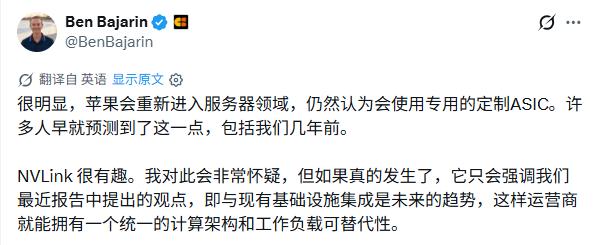
Ben Bajarin, CEO and chief analyst of technology analysis firm Creative Strategies, believes that it is not unexpected for Apple to re-enter the server market, and he previously predicted that Apple would use custom ASICs. He said he was skeptical about the use of NVLink, but if it is finally adopted, it will further indicate that AI infrastructure is moving towards stronger system-level integration.
For NVIDIA, NVLink Fusion provides another way to enter the AI server market. Even if customers design their own computing chips, NVIDIA can still participate in the ecosystem through interconnection, switching chips and rack-level infrastructure.
Dion Harris, senior director of high-performance computing and AI infrastructure at NVIDIA, did not confirm whether Apple has become an NVLink Fusion customer, only saying that Apple has always been an important customer and partner of NVIDIA. He once stated bluntly: "We would rather sell products than sell nothing."
Mac Products Pave the Way in Advance
One of the important reasons why Apple is accelerating the development of M7 is AI. According to relevant sources, M7 Ultra will have a significant AI performance upgrade, and its performance target may be close to that of dedicated AI accelerators such as NVIDIA Blackwell.
Apple's reconsideration of servers is not an idea that emerged suddenly.
Over the past year, Mac mini and Mac Studio have been used for inference by some AI companies, and large AI labs have purchased tens of thousands of Apple computers. For example, video intelligent analysis platform Dragonfruit AI uses Apple hardware to process security camera analysis for retailers, and startup company Mount Thor is also trying to use Apple hardware to build cloud computing businesses.
These products were not originally servers, but the energy efficiency and unified memory architecture of Apple Silicon have allowed Mac to enter some AI computing scenarios.
The performance of the Mac product line is also strong. Apple's Mac revenue reached 10.4 billion US dollars in its latest fiscal quarter, a year-on-year increase of nearly 29%, making it one of the product lines with rapid growth in the company.
However, if enterprises want to truly deploy AI computing in data centers, in addition to chips and computing power, they also need server capabilities such as racks, centralized deployment, remote management and fault monitoring. Apple held the "Business at the Park" event on June 23, inviting large enterprises and AI companies to demonstrate the application of Apple hardware in AI scenarios, which is also a way to reach out to such customers.
At the same time, Apple's own AI infrastructure is also using external technologies. In June this year, Private Cloud Compute was extended to Google Cloud, using NVIDIA Blackwell GPU and confidential computing technology.
Tech analyst @FinnStockinger believes that what is worth paying attention to in this matter is not just that Apple has started making servers, but that Apple seems to be reconsidering the layout of AI infrastructure. He pointed out that on the one hand, Apple hopes to control its own computing chips, and on the other hand, it may access NVIDIA's infrastructure through NVLink Fusion.
That is to say, NVIDIA's existing old customers will also have the opportunity to access Apple's server products in their own AI infrastructure through NVLink Fusion in the future, which is one of the incremental opportunities for Apple in the computing power market.
This article is from the WeChat official account "Tencent Tech", written by Su Yang, edited by Xu Qingyang, and republished with authorization from 36Kr.