Slapping Trump in the face, the Federal Reserve has raised interest rates for the first time in three years.
The hopes of US President Donald Trump, who has been insisting on interest rate cuts, have been dashed.
On Wednesday, September 16 Eastern Time, the Federal Reserve's Federal Open Market Committee voted unanimously to raise the benchmark interest rate by 25 basis points to a range of 3.75% to 4.00%.
The latest dot plot shows that there will be at least one more interest rate hike within this year. The market's implied probability of a rate hike in October immediately rose to around 50%, and expectations for a rate hike in December also moved higher simultaneously.
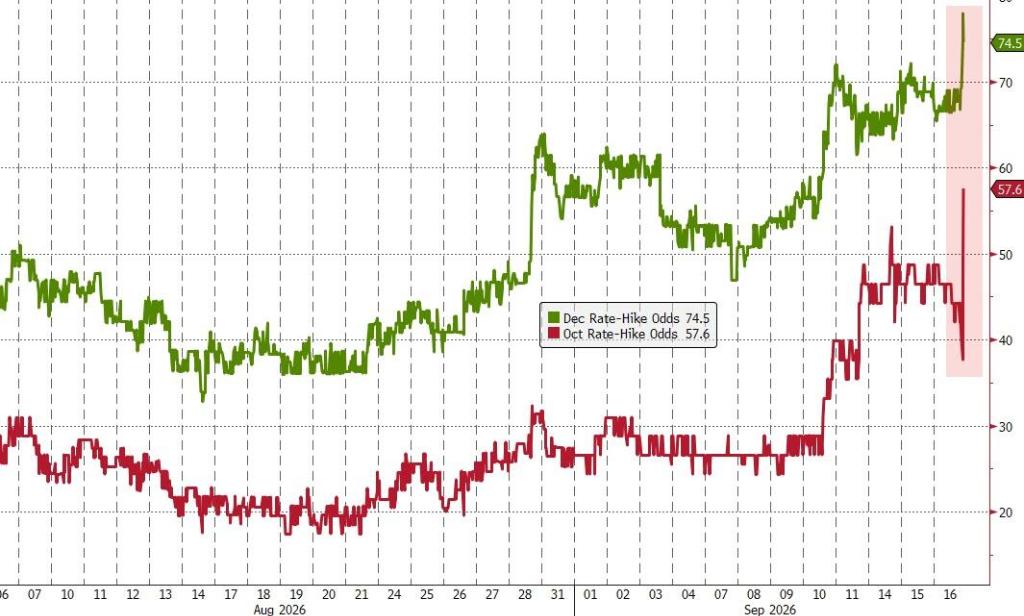
The Federal Reserve has raised interest rates for the first time in three years, sending a strong signal that the tightening cycle is far from over. The hawkish signal triggered a chain reaction in the market: US stocks and gold both came under pressure, the US dollar surged to a one-month high, and the yield curve flattened sharply in a bearish manner.
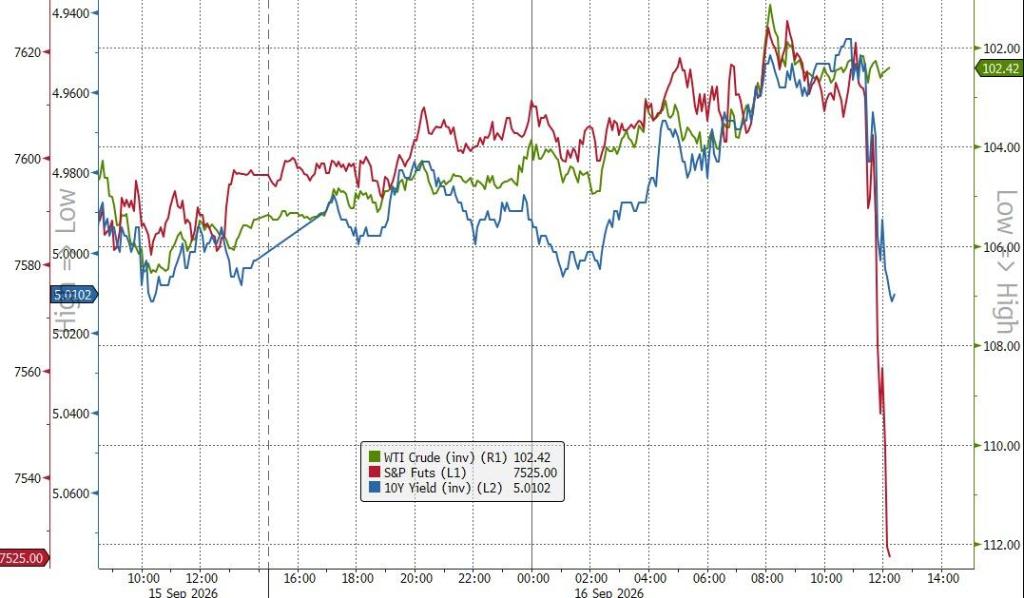
This press conference ended about 20 minutes earlier than usual, the shortest record in recent times, which is consistent with Wash's consistent stance of emphasizing no forward guidance. According to Bloomberg reports, market fluctuations on this Fed day mainly came from the press conference rather than the FOMC statement itself.
Fed unanimously approves first rate hike in three years, dot plot points to one more hike within the year
On Wednesday, September 16 Eastern Time, the Federal Reserve announced after the FOMC monetary policy meeting that it would raise the target range for the federal funds rate from 3.50% to 3.75% to 3.75% to 4.00%, a 25-basis-point increase.
This is the first time the Fed has adjusted its policy rate since entering 2026, and it is also the first rate hike by the Fed since July 2023. Prior to this, the Fed had decided to keep interest rates unchanged for five consecutive monetary policy meetings.
This interest rate decision was completely within the expectations of investors. By the close of this Tuesday, data from CME Group's FedWatch Tool showed that the futures market priced in a probability of over 92% that the Fed would raise interest rates by 25 basis points this week, a 44% probability of another hike of the same magnitude at the next October meeting, and a nearly 80% probability of two 25-basis-point hikes in total by the end of this year. This shows that most market participants bet that the September interest rate adjustment is not a one-off move, and the Fed will take further action within the year.
Nick Timiraos, a journalist known as the "new Fed wire service", wrote that Fed officials unanimously approved the first interest rate hike in three years at this meeting, which implicitly undermined the White House's argument that "there is no need to worry about inflation". Most officials now expect one more rate hike this year, as energy price shocks and the surge in artificial intelligence (AI) investment have reshaped the inflation outlook.
Timiraos mentioned that analysts had previously pointed out that although the market has paid close attention to the August inflation data recently, the biggest change in the economic outlook actually stems from the rise in energy and commodity prices. Dudley, former president of the Federal Reserve Bank of New York and the former "third-in-command" at the Fed, said: "The key is that the situation in Iran has become tense again, and the scale of the energy price shock is expanding once more."
The rate hike decision itself was within market expectations, but the signals released by the dot plot and the press conference are overall more hawkish than expected. The latest dot plot removed the previously projected median forecast for interest rate cuts next year, while showing that most officials support at least one more rate hike within this year.
The blue dots in the chart below represent the expectations of the September dot plot, and the gray dots represent the expectations of the June dot plot.
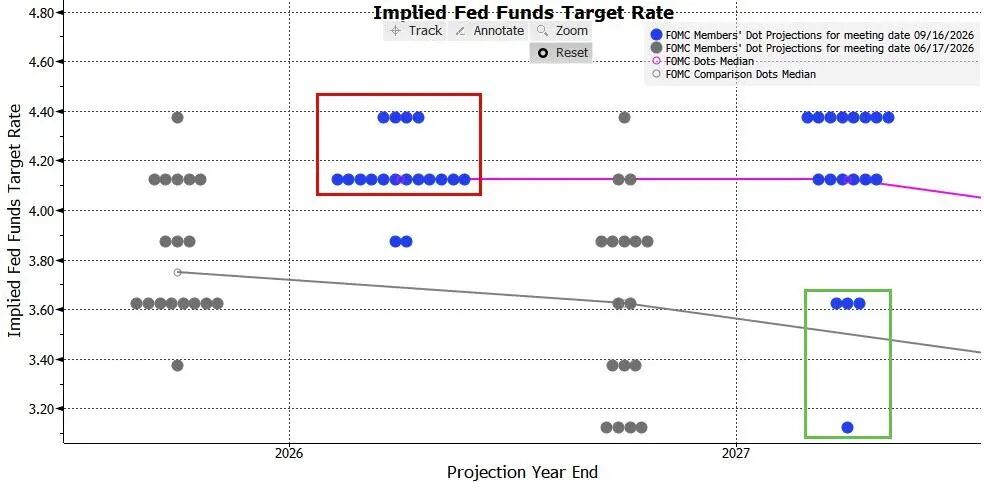
The dot plot shows that among the 18 Fed officials who provided interest rate expectations, 12 now expect one more 25-basis-point rate hike in 2026 after the September increase, four expect two more such hikes within this year, and two expect interest rates to remain unchanged for the rest of the year, meaning no more hikes after September. No one expects interest rate cuts this year.
However, there are significant divergences in the interest rate path for 2027. Eight Fed officials expect one rate hike next year, six expect interest rates to remain unchanged for the whole year, three expect two rate cuts, and one expects four rate cuts. This implies that some officials implicitly believe that there is a risk of policy missteps in the current path.
Luigi Buttiglione, CEO of consulting firm LB Macro, said:
By stating that this rate hike will help return to the 2% inflation target "in a more timely manner", the FOMC made it clear that there is still more work to be done, and most likely at least three more rate hikes will be needed.
The median value of Fed officials' interest rate forecasts released after the meeting this Wednesday shows that as the expected intensity of interest rate hikes this year increases, Fed officials have raised their interest rate expectations for this year, next year and the year after:
The median federal funds rate at the end of 2026 is 4.1%, compared with the 3.8% expectation in June; the federal funds rate at the end of 2027 is 4.1%, compared with the 3.6% expectation in June; the federal funds rate at the end of 2028 is 3.9%, compared with the 3.4% expectation in June; the federal funds rate at the end of 2029 is 3.6%, and the longer-term federal funds rate is 3.2%, compared with the 3.1% expectation in June.
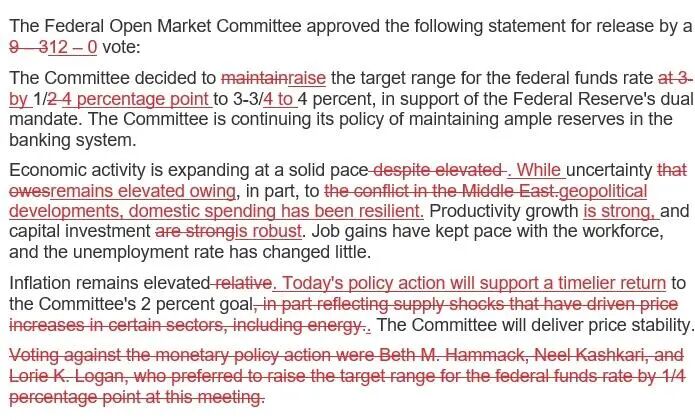
In addition to deciding to raise interest rates, the meeting statement also specifically mentioned that the "policy actions taken will help push inflation to fall back to the 2% target set by the (FOMC) Committee in a more timely manner".
Compared with the meeting statement at the end of July last time, another major difference in this statement is that all 12 FOMC voting members voted in favor of the rate hike, while three voting members opposed keeping interest rates unchanged at the last meeting. This clearly deviates from the position of US President Trump, who has repeatedly stated that he favors interest rate cuts, highlighting the anti-inflation pressure the Fed is facing against the backdrop of Middle East conflicts pushing up oil prices.
Regarding economic comments, this meeting statement remains largely unchanged compared with the previous one. It continues to emphasize that the Fed is committed to achieving price stability, and reiterates that the US economy is expanding steadily, employment growth is in step with the growth of the labor force, and the unemployment rate remains basically unchanged.
The previous two statements mentioned that the Middle East conflicts caused high economic uncertainty, and inflation remains high, partly due to rising energy prices. This statement changed the reference to "Middle East conflicts" to geopolitical situations, and added an assessment that domestic spending is resilient. The statement reads: "While uncertainty remains elevated, partly due to developments in geopolitical situations, domestic spending has shown resilience."
In addition, this statement slightly downgraded the assessment of the capital investment situation. The last statement said that both capital investment and productivity growth were strong, while this statement followed the above comment on high uncertainty and wrote: "Productivity growth is strong, and capital investment maintains a solid momentum."
The red text below shows the deletions and additions in this resolution statement compared with the previous one.
Wash: Rate hike shows firm unity within FOMC, inflation has been too high for too long, reducing inflation will not sacrifice employment
The Fed raised interest rates by 25 basis points against the backdrop that inflation is still above target but the US economy and labor market show resilience. Fed Chair Wash clearly stated that the top priority at present is to push inflation back to the 2% target in a more timely manner, while refusing to give forward guidance on the future interest rate path.
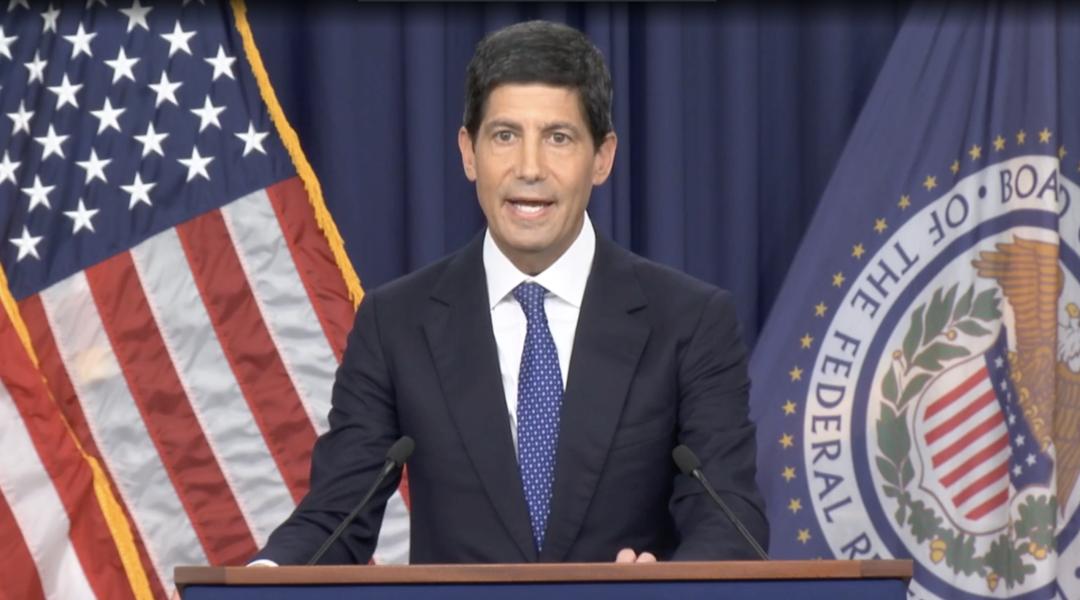
Wash repeatedly emphasized at the press conference that inflation is the core reason for this policy action.
"The obvious fact is that inflation is too high, and it has lasted for far too long."
But he said that based on the latest CPI and PPI data, the underlying trend has seen meaningful improvement. The year-on-year increase in the headline PCE price index in August may be around 3.6% (3.7% in July), while core PCE and CPI are about 3.2% (3.3% in July) and 2.4% respectively.
He previously proposed at the Jackson Hole symposium that the Fed needs to look at inflation trends rather than just focus on a single data point. At this press conference, he emphasized again:
"Trends matter. Data points are noisy, and focusing excessively on individual data points is a dangerous approach."
Wash said that over the past decade or so, market participants and journalists have become accustomed to "holding their breath waiting for a single data point", but that is not how he makes decisions. "I am not holding my breath waiting for any specific data, whether it is this morning's retail sales or last week's CPI."
In response to whether the rate hike may eventually lead to economic growth falling below potential and worsen the labor market, Wash gave a relatively clear answer.
"I don't think we need to damage the labor market to achieve our goals."
Wash said the US economy is strengthening, the labor market is generally near full employment, current domestic spending in the US is resilient, productivity growth is strong, capital investment also remains robust, and credit flows, especially corporate credit, have been "very strong". At the same time, he believes that broad financial conditions are not restrictive at present.
"It is very difficult for me to describe broad financial conditions as restrictive," Wash said. He said this judgment is also widely shared across the committee, so the Fed decided to "remove some of the accommodative measures" to make financial and credit conditions more aligned with policy targets.
Facing the issue that long-term US Treasury yields have risen significantly in recent months, especially in recent weeks, Wash said he wants to let the bond market "tell me whatever story they want to tell", and try to analyze the reasons behind the yield changes. He pointed out three main factors: the strengthening US economy, capital competition, and geopolitics.
When asked about the rapid development of AI and warnings from people in the AI industry about the risk of loss of control, Wash said he has spent a lot of time thinking about AI and its economic impact. But Wash emphasized that AI-related risks, returns and policy choices fall within the decision-making scope of other government departments. For the Federal Reserve, what needs to be focused on is how these policy decisions will ultimately affect its day-to-day work.
US stocks and bonds fall together, AI sector is relatively resilient to declines, US dollar rallies, gold plummets intraday
US stocks remained largely stable before the Fed's decision was released, but quickly turned downward during the press conference.
Fed Chair Wash said at the press conference, "We have removed a certain degree of accommodation to make financial and credit conditions more consistent with our goals", a wording widely interpreted by the market as a clear hawkish stance.
The major indices briefly rebounded after dipping lower during the session, but overall closed mostly weaker.
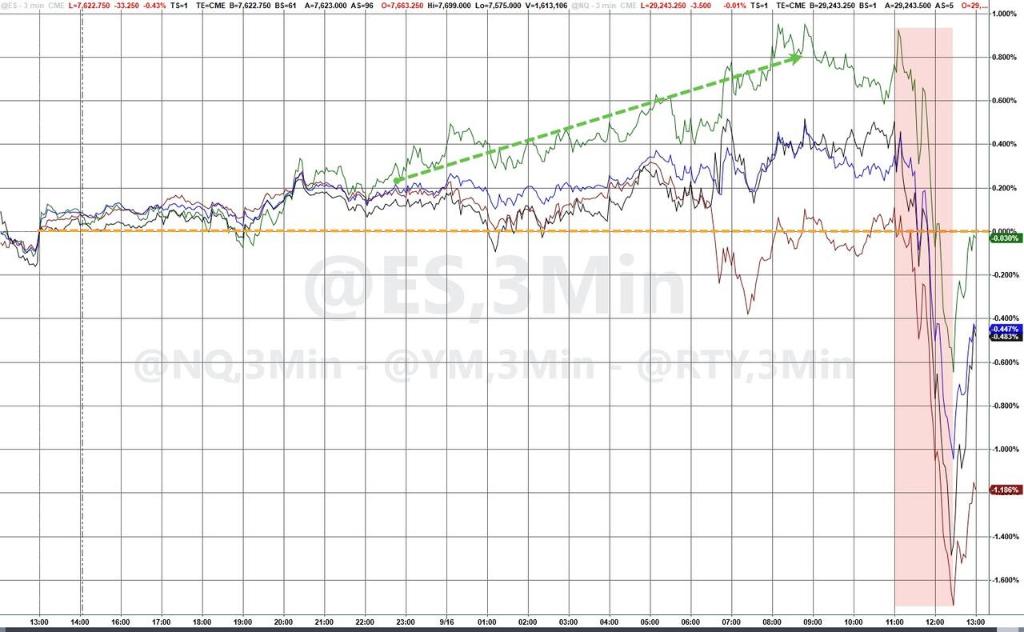
The S&P 500 index fell 0.45%, the Dow Jones Industrial Average dropped 1.2%, hitting a new three-month low. Only the Nasdaq 100 index was almost flat, with AI-related sectors relatively resilient to declines.
The 10-year US Treasury yield rose to 5.02%, and the 2-year yield climbed 7 basis points to 4.74%, the highest level since 2024. The 30-year yield was largely unchanged, while the spread between the 2-year and 30-year yields narrowed by about 8 basis points, the flattest level since April 2025.
At the same time, the US Dollar Index strengthened for the sixth consecutive day, rising to a nearly one-month high. Spot gold fell 0.5% to $4269.95 per ounce. Crude oil prices retreated by about 3.6% as supply disruptions in the Middle East were partially eased, with WTI crude trading at $102.05 per barrel.
This article does not constitute personal investment advice and does not represent the views of the platform. The market is risky, so be cautious when investing and make your own independent judgments and decisions.
This article is from the WeChat Official Account Wall Street CN, author: Wen Jianjun, published with authorization from 36Kr.