"Fragmented" metropolitan area welcomes its first cross-city subway line.
Another cross-city metro line is coming. According to Xiamen Daily and the New Fujian Client, Xiamen Metro Line 6 officially launched a trial ride campaign on September 16, marking that Fujian is about to welcome its first inter-city metro line in the history of rail transit, and Zhangzhou has officially stepped into the "metro era".
Xiamen Metro Line 6 has a total length of about 28 kilometers with 20 stations, connecting three urban areas of Jimei and Haicang in Xiamen, and Jiaomei in Zhangzhou. The report points out that this major transportation infrastructure project that has been planned for many years and affects the two cities is not only a key step for Xiamen to further promote its cross-island development strategy, but also a landmark breakthrough in exploring the integration of Xiamen and Zhangzhou, marking that Xiamen and Zhangzhou have officially entered the "half-hour transportation circle".
As the plate with the largest economic aggregate and the densest population in Fujian, the construction of Xiamen-Zhangzhou-Quanzhou integration has lasted for more than 20 years, but it has been progressing slowly before due to the constraints of "Xiamen is too small, Quanzhou is too scattered, and Zhangzhou is too weak".
As the Xiamen-Zhangzhou-Quanzhou Metropolitan Circle is upgraded to a national-level metropolitan circle, the integration of the three cities has pressed the acceleration button.
For the integration of the metropolitan circle, transportation is the forerunner. In June 2024, the People's Government of Fujian Province issued the "Development Plan for the Xiamen-Zhangzhou-Quanzhou Metropolitan Circle". It clearly states that a metropolitan circle on rails will be built. It specifically mentions that the Xiamen-Zhangzhou-Quanzhou Intercity Railway Line R1 will start construction, and the construction of other lines will be promoted in due course. The urban rail network will be improved, and projects including Xiamen Rail Transit Line 6 and its Jiaomei Extension Section in Zhangzhou will be promoted.
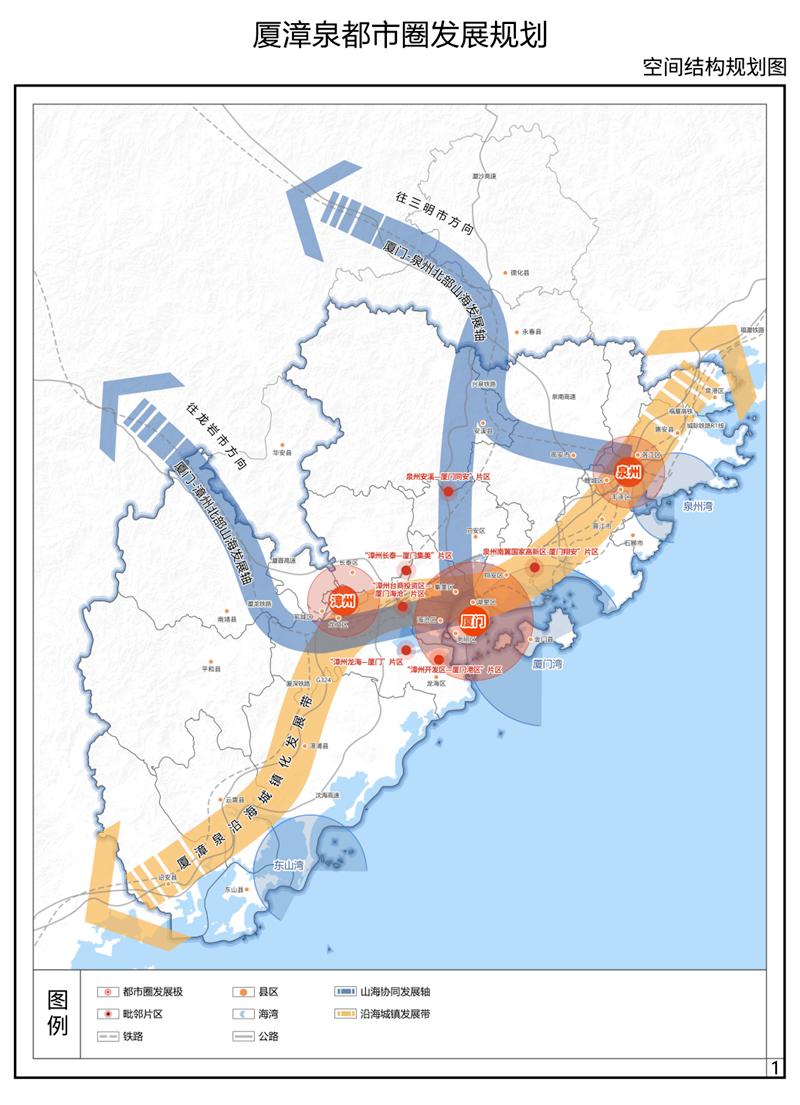
Image source: Xiamen Daily
Now, with the "delivery" of Xiamen Metro Line 6, the advantages of Xiamen in R&D, talent and market are expected to achieve efficient complementarity with the advantages of Zhangzhou in space, cost and industrial foundation.
What is more worth looking forward to is the Xiamen-Zhangzhou-Quanzhou Intercity Railway Line R1.
Public information shows that Line R1 was approved by the National Development and Reform Commission in 2023, running through Xiamen, Zhangzhou and Quanzhou, connecting the downtown areas of the three cities as well as key hubs such as Xiang'an Airport and Jinjiang Airport.
Earlier this year, Fujian Xiamen-Zhangzhou-Quanzhou Intercity Railway Co., Ltd. was officially established, which is jointly formed by Fujian Investment and Development Group and the three cities of Quanzhou, Xiamen and Zhangzhou, responsible for the overall technical coordination, investment and construction, operation management and overall coordination of Line R1 throughout its full life cycle.
At present, Line R1 is being pushed forward in full swing. After completion, it will effectively build a "half-hour transportation circle" in southern Fujian, realizing a half-hour direct access from the core area of Zhangzhou to Xiamen and one-hour access to Quanzhou, effectively promoting the efficient flow of industry, population and resources among the three cities of Xiamen, Zhangzhou and Quanzhou, and providing important support for the coordinated development of southwestern Fujian and the development of the whole Fujian Province.
Apart from transportation, the integration is also extending to deeper levels.
According to the "2026 Key Work Tasks and Key Cooperation Project List for the Xiamen-Zhangzhou-Quanzhou Metropolitan Circle", the three cities will focus on promoting the integrated co-construction of "five circles" including infrastructure, science and technology industry, public services, ecological environment, and cultural tourism this year. In terms of industry, they will jointly build a regional science and technology innovation center, promote the construction of Xiamen Science City and the sharing platform of scientific instrument and equipment resources in southwestern Fujian, and build key industrial clusters such as electronic information, biomedicine, advanced equipment manufacturing, and new chemical materials.
This article is from the WeChat official account "Urban Evolution Theory", written by Liu Yanmei, authorized for release by 36Kr.