Roundtable: Semiconductors: What Is the Next Step After Domestic Substitution? | 36Kr 2026 Industry Future Conference
In 2026, industrial investment has entered a deep-water zone, where capital, technology and industry are accelerating their integration. The old investment logic no longer applies, and new consensus is taking shape. The 2026 Industrial Future Conference focuses on opportunities in the new cycle, and jointly explores the future of the industry and the birth of the "Light of China". From September 9 to 10, the 2026 Industrial Future Conference hosted by 36Kr was held in Yizhuang, Beijing, with the theme of "Above the Deep Water, Resonate for New Life". Representatives from state-owned capital platforms, industrial investment funds, corporate CVCs, innovative enterprises, as well as experts and scholars gathered to focus on the industrialization of future industries such as quantum technology. The conference conducted in-depth discussions on cutting-edge technologies and industrial perspectives at the current stage, showcased technological breakthroughs in superconducting, optical quantum, ion trap and other technical routes, shared a large number of specific industrial scenarios, industrial system construction, and the prospects of heterogeneous computing, and jointly discussed the future of technology industry investment.
The following dialogue is sorted and edited by 36Kr:
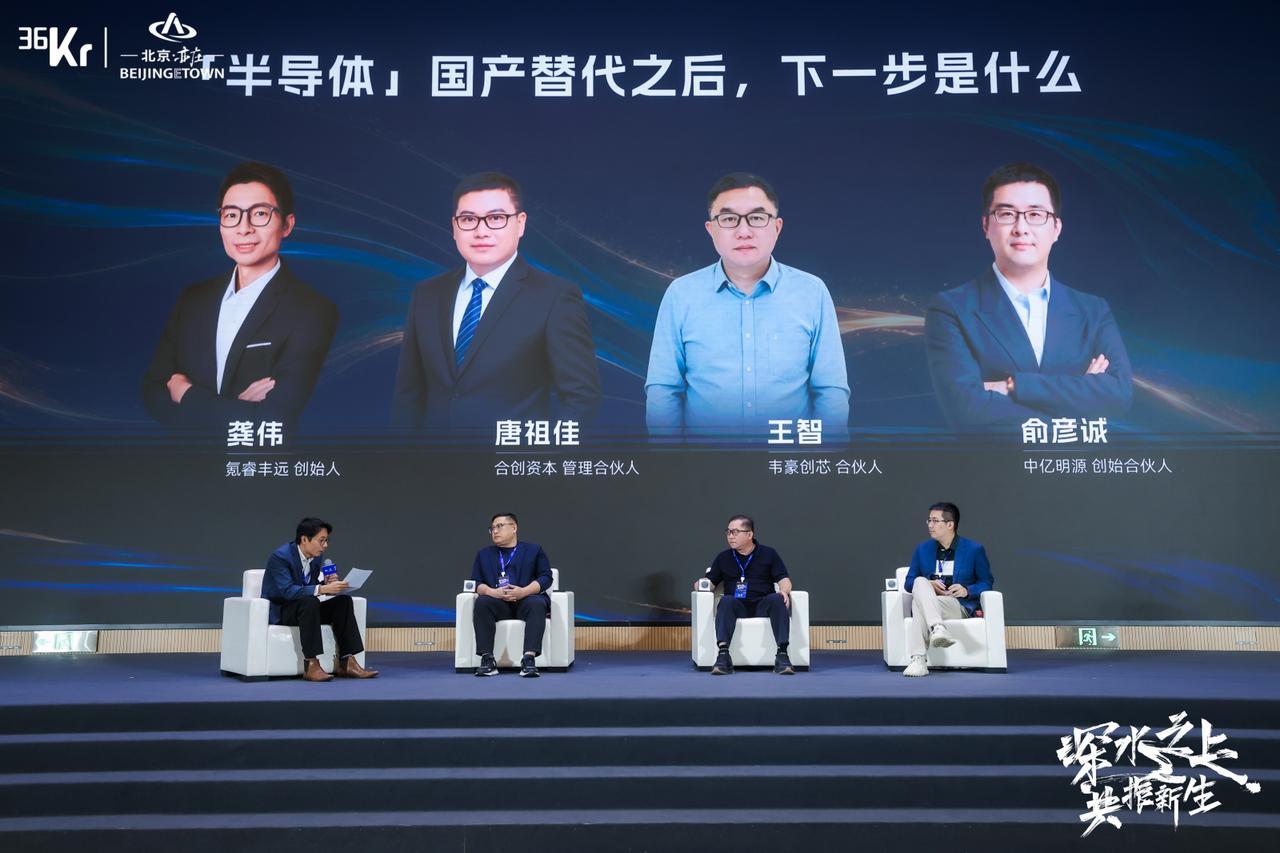
Host:
Mr. Gong Wei, Founder of Keruifengyuan
Guests:
Tang Zujia, Managing Partner of Hechuang Capital
Wang Zhi, Partner of Weihao Chuangxin
Yu Yancheng, Founding Partner of Zhongyi Mingyuan
Gong Wei: Dear guests and investors, good morning everyone. The theme of our roundtable discussion is "What comes next after the domestic substitution of semiconductors". First of all, let's review the report card of the first half. Ten years ago, the domestic production of semiconductors in China was almost a blank sheet of paper. Materials such as photoresist, etching equipment, EDA, and high-end packaging were almost all imported. Today, mature chip design has been fully independent, domestic equipment has been applied in batches in links such as etching, cleaning, and deposition, and domestic storage has occupied a seat in the global market.
Three months ago, Changxin Technology went public with a market value that once exceeded 3 trillion yuan, topping the A-share market. The exam question for the first half was "whether we have it", and the result was far beyond expectations. The more brilliant the performance in the first half, the clearer a fact we need to recognize: the battle of "whether we have it" is the easiest to fight, because the goal is clear. Every item on the list can be produced in accordance with national standards, and the market will absorb expanded production of the previously "strangled" links, even the valuation logic is simple, market value equals the substitution space multiplied by the climbing progress of localization.
The exam question for the second half has changed to a different dimension: "whether it is good enough". For the same domestic equipment, can the yield catch up with imported products? For the same domestic chips, dare customers adopt them in their core products? Any failure in any link of design, manufacturing, packaging and testing, materials and equipment will lead to shortcomings in the entire industrial chain, which is exactly the deep-water zone we are talking about.
The good news is that a huge opportunity represented by AI has emerged in the deep-water zone. The surge in computing power demand has given the domestic semiconductor industry a second growth curve. The restriction on advanced process nodes has instead forced out innovative path choices at the level of advanced packaging chiplet system. The outbreak of inference systems has for the first time allowed domestic computing power chips to compete with global giants in an incremental market. So the question is very clear, what is the next step after substitution?
Now let's move on to the six core questions of the roundtable. First, if "whether we have it" is the first half and "whether it is good enough" is the second half, is the capital in the first half and the second half the same type of capital? What factors that must be considered in the first half do not need to be considered in the second half, and vice versa, what factors that do not need to be considered in the first half must be considered in the second half?
Tang Zujia: Thank you all for attending this conference. Let me answer the host's question. First of all, I will not follow the host's train of thought to answer. As value investment and patient capital, my point of view is: the capital in the first half and the second half is the same capital, the matters we are dealing with are also the same, but the weights of different factors are changing. In the AI era, more and more people have realized that weight and probability are the essence. At different stages of industrial development, core value and bargaining power are continuously moving in the industrial chain, which is not as simple as dividing into first half and second half, and there may be multiple movements in the middle.
Semiconductor is a very large industry. In different subdivided fields: logic, storage, compound semiconductors and some new materials, their respective industrial logics are different, their development stages are different, and the trajectory of value chain movement is also different.
From our perspective, we need to closely observe the changes of the value chain, and which link the high point of the value chain will move to. As an early-stage investment institution, we need to lay out in these links one to two years in advance.
The market is now extremely polarized. Projects in a few tracks with high consensus may complete ten rounds of financing in one year, while many high-quality projects not in the hot tracks have no investors at all, with very low attention and lack of liquidity. But for us, we think that in the semiconductor track, we still need to see the future movement of the value chain, lay out in advance, and continue to strive for cognitive premium from non-consensus to consensus.
Wang Zhi: I think what Mr. Tang said just now is very good. The capital is basically the same, but there are some changes in the composition structure. My understanding of the first half and the second half is that according to our experience in the semiconductor field, China's semiconductor investment started after the launch of the Sci-Tech Innovation Board, especially after the Sino-US trade war and geopolitical conflicts. Around 2018 and 2019, the country realized that semiconductors should be placed in a very high strategic position, and at that time, semiconductor investment began to flourish.
Because semiconductors used to be a global industry before that, if there was no urgency for domestic substitution, customers would hardly have the motivation to adopt domestic semiconductor products, or domestic semiconductor products could only stay in some low-end and mid-end positions. After 2018 and 2019, the first half has two meanings: one is the first half of the industry itself, which is mainly called classic semiconductors. Before the rise of artificial intelligence in China, if you look at the revenue composition of TSMC, the largest part of revenue must come from consumer electronics, mobile phones, terminals and other products.
A major transformation has now taken place: the largest part has become HPC dominated by computing power, and its proportion in the latest quarterly financial report of this year has far exceeded that of consumer electronics. This reversal is very huge. Therefore, the internal structure of the industry itself in the first half and the second half has undergone great changes. Secondly, from China's perspective, the first half was mainly to solve the problem of "whether we have it" and realize domestic substitution.
So in the substitution part of the second half, except for EUV, it is not a big problem to build a domestic independent production line. No matter what the field is, the yield and performance may still need to be improved, but building a complete production line is no longer a major problem. But because of this, the second half needs to focus more on solving the problem of "whether it is good enough". The answer to this question cannot only be that after five to seven years or longer, we claim that the product has been polished and the performance has been greatly improved.
There is another problem. After entering the AI-driven semiconductor era, the overall goal of semiconductors, the PPA goal, has changed from pursuing extreme low power consumption and small area in the consumer terminal era to more pursuing performance, systematic, software and hardware co-design, and the improvement of overall system performance. We can see that the proportion of advanced packaging will become larger and larger, and the 2.5D and 3D processes used in it were relatively rarely used before.
We also know that this year we are focusing on the optical field, which was relatively marginal in the entire semiconductor industry before, and now it has begun to enter the mainstream. The integration of optoelectronics is also a situation that has never been encountered before, so in the second half, the requirements for the supply side are also different.
Back to the issue of capital, no matter in the first half or the second half, semiconductors are first and foremost an important national policy-oriented industry, which is characterized by long upfront investment and long return cycle. Government-backed funds play a very important role in it.
After the fruitful development in the first half, a large number of industrial companies have emerged. So in the second half, many semiconductor industrial companies or related industrial companies have also participated in semiconductor investment, which was relatively scarce in the first half. Of course, the main change is the change of component ratio. This is still an investment field dominated by the combination of state-owned capital and industrial capital.
Yu Yancheng: The Zhongyi Mingyuan Fund itself is a family-style fund, with about 50% of its capital being self-owned funds and 50% supported by government funds at all levels for investment. Our experience is highly consistent with the point of view put forward by Mr. Wang Zhi just now.
The earliest fund of Zhongyi Mingyuan started the primary market business before the foundation of the Asset Management Association of China. Looking back at the development of China's primary market, the main players in the early market were state-owned investment platforms and foreign dollar funds. Today, the main players in the semiconductor investment field have been transformed into funds backed by the state and local governments.
From this point of view, there is a clear difference between the first half and the second half of semiconductor investment. "Patient capital" will become a very critical element at present. Capital with different attributes has different tolerance for the holding period of assets, and there are also differences between policy objectives and financial investment objectives, which means that the competition in the industry in the second half will become more intense.
Why was the competition in the first half not so fierce? Looking back now, we can see that a large number of listed companies are newly listed enterprises in recent years, which means that the density of enterprise listings in the past was relatively low. We used to say internally that five years ago, everyone stood on the "field of hope": the market soil is fertile, the enterprise foundation is solid, the entrepreneurs are diligent and pragmatic, plus policy support, whether industrial policy or IPO policy, has actually spawned a large number of enterprises, thus forming the Sci-Tech Innovation Board and the current fifth set of standards for the Growth Enterprise Market, all of which belong to the first half.
Now we have come to the second half. We hold a cautiously optimistic attitude towards the development of the industry. First of all, investment must form a closed loop. If we still follow the past investment rhythm to continue to invest, judging from the capital level, the decline of project success rate and overall rate of return is almost inevitable. Whether looking at the secondary market index or the number of project supplies, there are signals that need to be alerted behind the current industry boom: the market has experienced two years of IPO tightening before, and the difficulty of enterprise listing has increased. After only two and a half years, the market sentiment has heated up rapidly again. I think this phenomenon itself is a signal worthy of vigilance.
Entering the second half, the first challenge we face is the valuation challenge. The past valuation system was built in an environment with limited project supply and clear domestic substitution logic, which was the growth stage of the industry from 0 to 1 and from 1 to 3. But today, if we still use the same investment method, I believe we will face very big challenges.
The policy level has actually paid attention to this problem. The introduction of Document No. 54 and its supporting detailed rules is a correction to some past blind investment behaviors. Even if such investment played a certain positive role in local industrial investment in the past, from the perspective of the whole industry, especially the primary market, it is also a reminder and gives us new inspiration.
So in the second half, the importance of valuation judgment and enterprise screening is placed at a higher position. The first half pays more attention to "participation", and the statement of "first half and second half" actually appeared very early in the capital market. When I was doing secondary market investment in the past, the late Dr. Gao, during his tenure at Essence Securities, put forward the judgment that "the first half of the bull market is over and we have entered the second half". If you look back at the history of more than ten years ago, you will obviously find that the second half is usually not easy. Because when everyone has seen the bull market, it usually means that the market has gone through a considerable distance. I hope this second half will be more wonderful.
Gong Wei: Let's move on to the second question. Regarding the entire chip and semiconductor industrial chain, many domestic enterprises, including the enterprises invested by the three of you, mostly started from single-point breakthroughs. Links such as chip design, wafer manufacturing, tape-out, packaging and testing are often undertaken by different enterprises. The coordination between industrial chains cannot be completed independently by a single enterprise, and it also involves issues such as cost and responsibility allocation mechanism.
Please judge, when the industry develops to a certain scale, will there be an obvious integration trend in the industrial chain in the future? Or will it remain in a relatively independent development state? If integration occurs, who is more likely to become the best lead party or "chain leader" in the industrial chain? Is it a chip design company, a wafer manufacturing company, or other types of enterprises? In this process, what other roles can investors play besides providing capital?
Tang Zujia: Let me talk about several views on this issue:
First, industrial integration is an inevitable trend, which will occur in all industries, and semiconductors are no exception. As far as semiconductors are concerned, many enterprises relied on the "pressure principle" in the early stage to achieve breakthroughs through single-point breakthroughs. After going public, if they want to continue to expand their scale, they will inevitably involve industry integration and product line expansion. At the same time, many relatively low-end mature fields have shown obvious excess supply, and there is objectively a demand for capacity clearance, so integration is an inevitable trend.
However, there are still great differences in how design companies integrate, how silicon-based semiconductors integrate, and how compound semiconductors and new materials integrate. Take some new material companies as an example, many enterprises do not have ready-made production capacity like silicon-based products when they start, and they naturally need to start layout from the IDM mode, which means that they enter the industry in the way of industrial chain integration from the very beginning, rather than only doing single-point business, and there is a natural integration trend between upstream and downstream.
Second, more and more downstream customers, especially some enterprises in the AI field, in order to maintain their own competitiveness and differentiated advantages, have begun to extend to the upstream. In addition to companies such as BYD and Huawei, domestic companies such as Alibaba, ByteDance, and American companies such as Tesla are also continuously carrying out vertical integration to the upstream of the semiconductor industry.
Everyone is integrating from their own competitive position. The success of the final integration will be restricted by many factors, including capital, industrial development cycle, resources such as road permits, and suitable M&A targets. Of course, there are also some special situations in China. For example, some enterprises with large investment from local governments will continue to get support, and the speed of capacity clearance may not be completely promoted in a market-oriented way. Therefore, the factors affecting integration are very complex and cannot be determined by a single variable.
From our point of view, this is a long process. The development process of the North American semiconductor industry itself is also a process of continuous integration and finally forming a few giants. China is also going through this stage. The specific difficulties we are facing may be different, but overall, it may take 5 to 10 years to complete gradually.
In this process, in addition to providing capital, more importantly, investors help enterprises complete integration from the perspective of the industrial chain. As Mr. Wang Zhi just said, state-owned capital and industrial capital have now become an important force in it, and the proportion of pure financial capital is relatively reduced. Investment institutions must be able to play a role at the industrial level to help enterprises complete this process, because the overall difficulty of this matter is very high.
Wang Zhi: As far as the semiconductor industry is concerned, according to historical experience, most industrial industries will eventually move to head concentration, and semiconductors will not be an exception. According to the experience of the United States, in major fields such as large chips, equipment, and EDA tools, after a long period of integration, a few giants are finally formed.
This trend has actually begun to emerge in China. First of all, this is an inevitable law of industrial development, because integration can reduce transaction frictions. At the same time, semiconductors itself is an industry with long cycle and heavy investment, which requires large platforms to have the ability of continuous investment.
Take the foundry as an example. Why is TSMC still difficult to see a real competitor at present? I think a very important