When AI enters the physical world, Kunshi will rebuild satellites in the 250km ultra-low orbit.
In July 2026, SpaceX submitted a striking application to the U.S. Federal Communications Commission: to deploy up to 100,000 third-generation satellites, with the lowest orbital shell dropping to 323 kilometers. In the application documents, SpaceX explicitly incorporated "AI's demand for large-scale uplink capacity" into the demand logic of Gen3 — high-definition spatial, visual and audio data need to be continuously transmitted to support real-time decision-making and industrial automation.
This is not merely an expansion of the constellation scale, but more like an industrial signal: satellite networks are redefining the objects they need to connect. In the past, the most important task of communication infrastructure was to deliver the internet to people; but when AI begins to integrate into robots, drones, vehicles, ships, industrial equipment and sensors, the network will no longer only carry web pages, videos and calls from humans, but also continuously generated machine data from the real world.
KunSpace has observed the same change, yet its judgment is more radical: if we want AI to truly understand the physical world, what is needed is not a better "satellite internet", but a true "Earth neural network" in the full sense.
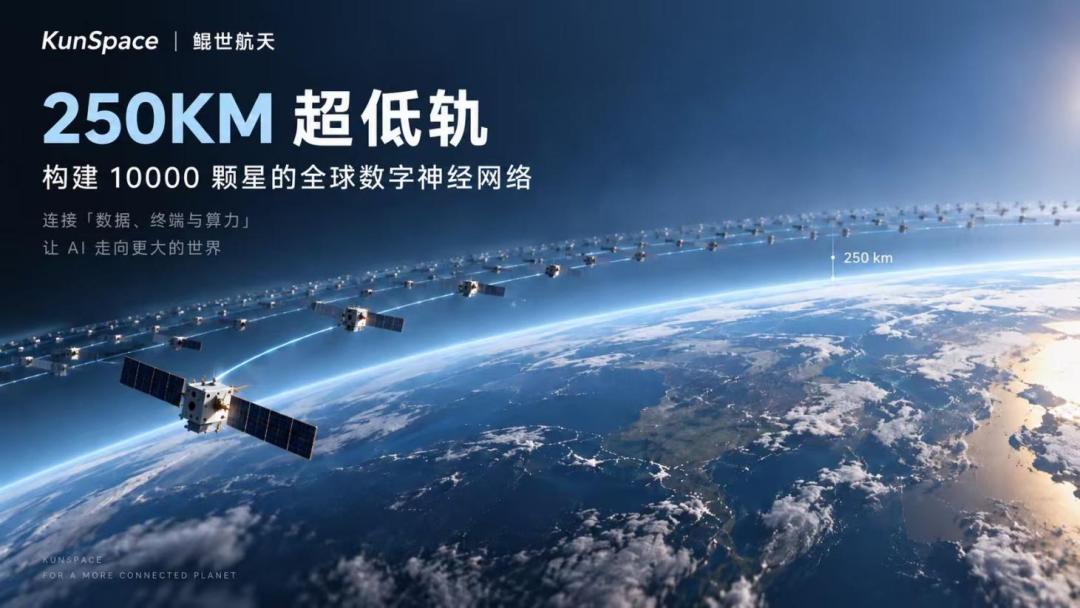
KunSpace's goal is to deploy 10,000 satellites in the 250km-class Very Low Earth Orbit (250KM VLEO) to build a space-ground integrated network with "large uplink" as its core capability. In KunSpace's own words: To lower orbits, for a larger world.
SpaceX Includes AI in Its Satellite Application, an Era of "Large Uplink" Has Begun
Over the past decades, communication networks have almost all been built around human needs. For watching videos, browsing web pages and downloading files, data mainly flows from the cloud to end users. Therefore, whether it is optical fiber, 4G, 5G or satellite internet, they have long naturally emphasized downlink capabilities.
But robots are exactly the opposite. A drone continuously generates high-definition video, an autonomous vehicle constantly produces visual and 3D point cloud data, ocean-going ships generate radar and marine environmental data, and unmanned equipment in mining areas continuously outputs industrial data. These devices are not simple network consumers, they are data sources themselves, and will continuously perceive the physical world at a frequency far higher than that of humans.
This means that when AI moves from the digital world to the physical world, the traffic structure of communication networks will also change. What really needs to be connected in the future are not just mobile phones and computers, but possibly machine terminals all over the world. They need to continuously send images, sounds, positions, point clouds and environmental information to edge nodes, cloud models and even future space computing nodes, before obtaining decision-making and control instructions.
SpaceX's Gen3 application releases a clear signal: when the connected objects expand from "humans" to tens of billions of AI-driven devices, the network must gradually evolve from a "download network" to a "perception network". KunSpace summarizes this demand as "large uplink" — not the traditional broadband downlink, but a continuous uplink data flow oriented to physical world intelligence.
There is another easily overlooked problem behind this: the deeper AI integrates into the physical world, the more it will enter areas that traditional terrestrial networks find most difficult to cover. Oceans, mines, deserts, polar regions, forests, ocean shipping routes and a large number of cross-regional mobile scenarios are often the places where unmanned and automated values are the highest, but also the places where optical fiber and 5G are most difficult to cover in an economical way.
In the past, devices in these areas could complete some tasks relying on local computing, but as models become more complex and cross-device collaboration becomes more common, standalone intelligence alone is no longer sufficient. An autonomous vehicle in a mining area needs to understand the entire operation area, a fleet of drones needs to share environmental information, and an ocean-going ship needs to continuously collaborate with cloud models. Once machine intelligence evolves from "standalone" to "group", connectivity will change from an auxiliary capability to a fundamental capability.
Therefore, KunSpace believes that communication demands in the AI era are undergoing a fundamental change: from "delivering the internet to people" to "delivering the real world to AI". The value of satellite networks will also further extend from supplementing terrestrial broadband to global perception data collection, machine interconnection and computing power collaboration.
KunSpace's Solution: 250km, 10,000 Satellites, to Build an "Earth Neural Network"
If we compare the future AI system to the human body, large models and super data centers are the "brain", and robots, vehicles, drones and sensors are the "nerve endings", then a "neural network" that truly covers the entire globe is needed between the two.
Today, this network is mainly composed of optical fiber, 4G and 5G. They are extremely efficient in cities and densely populated areas, but terrestrial networks naturally have geographical boundaries: base stations need site selection, optical fibers need to be laid, and the unit coverage cost of oceans and deserts is much higher than that of cities. When AI begins to enter the sky, oceans, mines and polar regions, it is difficult to achieve truly continuous global coverage only with terrestrial infrastructure.
KunSpace's solution is to deploy 10,000 satellites in the 250km-class Very Low Earth Orbit to build a space neural network with "large uplink" as its core capability.
Why 250 kilometers? If satellites only broadcast signals to the ground, there is no fundamental problem with a slightly higher orbit. But if the objects to be connected in the future are robots, drones, vehicles and small sensors, the situation will be completely different. Satellites can be equipped with larger antennas and energy systems, but terminals cannot infinitely increase their antenna size, transmission power and battery capacity. What is truly scarce is actually the capability on the terminal side.
The lower the orbit, the shorter the propagation distance, the more favorable the link budget, and the lower the latency. Reducing the satellite orbit from the 500km class to the 250km class essentially means actively moving space infrastructure closer to terminals, so that smaller, lower-power and more common devices can access the global network. KunSpace believes that the 250km-class Very Low Earth Orbit may become the layer of AI infrastructure closest to the physical world.
This is also why KunSpace does not regard 250KM VLEO as simply "a lower orbit". What really matters is that when the orbit, satellite platform, communication link and terminal capabilities are redesigned together, the product logic of space networks may change: in the past, terminals had to adapt to satellites, but in the future, satellite networks may actively lower the access threshold for ordinary terminals to connect to space networks.
What KunSpace is building is not just a communication network. With the development of on-board computing, laser communication and software-defined satellites, next-generation intelligent satellite nodes can simultaneously undertake three roles: perception, connection and computing. Data does not have to be all transmitted back to the ground before calculation starts, and the node closest to the data can first complete filtering, compression and preprocessing, before sending the truly high-value data to more powerful computing nodes.
This is the "Cloud+Edge+Space" architecture proposed by KunSpace: Cloud is responsible for large model training and complex reasoning, Edge is responsible for local real-time computing for robots, vehicles and factories, and Space is responsible for global perception, wide-area connection and on-orbit precomputation. The three do not replace each other, but together form the infrastructure layer of the AI era.
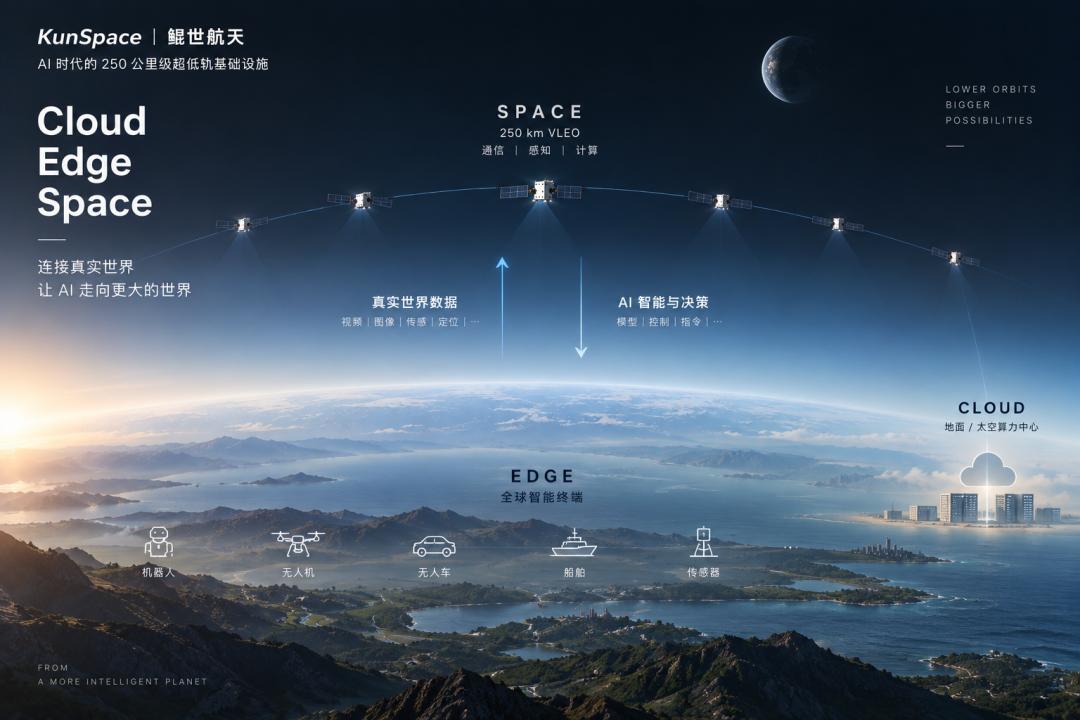
In this architecture, the value of Space is not to move the cloud to the sky, but to complement the layer of connection and computing that terrestrial networks cannot cover. For globally mobile, cross-region collaborative and remote-area machine terminals, the space network can become the first hop for data to enter the AI system, and also serve as the wide-area connection layer between different edge nodes.
From Satellite Manufacturing to Constellation Networking: KunSpace's Path and Ambition
KunSpace's strategic path is not to directly build a 10,000-satellite constellation from the very beginning, but to manufacture satellites first, then build platforms, and finally complete networking. For a company trying to enter the 250KM VLEO field, the first problem to be solved in this path is not how grand the story is, but whether 250KM VLEO can truly be made into a product that can operate stably, be manufactured in batches and iterate continuously.
The first step is to verify the full-satellite capability. 250KM VLEO is not simply "lowering" traditional satellites. Stronger atmospheric drag, more complex atomic oxygen environment, and long-term thrust-drag balance put forward systematic challenges to propulsion, energy, structure, materials, attitude and orbit control, and full-satellite coordination. The real threshold is therefore not just a certain technical indicator, but the complete engineering capability to carry out the whole process of a satellite from design, development, testing, batch production to stable in-orbit operation.
This is precisely where KunSpace's team has the deepest accumulation in the past. The core team has practical experience in hundreds of satellite engineering, and key members have deeply participated in large-scale constellation construction, covering the complete chain of overall satellite design, low-orbit constellation development, mass production, quality management, launch delivery and in-orbit operation, with complete engineering experience from single-satellite development to constellation-level batch production and delivery. KunSpace rarely takes "team" as its first selling point, but the company has a very clear judgment internally: if the competition of 250KM VLEO eventually focuses on full-satellite engineering capability and large-scale delivery capability, then this team that has real experience in satellite manufacturing, batch production and constellation operation is KunSpace's most confident advantage.
KunSpace believes that after entering the 250km-class Very Low Earth Orbit era, the industry competition will ultimately not be about "whether an experimental satellite can be built", but about whether the complex 250KM VLEO technology can be turned into a stable, low-cost and mass-replicable product. Proving that a technology is feasible in the laboratory, and stably delivering dozens or hundreds of satellites, are two completely different capabilities. For KunSpace, whose ultimate goal is a 10,000-satellite network, engineering and mass production capabilities must be incorporated into product definition from day one.
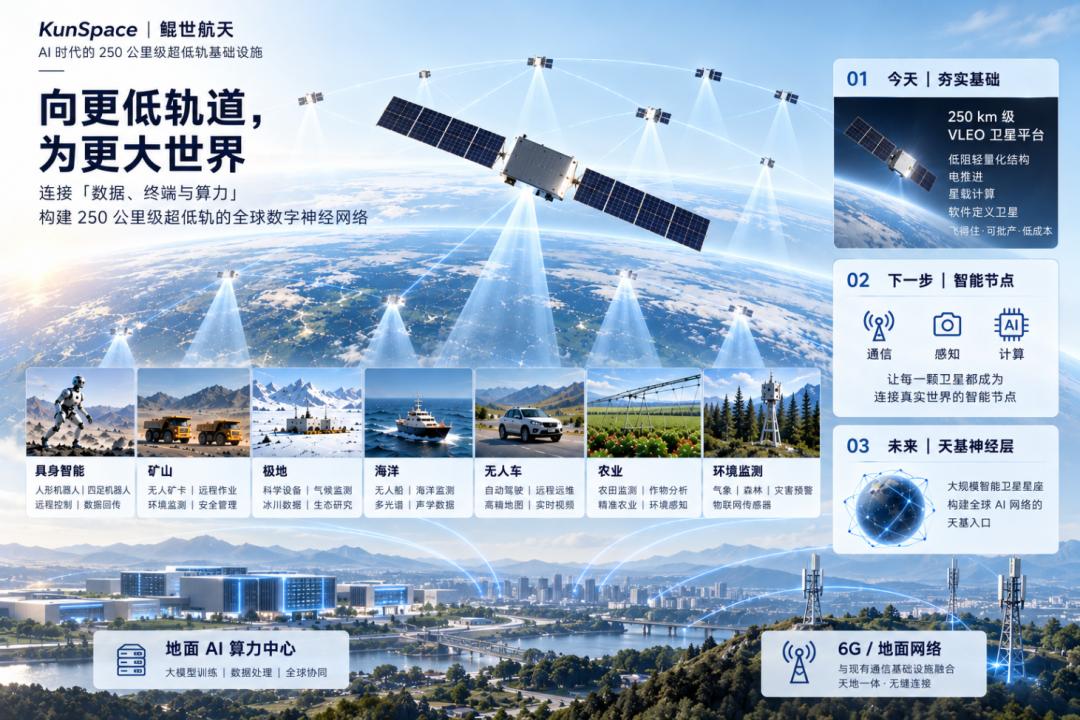
The second step is to form a platform that can be replicated on a large scale. KunSpace's goal is not to build a single 250km satellite, but to develop a new generation of intelligent satellite platform redesigned around 250KM VLEO. Low-resistance lightweight structure, high-efficiency electric propulsion, software-defined satellites, on-board computing and inter-satellite communication may all become the core capabilities of this platform.
Among them, the propulsion system ensures "long-term stable operation", the structure realizes "operation with lower resistance and lower weight", and the on-board computing is more like the "brain" of the entire satellite: by defining hardware with software, orbit prediction, thrust-drag balance, energy management, attitude control and task scheduling are integrated into a unified computing and software system. For KunSpace, 250KM VLEO is not an upgrade of a single subsystem, but a full-satellite level redesign.
More importantly, this platform does not only serve one type of task. Communication, remote sensing, AI computing and the Internet of Things can share quite a part of the platform capabilities, and the differences are mostly concentrated in the payload and task configuration. Only by precipitating common capabilities into a standard platform can satellites continue to iterate like industrial products, instead of customizing each one from scratch.
The third step is networking. The goal of 10,000 satellites means that what KunSpace will eventually build is not a traditional satellite manufacturing company, but a set of continuously expandable space infrastructure. Satellites are only nodes, and what really generates value is the connection between nodes, as well as the data flow between them and terrestrial terminals, edge computing and cloud AI.
Under this framework, KunSpace's 10,000 250km-class Very Low Earth Orbit satellites are not just communication relays, but nodes of the "planetary neural network". Satellite nodes act as "neurons", inter-satellite links act as "synapses", and robots, drones, vehicles, ships and sensors act as perception endings distributed on the Earth's surface.
This also explains why KunSpace sets its final vision on "connecting the physical world" rather than "connecting more users". When the number of machines far exceeds the number of human terminals, the core value of the network may no longer be to allow people to access the internet anytime and anywhere, but to allow the state of the real world to be continuously perceived, transmitted, computed, and then fed back to machines for execution.
A representative from KunSpace said: "The 250km-class Very Low Earth Orbit is only our physical entry point, not our final destination. If hundreds of billions of robots, drones, vehicles, ships and sensors need to access AI in the future, the space network will ultimately connect not just humans, but the entire physical world."
Over the past decade, humans have invested huge amounts of capital to build increasingly powerful "brains" for AI. Computing centers are getting larger, model parameters are getting more, and reasoning capabilities are getting stronger. But when AI truly steps out of the screen and into the real world, an equally important question arises: how can these brains continuously see, hear and understand the entire Earth?
If the previous generation of the internet solved the connection between people and information, then the next generation of AI infrastructure may need to solve the connection between intelligence and the physical world. Whoever can make machines all over the world become the perception endings of AI will have the opportunity to become part of this new infrastructure.